

‘Expect 2027 revenue to remain flat,’ finance officials warn Denver budget planners

Denver expects little to no revenue growth through 2027.
And “flat” growth is a “best-case scenario,” city finance experts told members of the Denver City Council’s Budget and Finance Committee, as preliminary efforts to organize and establish guidance for the 2027 budget planning process kicked off Tuesday.
The city anticipates 2027 revenue to remain around $1.66 billion.
Although Denver is in a better position than it was at this time last year, challenges remain.
Officials credit the city’s 2025 cost-cutting efforts and efficient use of reserves with keeping Denver’s 2026 budget on track, but they also signaled that spending for the coming year will remain tight.
The city’s revised revenue projections also proved accurate, with the general fund coming in just $2 million below forecast.
The city’s main sources of revenue — sales and use tax and property tax — have been roughly flat from 2023 through 2025, with overall revenue remaining at $1.6 billion.
Denver is, according to experts, operating in a “structural balance,” meaning that its ongoing revenues roughly equal its outgoing expenses.
While this avoids huge deficits, it also means there’s little room to absorb rising costs without making trade-offs.
“We expect this trend of flat revenue to continue into 2027, which means we will need to continue to be strategic and conservative in how we manage increasing costs,” said the city’s Chief Financial Officer Nicole Doheny in a statement.
In 2025, Denver brought in $1.664 billion in general fund revenue, which was within 0.1% of the revenue forecast.
Facing a $200 million budget deficit, officials also made major changes in 2025, which included a temporary hiring freeze, two to seven furlough days, and layoffs.
Those changes reduced city expenses to $1.707 billion in 2025 and $1.663 billion in 2026 and were critical to ensuring Denver remains financially sustainable and prepared for 2027, according to a statement from the Department of Finance.
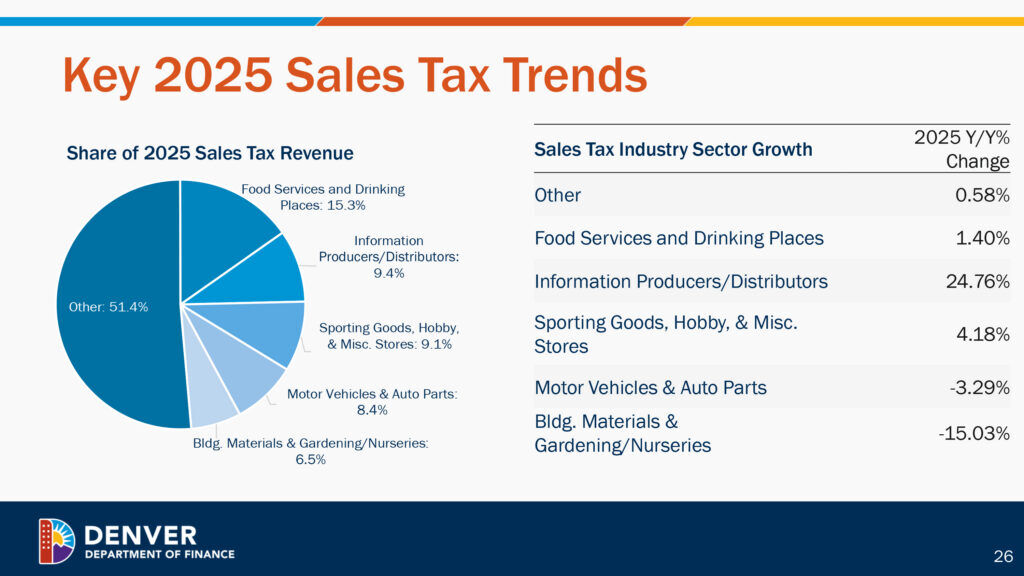
Higher interest rates and reduced spending on cars, homes, and construction, finance officials note, are slowing the inflow of the city’s sales and use tax.
The reason is that consumer spending is shifting away from taxable goods and moving toward services and online purchases.
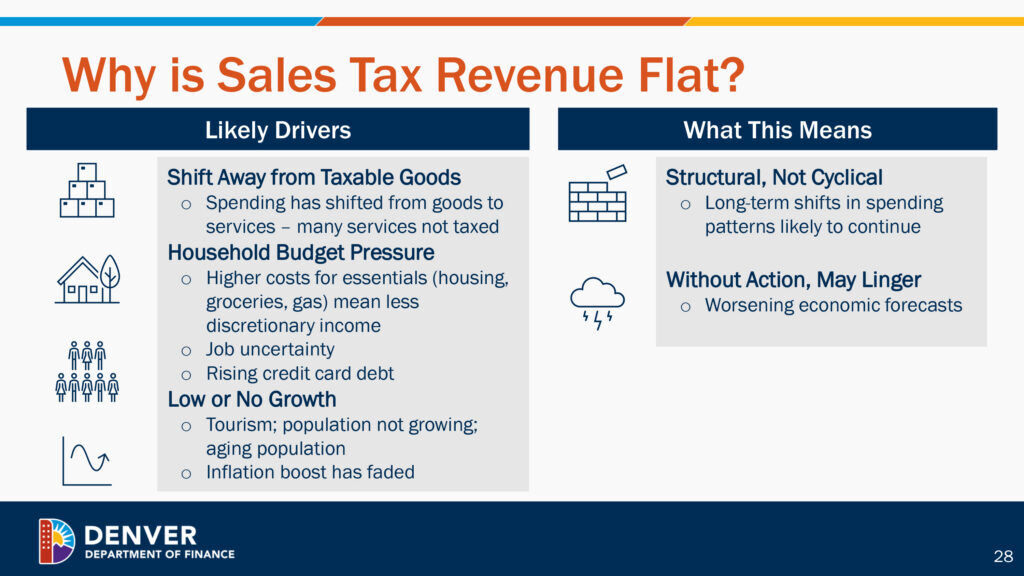
Additionally, slower wage and job growth, lower consumer confidence, and higher energy prices are leading people to spend less.
Global uncertainty also doesn’t help, Lisa Martinez-Templeton, chief economist for the Denver Department of Finance, said.
“Our economy is on the edge,” Martinez-Templeton said. “We have three supply shocks going on now. We’ve got immigration, you’ve got tariffs, and you’ve got the Iran war.”
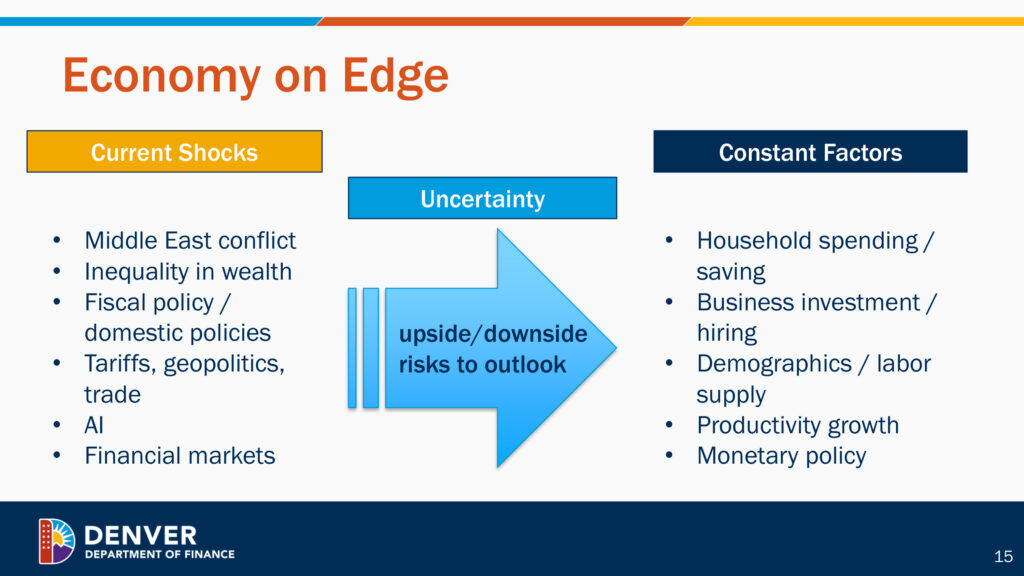
Tighter immigration rules, additional costs on imported goods, and higher prices at the pump all have contributed to a cooling economy.
Looking to the future, Martinez-Templeton said there’s uncertainty around the impact of artificial intelligence on the job market.
“If it (AI) proves to be effective enough to quickly reduce the need for large numbers of workers, this could lead to job losses, to increased unemployment, and again, lower consumer confidence and spending,” she said.
Reactions from some Denver City Council members signaled concern.
“I feel like we’re on palliative care here, because I see even more underlying weakness in the sales tax,” said Councilmember Kevin Flynn, who represents Denver District 2.
“I have a lot of concern, there’s not much more to cut, and I’ve been hearing from other departments that cuts they made last year will have to be permanent cuts in 2027,” said Denver City Council President Amanda Sandoval. “So if we have permanent cuts to our fire department, if our police department and our sheriffs are understaffed. I don’t think you can cut much more.”
Another variable budget planners will need to contend with is the expiration of the Xcel Energy franchise fee.
“That franchise agreement will require the City Council to refer it to the ballot and voters to approve it before it is extended, and that franchise fee revenue brings in about $30 million of revenue each year,” City Budget Director Justin Sykes said, adding that the city may not be able to budget for that $30 million of projected Xcel franchise fee revenues in 2027 until the item is referred to the ballot and passed by voters.
Xcel Energy currently adds a 3% franchise fee to Denver residential and commercial gas and electric bills. The pass-though charge is mandated under a 20-year agreement with the City and County of Denver. It is used to compensate for Xcel’s use of public rights-of-way to deliver energy services.
The next steps in the city’s forthcoming spending plan will be the annual budget workshop set for May 14, followed by a Sept. 15 deadline for Denver Mayor Mike Johnston to release his proposed budget.
Nov. 9 is the city’s deadline to adopt the budget.
Last year, Denver City Council members and Johnston locked horns over the proposed 2026 budget, which Johnston insisted would not cut core services, despite significant budget cuts across city departments.
“If there are any amendments to the budget that add cuts to any of the departments,” Johnston warned, “those would directly either cut these core services or require more limits, because there is nothing left to cut in these departments…”
Members of the Denver City Council ultimately rejected Johnston’s $1.66 billion spending plan. But the proposal, as amended, went on to govern operations, as the charter required the city to have a budget in place by Nov. 12.


Polis administration relaunches Colorado e-bike rebates with $3 million
Scott Weiser
scott.weiser@gazette.com
Updated 19 hours ago
Gov. Jared Polis and the Colorado Energy Office announced Thursday the return of the state’s popular e-bike rebate program, with registration set to open later this month. The office plans to provide point-of-sale rebates totaling $3 million from the Community...

Right-to-natural-gas proposal in Colorado qualifies for ballot
Marissa Ventrelli
marissa.ventrelli@coloradopolitics.com
Updated 2 days ago
A citizen initiative that seeks to enshrine the right to natural gas has qualified for the November ballot, Colorado’s election office confirmed on Thursday. Petitions containing signatures for Initiative No. 177 were turned in to the Secretary of State’s Office for review...

Colorado AG urges Supreme Court to let Boulder climate lawsuit proceed
Marissa Ventrelli
marissa.ventrelli@coloradopolitics.com
Updated 2 days ago
Colorado Attorney General Phil Weiser has filed a court brief with the U.S. Supreme Court in a lawsuit brought by Boulder city officials seeking to hold oil companies liable for their environmental impact. The case began in 2018, when the...

New Colorado laws going into effect cover AI disclosures, medical marijuana access and gambling limits
Marissa Ventrelli
marissa.ventrelli@coloradopolitics.com
Updated 2 days ago
More than 100 new Colorado laws take effect Aug. 12, bringing changes to chatbot safety rules, psychedelic research, campus wellness checks and sports betting restrictions. Here is a look at some of those laws set to take effect. The law:...

Denver aerospace company Voyager sees rapid growth in latest earnings
Bernadette Berdychowski
bernadette.berdychowski@denvergazette.com
Updated 2 days ago
A fast-growing aerospace and defense company based in Denver saw record revenues and record bookings in the latest quarter. Voyager Technologies announced it generated $52.7 million in the second quarter, according to its latest earnings report released Monday. Revenues are...

Early bird pricing ends soon for Fill a Plate for Hunger fundraiser | NONPROFIT REGISTER
Joanne Davidson Special to Colorado Politics
joanne-davidson-special-to-colorado-politics@coloradopolitics.com
Updated 20 minutes ago
WE DON’T WASTE Denver News: Early bird pricing for Fill a Plate for Hunger, the signature fundraiser for We Don’t Waste, ends on Aug. 10 when the Foodie-level tickets jump in price from their current $225. The 15th edition of this popular event takes place Sept. 10...

Pickleball, anyone? It’s for a good cause | NONPROFIT REGISTER
Joanne Davidson Special to Colorado Politics
joanne-davidson-special-to-colorado-politics@coloradopolitics.com
Updated 22 minutes ago
ROCKY MOUNTAIN CHILDREN’S HEALTH FOUNDATION Arvada News: Pickleball is still quite the rage, and to capitalize on its popularity, the Rocky Mountain Children’s Health Foundation will host its first fundraising tournament on Aug. 23. It will be from 2-5 p.m. at Chicken & Pickle, 14225...

Colorado joins 2 lawsuits against Trump administration over TANF, tariffs authority
Marissa Ventrelli
marissa.ventrelli@coloradopolitics.com
Updated 5 days ago
Colorado has joined a coalition of states in filing two new lawsuits against the Trump administration. The first lawsuit alleges the Trump administration’s move to expand the U.S. health department’s oversight of the Temporary Assistance for Needy Families would illegally...

Colorado farmers, ranchers wrestle with hurdles amid extreme drought conditions
Shen Wu Tan (Special to The Denver Gazette)
shen-wu-tan@gazette.com
Updated 5 days ago
Some producers take drastic steps to adapt to dry climate, record-low snowpack This is the first time that Jim Magnuson, who operates a family farm in the rural town of Eaton, can ever recall planting only 75% of his acreage. ...

Federal biotech commission examines Colorado’s role in critical minerals production
Scott Weiser
scott.weiser@gazette.com
Updated 1 week ago
China’s dominance over critical mineral supplies has left U.S. manufacturers vulnerable. Colorado’s biotech and research community is working to ease that dependence. Leaders from the National Security Commission on Emerging Biotechnology met last week at the Colorado School of Mines...
PREV
PREVIOUS

Colorado's unprecedented AI law can't be enforced yet, judge rules
A federal judge on Monday issued a delay in enforcing Colorado’s artificial intelligence law, touted by backers as a tool to protect consumers and residents from algorithmic discrimination but which critics called heavy-handed and unworkable. The lawsuit against Senate Bill 24-205 was filed by Elon Musk on behalf of his xAI company. The Trump administration […]

Arapahoe County lawmakers postpone vote on short-term rental regulations after tech issues
Arapahoe County Commissioners delayed an official vote Tuesday on regulating short-term rental properties after technological challenges caused issues for public comment. Commissioners voted to approve the regulations after a public comment period Tuesday, then revoked the vote and rescheduled it to May 12 after technical issues kept online participants from being able to hear or […]