

Federal judge weighs release of detained man tortured in home country
A federal judge on Friday considered whether to release a man in custody who suffered torture at the hands of government authorities in his home country and who remains detained, even after prevailing on multiple occasions in recent immigration proceedings.
Exactly two years ago, the Denver-based federal appeals court concluded an immigration judge’s decision to deport Dennis Arostegui-Maldonado “defies logic and the law” considering the abuse he experienced from Costa Rican police. Earlier this year, Maldonado received protection from deportation to Costa Rica and El Salvador, his countries of citizenship.
However, Maldonado has been detained continuously in U.S. Immigration and Customs Enforcement’s privately-run Aurora facility since December, in addition to a year spent in custody previously. He has asked U.S. District Court Senior Judge William J. Martínez to order his release on due process grounds, or at least to order an individualized review of his suitability for release on bond. Further, Maldonado seeks to prevent ICE from removing him from Colorado, if he is to remain in custody.

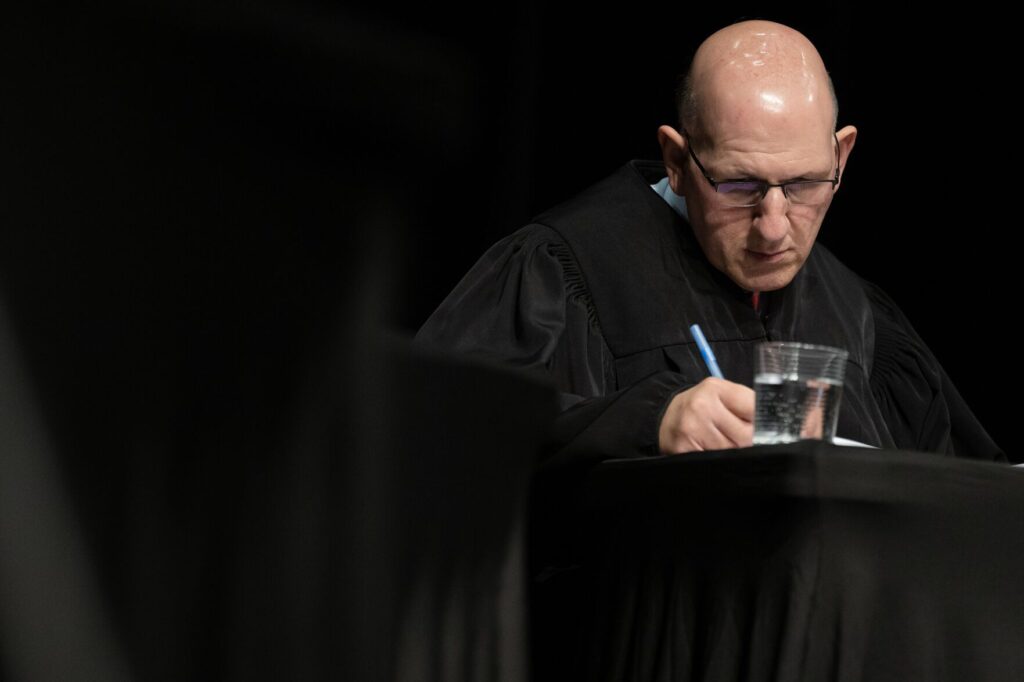
U.S. District Court Judge William J. Martínez
Courtesy photo

During a hearing before Martínez, attorney Laura Lunn teared up as she explained why she believed judicial intervention was necessary.
“I am terrified he will be removed unlawfully like Kilmar Abrego Garcia,” she said, referring to a Maryland man wrongfully removed to an El Salvador prison where numerous detainees have described widespread abusive conditions. The federal government did not return Abrego Garcia for months.
“You have a fear that under this administration, (the U.S. Department of Homeland Security) and ICE will not follow the rule of law?” asked Martínez, a Barack Obama appointee.
“That is exactly what I’m saying,” Lunn replied.
The government countered that Maldonado was not entitled to the relief he sought. Benjamin Gibson, of the U.S. Attorney’s Office, said the law and federal regulations would permit the government to remove Maldonado to countries other than the two he was protected from.
“My understanding is it is not ICE’s practice to do that,” he added.
“But you are not able to provide that assurance?” Martínez pressed.
No, said Gibson.
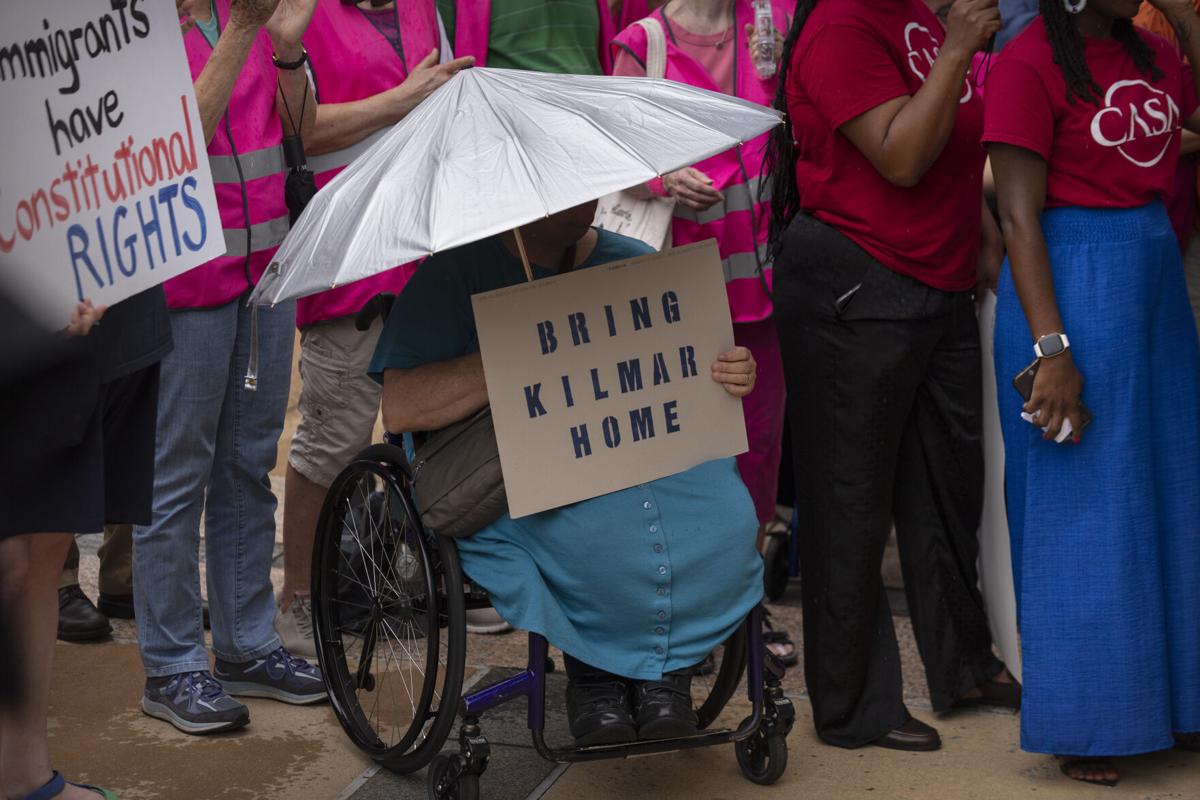
Supporters of Kilmar Abrego Garcia rally outside of the U.S. District Court in Greenbelt, Md., where a hearing was scheduled to be held on returning him to Maryland, Monday, July 7, 2025.
Mark Schiefelbein - AP

Because of the federal rules governing immigration cases, the vast majority of Maldonado’s proceedings is shielded from public view. However, the prior decision from the U.S. Court of Appeals for the 10th Circuit gave a fuller picture of Maldonado’s circumstances, and testimony during the hearing illuminated an ICE mix-up that prompted Martínez to recently halt Maldonado’s transfer out of Colorado.
Maldonado testified in his immigration proceedings that Costa Rican police officers kidnapped him at gunpoint and took him to an isolated location. They beat him and sexually assaulted him, demanding he sell drugs on their behalf. They also threatened to kill him if he made a report, and they demanded his family’s contact information. Finally, the officers transported him to jail and held him for 24 hours without any criminal charge.
An immigration judge found him credible, but ultimately denied protection from deportation. Specifically, the judge decided Maldonado had not shown the police who tortured him were acting as government agents at the time.
The 10th Circuit disagreed with that finding and ordered another look, culminating in a new order protecting him from deportation to Costa Rica and El Salvador. The government has since appealed that decision. Although the government removed Maldonado after a year in custody, he returned after he prevailed at the 10th Circuit — only to be immediately detained again.
On July 18, Maldonado’s lawyers learned ICE intended to move him somewhere unknown. Martínez, in response, temporarily blocked the removal.
“Notwithstanding that it appears ICE has, for the time being, suspended its efforts to transfer Maldonado, the Court is troubled by the unknown question as to where ICE was intending to transfer Maldonado,” Martínez wrote in a July 21 order.

FILE PHOTO: In this file photo, the entrance to the GEO Group's immigrant detention facility in Aurora is seen.
(AP Photo/David Zalubowski)

During the hearing, ICE deportation officer Irma Quinones testified about the intended transfer. She received an email on July 18 with a list of detainees who “might be transferred to another facility” because the Aurora detention center was reaching capacity. Detainees with pending habeas corpus petitions — meaning those seeking release from confinement — were not supposed to be transferred.
“There was no alert for any habeas” for Maldonado, said Quinones, even though he had a pending federal case. Subsequently, ICE realized Maldonado was not eligible for transfer to Natrona County, Wyo. with the others on the list.
“But for my order directing (ICE) not to transfer Mr. Maldonado out of Colorado,” asked Martínez, “would ICE have transferred him to Wyoming?”
Quinones said the habeas case would have still precluded the move.
Upon cross-examination from Maldonado’s lawyers, Quinones acknowledged she did not know the capacity of the Aurora detention center and did not know anything about Maldonado’s criminal history or his suitability for release. However, she confirmed the existence of a policy that “no paroles be granted” for those in immigration detention.
Maldonado testified through an interpreter, saying he has three children — one of whom is a U.S. citizen — and family in Virginia.
“I don’t know that anybody knows when it will end,” he said, referring to his immigration proceedings. Maldonado testified that he needs medical attention because of his torture and sexual assault, but he is not receiving care while in custody. He also has no criminal convictions in the U.S. or elsewhere.
“I am not a delinquent. I am not a criminal,” he said. “I really don’t know of any other country that has treated me with the respect and equality I have received here.”
Martínez said he would issue a written decision on Maldonado’s request for release or a bond hearing. In the meantime, he extended his temporary restraining order barring Maldonado’s transfer out of Colorado through Aug. 8.
The case is Arostegui-Maldonado v. Baltazar.

Colorado justices say insurers may access policyholders’ medical info in denied-benefits litigation
Michael Karlik
michael.karlik@coloradopolitics.com
Updated 2 days ago
The Colorado Supreme Court declined on Monday to expand its narrow prohibition on insurance companies accessing policyholders’ medical information, clarifying that a dispute over an insurer’s bad-faith decision to deny benefits is the only situation where a company is limited...

Colorado Supreme Court declines to loosen requirements for insurance company defendants
Michael Karlik
michael.karlik@coloradopolitics.com
Updated 12 hours ago
The Colorado Supreme Court declined last week to reconsider its longstanding expectations for insurance company defendants, and agreed that an insurer failed to properly raise its defenses against a policyholder’s breach-of-contract lawsuit. When an insured driver has an accident with...

Teen defendant properly transferred from youth detention to jail, Colorado justices conclude
Michael Karlik
michael.karlik@coloradopolitics.com
Updated 2 days ago
Colorado law required the transfer of a teenage murder suspect from youth detention to the county jail when he turned 18, the state Supreme Court ruled last week. Prosecutors have accused Issac James Lawrence of killing a younger boy and attempting to...
Divided Colorado Supreme Court finds parental anonymity in ‘safe haven’ law
Michael Karlik
michael.karlik@coloradopolitics.com
Updated 11 hours ago
Parents who surrender their newborns under Colorado’s “safe haven” law are entitled to anonymity and confidentiality in any subsequent adoptive proceedings involving the child, the state Supreme Court ruled on June 8. Colorado’s law, like its counterparts across the country,...
Safe2Tell tip, corroborated details provided grounds to search backpack, Colorado justices rule
Michael Karlik
michael.karlik@coloradopolitics.com
Updated 10 hours ago
The Colorado Supreme Court decided this month that a tip submitted through the state’s confidential school safety system, plus a Douglas County administrator’s corroboration of some details, provided reasonable suspicion to search a student’s backpack for drugs. Someone submitted a...
Appeals court finds opening in Colorado Supreme Court’s framework for child neglect cases
Michael Karlik
michael.karlik@coloradopolitics.com
Updated 2 days ago
Colorado’s second-highest court squeezed through an opening last week in a controversial state Supreme Court decision from 2025, concluding that the justices had not prohibited a child’s legal representative from being the one to request termination of parental rights in...
Colorado Supreme Court upholds police search of car based on arm movements
Michael Karlik
michael.karlik@coloradopolitics.com
Updated 12 hours ago
The Colorado Supreme Court decided last week that Denver officers’ search of a vehicle was constitutional, based on their perception of the occupants’ arm movements that a trial judge found to not be credible. Officers Keegan Grubb and Richard Eberharter...

10th Circuit tosses Pueblo County sheriff defendants’ appeal in fatal shooting lawsuit
Michael Karlik
michael.karlik@coloradopolitics.com
Updated 10 hours ago
The Denver-based federal appeals court rejected an attempt from Pueblo County sheriff’s employees on Wednesday to rely on their own version of the facts to escape liability for fatally shooting an unarmed man outside a middle school. A trial judge...
Colorado justices uphold strict interpretation of consumer protection law against debt collector
Michael Karlik
michael.karlik@coloradopolitics.com
Updated 12 hours ago
The Colorado Supreme Court concluded last month that a debt collector failed to comply with state law by suing a woman for an unpaid credit card debt without documentation that it owned her account. Portfolio Recovery Associates LLC filed a...
Colorado justices say judges can nearly eliminate parenting time without it being a ‘restriction’
Michael Karlik
michael.karlik@coloradopolitics.com
Updated 12 hours ago
The Colorado Supreme Court concluded last month that judges can reduce the number of days a parent spends with their child post-divorce to just above zero without it rising to the level of a “restriction” that requires more rigorous justification...