

Throwing sands into the gears of government | HUDSON
It was 45 years ago I attended a charity reception at a West City Park B&B, which has passed through several owners since. At the time there was a circa 1900 map of Colorado’s Front Range mounted on the staircase wall. As I examined it, I noted an arrow and lettering stating, “Denver Water Board Dam Site” on the South Platte. I marveled Denver’s ruling leaders had been looking so far ahead to meet future demand. It would be another decade before the Two Forks damsite rose to public attention. Sometime during the first part of the 20th century, the water board began to lease fishing camp homesites to Denver’s blueblood families. In fact, most of the town of Deckers is located on land originally acquired for this reservoir. Visiting the Castle Marne B & B several years ago, the map had vanished or been moved elsewhere.
The boom or bust character of Denver’s urban growth had finally caught up with supply, which had been augmented by Lake Dillon in Summit County and its trans-mountain diversion from the Blue River. It was time to consider a major expansion of storage at the south end of the metroplex. The politics of Colorado water had long been controlled by the rule it could be forced to flow uphill toward money. Yet, in the decades after World War II, an increasingly potent environmental lobby emerged to resist runaway suburban sprawl. I arrived in 1972, joining Mountain Bell to cope with the 40,000 homes that couldn’t order telephones as housing, primarily in Arvada, outstripped the company’s switching capacity. A joke circulating then accused the newcomers of suffering from “Last Man Syndrome” demanding, “I made it here. Now, put up the fence and keep any more immigrants out!”
Stay up to speed: Sign up for daily opinion in your inbox Monday-Friday
They kept arriving, of course. Neither lengthy waits for dial tone nor the threat of water rationing deterred this onslaught of young families. Nonetheless, an “environmental roundtable” led the charge to prevent the Two Forks dam and reservoir. They were quietly aided by those Denver Bluebloods, many members of the Wigwam Club near Deckers. The secluded cabins along one of the few gold medal trout fisheries in North America had been in their families so long they had forgotten the properties were leased. Or, if they remembered, they were rooting for adverse possession over decades. In an irony that will become apparent shortly, the environmental roundtable advocated for the expansion of the Gross Reservoir in Boulder County as a preferred alternative. When the George H.W. Bush Environmental Protection Agency killed the Two Forks proposal, it wasn’t entirely clear whether its veto was exercised on the basis of scientific findings or rumored lobbying pressure from the wealth property owners/lessees who had so generously donated to the president’s 1988 campaign.
Then Colorado Senator Tim Wirth brokered an agreement to construct the far smaller Strontia Springs dam and reservoir on the South Platte just upstream from the Chatfield flood control reservoir as a holding basin for a pre-treatment Denver water supply. The Hayman and Buffalo Creek fires in the early 2000s funneled charred debris into this containment, requiring an initial dredging and another soon to come. The Denver Water Board began to consider raising the Gross Reservoir Dam as a north side holding facility with its application to the Army Corps of Engineers submitted in 2002. The need for additional storage became acute following alternating floods and extended droughts in the basin. The permitting process and subsequent lawsuits launched by many of the same environmental groups that supported just such a project 20 years earlier dragged on until 2022.
Since the Gross Reservoir also produces hydroelectric power, which will be substantially expanded as part of the proposed dam expansion, the Federal Energy Regulatory Commission (FERC) finally ordered the water board to commence construction in 2022, requiring completion by 2027. All state and federal permits had been approved. This did not prevent a lingering legal squabble advanced by a handful of litigation predators who claim the Corps of Engineers failed to consider every conceivable option. They never requested an injunction to stop construction as the water board spent $314 million dollars to complete nearly 70% of the project. Nonetheless, Federal Court Judge Christine Arguello found in their favor and halted work late last year. A hearing is scheduled later this week (May 6) to determine how or whether to proceed. The water board believes they should be allowed to complete the construction as a matter of public safety, whether the water level is ever raised, or not.
The plaintiffs extracted a $100 million settlement from the Northern Integrated Supply Project (NISP) which will retain water from the Poudre for Fort Collins, Greeley and other northern Colorado municipalities. There’s little doubt they covet another bonanza extracted from Denver Water, lending a whole new meaning to “greenmailing.” As the Gazette newspapers editorialized, this is a group that is good at what they do — throwing sand into the gears of government. The $300 million already expended, and any additional mitigation expenditures required by the court will not be paid by some anonymous water board. They will be paid by you and I and our fellow ratepayers. There has to be some obligation to restore rationality to our permitting processes. Several recent books tackle the issue of “Why Nothing Works” by Marc Dunkleman and notably, “Abundance” by Ezra Klein and Derek Thompson. There are only so many regulatory hurdles projects should have to clear, and once cleared the courts should ratify those decisions. What possible expertise could Judge Arguello have to determine whether the new Gross Dam can safely be left partially finished?
I once joked the National Environmental Policy Act (NEPA) has become the employer of last resort for the college graduate children of the middle class. Their search for error can prove never ending. The Golden Gate Bridge and the Empire State Building were completed in less than two years a century ago. New York City is now five years into its effort to site public toilets. Colorado is more than 30 years into discussing a transit alternative connecting the Front Range to its mountain resorts. Add another 10 years for permitting and then 10 more for construction of a guideway and those who first proposed the rapid transit link we all know is needed will have passed away without ever taking a ride. That’s lunacy!
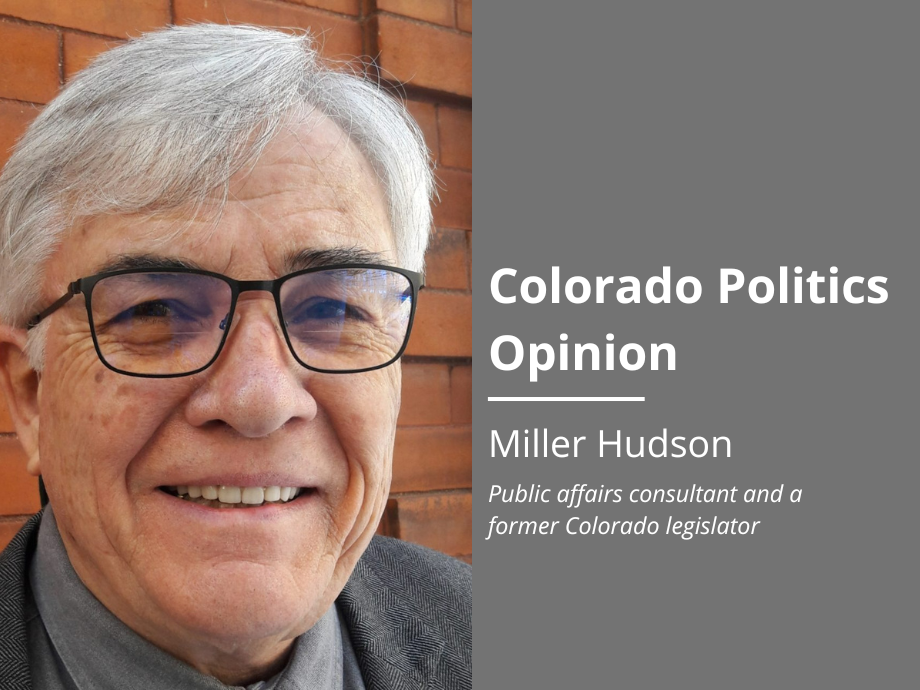
Miller Hudson is a public affairs consultant and a former Colorado legislator.

State money diversion scheme the unsurprising downfall of ERBOCES scam | Paula Noonan
Paula Noonan
paula-noonan@coloradopolitics.com
Updated 8 hours ago
Falcon School District 49, aka El Paso County School District 49, has finally cut bait, thrown the fishing pole into the lake and sunk the canoe. The longtime enabler of the Education Reenvisioned BOCES’ (ERBOCES) schemes to fund private Christian...

Steve Schuck on the ‘magic’ of school choice | The OpEdge Podcast
Tony Olivero
tony.olivero@gazette.com
Updated 1 day ago
Parents Challenge co-founder and longtime school choice advocate Steve Schuck joins The OpEdge to discuss expanding educational opportunities and ensuring parents are in charge of their kids’ education. Schuck tells investigative columnist and host Jimmy Sengenberger why he believes Colorado...
Do lobbyists add value to policymaking? | PODIUM
Colorado Politics
colorado-politics@coloradopolitics.com
Updated 1 day ago
By Corky Kyle I was recently asked a straightforward question: are lobbyists a valuable component in the development of public policy? After more than four decades working with the Colorado General Assembly, state agencies, local governments, associations and businesses, my...
Ain’t Polis’ Peters commutation a pity? | Hal Bidlack
Hal Bidlack
hal-bidlack@coloradopolitics.com
Updated 3 days ago
I am hoping that, yet again, my long-suffering and very forgiving editor will pardon my rambling thoughts today, as there are too many open tabs on my computer that deal with issues I want to talk about (Ed: pretty used...
Colorado lieutenant governor candidate Markert says early discipline and key mentors set his course
Marianne Goodland
marianne.goodland@coloradopolitics.com
Updated 3 days ago
Editor’s note: This is the first installment in a three-part series examining Colorado’s candidates for lieutenant governor. In this piece, Colorado Politics speaks with George Markert, the Republican running mate to gubernatorial candidate Victor Marx. Marx is competing against Democrat...
Colorado, like America, past due for generational change in politics | Miller Hudson
Miller Hudson
miller-hudson@coloradopolitics.com
Updated 1 day ago
I was 27 before I ever voted for president. At 19, in 1964, the Constitution had not yet been amended establishing 18-year-old voting eligibility. In 1968, I was serving overseas with the U.S. Navy at a time when there was...
Farmers and ranchers win on NIETC cancellation | Rachel Gabel
Rachel Gabel
rachel-gabel@coloradopolitics.com
Updated 4 days ago
The Department of Energy rolled into Lamar last week and Office of Electricity Assistant Secretary Katie Jereza stood in her neat, green suit in front of a room filled with farmers, ranchers and landowners. The crowd was filled with straw...

Going after the wrong butts | Jon Caldara
Jon Caldara
jon-caldara@coloradopolitics.com
Updated 1 week ago
Mayor Mike Johnston proclaimed, “It is past time Big Tobacco cleaned up the big mess it’s created.” Yep. Denver is suing tobacco companies for the cigarette butts littering the city. Because Denver’s Big Mess couldn’t possibly be the fault of...
Three districts that will answer key Colorado political questions | Paula Noonan
Paula Noonan
paula-noonan@coloradopolitics.com
Updated 1 week ago
Colorado’s legislature used to be a place where neither party was dominant. Dozens of seats were competitive and House and Senate majorities switched regularly. From 2010 to 2020, the House was predominantly Democratic with one two-year assembly under Republicans. The...

Hunting is a privilege, not a constitutional right | PODIUM
Colorado Politics
colorado-politics@coloradopolitics.com
Updated 1 week ago
By Roland Halpern Colorado voters may soon be asked to place hunting and fishing in the state constitution. Proposition 302 would establish the right to hunt, fish and take wildlife using “traditional methods,” while declaring hunting and fishing are the...