

Appeals court interprets ambiguous phrase in Colorado’s criminal records sealing law
Colorado’s second-highest court last month interpreted for the first time an ambiguous phrase in a 2019 law, and concluded a man convicted two decades ago for securities fraud was not entitled to have his criminal records sealed.
Lawmakers enacted House Bill 1275 nearly five years ago to increase the availability of records-sealing for people convicted of less serious crimes. The bill established a process for defendants to limit public access to their conviction records based on the severity of the offense.
The legislature also noted some types of convictions are not eligible for sealing at all. The prohibition encompasses, among other things, “sentencing for an offense classified as a class 1, 2, or 3 felony or a level 1 drug felony pursuant to any section of title 18,” which is Colorado’s criminal code.
However, the Court of Appeals noted the last seven words were not entirely clear.
An Arapahoe County jury convicted Brian Victor Prendergast in 2002 of securities fraud and theft. After he served his sentence, paid restitution to his victims and received no further criminal charges, he petitioned to seal his file. Prendergast argued his criminal record was a hindrance to obtaining loans for his small business.
District Court Judge Shay K. Whitaker denied the request, as Prendergast’s class 3 felonies are not eligible for sealing.
Prendergast, representing himself, turned to the Court of Appeals. He noted his securities fraud offenses were not established under title 18. Rather, they were offenses under title 11, designated “financial institutions.”
In light of the legal classification of securities fraud, Prendergast and the Colorado Attorney General’s Office advanced competing interpretations of the “pursuant to any section of title 18” language in HB 1275:
• It means class 3 felonies outside of the criminal code do not fall under the prohibition on sealing; or
• Because the securities fraud law indicates sentencing should be imposed pursuant to title 18, offenses outside the criminal code can still be prohibited from sealing
A three-judge Court of Appeals panel, in reviewing Prendergast’s case, believed there was a third interpretation possible:
• Because the disputed phrase is next to “a level 1 drug felony,” it only describes level 1 drug felonies
Given that the language “is reasonably susceptible of multiple interpretations, we conclude that it is ambiguous,” wrote Judge Christina F. Gomez in the Dec. 19 opinion.
The appellate panel instead looked at the legislative hearings to learn what lawmakers might have intended with the language. Gomez saw evidence that legislators and advocates meant to exclude all class 1, 2 and 3 felonies, plus level 1 drug felonies, from being shielded.
Although there was no explicit explanation for why the reference to title 18 stayed in the bill as enacted, the panel believed the most logical move was to view it as a modifier for the words immediately next to it — “level 1 drug felony.”
“We conclude that this legislative history demonstrates,” Gomez wrote, “the General Assembly intended to exclude all class 1, 2, or 3 felonies from record sealing, regardless of whether they are located in title 18. Accordingly, the phrase ‘pursuant to any section of title 18’ applies only to ‘a level 1 drug felony.'”
Consequently, the panel denied Prendergast’s appeal.
Colorado Politics contacted the sponsors of HB 1275 — then-Sen. Pete Lee, D-Colorado Springs; then-Rep. Mike Weissman, D-Aurora; and Rep. Matt Soper-R Delta — to inquire what they believed the title 18 reference meant. None responded to the inquiry.
The case is People v. Prendergast.

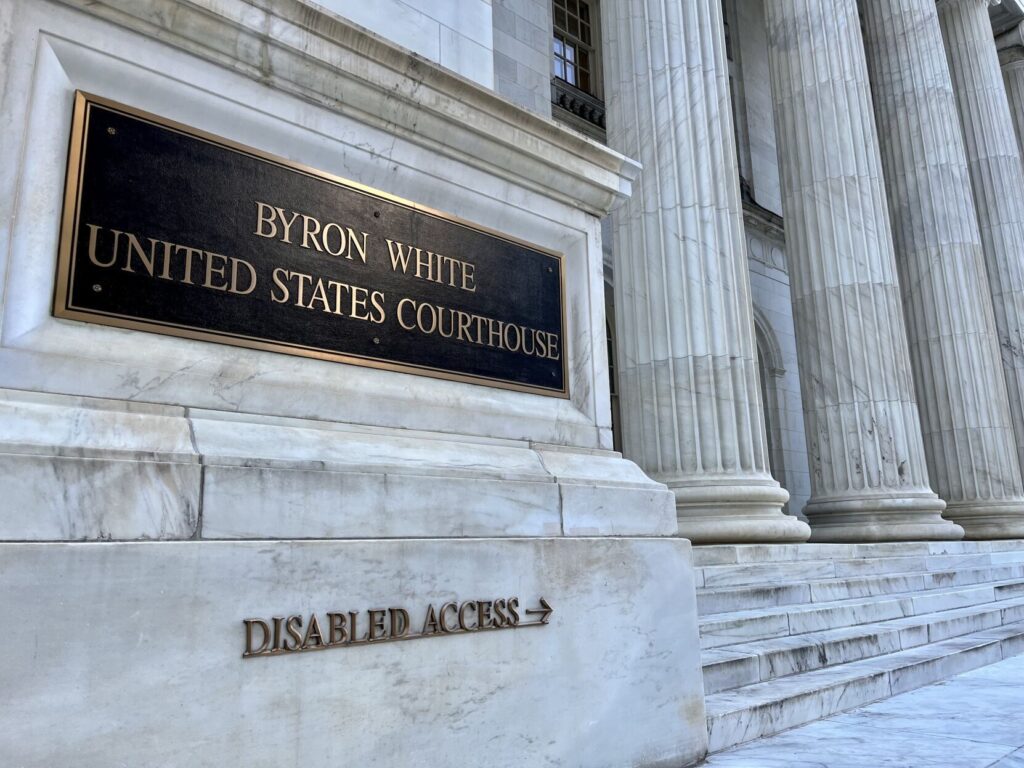
Misconduct complaints from ex-Colorado judicial discipline director dismissed against federal judges
Michael Karlik
michael.karlik@coloradopolitics.com
Updated 9 hours ago
The administrative body for the Denver-based federal appeals court upheld a finding last week that misconduct complaints against Colorado’s chief federal trial judge and the chief appeals judge warranted dismissal and appeared to be a “litigation tactic” by the complaining...

First-ever Red Rocks naturalization ceremony draws most diverse group of new citizens
Michael Karlik
michael.karlik@coloradopolitics.com
Updated 12 hours ago
Colorado’s federal trial court held its first-ever naturalization ceremony for nearly 300 new citizens on Thursday at Red Rocks Park and Amphitheater. “We’re doing it to commemorate the 250th anniversary of the Declaration of Independence and the United States. Red...
10th Circuit finds no fair housing violation by Littleton landlord for worker’s alleged rape of tenant
Michael Karlik
michael.karlik@coloradopolitics.com
Updated 2 days ago
The Denver-based federal appeals court concluded on Monday that Littleton’s housing authority could not be held liable for a maintenance worker’s alleged rape of a tenant, as the worker’s employment did not provide any special access to the victim. A...

Jeffco Public Schools sues Trump administration to protect funding after alleged transgender policies violation
Matt Kyle
matt.kyle@denvergazette.com
Updated 21 hours ago
In the wake of several threats by the Trump administration to revoke federal funding, Jeffco Public Schools filed a lawsuit against the Department of Education seeking to protect that badly needed money. Jeffco has been under investigation by the DOE’s...
Denver detox center did not violate man’s rights with 10-hour hold, 10th Circuit says
Michael Karlik
michael.karlik@coloradopolitics.com
Updated 2 days ago
The Colorado-based federal appeals court concluded on Tuesday that Denver’s detoxification facility did not violate a man’s rights by holding him against his will for 10 hours until his blood alcohol content was projected to reach zero. Unusually, Brian Garrett’s...

Federal judge clarifies ex-GOP treasurer candidate’s burden to prove defamation claims
Michael Karlik
michael.karlik@coloradopolitics.com
Updated 2 days ago
A federal judge clarified last week that businessman and former Republican statewide candidate Brian Watson will need to surmount a higher hurdle in proving his claim that a party guest’s alleged description of him as a “criminal” amounted to defamation....
Colorado board permits state to appeal injunction against arthritis drug price cap
Marissa Ventrelli
marissa.ventrelli@coloradopolitics.com
Updated 3 days ago
A Colorado board voted Friday to allow the Attorney General’s Office to fight an injunction against a price cap on a drug that treats arthritis. A U.S. district court judge had granted the company Amgen a preliminary injunction, temporarily blocking...

Federal judge rejects constitutional claims, ‘expressions of hatred’ by Club Q defendant
Michael Karlik
michael.karlik@coloradopolitics.com
Updated 3 days ago
A federal judge rejected a defendant’s claims that he received constitutionally ineffective assistance of counsel while facing federal hate crime and firearms charges for murdering five people at a Colorado Springs LGBTQ nightclub in 2022. Anderson Lee Aldrich is serving...

Divided 10th Circuit upholds Colorado congestion fee on car rentals
Michael Karlik
michael.karlik@coloradopolitics.com
Updated 3 days ago
The Denver-based federal appeals court concluded on Monday that a 2024 “congestion impact fee” that lawmakers imposed on short-term vehicle rentals did not conflict with a federal prohibition on certain airport-related charges. Beginning in the 1970s, Congress began limiting the...
10th Circuit dismisses woman’s lawsuit following 10-year attempt to undo restraining order
Michael Karlik
michael.karlik@coloradopolitics.com
Updated 6 days ago
The Denver-based federal appeals court rejected a woman’s challenge on Friday to a restraining order imposed on her more than a decade ago, finding that she cannot credibly claim she will be prosecuted for violating the restraining order through her...