

Colorado Supreme Court upholds Black Hills’ winter storm surcharge from 2021
The Colorado Supreme Court on Monday upheld the state utility commission’s authorized method of charging Black Hills Energy customers for $23 million in natural gas purchases for a winter storm, rejecting claims that the surcharge was unreasonable.
In advance of Winter Storm Uri in February 2021, Black Hills bought additional gas to ensure continued service to its customers. Afterward, the Public Utilities Commission signed off on a proposal for Black Hills to recover its costs by imposing a flat surcharge on its customers’ future energy use, spread out over two years.
One of Black Hills’ major customers, industrial materials producer Holcim, protested the plan. The company argued the fair method was to charge users based on the electricity they actually consumed during the storm. Under that methodology, Holcim asserted its true share of the gas purchase should be under $600,000, compared to roughly $2 million using the commission-approved plan.
However, the Supreme Court’s Jan. 13 opinion noted it must give substantial leeway to the commission’s decisions and ultimately determine whether they are “just and reasonable.” For a variety of reasons, Justice Richard L. Gabriel wrote that it was.
The surcharge “accurately reflects the cost of service because,” he explained, “the PUC concluded, with ample record support, that Black Hills had purchased natural gas based on total forecasted customer need, not based on actual individual consumption during Winter Storm Uri.”
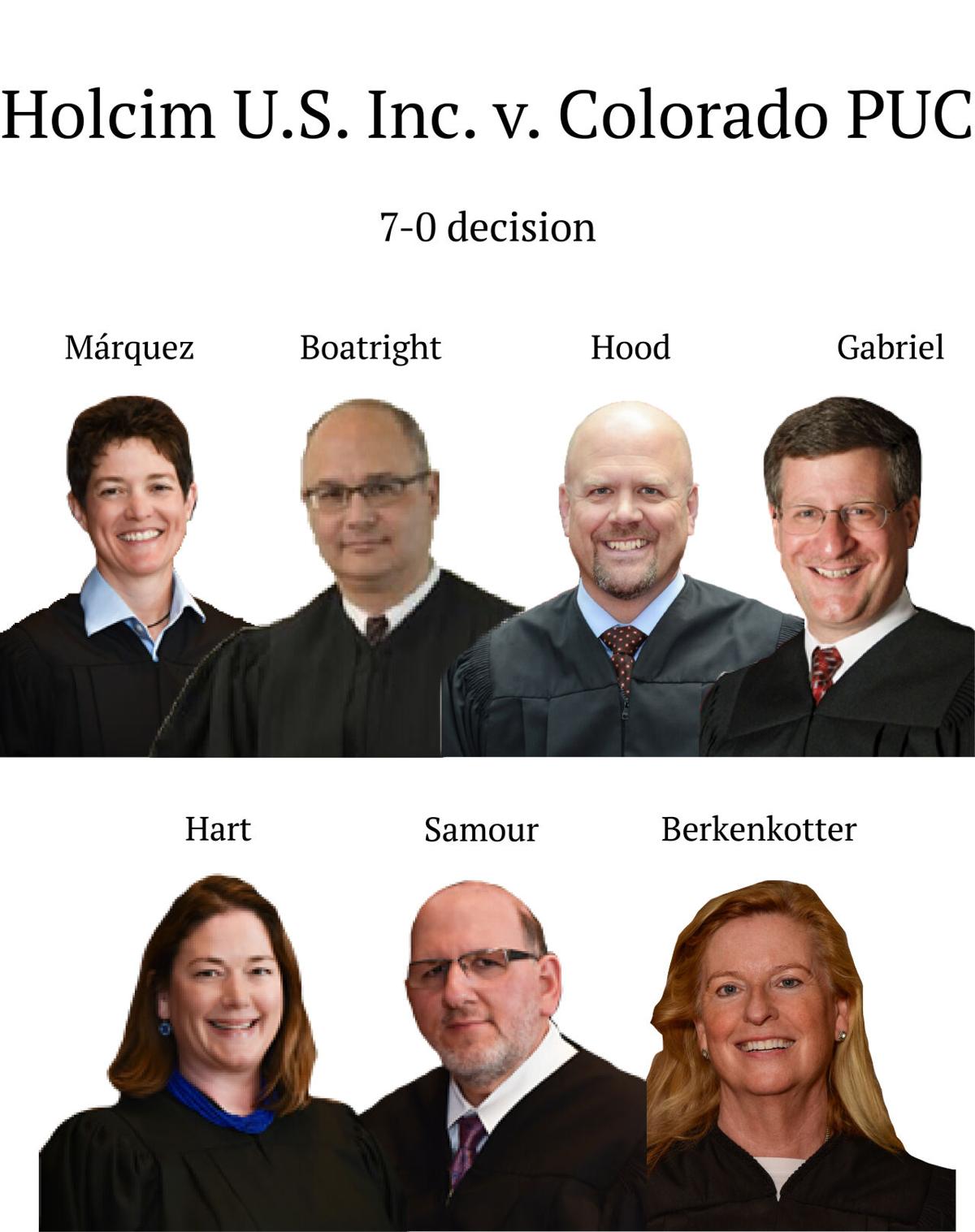

“Moreover,” Gabriel continued, “it appears undisputed that Black Hills’s natural gas purchases enabled it to provide to its customers uninterrupted service at normal usage volumes throughout the weather event, which was the very purpose for Black Hills’s advance purchases.”
The key question raised by Holcim was whether Black Hills’ attempt to recover its pricey gas purchase in advance of the storm should be proportional to customers’ actual energy use or whether the cost could rightfully be imposed with a flat rate systemwide.
Holcim took no issue with Black Hills recovering its expense from customers over two years, which was intended to avoid “rate shock.” Instead, the company insisted the surcharge was unreasonable because it was untethered to customers’ actual electricity use during the winter storm.
According to Holcim’s calculations, the plan required it to pay 360% more than it should, with residential customers receiving a windfall.
After the Public Utilities Commission sided against Holcim, Denver District Court Judge Andrew J. Luxen upheld that decision, finding a surcharge imposed equally on all customers was not arbitrary.
On appeal to the Supreme Court, Holcim argued it was “frustrating” to see its position characterized as “some haphazard selfish endeavor.”
“How much electricity you use is directly relevant to what you pay towards that cost,” said attorney Mark T. Valentine during oral arguments. “In this case, there’s no correlation between what Holcim used” and its surcharge over the next two years.
In response, the Public Utilities Commission contended Black Hills’ purchase enabled customers to use their normal amount of energy during the inclement weather, should they have desired. Therefore, Holcim received the same benefit from Black Hills’ actions as everyone else.
The Supreme Court agreed with that logic. Gabriel noted there was no evidence to show Holcim told Black Hills in advance that it intended to use less electricity during the storm, which could have affected the amount of gas purchased.
“Instead, Black Hills proceeded based on its forecasts, and all Black Hills customers, including Holcim, were able to satisfy their normal electricity needs throughout the storm,” he wrote.
The case is Holcim U.S. Inc. v. Colorado Public Utilities Commission et al.


10th Circuit partially revives lawsuit over 2020 Denver protest injuries
Michael Karlik
michael.karlik@coloradopolitics.com
Updated 2 days ago
The Colorado-based federal appeals court revived a man’s claims against Denver on Friday after concluding a trial judge resolved the case in the city’s favor without analyzing two of the three instances of alleged excessive force and other constitutional violations....
Federal judges find Colorado immigration judge violated several orders
Michael Karlik
michael.karlik@coloradopolitics.com
Updated 17 hours ago
Multiple federal judges in Colorado have freed people from immigration custody after determining that one immigration judge violated their directives for properly conducting bond hearings. For nearly a year, Colorado’s U.S. District Court has faced a flood of habeas corpus petitions...
Misconduct complaints from ex-Colorado judicial discipline director dismissed against federal judges
Michael Karlik
michael.karlik@coloradopolitics.com
Updated 3 days ago
The administrative body for the Denver-based federal appeals court upheld a finding last week that misconduct complaints against Colorado’s chief federal trial judge and the chief appeals judge warranted dismissal and appeared to be a “litigation tactic” by the complaining...

First-ever Red Rocks naturalization ceremony draws most diverse group of new citizens
Michael Karlik
michael.karlik@coloradopolitics.com
Updated 15 hours ago
Colorado’s federal trial court held its first-ever naturalization ceremony for nearly 300 new citizens on Thursday at Red Rocks Park and Amphitheatre. “We’re doing it to commemorate the 250th anniversary of the Declaration of Independence and the United States. Red...
Jeffco taxpayers could be on the hook for a possible child sex assault settlement
Matt Kyle
matt.kyle@denvergazette.com
Updated 2 days ago
Taxpayers may end up on the hook for a child sexual assault settlement, possibly worth up to $15 million, after Jeffco Public Schools failed to notify its insurance company in a timely manner about the case. The incident stems from...
10th Circuit finds no fair housing violation by Littleton landlord for worker’s alleged rape of tenant
Michael Karlik
michael.karlik@coloradopolitics.com
Updated 18 hours ago
The Denver-based federal appeals court concluded on Monday that Littleton’s housing authority could not be held liable for a maintenance worker’s alleged rape of a tenant, as the worker’s employment did not provide any special access to the victim. A...

Jeffco Public Schools sues Trump administration to protect funding after alleged transgender policies violation
Matt Kyle
matt.kyle@denvergazette.com
Updated 3 days ago
In the wake of several threats by the Trump administration to revoke federal funding, Jeffco Public Schools filed a lawsuit against the Department of Education seeking to protect that badly needed money. Jeffco has been under investigation by the DOE’s...
Denver detox center did not violate man’s rights with 10-hour hold, 10th Circuit says
Michael Karlik
michael.karlik@coloradopolitics.com
Updated 5 days ago
The Colorado-based federal appeals court concluded on Tuesday that Denver’s detoxification facility did not violate a man’s rights by holding him against his will for 10 hours until his blood alcohol content was projected to reach zero. Unusually, Brian Garrett’s...

Federal judge clarifies ex-GOP treasurer candidate’s burden to prove defamation claims
Michael Karlik
michael.karlik@coloradopolitics.com
Updated 5 days ago
A federal judge clarified last week that businessman and former Republican statewide candidate Brian Watson will need to surmount a higher hurdle in proving his claim that a party guest’s alleged description of him as a “criminal” amounted to defamation....
Colorado board permits state to appeal injunction against arthritis drug price cap
Marissa Ventrelli
marissa.ventrelli@coloradopolitics.com
Updated 5 days ago
A Colorado board voted Friday to allow the Attorney General’s Office to fight an injunction against a price cap on a drug that treats arthritis. A U.S. district court judge had granted the company Amgen a preliminary injunction, temporarily blocking...