

Despite trial error, 10th Circuit upholds Mesa County man’s child sex convictions
Although a trial judge wrongly permitted jurors to see a 9-year-old video of a child victim’s accusations, the federal appeals court based in Denver upheld the sex-related convictions of a Mesa County man last month.
Michael Tracy McFadden was originally convicted in state court for sexually assaulting multiple children, including on trips out of state through his work as a truck driver. After Colorado’s Court of Appeals overturned his convictions for a violation of McFadden’s right to a speedy trial, federal authorities indicted him on similar charges. Jurors again convicted him in 2022 and he is serving life in prison.
McFadden appealed his convictions and sentence on multiple grounds, but a three-judge panel of the U.S. Court of Appeals for the 10th Circuit largely rejected the challenge. However, all three judges agreed one piece of evidence was improperly admitted, and one judge indicated he would have overturned the affected guilty verdicts as a result.
At McFadden’s 2022 trial, jurors heard from one of the victims, identified as K.W. Twenty years old at the time of trial, K.W. testified McFadden attempted to sexually assault him on an interstate trucking trip. K.W. did not speak in detail, recalling only that McFadden “tried to stick his thing in me” and “I’ve tried to suppress most of these memories.”
The prosecution then moved to introduce a 2013 video of K.W., at age 11, being interviewed by a detective after McFadden’s arrest. Normally, out-of-court statements intended to prove the truth are not allowed because they are hearsay. Consequently, U.S. District Court Senior Judge Christine M. Arguello wondered why the video was necessary, given that K.W. had testified in person.
“K.W., while he did discuss the events in question, did so reluctantly and often after my prompting and after I used the words that he seemingly cannot,” the prosecutor responded.
Arguello acknowledged the video could be admitted if there were “sufficient guarantees of trustworthiness” and if it was “more probative” than any other evidence. She concluded the video met that standard and allowed jurors to see it.


The 10th Circuit panel found that decision problematic. Although there are several factors for judges to consider when considering if a hearsay statement is trustworthy, Arguello did not address most of them. Upon review, the panel noted several reasons why the 9-year-old video was not trustworthy, including the fact that K.W. knew he was going into a police interview, used terminology that suggested adults had coached him and had not originally accused McFadden of a crime.
“Going forward, district courts assessing child hearsay statements in sex-abuse cases would do well to articulate their reasoning on the record for each of the pertinent trustworthiness factors before admitting out-of-court statements,” warned Judge Gregory A. Phillips in the Aug. 30 opinion.
Phillips elaborated the video was also problematic because it was not more probative than any other evidence. While the prosecutor told Arguello that K.W. answered “reluctantly” in his live testimony, there were no direct questions about the assault and the details K.W. did offer were consistent with his 2013 interview.
“In this he said/he said case, the jury’s ability to assess K.W.’s credibility from live testimony was paramount,” wrote Phillips. “Because the 2013 video statements are not superior to K.W.’s live testimony, there was no justification to override our preference for in-court testimony.”
Nonetheless, wrote Phillips for himself and Senior Judge Paul J. Kelly Jr., it was “certain” that the video did not affect the jury’s verdict because his statements as a child “mirror his trial testimony.”

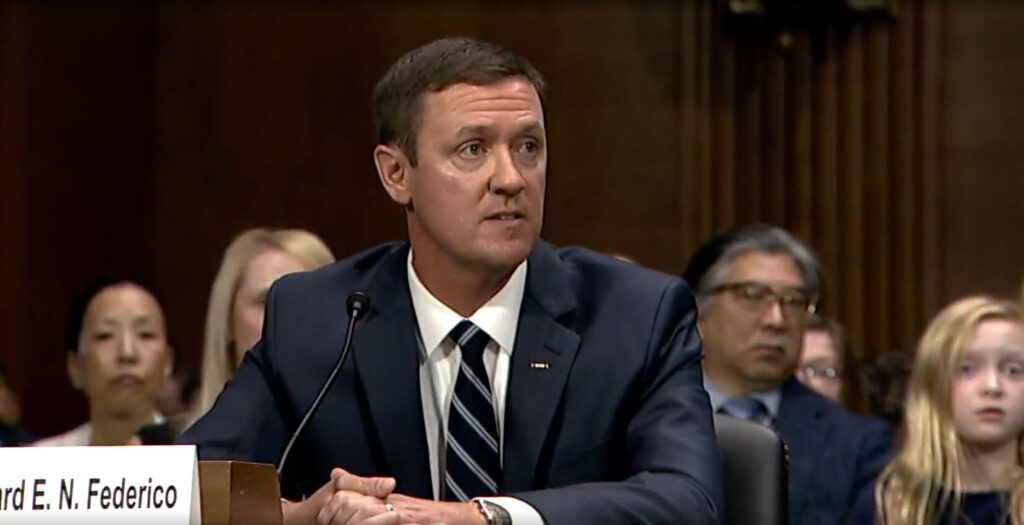
In this screen grab from C-SPAN, Richard E.N. Federico testifies at his confirmation hearing to the U.S. Court of Appeals for the 10th Circuit on Sept. 6, 2023.

In this screen grab from C-SPAN, Richard E.N. Federico testifies at his confirmation hearing to the U.S. Court of Appeals for the 10th Circuit on Sept. 6, 2023.
Judge Richard E.N. Federico disagreed with the majority’s conclusion and the path it took to get there. He noted the government never argued the video was harmless and he questioned why the court would put its thumb on the scale for the prosecution.
“On appeal, the government’s duty is to defend the convictions it secures at trial after the expenditure of significant time, labor, and resources,” Federico wrote. “The government is very capable of doing this and, rightfully, is usually not timid about arguing all potential legal paths to affirmance.”
Federico, one of two former public defenders on the 10th Circuit, further argued K.W.’s testimony as an adult and his video interview as a child did not mirror each other.
“Trials are live events, where jurors watch how witnesses testify as much as they listen to their words,” he wrote. “The eleven-year-old K.W. talking to a detective in a comfortable room, while draped in a blanket, and lying on a small blue sofa, is not the same as a twenty-year-old K.W. testifying in person before the jury, eight years later, recounting what happened in the past.”
Because he believed the video bolstered K.W.’s in-court testimony and McFadden’s convictions relied in large part on K.W.’s accusation of sex assault, Federico would have reversed McFadden’s two convictions pertaining to K.W.
The case is United States v. McFadden.


Misconduct complaints from ex-Colorado judicial discipline director dismissed against federal judges
Michael Karlik
michael.karlik@coloradopolitics.com
Updated 10 hours ago
The administrative body for the Denver-based federal appeals court upheld a finding last week that misconduct complaints against Colorado’s chief federal trial judge and the chief appeals judge warranted dismissal and appeared to be a “litigation tactic” by the complaining...

First-ever Red Rocks naturalization ceremony draws most diverse group of new citizens
Michael Karlik
michael.karlik@coloradopolitics.com
Updated 13 hours ago
Colorado’s federal trial court held its first-ever naturalization ceremony for nearly 300 new citizens on Thursday at Red Rocks Park and Amphitheater. “We’re doing it to commemorate the 250th anniversary of the Declaration of Independence and the United States. Red...
10th Circuit finds no fair housing violation by Littleton landlord for worker’s alleged rape of tenant
Michael Karlik
michael.karlik@coloradopolitics.com
Updated 2 days ago
The Denver-based federal appeals court concluded on Monday that Littleton’s housing authority could not be held liable for a maintenance worker’s alleged rape of a tenant, as the worker’s employment did not provide any special access to the victim. A...

Jeffco Public Schools sues Trump administration to protect funding after alleged transgender policies violation
Matt Kyle
matt.kyle@denvergazette.com
Updated 21 hours ago
In the wake of several threats by the Trump administration to revoke federal funding, Jeffco Public Schools filed a lawsuit against the Department of Education seeking to protect that badly needed money. Jeffco has been under investigation by the DOE’s...
Denver detox center did not violate man’s rights with 10-hour hold, 10th Circuit says
Michael Karlik
michael.karlik@coloradopolitics.com
Updated 2 days ago
The Colorado-based federal appeals court concluded on Tuesday that Denver’s detoxification facility did not violate a man’s rights by holding him against his will for 10 hours until his blood alcohol content was projected to reach zero. Unusually, Brian Garrett’s...

Federal judge clarifies ex-GOP treasurer candidate’s burden to prove defamation claims
Michael Karlik
michael.karlik@coloradopolitics.com
Updated 2 days ago
A federal judge clarified last week that businessman and former Republican statewide candidate Brian Watson will need to surmount a higher hurdle in proving his claim that a party guest’s alleged description of him as a “criminal” amounted to defamation....
Colorado board permits state to appeal injunction against arthritis drug price cap
Marissa Ventrelli
marissa.ventrelli@coloradopolitics.com
Updated 3 days ago
A Colorado board voted Friday to allow the Attorney General’s Office to fight an injunction against a price cap on a drug that treats arthritis. A U.S. district court judge had granted the company Amgen a preliminary injunction, temporarily blocking...

Federal judge rejects constitutional claims, ‘expressions of hatred’ by Club Q defendant
Michael Karlik
michael.karlik@coloradopolitics.com
Updated 3 days ago
A federal judge rejected a defendant’s claims that he received constitutionally ineffective assistance of counsel while facing federal hate crime and firearms charges for murdering five people at a Colorado Springs LGBTQ nightclub in 2022. Anderson Lee Aldrich is serving...

Divided 10th Circuit upholds Colorado congestion fee on car rentals
Michael Karlik
michael.karlik@coloradopolitics.com
Updated 3 days ago
The Denver-based federal appeals court concluded on Monday that a 2024 “congestion impact fee” that lawmakers imposed on short-term vehicle rentals did not conflict with a federal prohibition on certain airport-related charges. Beginning in the 1970s, Congress began limiting the...
10th Circuit dismisses woman’s lawsuit following 10-year attempt to undo restraining order
Michael Karlik
michael.karlik@coloradopolitics.com
Updated 6 days ago
The Denver-based federal appeals court rejected a woman’s challenge on Friday to a restraining order imposed on her more than a decade ago, finding that she cannot credibly claim she will be prosecuted for violating the restraining order through her...