

Divided appeals court upholds $111,600 restitution order in Denver murder case
Colorado’s second-highest court last week upheld a Denver judge’s crime victim restitution order as valid, but with continued disagreement over how to apply the Supreme Court’s recent guidance about the state’s restitution law.
In Colorado, when a convicted defendant is required to pay financial restitution, prosecutors typically must provide the requested amount by the time of sentencing or within 91 days of sentencing. Judges must also impose the restitution amount within 91 days of sentencing. If judges need to extend either deadline, they must find good cause exists.
In a major decision, People v. Weeks, the state Supreme Court ruled in November 2021 that judges’ typical process of awarding compensation to crime victims did not comply with Colorado law. The justices noted a lackadaisical approach had taken hold in the trial courts that neglected the clear deadlines and procedural requirements. Consequently, if trial judges fail to follow the law, they lose authority to issue a restitution order.
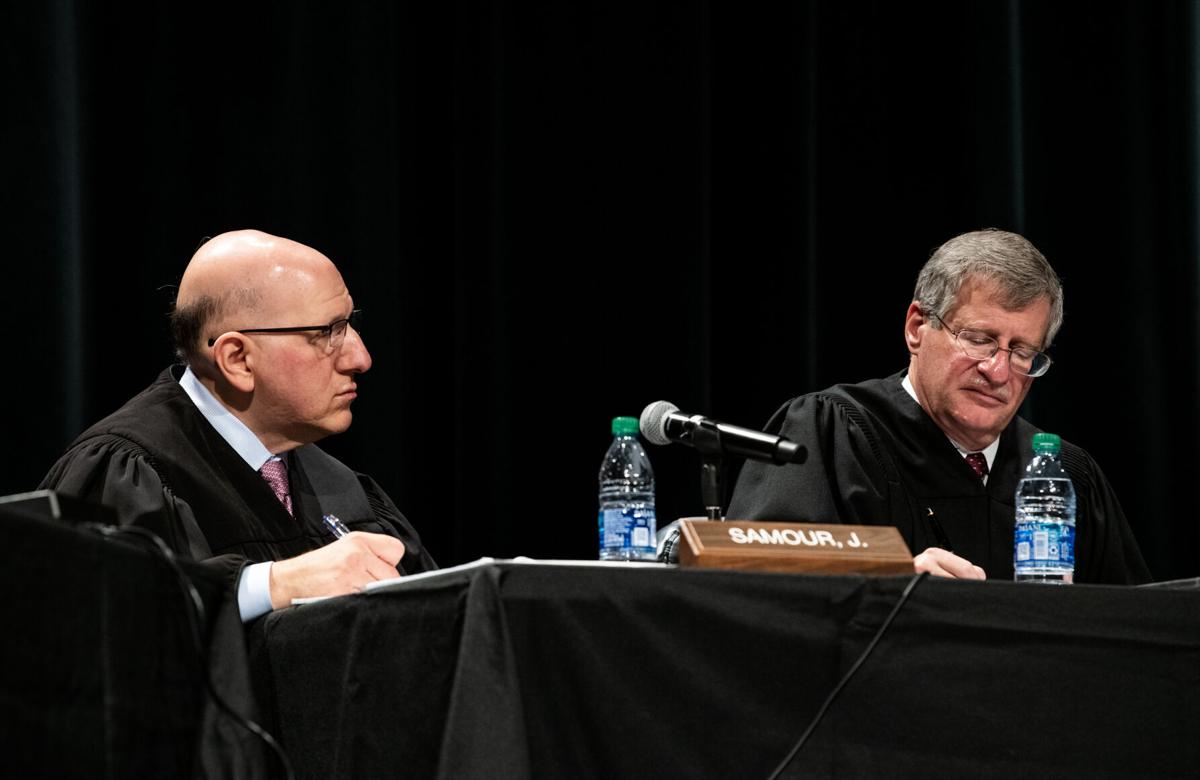
Colorado Supreme Court Justices Carlos A. Samour Jr., left, and Richard L. Gabriel listen to an argument during a Courts in the Community event held at Pine Creek High School in Colorado Springs on Thursday, Nov. 17, 2022.
Parker Seibold, The Gazette

Colorado Supreme Court Justices Carlos A. Samour Jr., left, and Richard L. Gabriel listen to an argument during a Courts in the Community event held at Pine Creek High School in Colorado Springs on Thursday, Nov. 17, 2022.
By 2-1, a three-judge panel for the Court of Appeals believed the $111,600 restitution order following the Denver murder conviction of Robert W. Feldman complied with the law. Even though Chief Judge Christopher J. Baumann ordered restitution beyond the deadline, never used the phrase “good cause” and did not explain why he could not make a decision within the 91-day window, the panel’s majority believed Baumann’s crowded docket qualified as good cause.
“It’s true that the Weeks court noted that the statute requires ‘an express finding’ relating to good cause for extending the deadline,” wrote Judge W. Eric Kuhn in the June 13 opinion. “But the supreme court did not dictate in that case how a trial court must communicate its express finding.”
Judge Karl L. Schock dissented, noting the only basis for good cause was a pair of emails Baumann’s clerk sent to the parties informing them the restitution hearing and decision would need to take place later because Baumann had other trials scheduled. Problematically, the emails did not contain the key feature the Supreme Court said was required: a judge’s specific finding of good cause.
“I do not think that an email from court staff satisfies the Weeks requirement of an express good cause finding by the district court,” Schock wrote.
Since the Weeks decision, the Court of Appeals has struggled at times to determine whether crime victim restitution orders are void if trial judges did not precisely follow the Supreme Court’s procedure. One member, Judge Jerry N. Jones, has repeatedly suggested restitution orders should not be overturned outright even if a trial judge fails to comply with the law.
Other appellate judges, however, have signaled their frustration with prosecutors and trial judges whose actions undermine the spirit or the letter of Weeks.
“The current flood of litigation over these issues will largely be avoided,” wrote Judge Timothy J. Schutz in February, “if the prosecution fulfills its obligation to use diligent efforts to gather and present the information necessary to resolve restitution at the sentencing hearing, coupled with the court’s establishment of case management practices that ensure such obligations are fulfilled.”
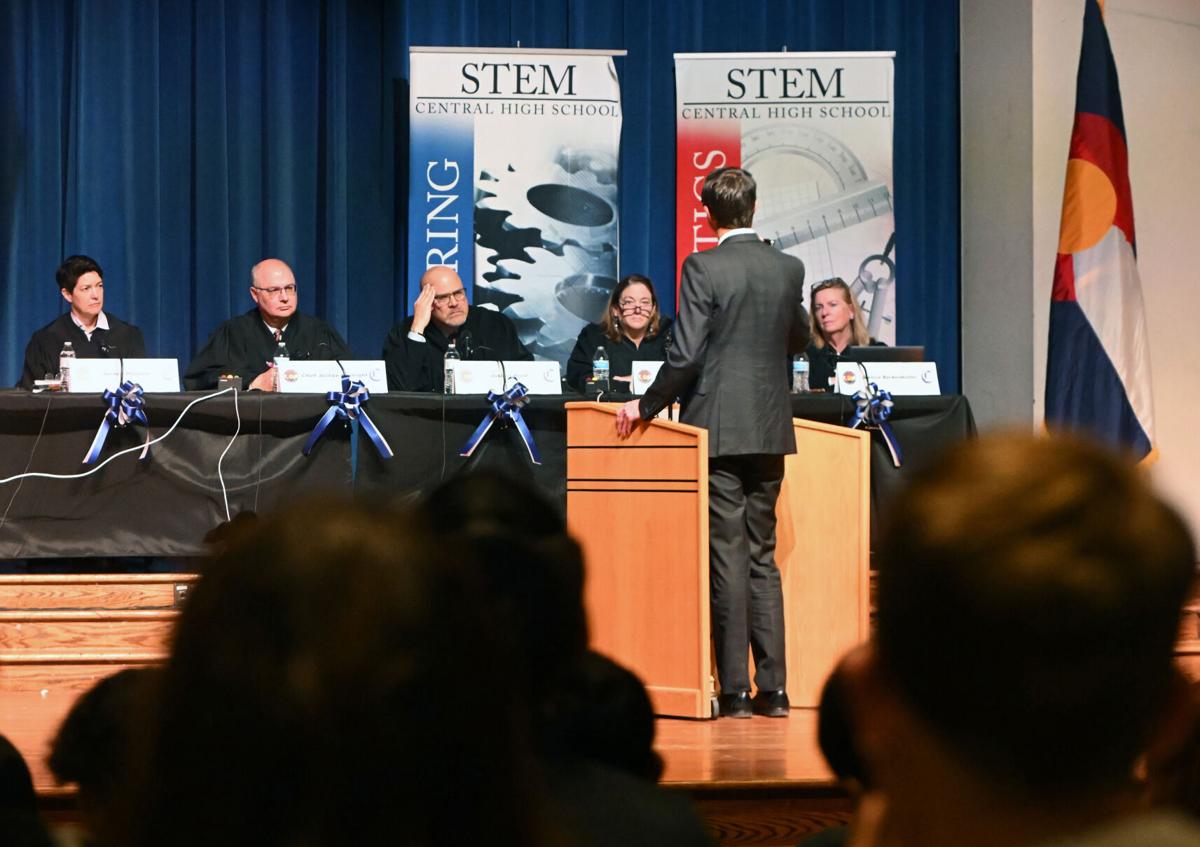
FILE PHOTO: Members of the Colorado Supreme Court listen to arguments from attorney Julian R. Ellis, Jr. during "Courts in the Community" at Pueblo's Central High School on Thursday, May 9, 2024. (Photo by Jerilee Bennett, The Gazette)
Jerilee Bennett/The Gazette

FILE PHOTO: Members of the Colorado Supreme Court listen to arguments from attorney Julian R. Ellis, Jr. during “Courts in the Community” at Pueblo’s Central High School on Thursday, May 9, 2024. (Photo by Jerilee Bennett, The Gazette)
This spring, the Supreme Court agreed to hear three restitution-related appeals that could potentially chip away at its 3-year-old decision in Weeks.
In Feldman’s case, a jury convicted him in April 2022 for murdering his wife. The prosecution submitted its crime victim restitution request one week later, seeking reimbursement for therapy for Feldman’s children. Feldman filed his objection a few days after.
Then-District Court Judge Edward D. Bronfin set a restitution hearing for July 11, one week before the 91-day deadline. However, in mid-June, he recused himself from the case without explanation. The case was reassigned to Baumann.
The Lindsey-Flanigan Courthouse in Denver.
Michael Karlik michael.karlik@coloradopolitics.com

The Lindsey-Flanigan Courthouse in Denver.
On June 22, Baumann’s clerk notified the parties Baumann had multiple trials scheduled for July 11, so there was a possibility Feldman’s restitution hearing would be postponed. Three days before the hearing, the clerk confirmed a postponement was necessary “due to a conflict on the court’s trial calendar.” She proposed three dates, all outside the 91-day window.
After the deadline, Feldman argued Baumann had no authority to hold the hearing. In a one-paragraph order, Baumann concluded his clerk’s emails put the parties on notice of a conflict and he did, in fact, have another jury trial take place the day of the original hearing. Baumann ordered Feldman to pay the six-figure restitution.
Feldman appealed the order, alleging non-compliance with Weeks. The government maintained there was no violation, and pointed out Feldman’s counsel had accepted a hearing date outside the 91-day window after the clerk’s second email.
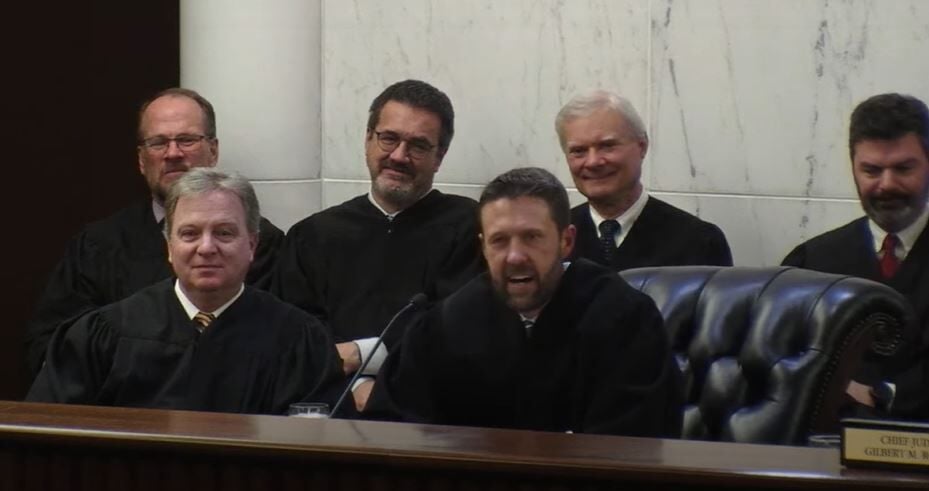
Judge Karl L. Schock speaks at his ceremonial swearing-in on Jan. 19, 2023. At left is Judge Jerry N. Jones. In the back row, from left to right, are Judges Timothy J. Schutz, Ted C. Tow III, Lino S. Lipinsky de Orlov and Matthew D. Grove.
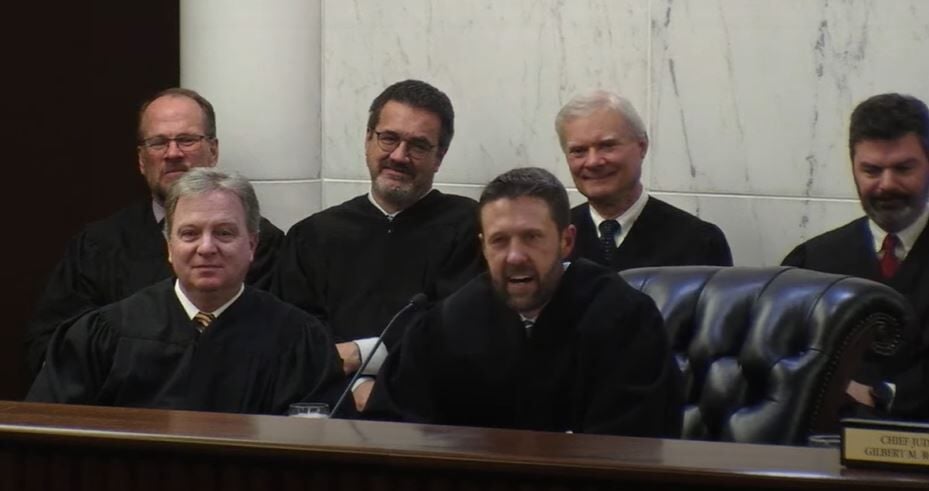
Judge Karl L. Schock speaks at his ceremonial swearing-in on Jan. 19, 2023. At left is Judge Jerry N. Jones. In the back row, from left to right, are Judges Timothy J. Schutz, Ted C. Tow III, Lino S. Lipinsky de Orlov and Matthew D. Grove.
The Court of Appeals panel agreed Feldman could not be faulted for agreeing to a hearing after 91 days because at that point, Baumann had already decided to reschedule. But the majority deemed it unnecessary that Baumann never explicitly analyzed whether there was good cause to do so.
“The substance of the orders in this case show that the court’s docket congestion constituted good cause,” wrote Kuhn for himself and Judge Anthony J. Navarro.
Schock countered it was not enough for there to be good cause, but a judge needs to say so before the deadline and on the record.
Even if the clerk’s emails could be interpreted as a judge’s order, the messages “simply said the hearing could not proceed on July 11, as scheduled. Neither email addressed whether the hearing could occur later that week or the following week — either of which would still have been within the ninety-one-day deadline,” Schock noted.
The case is People v. Feldman.

Denver murder conviction reversed for incomplete self-defense instruction
Michael Karlik
michael.karlik@coloradopolitics.com
Updated 5 hours ago
Colorado’s second-highest court reversed a defendant’s murder conviction last week because a Denver judge gave an incomplete instruction to the jury about the man’s right to self-defense. Donald R. Gonzales and Gary McLaughlin met up in a Capitol Hill parking...
Colorado lawmaker, House leaders named in workplace-retaliation lawsuit
Marianne Goodland
marianne.goodland@coloradopolitics.com
Updated 7 hours ago
A former legislative aide has filed a lawsuit alleging she was mistreated, illegally directed to perform campaign work and harmed by a House leadership structure she charged was fragmented, politicized and ineffective at protecting employees. The lawsuit, filed by Jennifer...
Federal judge hears arguments about Colorado’s 3-day gun purchase waiting period
Michael Karlik
michael.karlik@coloradopolitics.com
Updated 12 hours ago
A federal judge heard arguments on Monday about the constitutionality of a 2023 Colorado law that generally imposes a three-day waiting period on firearm purchases after the initiation of a background check. The test that the U.S. Supreme Court created...
Colorado Supreme Court intervenes in Weld County prosecution dismissed due to Missy Woods misconduct
Michael Karlik
michael.karlik@coloradopolitics.com
Updated 4 hours ago
The Colorado Supreme Court ordered a Weld County trial judge last week to respond to the district attorney’s claim that he improperly dismissed a criminal case because of “outrageous” conduct by the Colorado Bureau of Investigation. Daniel Lee Eatinger stood...
Schoolchildren’s presence at child sex-related trial did not harm Arapahoe County defendant, appeals court says
Michael Karlik
michael.karlik@coloradopolitics.com
Updated 3 days ago
Colorado’s second-highest court decided on Thursday that the presence of a group of schoolchildren on the first day of a child sexual exploitation trial did not violate an Arapahoe County defendant’s constitutional right to a fair trial. Prosecutors charged Jerry...
Appeals court cites week-old Colorado law to reinstate child neglect case at child, father’s request
Michael Karlik
michael.karlik@coloradopolitics.com
Updated 3 days ago
Colorado’s second-highest court invoked a new state law for the first time on Thursday and reinstated a child neglect case that both the child and her father wished to reopen. House Bill 1227 took effect on Aug. 12, reversing a...
Colorado Supreme Court names William Hood as next chief justice
Michael Karlik
michael.karlik@coloradopolitics.com
Updated 4 days ago
The Colorado Supreme Court has selected Justice William W. Hood III to be the next chief justice, the judicial branch announced on Friday. Hood will succeed Chief Justice Monica M. Márquez, who took over the role in July 2024. “I...
Family of slain Lakewood teacher releases statement as murder suspect makes first court appearance
Matt Kyle
matt.kyle@denvergazette.com
Updated 1 day ago
Patrick Theodore Barnett, the Lakewood man accused of killing his wife, a Jeffco Public Schools art teacher, made his first court appearance Friday morning as his wife’s family looked on. The status conference hearing was held before District Court Judge...
Appeals court upholds Park County trophy hunting conviction
Michael Karlik
michael.karlik@coloradopolitics.com
Updated 4 days ago
Colorado’s second-highest court clarified on Thursday that a defendant may stand convicted under the state’s trophy hunting laws if he abandons a bear carcass but returns later to remove the meat. Under Colorado law, it is a felony to detach...
Judge grants partial injunction to GEO in fight against state health inspection law
Kyla Pearce
kyla.pearce@gazette.com
Updated 5 days ago
A judge ruled Thursday that The GEO Group does not have to follow parts of a new state law requiring more frequent health and safety inspections at the U.S. Immigration and Customs Enforcement processing center in Aurora. Under the order...