

Appeals court agrees RTD not responsible for $111.5 million in costs from faulty rail line rollout
Colorado’s second-highest court agreed on Thursday that the contractor responsible for building and operating the recent expansion of the Regional Transportation District’s rail network cannot recover more than $100 million from RTD for the extended period in which grade crossing systems malfunctioned.
Denver Transit Partners and RTD engaged in a public-private partnership to construct a $2.2 billion, taxpayer-funded commuter rail network connecting Union Station to the suburbs and to Denver International Airport. However, federal and state regulators were concerned that the wireless system used to trigger the warning equipment at more than two dozen grade crossings was not operating correctly.
Consequently, between 2016 and 2019, Denver Transit Partners had to provide attendants at all grade crossings at all times while its vendors devised a software solution. The associated costs were $111.5 million, which Denver Transit Partners sought to recover from RTD through a breach-of-contract suit.
Last year, a Denver judge sided against Denver Transit Partners. The company then turned to the Court of Appeals, arguing that regulators’ directives to fix the prolonged activation of the grade crossing equipment effectively imposed a “maximum warning time” for oncoming trains. Because Denver Transit Partners had to meet this new regulation mid-project, it claimed it should not bear the costs.
But that is not what happened, countered Judge Stephanie Dunn in the three-judge panel’s May 9 opinion. Federal regulations require a minimum warning time for trains approaching grade crossings, and also that the warning systems activate “in accordance with the design.”
“That regulatory language remained unchanged,” she wrote. “And while the regulators were concerned with Denver Transit’s longer-than-designed warning times, it was because they exceeded Denver Transit’s own design warning times by an unacceptable margin.”
During a 19-day trial, District Court Judge Andrew P. McCallin heard extensive evidence about the malfunctioning grade crossing systems on the A Line to the airport and on the B and G Lines:
• There were three incidents on March 1, 2016 where the gates did not properly close at grade crossings, resulting in a near collision between a train and a vehicle
• Although the A Line’s grade crossings were designed to provide a warning time between 29 and 42 seconds, some gates and lights activated for as long as three minutes, on average
• In an October 2016 email, Denver Transit Partners informed its software vendor that “Clearly the proposed (warning system) is not functioning as intended”
Eventually, the vendor devised a patch that accounted for a missing factor. The Federal Railroad Administration approved a proposal from Denver Transit Partners allowing a 20-second deviation from designed warning times.
McCallin, in a 2023 order finding in favor of RTD, concluded the FRA never changed its regulatory standard. Instead, the focus was always on whether the warning system functioned as designed, which it did not.
“A system that has long gate down time and gates that fail to descend reliably is not activating in accordance with its design,” he wrote. “The actual experiences of the traveling public show that the system was not operating properly or as designed.”
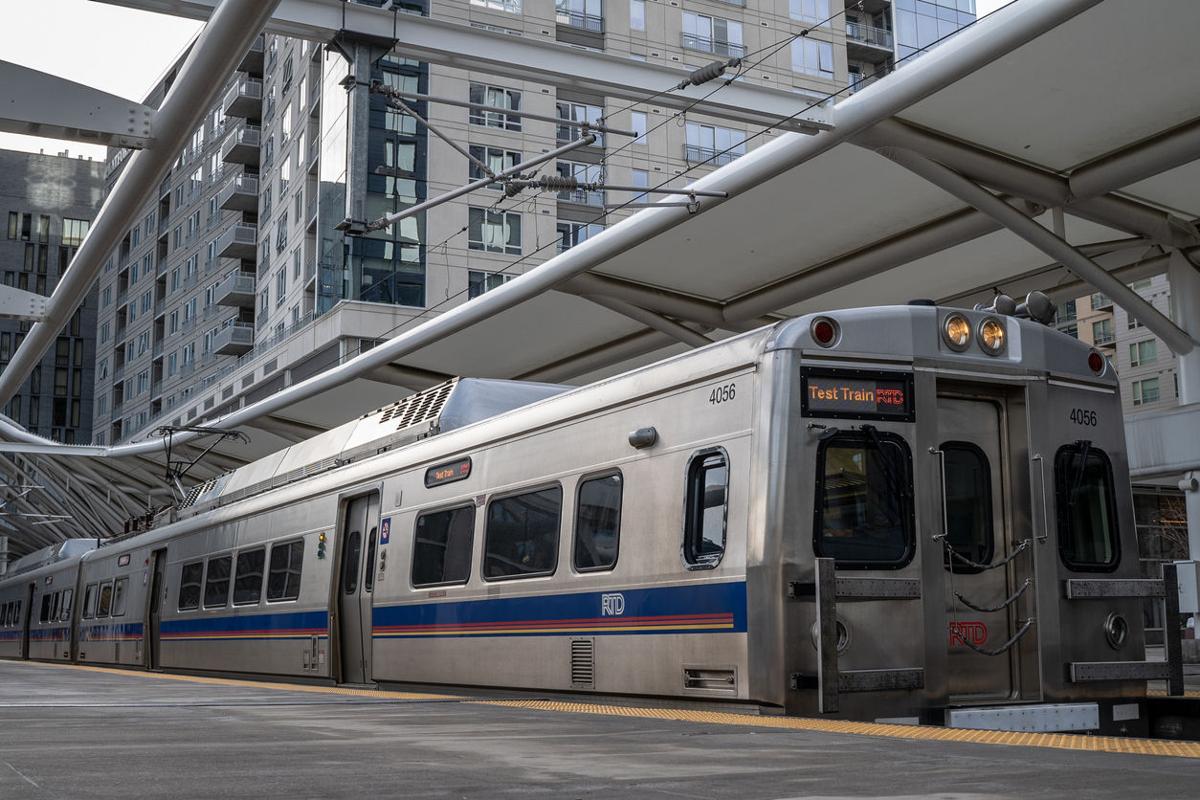
Metro Denver's Regional Transportation District test train at Union Station.
(Photo by Jose A Feliciano Cestero, iStock)

Metro Denver’s Regional Transportation District test train at Union Station.
Denver Transit Partners appealed, insisting the regulators’ problem with excessive activation times of the grade crossing equipment forced the company to address a “maximum warning time,” which was never a requirement in the first place.
During oral arguments before the appellate panel, Judge Neeti V. Pawar observed the regulators’ problem was actually with the grade crossing equipment’s deviation from its design.
“I guess I want to clarify that when you’re talking about a maximum warning time, you’re talking about the significant difference between what the plan or the design indicated versus how it was running,” she said. “Is your client’s position that the system has always — always — been functioning in accordance with its design?”
Since the commuter lines entered revenue service, “it has always provided the minimum warning times supplied by the regulation,” responded Denver Transit Partners’ attorney, Sean Connelly.
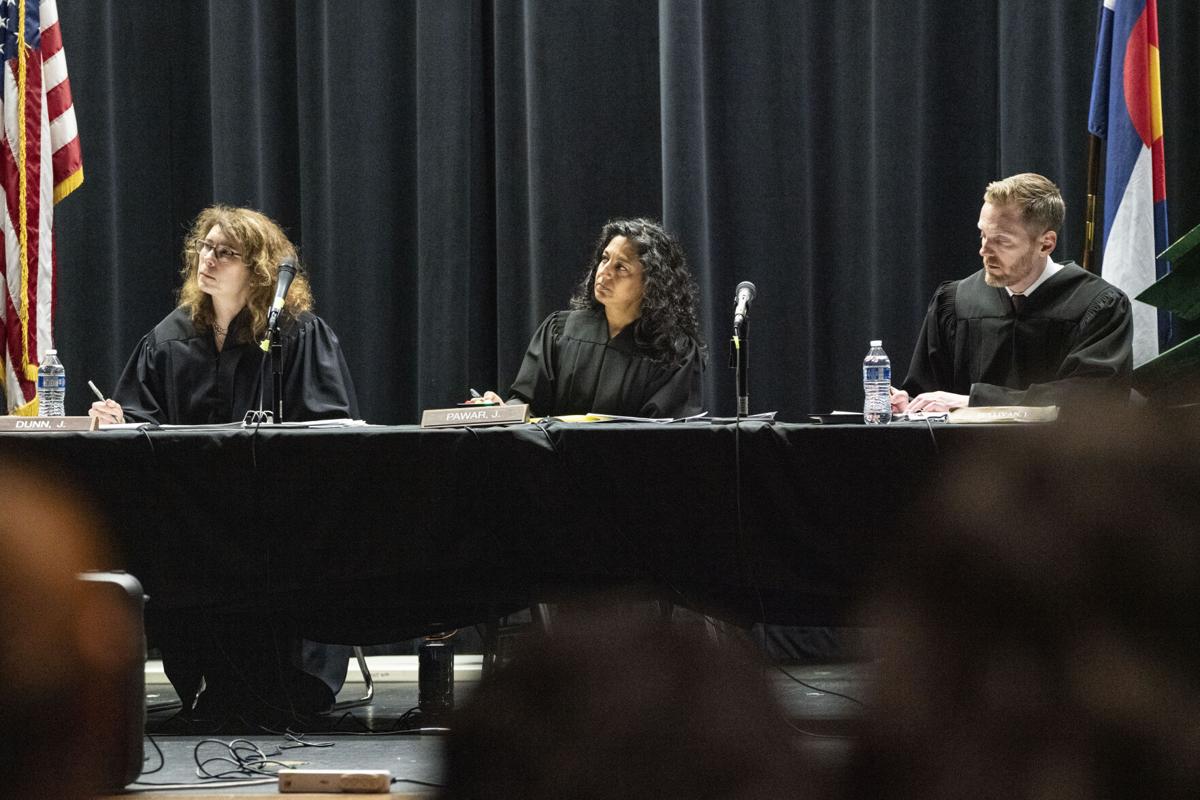
Colorado Court of Appeals Judges Stephanie Dunn, Neeti V. Pawar and Grant T. Sullivan listen to the case of Strange v. GA HC Reit Liberty CRCC, LCC at Fort Lupton High School on Tuesday, April 2, 2024 in Fort Lupton, Colorado. The Colorado Court of Appeals and Supreme Court hold "Courts in the Community" events for students to learn about the justice system and hear real cases. (Rebecca Slezak For The Denver Gazette)
Rebecca Slezak

Colorado Court of Appeals Judges Stephanie Dunn, Neeti V. Pawar and Grant T. Sullivan listen to the case of Strange v. GA HC Reit Liberty CRCC, LCC at Fort Lupton High School on Tuesday, April 2, 2024 in Fort Lupton, Colorado. The Colorado Court of Appeals and Supreme Court hold “Courts in the Community” events for students to learn about the justice system and hear real cases. (Rebecca Slezak For The Denver Gazette)
RTD pointed out that the regulations and the project contract did not simply require 20-second minimum activation of the warning system, but for the system to function correctly as a whole.
Based on Denver Transit Partners’ argument, “the gates could stay down in an urban environment for 20 minutes, an hour, two hours. Yet, according to DTP, the system would be activating in accordance with its design,” said attorney Steven J. Wells.
The appellate panel sided against Denver Transit Partners, agreeing regulators were concerned with the functionality of the system as designed, not on a new “maximum warning time” metric.
“Because the evidence supports these findings, we reject Denver Transit’s arguments that the district court erred,” wrote Dunn.
“The decision issued by the Colorado Court of Appeals affirms the Regional Transportation District’s longstanding conviction that Denver Transit Partners is responsible for the costs associated with its initial failure to deliver a system consistent with federal and state standards, as promised,” RTD said in a statement.
Through its attorneys, Denver Transit Partners declined to comment.
The case is Denver Transit Partners, LLC v. Regional Transportation District.

Federal judge hears arguments about Colorado’s 3-day gun purchase waiting period
Michael Karlik
michael.karlik@coloradopolitics.com
Updated 9 hours ago
A federal judge heard arguments on Monday about the constitutionality of a 2023 Colorado law that generally imposes a three-day waiting period on firearm purchases after the initiation of a background check. The test that the U.S. Supreme Court created...
Colorado Supreme Court intervenes in Weld County prosecution dismissed due to Missy Woods misconduct
Michael Karlik
michael.karlik@coloradopolitics.com
Updated 12 hours ago
The Colorado Supreme Court ordered a Weld County trial judge last week to respond to the district attorney’s claim that he improperly dismissed a criminal case because of “outrageous” conduct by the Colorado Bureau of Investigation. Daniel Lee Eatinger stood...
Schoolchildren’s presence at child sex-related trial did not harm Arapahoe County defendant, appeals court says
Michael Karlik
michael.karlik@coloradopolitics.com
Updated 2 days ago
Colorado’s second-highest court decided on Thursday that the presence of a group of schoolchildren on the first day of a child sexual exploitation trial did not violate an Arapahoe County defendant’s constitutional right to a fair trial. Prosecutors charged Jerry...
Appeals court cites week-old Colorado law to reinstate child neglect case at child, father’s request
Michael Karlik
michael.karlik@coloradopolitics.com
Updated 2 days ago
Colorado’s second-highest court invoked a new state law for the first time on Thursday and reinstated a child neglect case that both the child and her father wished to reopen. House Bill 1227 took effect on Aug. 12, reversing a...
Colorado Supreme Court names William Hood as next chief justice
Michael Karlik
michael.karlik@coloradopolitics.com
Updated 3 days ago
The Colorado Supreme Court has selected Justice William W. Hood III to be the next chief justice, the judicial branch announced on Friday. Hood will succeed Chief Justice Monica M. Márquez, who took over the role in July 2024. “I...
Family of slain Lakewood teacher releases statement as murder suspect makes first court appearance
Matt Kyle
matt.kyle@denvergazette.com
Updated 19 hours ago
Patrick Theodore Barnett, the Lakewood man accused of killing his wife, a Jeffco Public Schools art teacher, made his first court appearance Friday morning as his wife’s family looked on. The status conference hearing was held before District Court Judge...

Appeals court upholds Park County trophy hunting conviction
Michael Karlik
michael.karlik@coloradopolitics.com
Updated 3 days ago
Colorado’s second-highest court clarified on Thursday that a defendant may stand convicted under the state’s trophy hunting laws if he abandons a bear carcass but returns later to remove the meat. Under Colorado law, it is a felony to detach...
Judge grants partial injunction to GEO in fight against state health inspection law
Kyla Pearce
kyla.pearce@gazette.com
Updated 4 days ago
A judge ruled Thursday that The GEO Group does not have to follow parts of a new state law requiring more frequent health and safety inspections at the U.S. Immigration and Customs Enforcement processing center in Aurora. Under the order...

Parker man faces 20 years to life for serial sexual assaults
Nicholas Fogleman
nicholas.fogleman@denvergazette.com
Updated 5 days ago
A 25-year-old Parker man who sexually assaulted three women in 2025 pleaded guilty Wednesday and will serve 20 years to life in prison. Javier Rodriguez-Andrade pleaded guilty to charges stemming from three sexual assaults involving women ages 19 to 24. ...
Divided appeals court upholds warrantless DNA collection in Colorado cold case, cautions of government overreach
Michael Karlik
michael.karlik@coloradopolitics.com
Updated 5 days ago
Colorado’s second-highest court upheld the warrantless collection of a suspect’s DNA from a discarded soda can as constitutional on Thursday, while warning about potential abuse of DNA privacy in the absence of further guardrails. By 2-1, a three-judge Court of...