

Colorado lawmakers OK measures on concealed carry, gun licensing and liability
On the eve of the 25th anniversary of the mass shooting at Columbine High School, Colorado lawmakers in both the House and Senate spent Friday debating five bills that deal with guns.
The biggest one — a House bill to ban so-called “assault weapons” — is now awaiting its first Senate hearing.
In the House, the day started with time limitations on debate imposed by the majority Democrats on three measures.
House Bill 1270 would require gun owners to obtain liability insurance and insurance companies to offer homeowner or renter insurance that covers a firearm’s owner in the event of an accidental discharge.
The bill was watered down by Democrats Friday to provide a list of “affirmative” defenses someone could use if they do not obtain the insurance, such as when denied coverage by two or more insurers; when they can’t afford it; when they already own a gun safe or other safe storage container for firearms; or when they are “likely to behave prudently and safely in the storage, carrying and use of a firearm.”
The measure, as amended, also said insurance companies could not seek the serial number or “other information” about the firearm.
Republicans sought amendments to reduce the fine for failure to obtain liability insurance and to add a petition clause that would allow citizens to submit a ballot measure. Given that the deadline for submitting new ballot measures was March 22, the petition clause is the last remaining pathway forward to a ballot challenge in November.
The bill could come up for a final vote as soon as Saturday and head to the state Senate if it won approval in the House.
Meanwhile, House Bill 1353 would require firearms dealers to obtain a state license in addition to federal licenses.
The bill was heavily amended in three committee hearings to respond to concerns by business owners, according to co-sponsor Rep. Emily Sirota, D-Denver.
She said the bill would impact 1,560 out of 2,258 federally-licensed firearms dealers in Colorado.
The bill authorizes the state to vet anyone who applies to be a dealer, allows for random inspection of dealers to ensure compliance, and requires dealers to undergo training to spot fraudulent activity, including background checks for dealers and employees, as well as a requirement to keep firearms secured.
Sirota said there are five incidents per day, in which firearms go missing due to robbery, burglary, larceny or other loss and wind up in the illegal market. She claimed that oversight from the Bureau of Alcohol, Tobacco and Firearms, which is understaffed, is insufficient.
The bill, which won preliminary approval, could be up for a final vote as soon as Saturday. It, too, would then head to the Senate.
Another measure, House Bill 1349, would impose an excise tax on firearms and ammunition purchases. Given that it’s a new tax, the bill would require voter approval. As of press time, the House was still debating the measure and adding amendments.
In the Senate, lawmakers debated House Bill 1348, which requires safe storage of a firearm in a motor vehicle, and House Bill 1174, which deals with expanded training and requirements to get a concealed weapons permit.
In committee, the measure was amended to require the storage unit to be locked and permanently affixed inside the vehicle or located in the vehicle’s locked trunk or locked glove box.
In the Senate, the bill was amended to make it a Class 1 misdemeanor — the highest level — if a firearm valued at $2,000 or less is stolen from a motor vehicle.
HB 1348 won preliminary approval on Friday and will be up for a final vote likely on Monday. It would then need to go back to the House for review of the Senate amendments.
House Bill 1174 was not amended in its trip through the Senate.
Currently, a person can obtain a permit from the local sheriff after completing a firearms training course, which includes “live-fire” exercises for 20 rounds, and submitting an ID and fingerprints and a background check. The permit is good for five years.
Under HB 1174, for first time permits, the applicant must take an 8-hour, in-person course, with a “live-fire” shooting exercise of 50 rounds. The course must also include instruction on safe storage, information on state and federal laws on how to report stolen weapons, use of deadly force and self-defense, and conflict resolution.
A student must achieve a minimum score of 75% on the live-fire exercise and a passing score of at least 80 on the written exam.
The bill won preliminary approval Friday and is likely to be up for its final vote on Monday. If it won approval, it heads to the governor’s desk.
The conversation around the last major firearm bill — the ban on so-called “assault” weapons — shifted when House Bill 1292 was assigned to the Senate State, Veterans and Military Affairs Committee.
The committee is one of two where the measure could have been assigned, with the other the Senate Judiciary Committee, where focus would have been on the vote by Sen. Dylan Roberts, D-Summit County, who has expressed misgivings about the measure.
Now that it’s in the state affairs committee, the focus is likely to be on Sen. Tom Sullivan, D-Centennial, who has also expressed skepticism about a ban, despite his advocacy for stricter gun control laws.
Sullivan, the father of a son murdered in the Aurora Theater shooting in 2012, has twice sponsored the state’s “red flag” laws, a law to ban the carrying of firearms at polling places, and the law setting up the state’s office of gun violence prevention.
The lawmaker has expressed skepticism at banning “assault weapons” as an antidote, and so does Gov. Jared Polis, believing the issue should be dealt with by Congress.

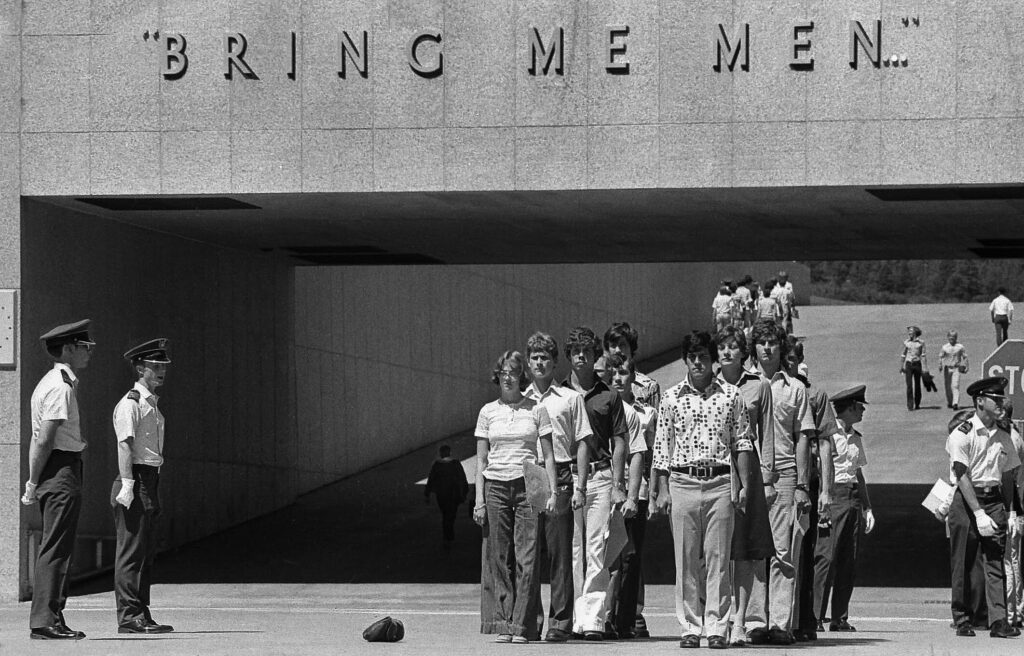
Fifty years later, women reflect on first coed class at the Air Force Academy, struggle for equality
Mary Shinn
mary-shinn@coloradopolitics.com
Updated 1 day ago
When the first female Air Force Academy cadets arrived 50 years ago this summer, they stood in front of an enormous sign on campus that read “Bring me men.” In the shadow of that sign, Kathleen Utley Kornahrens, one of...

As Lake Powell shrinks, marinas are having to adapt to dwindling water levels | OUT WEST ROUNDUP
The Associated Press
the-associated-press@coloradopolitics.com
Updated 4 days ago
ARIZONA Reservoirs near record lows PAGE — The Colorado River’s Lake Powell, the second largest reservoir in the U.S., is shrinking. A record-dry winter and extreme heat — as well as decades of overuse, chronic drought and climate change —...

A new day? Colorado’s troubled guardianship office pursues ‘cultural reset’
Marianne Goodland
marianne.goodland@coloradopolitics.com
Updated 3 days ago
Colorado’s guardianship program, long criticized for mismanagement and high staff attrition, is undergoing a “cultural reset,” as its new director works to repair partnerships and prepare for a major expansion under recent legislation. Created by lawmakers in 2017, the Office...
U.S. Senate OKs funding bill to avoid government shutdown
Wire Services
wire-services@coloradopolitics.com
Updated 1 day ago
Hemp provision became point of contention WASHINGTON • The U.S. Senate in an overnight vote Saturday approved a short-term measure to fund federal agencies into early December and avoid a government shutdown during the middle of campaign season. The late-summer...

The relevance of Watergate more than a half-century later | SONDERMANN
By Eric Sondermann
by-eric-sondermann@coloradopolitics.com
Updated 4 days ago
It was the scandal for which all other scandals are now named. In June 1972, a small group of Cuban burglars with high-level connections broke into the headquarters of the Democratic National Committee. Those headquarters were located in the Watergate...

Wirth downplays Social Security disaster talk | A LOOK BACK
Rachael Wright, Special to Colorado Politics
rachael.wright@coloradopolitics.com
Updated 3 days ago
Forty-five years ago this week: “As time goes on,” said Democratic U.S. Rep. Tim Wirth, of the 2nd Congressional District, “we are finding that the safety net, which was proposed earlier this year, has some very large holes in it,”...

Colorado Politics Calendar Aug. 10-16
Rachael Wright, Special to Colorado Politics
rachael.wright@coloradopolitics.com
Updated 3 days ago
CoPo’s weekly political calendar will help you find political and public-policy events throughout Colorado. It includes candidate and issue campaign events, public policy meetings, court hearings, state and local party conventions, assemblies, debates, rallies, parades, speaking engagements, traveling dignitary appearances,...

Democratic group aims Spanish-language TV ad at Gabe Evans in Colorado’s battleground 8th CD
Ernest Luning
ernest.luning@coloradopolitics.com
Updated 2 days ago
A national group tied to House Democratic leadership launched a six-figure Spanish-language TV ad in Colorado this week targeting Republican U.S. Rep. Gabe Evans and the GOP’s signature budget legislation. The 30-second spot is part of $15 million in new...
Colorado School of Mines lands major share in Trump’s $100M mining-education plan
Thelma Grimes
thelma.grimes@coloradopolitics.com
Updated 2 days ago
President Donald Trump on Friday named the Colorado School of Mines among roughly a dozen institutions that will share in a $100 million commitment “to train the next generation of American miners.” Paul Johnson, the university’s president, said he is...

Local party leaders, incoming judge among members of judicial performance commission that violated law
Michael Karlik
michael.karlik@coloradopolitics.com
Updated 1 day ago
A local Democratic leader and 2024 presidential elector. A legislative aide and leader in the Young Republicans. An incoming county court judge freshly appointed by the governor. They are among the eight members of the northeastern Colorado judicial performance commission...