

Disruptions, protests plague council meetings in metro Denver
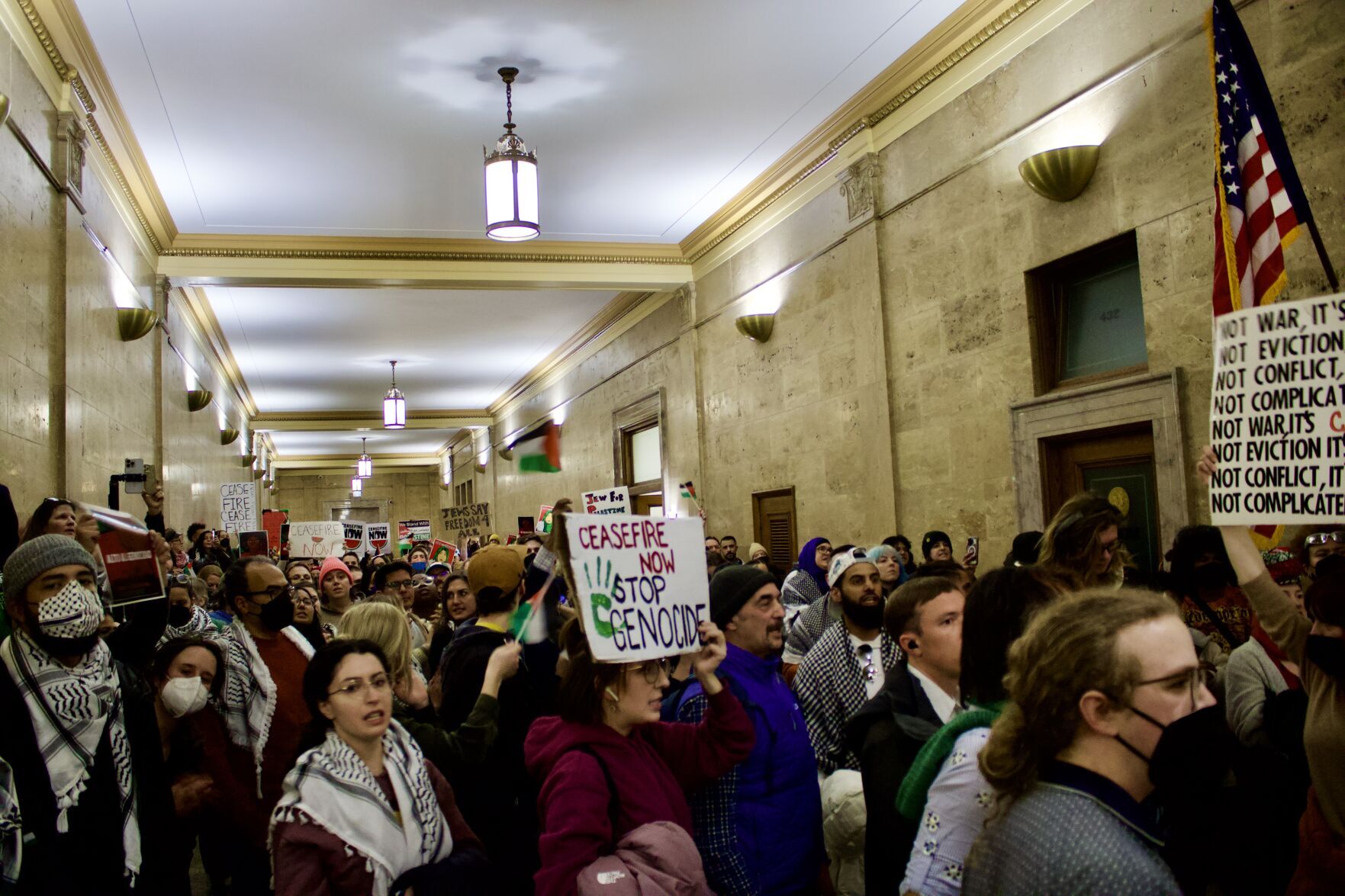
Disruptions have plagued the Denver City Council in the last several months, forcing it to go into recess or shut down proceedings as the meetings devolved into chaos.
In at least one instance, a disruption compelled councilmembers, subjected to incessant yelling by protesters, to vote against the preferred outcome of the protesters.
“By what has happened in chambers today and the lack of respect and the lack of ability to have a civil discourse and conversation, I am going to have to be a no on this one,” District 7 Councilwoman Flor Alvidrez said earlier this month, when she, along with several others, rejected a proclamation calling for a “cease-fire” of the Israel-Hamas war.
Alvidrez later told The Denver Gazette that the council “will not be bullied into submission.”
The disruption on Feb. 12 — over a war half a world away — is becoming a regular occurrence. Discussions of Denver’s most pressing issues have also led to disruptions.
Homeless advocates took over the City Council’s public comment portion of a meeting in October, resulting in an hours-long delay. And in November, pro-Palestinian supporters demanded that the body condemn the annual Jewish National Fund conference that took place in Denver.
The high tension act unfolding in Denver is also occurring elsewhere.
Protesters made antisemitic comments during the Lakewood City Council’s public comment period during its regular meeting last Monday, officials said.
“I was horrified to hear the awful and disgusting comments provided during one of our public comment periods,” Lakewood Mayor Wendi Strom said in a statement. “I worked as best I could to curtail this organized effort to disrupt our meeting.”
Lakewood’s meeting, which started at 7 p.m. and went on for six hours, attracted pro-Palestinian demonstrators, many of whom have also showed up at Denver’s meetings.
Protests and counter-protests are a staple of American democracy, and often, the question for administrators of public bodies is whether to intervene or when.
First Amendment attorney Mike Beylkin of Zansberg Law earlier said protests inside the state Capitol, for example, should be allowed so long as they don’t interfere with the orderly conduct of legislative proceedings.
Beylkin made a distinction between more benign forms of protests, such as the carrying of signs, and “large scale” protests that might be “beyond the rules of decorum.”
“Carrying signs or wearing slogans as a form of protest should be permitted so long as it does not actually interfere with the proper functioning of the government proceedings,” Beylkin told Colorado Politics last month.
Beylkin also made a distinction between protests inside a government building, where rules of decorum typically apply, and activities that occur outside in public spaces or on streets, where protesting is a “traditional public right.”
He said the size of a protest matters. If the protest is intended to be “large scale,” Beylkin said they may be beyond decorum rules and therefore prohibited inside a government building. The lawyer said for protests outside, the government may only impose “reasonable, content-neutral ‘time, manner and place’ restrictions.”
Beylkin added that protesters who violate the statutes of general application by “engaging in civil disobedience, like disruptive protests or the destruction of property, should reasonably expect to face the sanctions the law may impose for their doing so.”
“The First Amendment has limits, like all other constitutional rights,” Beylkin said. “No one should believe that they have a legal right to interfere with the orderly conduct of government proceedings and to do so without impunity.”
Denver City Council rejects Israel-Hamas war cease-fire proclamation
Protest compels council to go into recess
Pro-Palestinian demonstrators jeered and yelled at Denver’s councilmembers Feb. 12 as they considered a cease-fire proclamation.
The war began on Oct. 7, when Hamas militants crossed Israel’s southern border, killed roughly 1,200 people, mostly civilians, and abducted around 250 people. The Palestinian death toll from the war has surpassed 28,000 people, according to the Hamas-run Health Ministry in Gaza.
The meeting, which was packed, drew more than 100 “cease-fire” supporters and a few dozen opponents of the proclamation.
“What your proclamation calls for is not for peace,” Elliot Fladen, a local resident, said, adding it has “shades” of antisemitism. Meanwhile, Abdullah Elaga, a Palestinian, insisted the resolution’s language is “simple” and “not antisemitic.”
The proclamation, sponsored by District 8 Councilmember Shontel Lewis and at-large Councilmember Sarah Parady, read: “All life is worth protecting and the City of Denver calls on elected officials and residents alike to protect life and stand united against violence.” It also said it “condemns anti-Semitic, anti-Palestinian, anti-Arab, Islamophobic, racist, and xenophobic attacks in our city and across the nation.”
Every time a Denver councilmember tried to speak, the pro-Palestinian crowd heckled.
And when the councilmembers offered reasons for rejecting the proclamation, pro-Palestinian protesters yelled, “Vote her out,” “You support genocide” and “Shame!”
The council’s protocols say when incessant interruptions occur, the policymaking body can recess until order is restored or finish the meeting remotely.
Councilmembers chose the latter, remotely rejoining via Zoom and its broadcasting channel, which was open to the public, and ultimately rejecting the proclamation, 8-4.
Interruptions of the meeting “prevented the council from conducting the people’s business,” a City Council spokesperson said. “Maintaining order, efficiency, and respectful disagreement in carrying out the people’s business falls to all of us.”
Following the council’s vote to reject the proclamation, pro-Palestinian demonstrators took to the hallways, chanting “cease-fire now!” and “free free Palestine!”
Some yelled out with a sign reading, “From the river to the sea, Palestine will be free!”
The river is the Jordan and the sea is the Mediterranean, between which lie Israel and the Palestinian territories. Palestinian activists say it’s a call for peace and equality after 75 years of Israeli statehood and decades-long Israeli military rule over millions of Palestinians. Jews hear a clear demand for Israel’s annihilation.
‘Performative political theater’
Some councilmembers, including those sympathetic to the protesters’ cause, said they did not take the disruptions kindly.
District 3 Councilmember and Council President Jamie Torres, who was one of the four “yes” votes, said, “I vote based on the issue and whether I agree with it, not on the behavior of those who support or oppose it.”
District 2 Councilmember Kevin Flynn said what happened was “completely predictable,” noting it also happened in other cities.
“It was performative political theater in which the Denver City Council was to play the supporting role to a scripted outcome,” said Flynn, adding he didn’t expect the proclamation to pass.
The disruption “was not what democracy looks like, it was what anarchy looks like,” District 9 Councilmember Darrell Watson told The Denver Gazette. “The groups that came to protest did not come to listen or enlighten. They came to force their belief of a need for a cease-fire proclamation and to silence any opposition.”
District 5 Councilmember Amanda Sawyer said disruptions were “really inappropriate” and “extremely traumatic” for new councilmembers.
Sawyer, who represents the largest Jewish community in Denver, later said the most concerning thing about the meeting was “that members of the Jewish community did not feel safe attending and speaking up in opposition to the cease-fire.”
Sawyer said that she was asked to speak at a Jewish Community Relations Council news conference outside the Denver City and County Building before the Feb. 12 meeting. That was canceled, Sawyer said, “because they were afraid there would be a confrontation.”
Sawyer said a committee meeting, which first discussed the proclamation, left her in tears. She said the proposal was “personally hurtful.” Sawyer added she felt “insulted” when the proclamation was filed, saying she has never seen the city — and the council itself — more divided.
Lewis, who sponsored the cease-fire proclamation, maintained there was “constant coordination and conversation to finalize the language for the proclamation.”
Lewis said she and Parady, the other sponsor, “worked hard to incorporate only that which our colleagues asked to see and had multiple conversations with colleagues to address their concerns and needs.”
“Most councilmembers were not supportive of the original proclamation language,” said Torres, the council president.
Torres said that, even with some changes, she “didn’t expect that to move most members.”
District 6 Councilmember Paul Kashmann, who ended up being a “no” vote, said he contacted Colorado’s congressional delegates to consider a permanent “cease-fire” resolution.
“The loss of life in Israel and Gaza is horrific,” Kashmann said. “It has gone from ‘ought to stop’ to ‘must be stopped.’”
But the cease-fire proclamation in front of the council did not “adequately consider elements of a cease-fire that is anywhere near permanent,” Kashmann said.
Kashmann urged residents to reach out to their congressional delegates on the conflict, instead of the City Council weighing in on international affairs.
Flynn noted similar resolutions in other major American cities. The Chicago City Council approved its own call for a cease-fire in a meeting that was delayed over an hour because of pro-Palestinian protests. Meanwhile, San Francisco, Seattle and Minneapolis are among almost 50 other U.S. cities that have called for a “cease-fire.”
Some major cities are calling for a Israel-Hamas war ceasefire; Denver could be next
“In the end, it was clear there was an anti-Israel undercurrent to this and the entire nationally organized efforts to get cities to pass these proclamations,” Flynn said.
Alvidrez, a new councilmember, said council meetings are supposed to be the place where “everyone across the city can come and talk about the issues they are facing, in dignity and safely.”
“However, that is not the reality I have witnessed with my time on council,” she said.
Each time a council meeting disruption occurs, Watson added, “the vitriol is increased, and the threats are more direct and personal.”
Polis urges Coloradans to stand behind Israel as pro-Palestinian protesters bang on windows
The Associated Press and reporter Marissa Ventrelli contributed to this article.

Blue states should avoid disasters | Hal Bidlack
Hal Bidlack
hal-bidlack@coloradopolitics.com
Updated 8 hours ago
Back when I was teaching political science at the U.S. Air Force Academy (and amazingly to me, a week from this column’s publication will mark 20 years since my retirement from active duty. Where the heck did that time go?)...
Right-to-hunt ballot measure’s a cruel, anti-wildlife solution to a nonexistent problem | GUEST COLUMN
Colorado Politics
colorado-politics@coloradopolitics.com
Updated 8 hours ago
By Eric Washburn I love to hunt. Every year I try to hunt big game in Colorado and waterfowl in Louisiana. This year, I applied for five Colorado big game licenses — elk, deer, pronghorn, moose and bighorn sheep. I...
Federal judge hears arguments about Colorado’s 3-day gun purchase waiting period
Michael Karlik
michael.karlik@coloradopolitics.com
Updated 9 hours ago
A federal judge heard arguments on Monday about the constitutionality of a 2023 Colorado law that generally imposes a three-day waiting period on firearm purchases after the initiation of a background check. The test that the U.S. Supreme Court created...

U.S. Supreme Court clears way for Trump mail voting order in advance of midterms
Wire Services
wire-services@coloradopolitics.com
Updated 13 hours ago
WASHINGTON • The U.S. Supreme Court on Monday cleared the way for President Donald Trump to move ahead with an executive order that seeks to restrict the mailing of ballots to American citizens in an eligible voters list. The executive...
Colorado Supreme Court intervenes in Weld County prosecution dismissed due to Missy Woods misconduct
Michael Karlik
michael.karlik@coloradopolitics.com
Updated 13 hours ago
The Colorado Supreme Court ordered a Weld County trial judge last week to respond to the district attorney’s claim that he improperly dismissed a criminal case because of “outrageous” conduct by the Colorado Bureau of Investigation. Daniel Lee Eatinger stood...
Trump opens ‘economic D-Day’ offensive against Iran as war nears six-month mark
Christian Datoc
christian-datoc@coloradopolitics.com
Updated 18 hours ago
President Donald Trump is seeking to increase the financial pressure on Iran with new secondary sanctions on nations and foreign actors propping up the regime’s economy as the war between the United States and Tehran nears the six-month mark. Treasury...

Trump announces 50% tariffs on Canadian cars, auto parts, and steel
Naomi Lim
naomi-lim@coloradopolitics.com
Updated 18 hours ago
President Donald Trump escalated the trade war with Canada after talks collapsed last week, announcing Monday that the United States would impose 50% tariffs on cars, trucks, automotive components, and steel starting Jan. 1, 2027. “Canada has been ripping off...

Iran puts out propaganda video tracking Barron Trump’s location, offering $10 million for his assassination
Timothy Nerozzi
timothy-nerozzi@coloradopolitics.com
Updated 19 hours ago
The Islamic Revolutionary Guard Corps is putting a hit out on President Donald Trump’s son, Barron Trump, with an inflammatory video claiming to track his location. State-run television in Iran is broadcasting a propaganda video claiming to show the locations...
Nevada sues Trump administration over Colorado River cuts
Marianne Goodland
marianne.goodland@coloradopolitics.com
Updated 11 hours ago
On Monday, the state of Nevada filed a lawsuit against the Trump administration and Interior Secretary Doug Burgum, seeking to block the Colorado River management plan. On Friday, Burgum released a “record of decision” that would reduce water allocations to...

Healthcare Freefall: Longer drives, fewer options for maternity care in Colorado
Thelma Grimes
thelma.grimes@coloradopolitics.com
Updated 21 hours ago
Editor’s Note: Colorado’s healthcare system is entering a period of accelerating instability — a “tsunami,” as multiple leaders describe it — driven by collapsing hospital finances, shrinking Medicaid reimbursements, disappearing services and a political fight over who is responsible for...