

Recent severe weather makes ag matters difficult | GABEL
It’s fair to say agriculture producers are rarely happy with the weather. After several years of devastating drought, producers in the state slogged through a tremendously wet and miserable winter, a strangely cool and wet spring, and now a summer filled with record rainfall and punctuated by severe weather.
In my area, northeastern Colorado, many crops are behind, including winter wheat, alfalfa and barley. In the weekly crop progress report released by the U.S. Department of Agriculture, the food and agriculture harvest continued to significantly trail the 5-year average pace with 88% of first cutting and 5% of second cutting harvested. Dry edible bean emergence is nearing the end, with 93% of the crop emerged, behind both the previous year and 5-year average.
In the San Luis Valley, potato emergence, at 97% complete, made substantial progress last week, but continued behind the 5-year average pace of 99%. Planting of the proso millet crop sustained a slower than average pace, with 84% of the acreage planted, behind the 5-year average of 98%.
Stay up to speed: Sign-up for daily opinion in your inbox Monday-Friday
Winter wheat harvest began last week, significantly trailing the previous year of 25% and 5-year average of 32%. Statewide, 59% of the winter wheat crop was reported in good to excellent condition, compared with 56% last week, 16% last year and a 5-year average of 44%. Condition ratings in east central Colorado, where the largest portion of the winter wheat crop is produced, were mostly fair to good.
The wheat field visible from my desk is ready to cut, but the ground is saturated and though it’s not muddy, it is soft enough that combines and heavy grain carts and trucks will become stuck, leaving nasty ruts and causing long days for producers. Conversely, the dryland corn field just west of our house is thriving. Corn seed is incredibly expensive and planting dryland corn in this area is a significant gamble, though it’s one that paid off for this particular farmer.
We farm only to produce cow chow, and we chopped triticale for haylage with very high yields for dryland fields. Triticale is a cousin of wheat, and it is chopped, packed and stored in a concrete pit. It ferments and we will feed it as part of our cattle ration this winter. Prior to baling some of the triticale, our hay yard was bare from prior years during which we never stopped feeding cattle because the pastures couldn’t support the grazing due to drought.
Just to the east, there is a field that produced an excellent crop of alfalfa earlier in the spring. Alfalfa is typically cut and baled multiple times through the year, and it is an excellent source of protein in livestock rations. When one of the many hailstorms rolled through the area, the alfalfa was beaten so badly, the producer farming it tore it out and planted corn. Several weeks later, the stand of corn looked promising, like Plan B worked out. Hail destroyed that crop as well. I drove by last week and I couldn’t tell what was planted in the field, but the marks from a grain drill are proof positive that farmers are eternal optimists.
Sugar beets, alfalfa, pastures, corn and wheat further into northeastern Colorado have been destroyed by hail and there have been a significant number of acres destroyed by standing water for weeks on end. One farmer in Logan County had enough standing water in a cattle pasture that there was pontoon boating there over the Fourth of July holiday. The family wasn’t making light of the situation – it has cost them valuable grass, an alfalfa crop, miles of destroyed fence at $10,000 per mile – but the weather is so far outside their control that sometimes a beer and a boat is the last best thing to do.
Though the entire state is designated as drought-free for the first time since 2019, there are certainly areas that could benefit from rainfall. The southwest and northwest portions of the state would happily take some of the rain northeastern Colorado has received, though I imagine they would turn down the hail.
Agriculture is strange because it is an incredibly important industry but its success rests outside of the control of the people with dirt on their boots. Paul Harvey, a legendary radio newsman and agriculture advocate, was correct when he said, “Despite all our accomplishments, we owe our existence to a six-inch layer of topsoil and the fact it rains.”
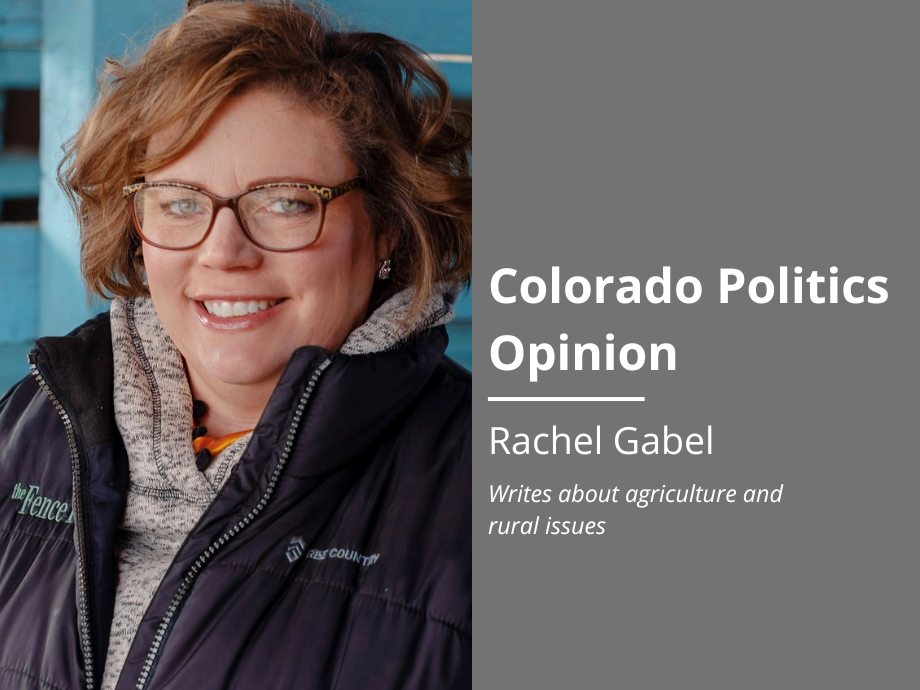
Rachel Gabel writes about agriculture and rural issues. She is assistant editor of The Fence Post Magazine, the region’s preeminent agriculture publication. Gabel is a daughter of the state’s oil and gas industry and a member of one of the state’s 12,000 cattle-raising families, and she has authored children’s books used in hundreds of classrooms to teach students about agriculture.

Colorado must continue finding common ground on wildfire policy | GUEST COLUMN
Colorado Politics
colorado-politics@coloradopolitics.com
Updated 1 day ago
By John Herrick Colorado has never lacked for opinions about wildfire policy. We debate forest management, climate change, prescribed burns, land use, air quality and budgets. Those debates are familiar territory, but a new discussion is beginning to happen around...

Proposition NN is the best investment for Colorado’s students and schools | GUEST COLUMN
Colorado Politics
colorado-politics@coloradopolitics.com
Updated 1 day ago
By Justin Ogden Colorado families know what it means to make difficult budget decisions. Inflation has driven up the cost of groceries, housing, utilities and just about everything else. Families like mine work hard to stretch every dollar while still...
Were the primaries a preview for consequential general election? | Paula Noonan
Paula Noonan
paula-noonan@coloradopolitics.com
Updated 2 days ago
Colorado’s political future will go the way of this election. Historically, the state has not had both chambers controlled by a supermajority. This election may change that. The primaries suggest how the general election may play out. Democrats had solid...

Disagreement doesn’t have to mean disrespect | GUEST COLUMN
Colorado Politics
colorado-politics@coloradopolitics.com
Updated 2 days ago
By Vincent Atchity These days, it doesn’t take long to feel overwhelmed by politics. Turn on the news, scroll through social media or read the comments on almost any political post and you’ll find anger, outrage and personal attacks. For...

Keeping Colorado’s kids’ trust online | PODIUM
Colorado Politics
colorado-politics@coloradopolitics.com
Updated 3 days ago
By Stuart Jenkins Almost every day, the kids and teens we serve across Colorado are introduced to new generative artificial intelligence and other emerging technology, including conversational AI systems designed to simulate human conversation. These tools are no longer a...

Marx’s ‘through line’ predates Trump, connects to Maes | FEEDBACK
Colorado Politics
colorado-politics@coloradopolitics.com
Updated 3 days ago
Eric Sondermann is of course correct Victor Marx is an unserious, unelectable, embarrassing Republican nominee for governor of Colorado. But I respectfully submit that the “through line,” as Mr. Sondermann describes it, is not from Trump to Marx, despite their...

Cedric Pride’s blueprint for opportunity through the trades | The OpEdge Podcast
Tony Olivero
tony.olivero@gazette.com
Updated 3 days ago
Cedric Pride, CEO of the nonprofit Pride Initiative in Denver, joins The OpEdge with a blueprint for workforce development, skilled trades, and economic opportunity. Pride tells host and investigative columnist Jimmy Sengenberger why he believes the trades offer a path...

Colorado’s No. 1 education ranking should raise our ambition | GUEST COLUMN
Colorado Politics
colorado-politics@coloradopolitics.com
Updated 3 days ago
By Scott Laband Colorado has earned the right to celebrate its new No. 1 ranking in education from U.S. News & World Report. Gov. Jared Polis called it “one of the proudest moments” of his time in office and shared the...

Colorado’s No. 1 education ranking reflects the power of school choice | GUEST COLUMN
Colorado Politics
colorado-politics@coloradopolitics.com
Updated 4 days ago
By Peter Mason Colorado is now the No. 1 state in the nation for education, according to the 2026 U.S. News & World Report Best States rankings. That is a distinction worth celebrating. It is also a distinction worth understanding....
Courageous Colorado bucks Trump’s federal stupidity | Miller Hudson
Miller Hudson
miller-hudson@coloradopolitics.com
Updated 4 days ago
There are several theories regarding the rhythm of American politics. The most frequently cited is the pendulum hypothesis — positing that episodes of liberal dominance are then interrupted by spans of conservative control. Since Ronald Reagan’s presidential election in 1980,...
PREV
PREVIOUS

State commission does Don Polis's dirty work | CALDARA
Jon Caldara Gov. Jared Polis has his own secret police. They create their own laws without the approval or even review of any of our directly elected representatives. We must live by their edicts or be punished as they see fit. The governor has sole tyrannical authority to appoint his secret police, just like Stalin. […]
Johnston's plate full as Denver mayoralty commences | HUDSON
Miller Hudson It’s not uncommon for newly elected Colorado executives – mayors and governors – to organize pre-inaugural hearings intended to measure public opinion regarding the challenges they expect to face. For that purpose, Mike Johnston’s 28 public forums are not unusual. Their breadth, scope and number are surprising, however. The good news is they were even […]