

Challenges to vaccine policy at CU medical campus narrowed

A federal judge has taken a sprawling lawsuit from 17 anonymous staff and students at the University of Colorado’s Anschutz Medical Campus and pared down the number of legal claims that may go forward challenging the school’s COVID-19 vaccination policy.
U.S. District Court Judge Raymond P. Moore previously declined to block the medical campus’ vaccine mandate, indicating it did not appear to burden the plaintiffs’ religious exercise in an unconstitutional manner. Now, Moore has again reiterated the university acted reasonably by requiring COVID-19 vaccinations, but nevertheless permitted some plaintiffs’ allegations to proceed against only some CU defendants.
Specifically, Moore determined the claims of three plaintiffs were moot: a female faculty member who resigned, a male student who withdrew, and a female student who ultimately received the COVID-19 vaccine. He also fully dismissed the plaintiffs’ “novel legal theory” that the school treated unvaccinated people as disabled and, therefore, excluding them from the university violated their rights under the Americans with Disabilities Act.
“Plaintiffs do not cite, nor is the Court aware of, any authority that might have placed Defendants on notice that enforcing the vaccination policies could violate Plaintiffs’ rights under the ADA, or that such a claim is viable under the ADA,” Moore wrote in a Sept. 29 order.
The primary allegations of the unnamed staff and students remain intact – that the school’s September 2021 policy for obtaining religious exemptions to vaccination violates the religious freedom provisions of the state and federal constitutions.
The case is in an unusual stage, as Moore has refused to pause the proceedings while the Denver-based federal appeals court reviews his previous rulings denying the plaintiffs a preliminary injunction. The U.S. Court of Appeals for the 10th Circuit heard arguments in late September about that issue. Lawyers for the plaintiffs said a decision from the appellate court could affect Moore’s dismissal order.
At the heart of the litigation is a pair of policies CU Anschutz issued in September amid an increase in COVID-19 infections. According to a Sept. 1 directive, medical staff and students could obtain a faith-based exemption from COVID-19 vaccination if the teachings of their religion “are opposed to all immunizations.” Then on Sept. 24, the school replaced that policy with a new vaccine mandate permitting medical exemptions for staff and students, but religious exemptions only for employees.
Both types of exemptions, pursuant to the latter policy, would only be granted if doing so would not threaten the health and safety of others.
The plaintiffs each applied for a religious exemption, with most of them citing their faith-based opposition to the use of cells derived from aborted fetuses in the development of some COVID-19 vaccines. (The vaccines as produced and administered do not contain aborted fetal cells.) Although the school denied their requests under the Sept. 1 policy, it ultimately granted several accommodations after Sept. 24, allowing the requesters to perform work remotely.
Other plaintiffs, however, resigned or were terminated because their roles required in-person care of immunocompromised or young patients.
The university then sought to dismiss the claims of the plaintiffs who received accommodations, arguing they had obtained the exemptions they wanted in the first place. It also contended the school officials involved with administering the policy were entitled to qualified immunity, which shields government employees from civil liability unless they violate a person’s clearly-established legal rights.
“(T)here was (and remains) no clearly established right to a religious exemption,” wrote attorneys for CU Anschutz. “Neither the Supreme Court nor the Tenth Circuit has held that a public university or other public education institution violates its students’ constitutional rights when it declines to provide religious exemptions to a COVID-19 vaccination requirement.”
The university added that it was not discriminating against people of faith by granting medical exemptions more broadly than religious exemptions, noting that medical exemptions are intended for people who would be physically harmed by the COVID-19 vaccine.
The plaintiffs insisted both September 2021 policies deliberately or effectively discriminated against people who have the “wrong” religious beliefs.
“This timeline reveals Defendants’ actions here as part of a sustained, unapologetic effort to eliminate all religious objectors to COVID vaccination from the Anschutz community, based on a presumptively unconstitutional distrust of their stated religious objections to COVID vaccination,” wrote lawyers for the Thomas More Society, which advocates on behalf of religious causes.
In evaluating the university’s request to dismiss the case, Moore stood by his earlier determination that school officials acted in accordance with the First Amendment in issuing the vaccination policies and, consequently, were entitled to qualified immunity on the plaintiffs’ religious freedom claims.
“Given the unprecedented nature and global scope of the Covid-19 pandemic as well as its devastating impacts, the Court finds the allegations in the Complaint do not establish that these Defendants acted unreasonably,” he wrote. “Therefore, at a minimum, they did not violate Plaintiffs’ clearly established rights.”
The judge did find, however, that six plaintiffs who received accommodations to perform their jobs remotely – including two who had their pay decreased slightly – could benefit from a court decision blocking the Sept. 24 policy. He determined their claims were not moot, contrary to CU’s arguments.
Currently, a three-judge panel of the 10th Circuit is weighing whether to uphold Moore’s prior denial of a preliminary injunction against the vaccination policies. The three members, all appointed by Republican presidents, appeared slightly more sympathetic to the plaintiffs’ claims during oral arguments.
“Burdening an individual constitutional right so you can, in the aggregate, reduce the number of people on campus who have potential for COVID – I’m not sure the Constitution contemplates that,” said Chief Judge Jerome A. Holmes at the time.
The case is Doe et al. v. University of Colorado et al.
Editor’s note: Colorado Politics’ parent company is a subsidiary of the Anschutz Corporation.



10th Circuit upholds federal prohibition on juvenile handgun possession
Michael Karlik
michael.karlik@coloradopolitics.com
Updated 1 hour ago
The Denver-based federal appeals court concluded on Monday that Congress acted within its constitutional powers to make it a crime for juveniles to possess handguns in most instances. The decision from the U.S. Court of Appeals for the 10th Circuit...

Senate advances judicial nominee, Montezuma County judge agrees to discipline | COURT CRAWL
Michael Karlik
michael.karlik@coloradopolitics.com
Updated 5 hours ago
Welcome to Court Crawl, Colorado Politics’ roundup of news from the third branch of government. A U.S. Senate committee advanced a judicial nominee from Colorado, plus a Montezuma County judge agreed to receive discipline for his misconduct that stops short...
Judge denies Calderon injunction case against Denver, Johnston
Deborah Grigsby
deborah.smith@denvergazette.com
Updated 8 hours ago
A U.S. District Court judge has denied a preliminary injunction in the case of Jessica Calderon, the Denver city employee who won a temporary restraining order preventing the City and County of Denver from terminating her amid the 2025 citywide...

10th Circuit partially revives lawsuit over 2020 Denver protest injuries
Michael Karlik
michael.karlik@coloradopolitics.com
Updated 1 day ago
The Colorado-based federal appeals court revived a man’s claims against Denver on Friday after concluding a trial judge resolved the case in the city’s favor without analyzing two of the three instances of alleged excessive force and other constitutional violations....
Federal judges find Colorado immigration judge violated several orders
Michael Karlik
michael.karlik@coloradopolitics.com
Updated 2 days ago
Multiple federal judges in Colorado have freed people from immigration custody after determining that one immigration judge violated their directives for properly conducting bond hearings. For nearly a year, Colorado’s U.S. District Court has faced a flood of habeas corpus petitions...
Misconduct complaints from ex-Colorado judicial discipline director dismissed against federal judges
Michael Karlik
michael.karlik@coloradopolitics.com
Updated 4 days ago
The administrative body for the Denver-based federal appeals court upheld a finding last week that misconduct complaints against Colorado’s chief federal trial judge and the chief appeals judge warranted dismissal and appeared to be a “litigation tactic” by the complaining...
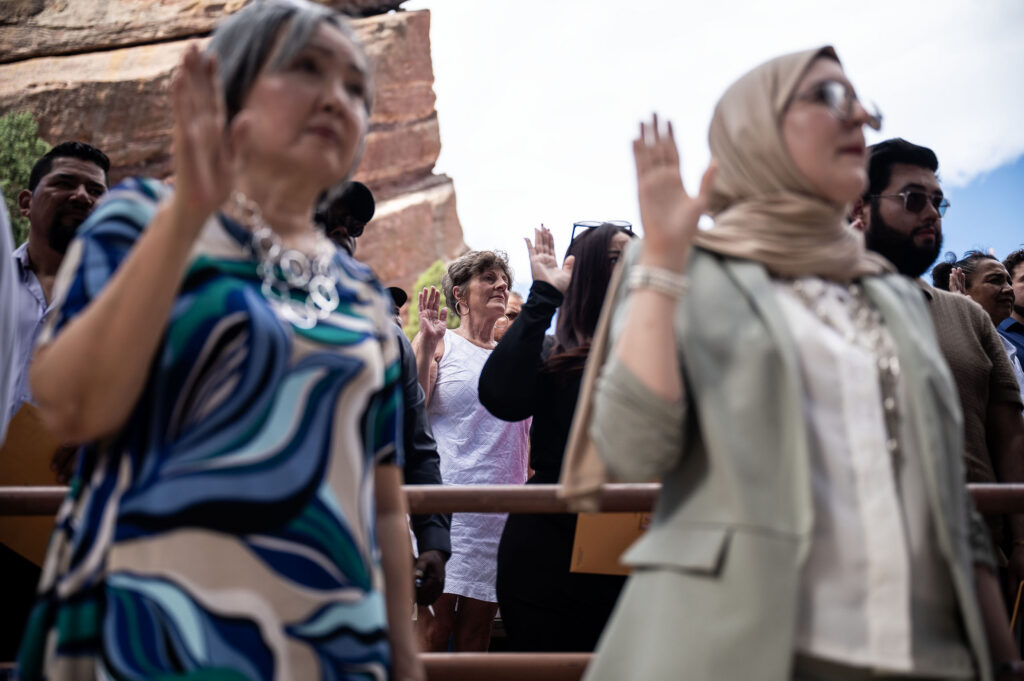
First-ever Red Rocks naturalization ceremony draws most diverse group of new citizens
Michael Karlik
michael.karlik@coloradopolitics.com
Updated 2 days ago
Colorado’s federal trial court held its first-ever naturalization ceremony for nearly 300 new citizens on Thursday at Red Rocks Park and Amphitheatre. “We’re doing it to commemorate the 250th anniversary of the Declaration of Independence and the United States. Red...
Jeffco taxpayers could be on the hook for a possible child sex assault settlement
Matt Kyle
matt.kyle@denvergazette.com
Updated 3 days ago
Taxpayers may end up on the hook for a child sexual assault settlement, possibly worth up to $15 million, after Jeffco Public Schools failed to notify its insurance company in a timely manner about the case. The incident stems from...
10th Circuit finds no fair housing violation by Littleton landlord for worker’s alleged rape of tenant
Michael Karlik
michael.karlik@coloradopolitics.com
Updated 5 hours ago
The Denver-based federal appeals court concluded on Monday that Littleton’s housing authority could not be held liable for a maintenance worker’s alleged rape of a tenant, as the worker’s employment did not provide any special access to the victim. A...

Jeffco Public Schools sues Trump administration to protect funding after alleged transgender policies violation
Matt Kyle
matt.kyle@denvergazette.com
Updated 4 days ago
In the wake of several threats by the Trump administration to revoke federal funding, Jeffco Public Schools filed a lawsuit against the Department of Education seeking to protect that badly needed money. Jeffco has been under investigation by the DOE’s...
PREV
PREVIOUS

Colorado insurance recoveries up 93% due to wildfire claims
The state helped Coloradans recover nearly $20 million in additional insurance payments last year, mostly from catastrophic wildfire claims. A report released Tuesday found that the Colorado Division of Insurance recovered more than $19.6 million from investigating consumer complaints during the 2021-22 fiscal year – an increase of 93% from the previous year. The report […]

Democrat Yadira Caraveo tops $1.5 million for 3rd quarter in Colorado's battleground 8th CD
Democrat Yadira Caraveo plans to report raising more than $1.5 million in the most recent quarter, bringing her total haul to more than $2.6 million since the state representative and Thornton pediatrician launched a bid to represent Colorado’s new 8th Congressional District, her campaign said Tuesday. Caraveo is running against state Sen. Barb Kirkmeyer in […]