

A LOOK BACK | Senator calls for relocation of space capsule to Boulder

Fifty Years Ago This Week: U.S. Sen. John Carroll said that if he had anything to say in the matter, the Aurora 7 space capsule would be turned over to the city of Boulder to become the center attraction of a memorial park created in honor of astronaut Scott Carpenter.
The highly successful OSO-1 orbiting solar observatory was deployed in early 1962 by NASA and was developed in Boulder by the Ball Brothers Research Corporation.
In a letter to James E. Webb, administrator of the National Aeronautics and Space Administration, Carroll wrote that the city of Boulder, “and indeed the entire state – are most anxious to have the Aurora 7 permanently housed in Boulder and made the focal point of the monument. Coloradans are extremely proud of their native son and his spectacular achievement. They demonstrated their admiration and affection in their wildly enthusiastic welcome of the astronaut during his visit to his home state.”
Carroll closed by stating that Boulder had become a vibrant and enterprising center of civilian space activity and would only continue to innovate.
Carpenter, a veteran of the Korean and Cold Wars, was a naval test pilot before he joined NASA to become the second American to orbit the Earth and the fourth American in space. Carpenter piloted the Aurora 7 (originally named Mercury-Atlas 7) on an orbital mission, and, though the craft suffered a series of malfunctions and landed 250 miles away from its intended splashdown point, both he and the Aurora 7 were successfully retrieved.
Thirty-Five Years Ago: Denver Mayor Federico Peña won reelection with a narrow margin of 51% of the vote.
His challenger Don Bain gave a respectful conciliatory speech, urging “…all of you, Peña and Bain supporters alike, to join hands and unite behind our common goal, our wonderful city of Denver,” but his own supporters were not as sanguine.
Former mayoral candidate and City Auditor Mike Licht did not mince words in his assessment of Peña.
“Peña got his votes out,” Licht said. “He runs a good election campaign, but he doesn’t run a good city. I’m concerned for Denver about the next four years under Peña. He articulates certain things well, but those things don’t happen.”
When asked if he had political plans after leaving the auditor’s office in July, Licht replied, “If I never see another politician again, it’ll be too soon.”
Peña’s campaign manager, Tom Mussbaum, said he was relieved to finally be able to admit that he had been worried about the outcome.
“I was scared it would be very close,” Mussbaum told reporters, referencing nerve-racking numbers in the polls. “I’m always optimistic, but I thought it would be very close. But it’s the mayor and his character that won out. It’s due to the qualities that the mayor has. People have seen him to be a hard-working, honest man.”
Peña urged his supporters to, “…unite our city, let’s work together. Let’s join hands, pull together for the benefit of Denver. We have a common goal, and that’s our city. Let’s keep Denver a great city, and make it an even better city.”
“This city was going nowhere when the mayor was elected in 1983,” Nussbaum told The Colorado Statesman, “it was directionless and no one paid any attention to the way in which the city government was run. Things will definitely change” because Peña “…has four years under his belt and I do think … he will look around, he will make decisions about staffing, he will listen.”
Although there were rumors swirling that Don Bain might become involved in city management, Bain told The Statesman, “We never know what the future holds for us. When historians analyze the Bain campaign, they will say: Don Bain loved his city, respected his fellow man, he worked hard and gave it his all.”
Rachael Wright is the author of the Captain Savva Mystery series, with degrees in Political Science and History from Colorado Mesa University and is a contributing writer to Colorado Politics and The Gazette.

Colorado measure redirects sales tax revenue from sporting goods, equipment to conservation programs
The Denver Gazette
the-denver-gazette@coloradopolitics.com
Updated 13 hours ago
A proposal to redirect sales tax revenues from sporting goods and equipment toward wildfire and conservation programs will appear on the ballot this November, election officials in Colorado confirmed. The measure, if approved by voters, would reduce the amount available...
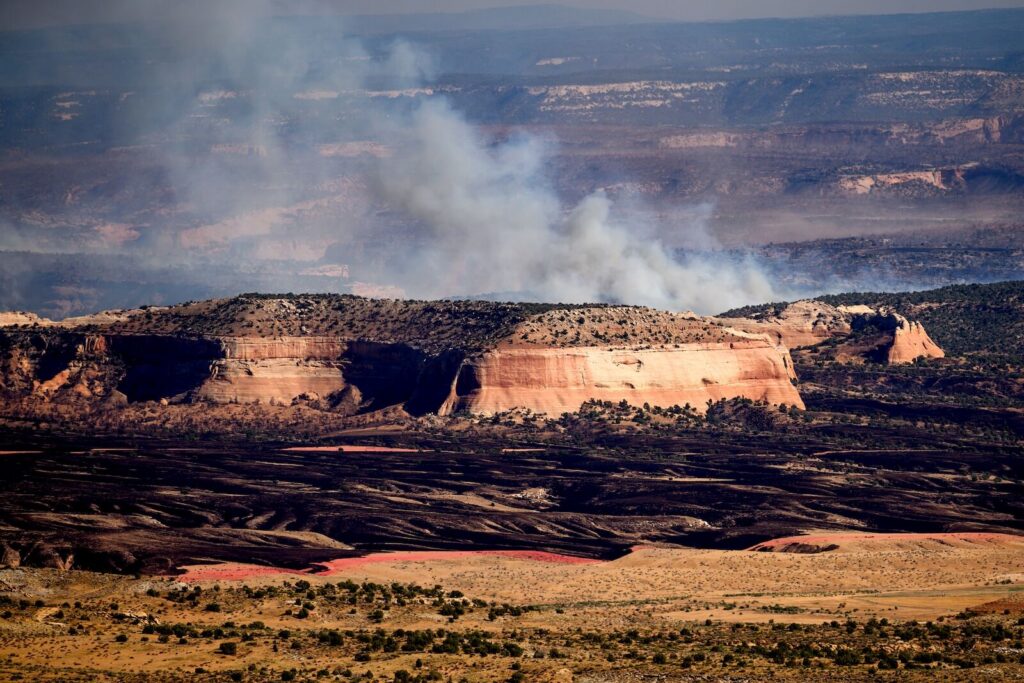
Firefighters’ deaths prompt debate over 100% suppression wildfire strategy
Rachael Wright, Special to Colorado Politics
rachael.wright@coloradopolitics.com
Updated 10 hours ago
On July 22, 2026, the chief of the U.S. Forest Service testified before a House Agriculture subcommittee that his agency pursues a “full suppression” strategy to contain all fires while they are still small, rather than allowing them to burn...

A summertime all-you-can-eat political buffet | SONDERMANN
Eric Sondermann
eric-sondermann@coloradopolitics.com
Updated 5 days ago
We find ourselves in the doldrums of August with a complete dearth of political news. Yeah, right. These days, that train never stops moving. It is a 24/7/365 express amplified by 24/7/365 media. Let me respond with one of my...
GOP worker pleads guilty to campaign funds embezzlement scheme | A LOOK BACK
Rachael Wright, Special to Colorado Politics
rachael.wright@coloradopolitics.com
Updated 5 days ago
Forty-five Years ago this week: After pleading not guilty to a Denver federal grand jury indictment of five counts of bank embezzlement, Eve Lynn Lincoln, a Colorado Republican Party employee, decided to plead guilty to one count: using bank credit...
Schoolchildren’s presence at child sex-related trial did not harm Arapahoe County defendant, appeals court says
Michael Karlik
michael.karlik@coloradopolitics.com
Updated 1 day ago
Colorado’s second-highest court decided on Thursday that the presence of a group of schoolchildren on the first day of a child sexual exploitation trial did not violate an Arapahoe County defendant’s constitutional right to a fair trial. Prosecutors charged Jerry...
Appeals court cites week-old Colorado law to reinstate child neglect case at child, father’s request
Michael Karlik
michael.karlik@coloradopolitics.com
Updated 1 day ago
Colorado’s second-highest court invoked a new state law for the first time on Thursday and reinstated a child neglect case that both the child and her father wished to reopen. House Bill 1227 took effect on Aug. 12, reversing a...
Democratic candidate in Colorado’s 4th CD urges long-term water planning
Marianne Goodland
marianne.goodland@coloradopolitics.com
Updated 1 day ago
The Democrat hoping to become the next representative of Colorado’s 4th Congressional District on Thursday made her case on the final day of Colorado Water Congress in Steamboat Springs. Eileen Laubacher, who spent 34 years in the U.S. Navy and...

Castle Rock council declines to censure member accused of misconduct
Nicholas Fogleman
nicholas.fogleman@denvergazette.com
Updated 3 days ago
A Castle Rock Town Council meeting Tuesday became consumed by allegations that a councilmember attempted to trade a town policy decision for the withdrawal of a recall effort against him. The allegations against Councilmember Mark Davis surfaced during public comment...

Proposal to cap Colorado income tax rate qualifies for November ballot
Thelma Grimes
thelma.grimes@coloradopolitics.com
Updated 17 hours ago
Election officials on Thursday confirmed that the proposal to cap the state’s income tax at the current rate submitted signatures and voters will consequently decide its fate this November. The fight over tax rates is part of the tug and...

Trump reaches deal to halt tariffs on beef for 90 days in bid to lower prices
Rena Rowe
rena.rowe@washingtonexaminer.com
Updated 3 days ago
President Donald Trump announced Friday that he had reached a deal to temporarily ease tariffs on beef imports, saying the move would help lower prices for families as the United States faces a severe cattle shortage and record-high beef prices....
PREV
PREVIOUS

COVER STORY | Denver's permit backlog illustrates challenges amplifying Colorado's housing woes
Peter Rueth, a resident of Denver, has been trying to remodel his daughter’s house on Franklin Street. “Our contractor started the permit process on January 25th,” Rueth wrote in an email to Denver Community Planning and Development and a city council member. “Twenty-three weeks (23) have passed since the initial application submission was made.” Rueth […]

Campaign to put recreational marijuana sales on Colorado Springs ballot collects 98,000 signatures
A local campaign to legalize and tax recreational marijuana sales in Colorado Springs turned in 98,000 signatures to city officials Friday, far more than the number needed to place the questions on the ballot in November. The city clerk has a month to verify the signatures and decide whether two companion marijuana questions will be […]