

State Supreme Court considers whether judge set bar for kidnapping too low

Since Colorado lawmakers created the crime of kidnapping five decades ago, it has included a simple set of circumstances: seizing and carrying a person from one place to another without consent.
The state Supreme Court is now being asked to determine whether a Gilpin County judge, along with other trial courts, mutated the criteria for finding someone guilty while attempting to define kidnapping. Specifically, the justices must decide whether describing the act of seizing and carrying someone as “any movement, however short in distance” was a mistake requiring the reversal of Nicholas Garcia’s conviction.
“Presumably you can move someone three inches,” observed Justice Richard L. Gabriel at oral arguments on Monday. “That’s however small, and that’s not from place to place.”
Garcia’s original case reflected two different accounts of what occurred after he and his sons met their victim at a Black Hawk casino. According to the victim, he met Garcia’s group and they agreed to smoke marijuana at a cemetery. When the victim could not find the cemetery, the group put him in a headlock, assaulted him, took his possessions and drove him to Denver. While parked in an alley, the victim attempted to flee, but the men caught him, forced him into the car and drove off again. He eventually escaped.
In Garcia’s telling, everyone voluntarily rode in the car to Denver to purchase methamphetamine. Upon reaching Denver, Garcia got out and obtained meth for the victim. But driving away, the victim grew upset and punched Garcia. One of Garcia’s sons stopped the car and told everyone to get out, and Garcia’s group assaulted the victim in an alley. They then drove off.
Prosecutors charged Garcia with kidnapping, robbery, assault and menacing. During jury deliberations, District Court Judge Dennis J. Hall received a question from the jurors, suggesting they were considering both the victim’s account of being forced back into the car after an escape attempt as well as Garcia’s claim about a brief fight in the car before ejecting the victim.
“What are the parameters of kidnapping,” the jury asked. “Is it kidnapping if a person is put back in a car? Is it kidnapping if they are dumped and left behind?”
Hall, citing a prior court case involving kidnapping, decided to tell the jury that seized and carried meant “any movement, however short in distance.”
The defense objected, arguing that the judge’s definition significantly changed the elements of the crime. Instead of requiring the jury to find the victim had been both confined and transported, all they now had to do was determine if there was any movement.
The jury convicted Garcia on all counts.
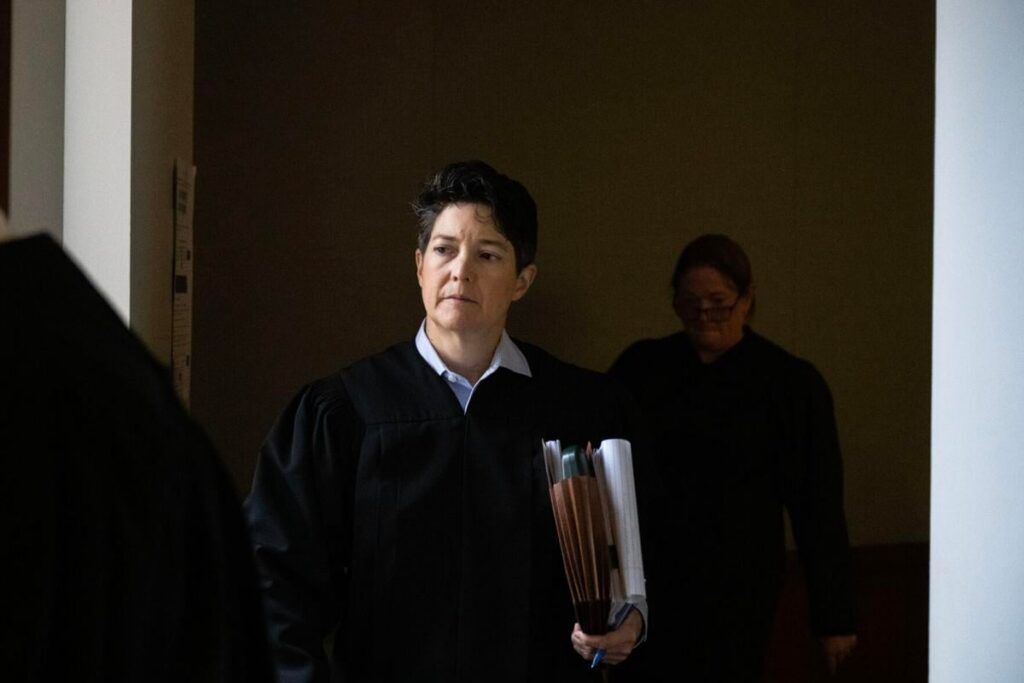
In August of last year, a panel of the Court of Appeals found Hall’s instruction to be reasonable, mirroring other previous decisions. In the 2-1 ruling, Judge Jaclyn Casey Brown dissented, believing “any movement, however short” would incorrectly label the act of ejecting someone from a car as kidnapping, without any reference to being seized and carried. Therefore, she would have reversed Garcia’s kidnapping conviction because the trial court had lowered the prosecution’s burden of proof.
On appeal to the Supreme Court, Garcia described that the legislature created the kidnapping offense in 1971 to essentially combine false imprisonment with movement from place to place. A 1964 report to the General Assembly explained that the new offense would cover a “normal case of kidnaping where the victim is overpowered and is lifted or forced at gun point to an awaiting car.”
However, the defense argued, courts have since engaged in a “game of telephone” about the definition, culminating in the instruction that any movement constitutes kidnapping. To complicate matters, other Court of Appeals panels have endorsed the notion that any movement, however short must also result in a “substantial increase” in the risk of harm to a victim.
Some members of the Supreme Court were sympathetic to the notion that such an explanation from Hall in response to the jury’s specific question was improper.
“I don’t understand how a definition of two verbs, seize and carry, can be any movement, however small,” Justice Melissa Hart acknowledged on Monday. “And if I were on the jury I would’ve been super confused by that statement.”
Gabriel said that the jury’s note did not even request a definition of seized and carried, and yet that was the question Hall had answered.
“The jury didn’t ask what the meaning of that is in this case,” public defender Jud Lohnes agreed, “but when the jury does ask, telling them it means any movement, however short in distance is always the wrong answer.”
Senior Assistant Attorney General Ellen Michaels asked the justices to uphold Hall’s instruction, even though it could have been phrased more clearly. She elaborated that even under Garcia’s account, the victim was still driven several blocks while fighting with other people in the car, and was ultimately ejected. That would have qualified as being seized and carried.
Gabriel pushed back, saying Michaels’ interpretation would deem as kidnapping any scenario in which the victim was voluntarily in a car before being pushed out. In that instance, there is no seizure.
“That’s the problem,” he said.
The case is Garcia v. People.


Trump’s judicial nominee orders bond in wave of cases after 10th Circuit rejects government’s position
Michael Karlik
michael.karlik@coloradopolitics.com
Updated 3 days ago
Within 24 hours of the Denver-based federal appeals court rejecting the government’s expansive view of its immigration detention authority, the lone judge in Colorado to embrace that view ordered bond hearings for detainees in at least 20 cases. U.S. District...
10th Circuit agrees Colorado satisfied jury award after intercepting money for restitution
Michael Karlik
michael.karlik@coloradopolitics.com
Updated 3 days ago
The Denver-based federal appeals court agreed last week that Colorado satisfied its obligations by not paying a man directly for violating his rights, but rather crediting the jury’s multimillion-dollar award toward the crime victim restitution he still owed in his...
Colorado justices ponder whether insurer should save company from asbestos suits
Michael Karlik
michael.karlik@coloradopolitics.com
Updated 4 days ago
Some members of the Colorado Supreme Court appeared skeptical last week that an insurance policy that reaches beyond the limits and coverage of a company’s other policies must “step down into the shoes” of those policies after they become insolvent....
Colorado justices weigh ‘extreme’ proposals for civil jury trial requests
Michael Karlik
michael.karlik@coloradopolitics.com
Updated 4 days ago
Members of the Colorado Supreme Court grappled last week with two vastly different proposals for evaluating when it is appropriate for a civil litigant to ask for a jury trial, as opposed to a bench trial before a judge. The...
Colorado justices weigh ‘extreme’ proposals for civil jury trial requests
Michael Karlik
michael.karlik@coloradopolitics.com
Updated 15 hours ago
Members of the Colorado Supreme Court grappled last week with two vastly different proposals for evaluating when it is appropriate for a civil litigant to ask for a jury trial, as opposed to a bench trial before a judge. The...
10th Circuit reverses perjury conviction, warns prosecutors to watch their questioning
Michael Karlik
michael.karlik@coloradopolitics.com
Updated 4 days ago
The Denver-based federal appeals court reversed a defendant’s perjury conviction last week, warning prosecutors that it is better to follow up on imprecise or unclear answers than to criminally charge a witness for their response. A jury convicted Lori Milliron...
10th Circuit rebuffs government, rules against shift to mandatory immigration detention
Michael Karlik
michael.karlik@coloradopolitics.com
Updated 5 days ago
The Denver-based federal appeals court ruled on Tuesday against the government’s broad assertion of authority to keep people in immigration custody without the opportunity to demonstrate their suitability for release on bond. Although the regional appeals courts have reached different...

Appeals court revives tenants’ lawsuit over landlords’ illegal fee demands
Michael Karlik
michael.karlik@coloradopolitics.com
Updated 5 days ago
Colorado’s second-highest court revived a proposed class-action lawsuit against landlords and other entities last month, concluding that state law did not permit the practice of demanding that tenants pay attorney fees in certain eviction proceedings. In 2021, lawmakers enacted a...

Appeals court reverses Jeffco assault convictions due to omitted jury instruction
Michael Karlik
michael.karlik@coloradopolitics.com
Updated 5 days ago
Colorado’s second-highest court agreed last month that a Jefferson County defendant’s assault convictions could not stand because his jury should have been allowed to consider whether he used force against a bar patron to defend his girlfriend from inappropriate touching....
Colorado Supreme Court tosses man’s lawsuit over daughter’s traffic death
Michael Karlik
michael.karlik@coloradopolitics.com
Updated 5 days ago
The Colorado Supreme Court applied a confusing matrix of conditions and deadlines in state law to conclude on Monday that a man waited too long to sue after his daughter was rendered unconscious and later died from a vehicle accident....
PREV
PREVIOUS

NONPROFIT REGISTER | 2021 Mile High MMAyhem generates big profit, big news
MILE HIGH FIVE FOUNDATION Denver News: Over the course of 11 years, the Mile High Five Foundation, through its annual Mile High MMAyhem, has raised $1.1 million, money that has enabled a host of Denver-area nonprofits to make appreciable impacts on the wellbeing of children. The 2021 edition of this black-tie event, held Oct. 29 […]

Denver’s East Colfax neighborhood could be rezoned for ‘granny flats’
Denver’s entire East Colfax neighborhood may soon be rezoned to allow for accessory dwelling units, colloquially called “granny flats,” after the City Council land use committee approved the proposal Tuesday. If passed by the full council, the measure would allow homeowners in East Colfax to build ADUs on their properties without asking the council for […]