

Federal judge rejects Superior’s attempt to derail Rocky Flats refuge trails
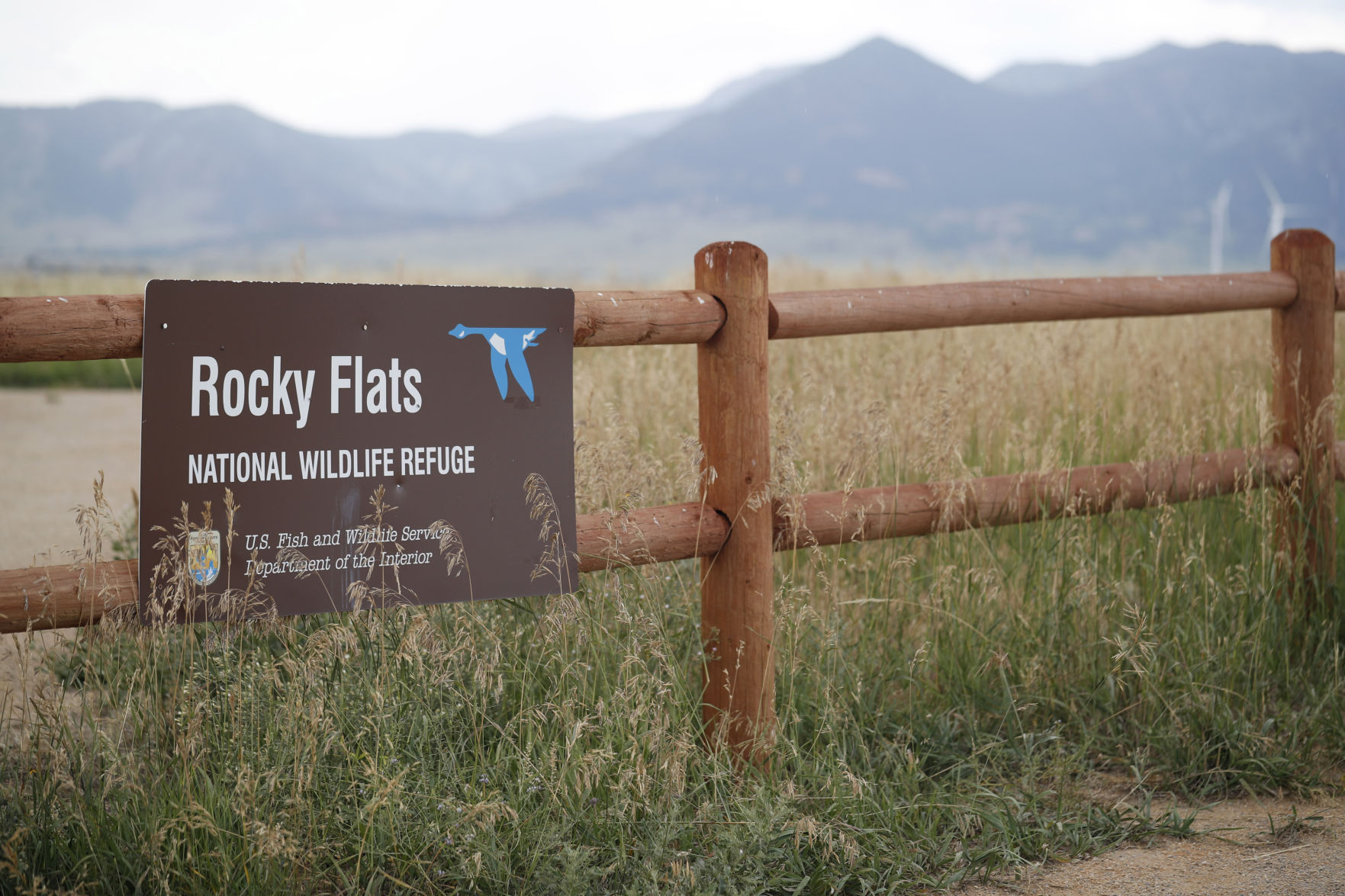
A federal judge sided against the town of Superior in determining the federal government did not violate the law by making modifications to trails in the Rocky Flats National Wildlife Refuge.
The town had alleged in a lawsuit that the U.S. Fish and Wildlife Service failed to perform the needed environmental review when it adjusted part of the refuge’s trail alignment via a 2018 statement of minor changes. Superior asked a court to halt the trail development plan until a proper environmental assessment took place.
But U.S. District Court Senior Judge Marcia S. Krieger explained that the relatively narrow issue before her was the government’s modification to the trails in the refuge, and not, as the town argued, the larger project of connecting the refuge to other regional amenities.
“The only agency action at issue here are the decisions embodied by the 2018 Statement — namely minor adjustments of trail routings and other inconsequential actions. When the Court’s focus is narrowed to just those issues, none appear to be the subject of meaningful controversy,” she wrote in a Sept. 16 order.
Krieger’s decision marks another legal setback for efforts to derail the completion of the wildlife refuge’s trail system. In July, U.S. District Court Chief Judge Philip A. Brimmer upheld the same environmental action statement amid claims from concerned community groups that the government’s original 2004 environmental analysis was outdated.
“Although plaintiffs sincerely believe that the [Fish and Wildlife Service] allowing any public access to the Refuge is unwise, it is not the Court’s role to review the wisdom of an agency’s decision,” Brimmer wrote at the time.
Rocky Flats was formerly the site of a Cold War-era nuclear weapons production facility, located largely within Jefferson County, 10 miles south of Boulder. It closed in 1993 following a law enforcement raid and was the subject of a $7 billion cleanup to remove 21 tons of potentially radioactive material. Multiple advocacy groups still oppose allowing public access to the site, citing cancer risks.
Eventually, the Fish and Wildlife Service took over the area — with the exception of the portion at the center containing the most extensive contamination — to create the refuge. Following an environmental review released in 2004, the service adopted a comprehensive plan for the refuge in 2005, which envisioned just under 13 miles of trails for pedestrian, equestrian and bicycle use. There would be additional hiking-only trails and other infrastructure for visitors, like parking.
In 2012, planning began for the Rocky Mountain Greenway Project, linking Rocky Mountain National Park near Estes Park and Rocky Mountain Arsenal near Denver. As part of the design, trails in Rocky Flats National Wildlife Refuge would link up with neighboring facilities in Boulder County and Westminster, tying in to the larger project.
When the Fish and Wildlife Service released its environmental action statement in March 2018 focused on modifications to the 2005 trail plan, it mentioned that that the Greenway Project connections were “proposed by adjacent local governments, may or may not occur in the future, and are not included with this determination thus requiring a future NEPA determination(s).”
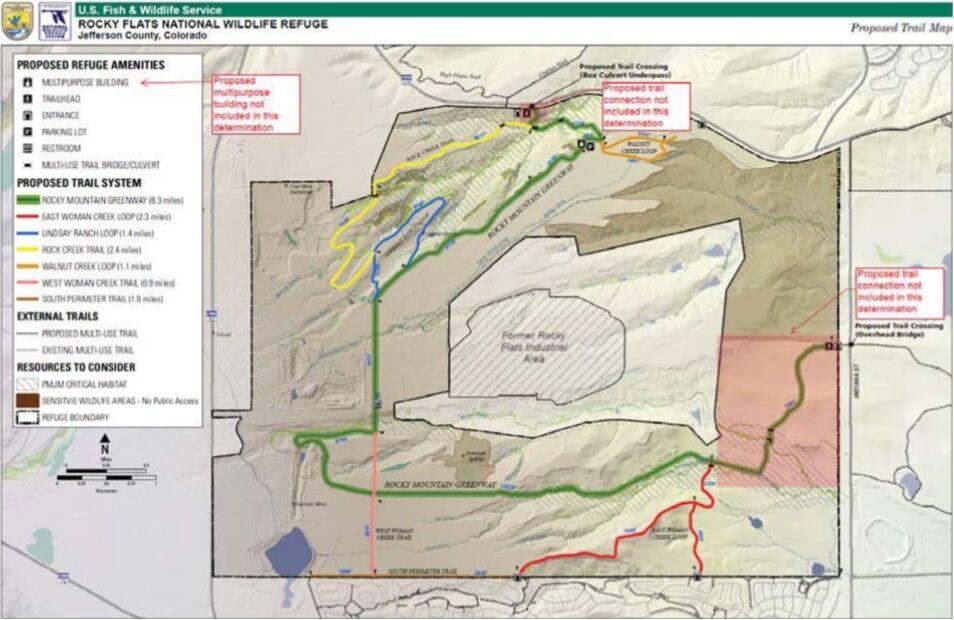
Trail connections on the eastern and northern portions of the refuge, as well as the Greenway trail (in green) are at issue in the town of Superior's lawsuit.
NEPA refers to the National Environmental Policy Act, the federal law that requires government agencies to review the environmental implications of their proposals before making decisions. The Fish and Wildlife Service determined the 2018 modification to the trails by itself was so minor as to be exempt from another environmental analysis.
The town of Superior, which sits northeast of the refuge, then sued. It alleged a violation the law for the federal government not to perform additional review, given that the refuge’s connection to Greenway Project would have significant environmental effects. In particular, the town claimed the Greenway Project would bring more visitors by trail to the refuge than originally anticipated — from 85,000 annually to now 200,000 annually. It also pointed out the Fish and Wildlife Service redesignated 8.3 miles of trails in the refuge as the “Greenway trail.”
“FWS cannot pretend that its actions in the 2018 EAS are unrelated” to the Greenway Project, the town wrote in its legal filings. “The 2018 EAS decision facilitates and is part of the related decisions to route the Greenway through the Refuge.”
In her order, Krieger acknowledged that NEPA requires agencies to consider environmental consequences for activities connected to the planned course of action. The goal is to prevent the government from splitting up projects into smaller chunks, each of which has a minimal footprint but, taken as a whole, results in a much bigger impact.
But she found there was no reason to perform an environmental review of the refuge’s trail modifications when, to her, the connections to Boulder County and Westminster still remain hypothetical.
“NEPA specifically requires FWS to consider effects that are ‘reasonably foreseeable’ from the action being considered,” Krieger wrote. “If it can reasonably be foreseen that connecting the Greenway Project to the Refuge’s trails will result in a substantial increase in the number of users of Refuge trails or the manner in which the Refuge will be used, FWS will have to consider those effects as part of its NEPA review of the decision to construct the connectors. But the mere fact that FWS may expect to join its trails to the Greenway Project in the future does not suffice.”
Neither the Fish and Wildlife Service nor the town of Superior immediately responded to requests for comment.
Earlier this year, the Boulder County Board of County Commissioners approved an intergovernmental agreement to fund its grade-separated trail connections to the refuge, The Daily Camera reported. Although those in favor said the risk of getting hit by a car in the absence of such connections would be much larger than developing cancer from the Rocky Flats site, Commissioner Matt Jones remained opposed.
“Yeah, I know the chance is low, but I wouldn’t wish that on anyone,” he said. “I just don’t want to be promoting use out there.”
The case is Superior v. Fish and Wildlife Service et al.
Colorado Politics Must-Reads:

10th Circuit agrees Colorado Springs paramedic, officer not liable for constitutional violations in man’s death
Michael Karlik
michael.karlik@coloradopolitics.com
Updated 7 hours ago
The Denver-based federal appeals court decided on Monday that a Colorado Springs paramedic and police officer could not be held liable for constitutional violations for their roles in restraining a man in a mental health crisis, leading to his death....

Prosecutor plans to enter physical abuse evidence in Barry Morphew murder trial
Carol McKinley, Special to The Denver Gazette
carol.mckinley@gazette.com
Updated 3 hours ago
The prosecutor in the Barry Morphew murder trial told a judge on Monday that she plans to introduce evidence of physical abuse in the couple’s marriage, which ended when Suzanne Morphew disappeared on Mother’s Day in 2020. Morphew has been...
10th Circuit revives Colorado voter intimidation lawsuit due to judge’s error
Michael Karlik
michael.karlik@coloradopolitics.com
Updated 22 hours ago
The Denver-based federal appeals court on Monday reversed a trial judge’s finding that the leaders of an “election integrity” effort had not illegally intimidated Colorado voters through an organized door-to-door canvassing project to search for election fraud in the wake...

State Supreme Court’s final decisions of term, Trump’s judicial nominee appears before Senate | COURT CRAWL
Michael Karlik
michael.karlik@coloradopolitics.com
Updated 18 hours ago
Welcome to Court Crawl, Colorado Politics’ roundup of news from the third branch of government. The state Supreme Court has released its final opinions before its summer recess, plus the president’s nominee for the Denver-based federal appeals court fielded questions...

Civil rights law firm sues DPS over race-based redistricting
Nico Brambila
nico.brambila@denvergazette.com
Updated 4 hours ago
A civil rights law firm based out of Virginia has filed a lawsuit against Denver Public Schools, alleging Colorado’s largest school district redrew its five district seats with an “illegal racial intent” that violates the Fifteenth Amendment. Filed in U.S....
Trump’s judicial nominee orders bond in wave of cases after 10th Circuit rejects government’s position
Michael Karlik
michael.karlik@coloradopolitics.com
Updated 5 days ago
Within 24 hours of the Denver-based federal appeals court rejecting the government’s expansive view of its immigration detention authority, the lone judge in Colorado to embrace that view ordered bond hearings for detainees in at least 20 cases. U.S. District...
10th Circuit agrees Colorado satisfied jury award after intercepting money for restitution
Michael Karlik
michael.karlik@coloradopolitics.com
Updated 5 days ago
The Denver-based federal appeals court agreed last week that Colorado satisfied its obligations by not paying a man directly for violating his rights, but rather crediting the jury’s multimillion-dollar award toward the crime victim restitution he still owed in his...
Colorado justices ponder whether insurer should save company from asbestos suits
Michael Karlik
michael.karlik@coloradopolitics.com
Updated 5 days ago
Some members of the Colorado Supreme Court appeared skeptical last week that an insurance policy that reaches beyond the limits and coverage of a company’s other policies must “step down into the shoes” of those policies after they become insolvent....
Colorado justices weigh ‘extreme’ proposals for civil jury trial requests
Michael Karlik
michael.karlik@coloradopolitics.com
Updated 6 days ago
Members of the Colorado Supreme Court grappled last week with two vastly different proposals for evaluating when it is appropriate for a civil litigant to ask for a jury trial, as opposed to a bench trial before a judge. The...
Colorado justices weigh ‘extreme’ proposals for civil jury trial requests
Michael Karlik
michael.karlik@coloradopolitics.com
Updated 2 days ago
Members of the Colorado Supreme Court grappled last week with two vastly different proposals for evaluating when it is appropriate for a civil litigant to ask for a jury trial, as opposed to a bench trial before a judge. The...
PREV
PREVIOUS

Senate confirms Colorado public defender to be federal appeals judge
Federal public defender Veronica S. Rossman of Colorado became the Biden administration’s 12th confirmed judicial nominee on Monday, as the U.S. Senate voted 50-42 to approve her appointment to the federal appeals court based in Denver. Rossman will be the only public defender on the U.S. Court of Appeals for the 10th Circuit, which hears […]

Court stands by finding that ex-state employee fabricated evidence
A federal court has reaffirmed that a former Colorado state employee fabricated evidence for his discrimination lawsuit, and will now consider the state’s request to be awarded $300,000 in attorney fees. In June, U.S. Magistrate Judge Michael E. Hegarty concluded that Yoseph Yadessa Kenno, a former database administrator for the Governor’s Office of Information Technology, had […]