

State Supreme Court to hear appeals involving forced blood draws, spitting on officers
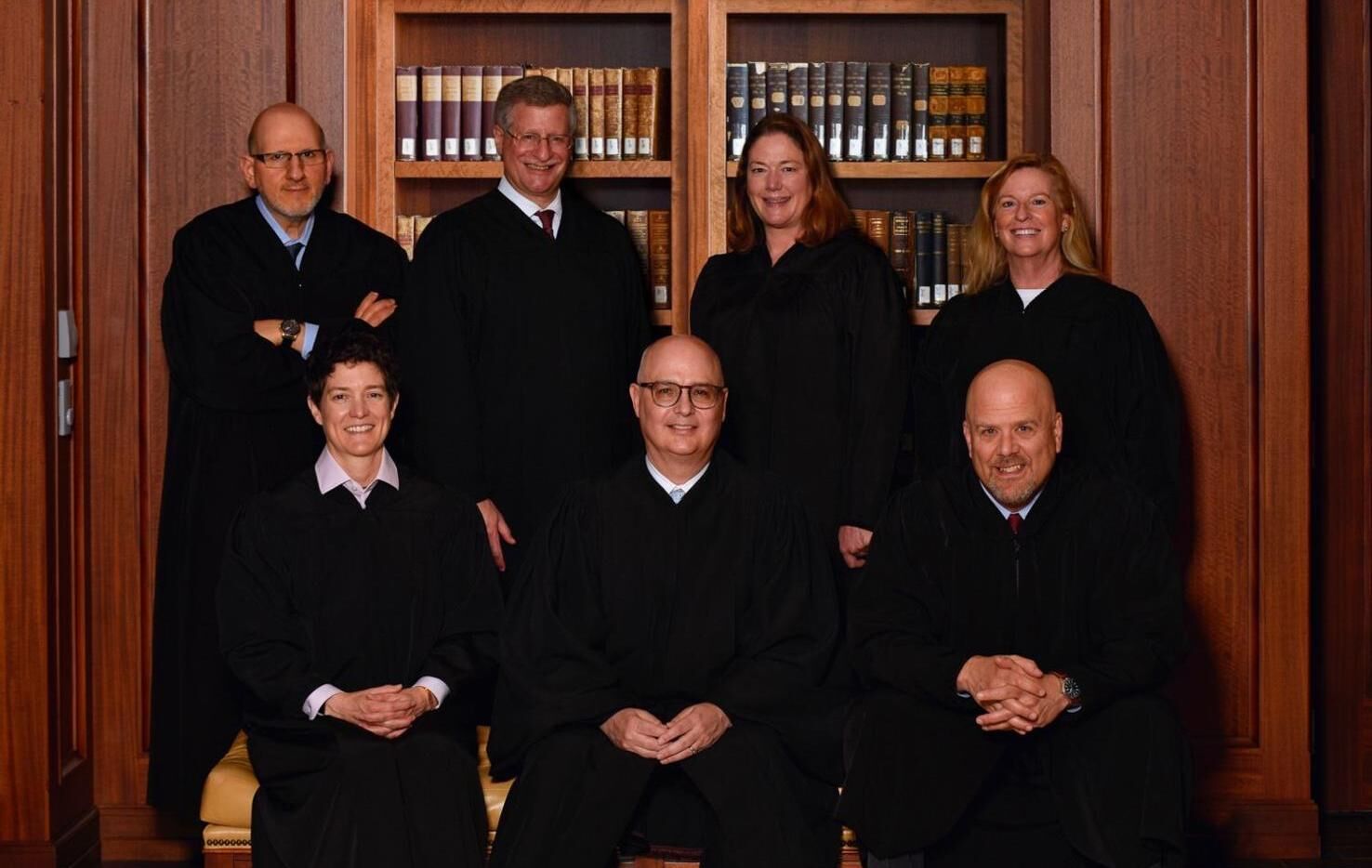
The Colorado Supreme Court announced it will review three decisions from the state’s Court of Appeals on subjects ranging from the ability of police to forcibly draw blood from a suspected drunk driver, to the law that criminalizes spitting on first responders, and whether Arapahoe County waited 10 years too long to sue a couple for Medicaid fraud.
Forced blood draw of drunk driver
Anyone driving a motor vehicle in Colorado has already given their consent for a breath test or blood draw from law enforcement upon request, if there is probable cause to suspect drug or alcohol impairment. Police may also forcibly restrain a person in order to perform the test, but only for four suspected crimes: homicide, vehicular homicide, assault or vehicular assault.
Fort Collins police obtained a search warrant to draw Charles Raider Jr.’s blood after they found him sitting in a parked car, apparently inebriated, and he refused a sobriety test. However, officers only sought to charge him with felony driving under the influence. They restrained him for the blood draw at the hospital, and Raider’s blood alcohol content tested 0.188, above the legal limit.
Raider appealed, arguing the evidence from his blood draw should have been suppressed at trial because it circumvented what is known as the expressed consent statute. Even if police have a warrant, he contended, the four crimes listed are the only ones that can allow for a forced blood draw, and not DUI alone.
In January 2021, a three-member panel of the Court of Appeals agreed with Raider and ordered a new trial.
“The General Assembly has decided that, in the case of someone who is suspected of driving under the influence of alcohol or drugs but is not suspected of one of the four listed offenses,” wrote Judge Christina F. Gomez, “the driver may be motivated to cooperate with testing by threatened punishments but may not be forced to undergo such testing.”
The government appealed, and the Supreme Court has agreed to consider whether the appellate panel was correct that the expressed consent statute protects drivers suspected of DUI from the type of physical restraint used against Raider.
The case is People v. Raider.
Spitting on officers
A La Plata County jury convicted Cheryl Lynette Plemmons on three counts of second degree assault for spitting on two sheriff’s deputies who conducted a welfare check at her home in 2016.
State law criminalizes as a felony the act of expelling bodily fluids onto a first responder with “intent to infect, injure, or harm another person.” However, it is only a misdemeanor to spit with the intent to harass or annoy.
Plemmons argued the evidence in her case did not show she intended to infect or injure the deputies. Moreover, the law is unconstitutional because it has no definition of “harm,” therefore providing no notice of what is illegal.
The Court of Appeals sided against her, believing the evidence was not only sufficient, but that harm encompassed more than simply a physical danger. The appellate judges upheld the instruction that the trial court gave to Plemmons’ jury: that psychological or emotional harm was sufficient, examples of which included the officers’ fear and anxiety.
One member of the panel, Daniel M. Taubman, warned that the law may well be constitutional, but it is nonetheless quite vague. He noted that Plemmons was convicted even though neither officer said he had experienced psychological or emotional distress after being spat upon.
The Supreme Court agreed to review whether the jury instruction was correct, as well as whether sufficient evidence existed that Plemmons intended to harm the deputies.
The case is Plemmons v. People.
Ten years too late?
Between 2002 and 2004, Monica Velarde and Michael Moore received $79,591 in Medicaid benefits. Arapahoe County claimed Velarde failed to report that she and Moore shared an income, and that the couple therefore obtained the assistance fraudulently.
The county sued in December 2018, but a lower court dismissed the case. The county informed Velarde about the overpayments in February 2008, but the relevant law allowed her to challenge the determination within 90 days, after which the county had 35 days to turn to the courts.
The Court of Appeals agreed with the dismissal, saying Arapahoe County had clearly filed suit beyond the deadline. The appellate panel rejected further the argument that the legal time limit did not apply to the county.
The Supreme Court will review whether the panel decided correctly.
The case is Arapahoe County Department of Human Services v. Velarde and Moore.
Colorado Politics Must-Reads:

10th Circuit finds no fair housing violation by Littleton landlord for worker’s alleged rape of tenant
Michael Karlik
michael.karlik@coloradopolitics.com
Updated 7 hours ago
The Denver-based federal appeals court concluded on Monday that Littleton’s housing authority could not be held liable for a maintenance worker’s alleged rape of a tenant, as the worker’s employment did not provide any special access to the victim. A...
Denver detox center did not violate man’s rights with 10-hour hold, 10th Circuit says
Michael Karlik
michael.karlik@coloradopolitics.com
Updated 1 day ago
The Colorado-based federal appeals court concluded on Tuesday that Denver’s detoxification facility did not violate a man’s rights by holding him against his will for 10 hours until his blood alcohol content was projected to reach zero. Unusually, Brian Garrett’s...

Federal judge clarifies ex-GOP treasurer candidate’s burden to prove defamation claims
Michael Karlik
michael.karlik@coloradopolitics.com
Updated 1 day ago
A federal judge clarified last week that businessman and former Republican statewide candidate Brian Watson will need to surmount a higher hurdle in proving his claim that a party guest’s alleged description of him as a “criminal” amounted to defamation....
Colorado board permits state to appeal injunction against arthritis drug price cap
Marissa Ventrelli
marissa.ventrelli@coloradopolitics.com
Updated 2 days ago
A Colorado board voted Friday to allow the Attorney General’s Office to fight an injunction against a price cap on a drug that treats arthritis. A U.S. district court judge had granted the company Amgen a preliminary injunction, temporarily blocking...

Federal judge rejects constitutional claims, ‘expressions of hatred’ by Club Q defendant
Michael Karlik
michael.karlik@coloradopolitics.com
Updated 2 days ago
A federal judge rejected a defendant’s claims that he received constitutionally ineffective assistance of counsel while facing federal hate crime and firearms charges for murdering five people at a Colorado Springs LGBTQ nightclub in 2022. Anderson Lee Aldrich is serving...

Divided 10th Circuit upholds Colorado congestion fee on car rentals
Michael Karlik
michael.karlik@coloradopolitics.com
Updated 2 days ago
The Denver-based federal appeals court concluded on Monday that a 2024 “congestion impact fee” that lawmakers imposed on short-term vehicle rentals did not conflict with a federal prohibition on certain airport-related charges. Beginning in the 1970s, Congress began limiting the...
10th Circuit dismisses woman’s lawsuit following 10-year attempt to undo restraining order
Michael Karlik
michael.karlik@coloradopolitics.com
Updated 5 days ago
The Denver-based federal appeals court rejected a woman’s challenge on Friday to a restraining order imposed on her more than a decade ago, finding that she cannot credibly claim she will be prosecuted for violating the restraining order through her...
10th Circuit dismisses woman’s lawsuit following 10-year attempt to undo restraining order
Michael Karlik
michael.karlik@coloradopolitics.com
Updated 5 days ago
The Denver-based federal appeals court rejected a woman’s challenge on Friday to a restraining order imposed on her more than a decade ago, finding that she cannot credibly claim she will be prosecuted for violating the restraining order through her...
Colorado equal pay law does not require plaintiffs to allege gender-based retaliation, appeals court finds
Michael Karlik
michael.karlik@coloradopolitics.com
Updated 4 days ago
The 2019 Colorado law aimed at rooting out pay discrimination on the basis of sex does not require a plaintiff to allege their employer retaliated against them for sex- or gender-related reasons, the state’s second-highest court decided on Thursday. Lawmakers...
Hudson faces lawsuit over ICE detention facility
Nicole C. Brambila
nicole-c-brambila@coloradopolitics.com
Updated 6 days ago
A nonprofit organization filed a lawsuit against the Town of Hudson Wednesday, challenging plans to reopen a former federal prison in the town as a U.S. Immigration and Customs Enforcement detention facility. Together Colorado, along with Janet E. Carlson, filed...
PREV
PREVIOUS

Justices mull the meaning of 'under arrest'
Being under arrest involves some combination of handcuffs, a police vehicle and not having the freedom to leave. But when, precisely, does someone become “under arrest?” Weston Jefferson Thomas is asking the Colorado Supreme Court to overturn his conviction for resisting arrest based on what transpired after Mesa County authorities showed up at his home. […]

Appeals court finds no disability discrimination from Southwest against ex-DIA employee
Southwest Airlines did not violate civil rights laws when it fired an employee at Denver International Airport who had a learning disability, the federal appeals court based in Denver ruled on Thursday. The U.S. Court of Appeals for the 10th Circuit rejected the argument of Krista Edmonds-Radford that because Southwest benefitted from a federally-funded airport improvement […]