

Appeals court declines to say Colorado Springs officers acted unconstitutionally at traffic stop

The federal appeals court based in Denver declined to say whether Colorado Springs police acted unconstitutionally by turning their traffic stop of a driver into a firearm arrest for the passenger.
The narrow ruling on Monday from the U.S. Court of Appeals for the 10th Circuit implicated a 2015 U.S. Supreme Court decision, Rodriguez v. United States. A majority of justices in that case found officers, without reasonable suspicion, may not make “detours” from the original mission that prolong the traffic stop.
Colt Francis Malone had asked the 10th Circuit to find that Colorado Springs police committed such a detour when they pulled over the car he was riding in for a minor traffic violation that culminated in his arrest. A three-judge panel upheld a lower court ruling against Malone, even as one appellate judge expressed concern that the case may be an example of police doing “whatever they want … for as long as they want.”
On June 18, 2019, members of a Bureau of Alcohol, Tobacco, Firearms and Explosives task force saw a car pull into the Knights Inn hotel. They watched a person exit the car, go into a first floor room, then return to the car and drive away. They alerted nearby Colorado Springs patrol officers Adam Brewer and Brook Hathaway.
The officers saw the driver make a wide right-hand turn and pulled the car over. The driver, Darlene Tucker, told Brewer she was staying at the hotel and handed over her driver license, while also searching for her registration and insurance information. Malone, her passenger, also provided his identification, informing the officers he was on parole for burglarizing a pawn shop.
Brewer instructed Tucker to keep looking for her registration and insurance. Although Tucker’s background check reportedly came up clear, the car was not stolen and there were no warrants out for either occupant’s arrest, Brewer learned in the patrol car that Malone was a suspected gang member.
When he returned to the car with Hathaway, the two allegedly began the “detour” from the traffic stop. The officers asked Malone to exit the car for a pat-down. Hathaway noticed a liquor bottle near the passenger seat, but then saw part of a gun when reaching in for the bottle. The officers searched the car, found a pistol and arrested Malone for weapons possession by a felon.
Malone asked a trial court to suppress evidence of the firearm, alleging a violation of the Fourth Amendment’s prohibition on unreasonable searches and seizures. In particular, the defense cited the Supreme Court’s Rodriguez decision, in which the justices found the use of a K-9 to sniff out drugs after officers completed their traffic stop was unconstitutional.
U.S. District Court Chief Judge Philip A. Brimmer initially agreed with Malone.
“I don’t think that there is any – there wouldn’t be some independent basis to take Mr. Malone out of the car, in other words, some type of reasonable suspicion that would have justified that,” said Brimmer, who found no connection between the traffic stop and the criminal activity officers suspected at the hotel.
But the judge declined to suppress the evidence, determining the Colorado Springs officers had a reasonable interest in removing Malone from the car: thinking he may have stolen a gun from the pawn shop and posed a danger. Because Tucker had not yet produced the documents Brewer asked for, the officers’ handling of Malone did not prolong the traffic stop, as was the case in Rodriguez. The officers acted reasonably, Brimmer concluded.
During oral argument before the 10th Circuit panel, Judge Gregory A. Phillips grilled the government’s lawyer about whether there was any legal limit to the officers’ interaction with Malone, given that they never returned to Tucker for her paperwork and in effect left the traffic stop open ended.
“My problem with the government’s position in this case is you have known facts, which is the real reason for this stop is the hotel,” he said. “But the officers never go back to [Tucker] and say, ‘Did you find those [documents]?’ Instead, your view, it seems to me, just allows the officers to do whatever they want to for the rest of the stop and investigate the hotel, pull people out of cars – ‘Do I see anything under the seat?’ – for as long as they want.”
Phillips added: “So you have this unlimited stop that never stops until they are satisfied to themselves that they can’t investigate and prove another crime. That can’t be the law that they’re allowed to do that.”
Cyrus Y. Chung with the U.S. Attorney’s Office responded that everything happened relatively quickly in Malone’s case, clarifying that “I’m not contending that the stop can go on forever.”
“We still don’t know if she had proof of insurance and registration to this day,” Phillips emphasized.
But the appellate panel did not tackle that larger question, instead noting Malone had not challenged Brimmer’s finding that the officers had not prolonged the traffic stop in their interaction with Malone. Because the Rodriguez decision only established the officers’ behaved unconstitutionally after they extended the length of the traffic stop, Malone’s case was not identical.
If Tucker “were still looking for the registration and proof of insurance, the officers could have investigated Mr. Malone while they were waiting,” wrote Judge Robert E. Bacharach for the panel.
The case is United States v. Malone.


Wrongfully deported man to be returned to U.S., Colorado federal judge orders
Michael Karlik
michael.karlik@coloradopolitics.com
Updated 23 hours ago
Colorado’s chief federal judge took the extraordinary step of directing the government on Tuesday to do everything it can to return a man it deported in violation of his order. At the same time, Colorado’s chief magistrate judge has set...
Denver murder, assault convictions reversed due to faulty jury instructions
Michael Karlik
michael.karlik@coloradopolitics.com
Updated 2 days ago
Colorado’s second-highest court reversed a defendant’s convictions for murder and assault last week after concluding a Denver judge incorrectly omitted key jury instructions that could have affected the verdict and sentencing. Stephen C. Swainson fatally stabbed Israel Casillas in downtown...
‘Understand people for who they are’: 2 federal judges talk about compassion in courtroom
Michael Karlik
michael.karlik@coloradopolitics.com
Updated 13 hours ago
Before taking the bench in 2022, U.S. District Court Judge Charlotte N. Sweeney was an employment discrimination attorney. While the cases could be emotionally charged, they were different from the criminal proceedings she is now handling. “It wasn’t necessarily affecting...
Denver murder conviction reversed for incomplete self-defense instruction
Michael Karlik
michael.karlik@coloradopolitics.com
Updated 3 days ago
Colorado’s second-highest court reversed a defendant’s murder conviction last week because a Denver judge gave an incomplete instruction to the jury about the man’s right to self-defense. Donald R. Gonzales and Gary McLaughlin met up in a Capitol Hill parking...
Colorado lawmaker, House leaders named in workplace-retaliation lawsuit
Marianne Goodland
marianne.goodland@coloradopolitics.com
Updated 3 days ago
A former legislative aide has filed a lawsuit alleging she was mistreated, illegally directed to perform campaign work and harmed by a House leadership structure she charged was fragmented, politicized and ineffective at protecting employees. The lawsuit, filed by Jennifer...
Federal judge hears arguments about Colorado’s 3-day gun purchase waiting period
Michael Karlik
michael.karlik@coloradopolitics.com
Updated 3 days ago
A federal judge heard arguments on Monday about the constitutionality of a 2023 Colorado law that generally imposes a three-day waiting period on firearm purchases after the initiation of a background check. The test that the U.S. Supreme Court created...
Colorado Supreme Court intervenes in Weld County prosecution dismissed due to Missy Woods misconduct
Michael Karlik
michael.karlik@coloradopolitics.com
Updated 3 days ago
The Colorado Supreme Court ordered a Weld County trial judge last week to respond to the district attorney’s claim that he improperly dismissed a criminal case because of “outrageous” conduct by the Colorado Bureau of Investigation. Daniel Lee Eatinger stood...
Schoolchildren’s presence at child sex-related trial did not harm Arapahoe County defendant, appeals court says
Michael Karlik
michael.karlik@coloradopolitics.com
Updated 6 days ago
Colorado’s second-highest court decided on Thursday that the presence of a group of schoolchildren on the first day of a child sexual exploitation trial did not violate an Arapahoe County defendant’s constitutional right to a fair trial. Prosecutors charged Jerry...
Appeals court cites week-old Colorado law to reinstate child neglect case at child, father’s request
Michael Karlik
michael.karlik@coloradopolitics.com
Updated 5 days ago
Colorado’s second-highest court invoked a new state law for the first time on Thursday and reinstated a child neglect case that both the child and her father wished to reopen. House Bill 1227 took effect on Aug. 12, reversing a...
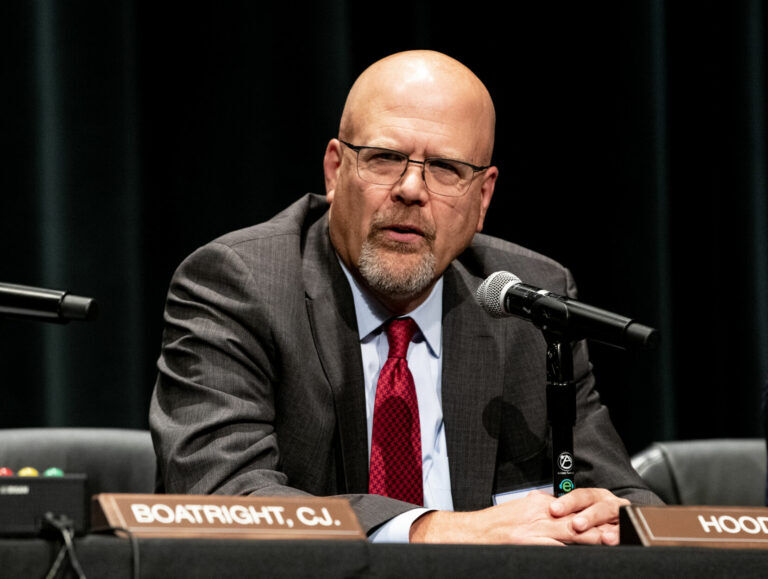
Colorado Supreme Court names William Hood as next chief justice
Michael Karlik
michael.karlik@coloradopolitics.com
Updated 17 hours ago
The Colorado Supreme Court has selected Justice William W. Hood III to be the next chief justice, the judicial branch announced on Friday. Hood will succeed Chief Justice Monica M. Márquez, who took over the role in July 2024. “I...
PREV
PREVIOUS

Community panel explores using federal funds to make 'transformational change' in Colorado’s behavioral health system
A cohort of more than two dozen elected officials and community members on Monday kicked off crafting recommendations to use $450 million in federal dollars to create “transformational change” in Colorado’s behavioral health system. The Behavioral Health Subpanel is charged with developing recommendations to be considered by the Behavioral Health Transformational Task Force, a panel […]
Colorado nonprofit targeted with redistricting lobbying complaint helped draft others’ map proposals
Days after a formal complaint accused a secretly funded nonprofit organization of violating redistricting lobbying disclosure laws, a video recording obtained by The Gazette reveals the same group helped craft maps proposed by the prominent Colorado Farm Bureau, contradicting what the Farm Bureau’s president told the state’s redistricting commissioners. The Farm Bureau president Carlyle Currier […]