

Denver’s homicides on track to outpace 2020
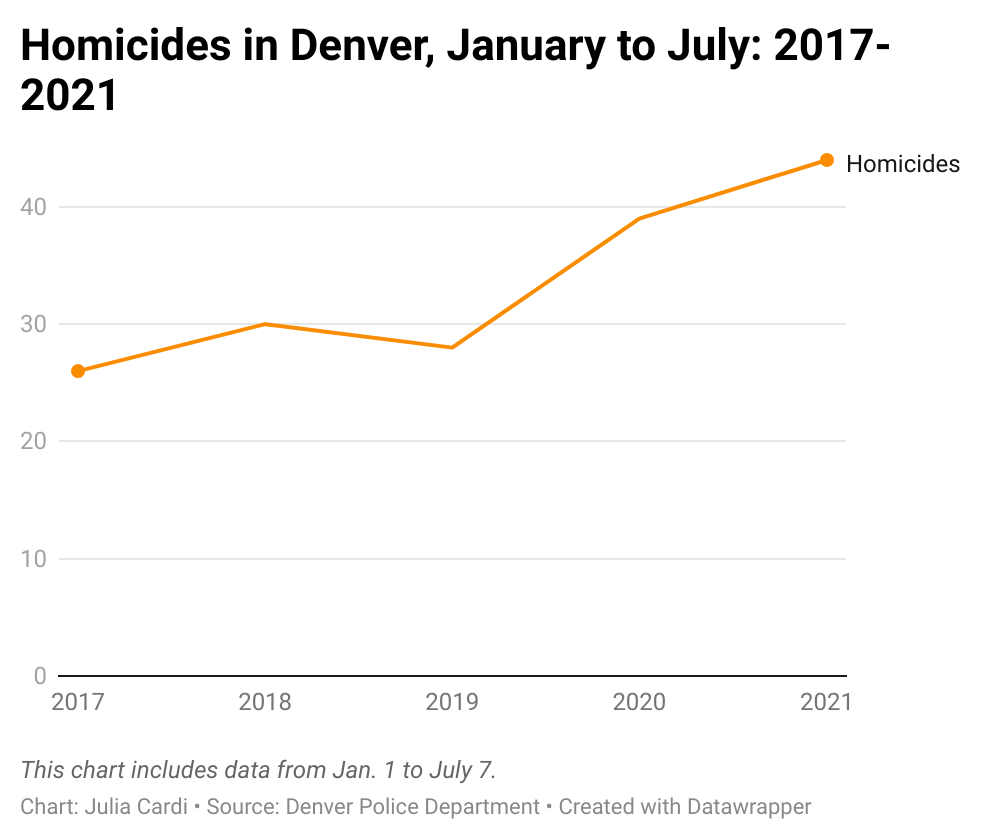
Homicides in Denver in the first six months of 2021 have outpaced the same time frame in 2020, on track for a multi-year record for homicides.
According to the Denver Police Department’s open data portal, the city recorded 44 homicides in 2021 as of Wednesday, compared with 39 in the same period last year. The 95 homicides reported by police in 2020 represented about a 50% increase over 2019.
The city’s recent spike in homicides mirrors increases in non-fatal shootings. When city officials in late May announced a new strategy for policing in crime-ridden areas where crime is most prevalent, they said shootings had increased 62.8% over Denver’s three-year average.
Violent crimes in general have increased this year as well: According to police data, officers had recorded 1,852 incidents as of Wednesday, including homicides. The police department includes aggravated assault, sexual assault and murder in its violent crime statistics.
Over the same period in 2020, the police department had recorded 1619 violent crime incidents.
Denver Police Chief Paul Pazen told The Denver Gazette he believes stress and anxiety brought on by a confluence of circumstances last year drove violence. Issues faced by Denver residents included economic uncertainty tied to the pandemic and protests against police tied to the Minnesota killing of George Floyd.
The chief also cited an increased number of illegal guns on the streets as a factor in growing violence in the city.
Denver’s sustained growth in shootings and homicides is similar to spikes in other cities large and small, according to reporting by The Washington Post. The policy implications have divided activists and lawmakers, but crime analyst Jeff Asher said he has not seen a link between homicide increases and police funding.
At the end of May, Mayor Michael Hancock announced a plan for “collaborative policing” targeting areas of Denver where violent crime is concentrated: South Federal Boulevard and West Alameda Avenue, Colfax Avenue and Broadway, East Colfax Avenue and North Yosemite Street, East 47th Avenue and North Peoria Street, and Martin Luther King Jr. Boulevard and North Holly Street.
Denver begins collaborative policing strategy targeting most violent areas in city
Officials said those areas accounted for 49% of the city’s nonfatal shootings and about 26% of homicides and aggravated assaults in 2020.
To reverse the trend, Pazen said he wants to build relationships with community members, businesses, nonprofits and mental health professionals to deliver services needed by residents. The collaborative policing strategy aims to prevent crime in the areas, instead of only responding to it, he said.
Officials said police have tracked the times and days when violent crimes most often occur in those neighborhoods and plan to put more officers on the street at peak times in a bid to deter crimes.


Gazette family of papers rakes in 64 awards at 2025 Colorado Press Association Better News Contest
Elizabeth Pond
elizabeth.pond@denvergazette.com
Updated 13 hours ago
The Gazette family of newspapers won 64 awards in the Colorado Press Association’s annual Better News Contest — a whopping 36 more than the three papers collectively won last year. Colorado Politics raked in 27, The Colorado Springs Gazette took...

What courageous citizenship really looks like | Vince Bzdek
Vince Bzdek
vince.bzdek@gazette.com
Updated 2 days ago
By Vince Bzdek What exactly is courage? Ernest Hemingway famously called it grace under pressure. Mark Twain wrote that “courage is resistance to fear, mastery of fear — not absence of fear.” C.S. Lewis refined that even more: “Courage is...
The coming election and mischief in the making | SONDERMANN
Eric Sondermann
eric-sondermann@coloradopolitics.com
Updated 4 days ago
America’s tribalism is such these days that we struggle to even agree on the basic rules. Elections have always been hotly contested. As the saying goes, “Politics ain’t beanbag.” The process has long involved elements of nastiness and underhanded conduct....

Colorado Politics Calendar Aug. 31-Sept. 6
Rachael Wright, Special to Colorado Politics
rachael.wright@coloradopolitics.com
Updated 5 days ago
CoPo’s weekly political calendar will help you find political and public-policy events throughout Colorado. It includes candidate and issue campaign events, public policy meetings, court hearings, state and local party conventions, assemblies, debates, rallies, parades, speaking engagements, traveling dignitary appearances,...
Tancredo in Running for Dept. of Ed. Position | A LOOK BACK
Rachael Wright, Special to Colorado Politics
rachael.wright@coloradopolitics.com
Updated 5 days ago
Forty-five years ago this week: “I know that my name has been placed before the Secretary of Education, and I know that I’m one of three or four being considered for the Department of Education’s Region 8,” said state Rep....
Colorado measure adding ID checks to mail-in voting qualifies for ballot
Marissa Ventrelli
marissa.ventrelli@coloradopolitics.com
Updated 2 days ago
A ballot initiative that would require voters to include additional information on mail-in ballots has qualified for the November election, according to the Secretary of State’s Office. Backed by El Paso County Treasurer Chuck Broerman and former Deputy Secretary of...
Colorado election website error exposes personal data of confidential voters
Marissa Ventrelli
marissa.ventrelli@coloradopolitics.com
Updated 2 days ago
A system update accidentally lifted protections on confidential records in Colorado, exposing dozens of voters’ personal information, according to the Secretary of State’s Office. The limit that normally blocks access to confidential voter profiles was inadvertently disabled during an update...

PUC adds weekly comment after killing private talks
Scott Weiser
scott.weiser@gazette.com
Updated 2 days ago
The Colorado Public Utilities Commission will take public comment at the start of every commissioner’s weekly meeting beginning Sept. 9 as part of its new transparency mandate, the commission announced, expanding a slot previously limited to the second Wednesday of...
10th Circuit overturns framework for sentencing probation violators by 11-1
Michael Karlik
michael.karlik@coloradopolitics.com
Updated 2 days ago
In a rare decision by all 12 of its full-time judges, the Denver-based federal appeals court ruled in a lopsided vote on Friday that one of its members created a sentencing process for probation violators that was out of step...
Federal judge dismisses excessive force lawsuit against Colorado Springs, officer
Michael Karlik
michael.karlik@coloradopolitics.com
Updated 2 days ago
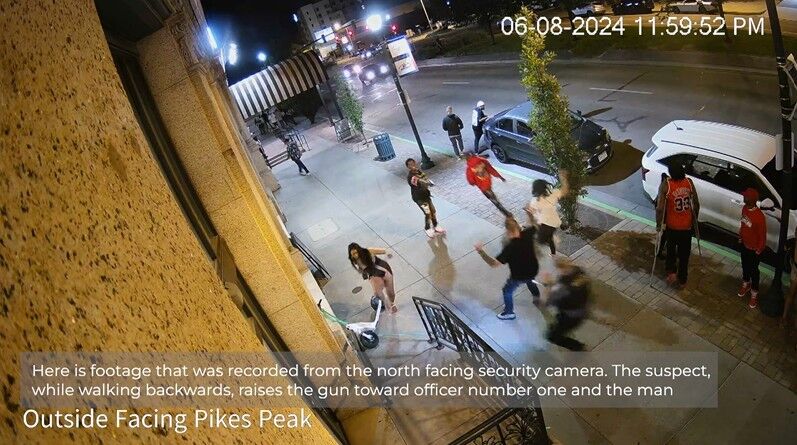
A federal judge concluded last week that a Colorado Springs police officer could not be held liable for shooting a suspect three times after the man menaced two victims with a gun and fled the scene. Al’morion Germany was involved...
PREV
PREVIOUS
Colorado Springs considers changing land-use, planning appeals process to cut out city council
The Colorado Springs City Council may no longer have the last word on appeals of land-use or planning decisions, such as rezonings and concept plan changes, if a proposed change to the new zoning code is approved. If approved, lower boards of appointees, such as the planning commission and Historic Preservation Board, would have the […]

Court of Appeals abruptly rescinds decision on race-based juror dismissal
In an “exceedingly rare” move, as one lawyer described it, the Court of Appeals has withdrawn a prior decision that found an Arapahoe County judge incorrectly handled the dismissal of two jurors of color, and issued a new opinion decided on different grounds entirely. On April 8, a three-judge appeals panel decided by 2-1 to […]