

HOLBERT | A dollar actually means one dollar

It is common for people to advocate with all the right intentions to the Colorado General Assembly in the same way that they might advocate to Congress, our federal legislature. Often times, that makes their advocacy ineffective. Why? Because over the past 144 years, the people of Colorado have amended our state constitution to make our state legislature a very different environment than that which exists in Washington, DC.
Over the past two months, Congress has authorized Paycheck Protection Programs for employers to pay employees, federal funding to counties and municipalities, and for “stimulus” checks to be sent to “We the People.” Congress can allocate more money than it collects because Congress can print and borrow money.
Meanwhile, back here in Colorado, the General Assembly cannot do those things because our state constitution requires that our state legislature pass a budget every year and that each annual budget must be balanced. Unlike Congress, the Colorado General Assembly doesn’t operate with an annual deficit each year because we cannot allocate or spend more dollars than we actually have. Thus, here in Colorado, a dollar actually means one dollar.
Our annual state budget is based on how many dollars our staff experts in the Office of Legislative Counsel estimate that the state will receive during the next fiscal year, which will begin July 1, 2020 and end June 30, 2021. As of today, they can estimate those dollar amounts. When the General Assembly convenes next January, both chambers will work to rebalance the 2020-21 budget based on actual revenues collected, along with estimates for revenues still to be collected through June 30, 2021.
What that means for the six-member Joint Budget Committee (“JBC”) is that an estimated three-to-four billion dollars must be cut from the budget that Governor Polis proposed last November. Many of the agenda items that the Governor discussed during his State of the State Address in January will not be part of the budget that passes in May or early June. Why? Because, here in Colorado, a dollar means a dollar and, our current estimates are that three-to-four billion fewer dollars will be paid into the state General Fund during the 2020-21 fiscal year than were estimated prior to the COVID-19 outbreak.
Thus, to the casual viewer, it might appear that the General Assembly will be harsh, while Congress might be seen as having been generous. For better or worse, our state legislature operates under very different constitutional requirements than does Congress where the number of tax dollars paid into the system has little bearing on how many dollars are allocated or spent by our federal government.
Thus, in order to be effective, advocacy to our state legislature should embrace the fact that dollars are a finite resource here. The 2020-21 state budget will likely be hard for any of our 100 part-time, citizen, state legislators to support. However, it must pass, and it must be balanced.
Sen. Chris Holbert of Parker represents Senate District 30 in the Colorado General Assembly and serves as Senate minority leader.



Group aims to add right to hunt and fish to Colorado Constitution
Marissa Ventrelli
marissa.ventrelli@coloradopolitics.com
Updated 38 minutes ago
A group is seeking to make Colorado the 25th state in the nation with an established constitutional right to hunting and fishing through a proposed ballot initiative. Backed by the International Order of T. Roosevelt, a group dedicated to preserving...

Colorado Politics Calendar June 15-21
Rachael Wright, Special to Colorado Politics
rachael.wright@coloradopolitics.com
Updated 3 days ago
CoPo’s weekly political calendar helps you find political and public policy events throughout Colorado. It includes candidate and issue campaign events, public policy meetings, court hearings, state and local party conventions, assemblies, debates, rallies, parades, speaking engagements, traveling dignitary appearances,...

A primary brings out primal instincts | SONDERMANN
Eric Sondermann
eric-sondermann@coloradopolitics.com
Updated 2 days ago
There are no Stanley Cup finals or NBA title showdowns involving local teams this June. In their place, we are inundated with primary election campaign ads. Coloradans can be excused for missing the diversion and alternate programming. But life can...

Dem-GOP tension dominates 1,000-bill legislative session | A LOOK BACK
Rachael Wright, Special to Colorado Politics
rachael.wright@coloradopolitics.com
Updated 2 days ago
Forty-Five Years Ago This Week: “I can honestly say that until now, we got along well with the governor’s office,” said House Minority Leader Federico Peña, D-Denver. “We visited frequently with the staff. And you didn’t see certain legislators speaking...

Hickenlooper lands endorsements from Elizabeth Warren, Ministerial Alliance in US Senate primary
Ernest Luning
ernest.luning@coloradopolitics.com
Updated 18 hours ago
U.S. Sen. John Hickenlooper won endorsements this week from a progressive Democratic colleague and a coalition of metro-area African American faith leaders as voting began in Colorado’s primary election. U.S. Sen. Elizabeth Warren of Massachusetts and the Greater Metro Denver...
Colorado justices say insurers may access policyholders’ medical info in denied-benefits litigation
Michael Karlik
michael.karlik@coloradopolitics.com
Updated 19 hours ago
The Colorado Supreme Court declined on Monday to expand its narrow prohibition on insurance companies accessing policyholders’ medical information, clarifying that a dispute over an insurer’s bad-faith decision to deny benefits is the only situation where a company is limited...

House District 14: Businesswoman, consultant square off in GOP primary
Mary Shinn
mary-shinn@coloradopolitics.com
Updated 21 hours ago
Firearms training company owner Ava Flanell will face Troy Vanderhule, the chief fundraising officer for Dobson Philanthropic, in the June 30 Republican primary for state House District 14, an area in northern Colorado Springs. Flanell was appointed to the seat...
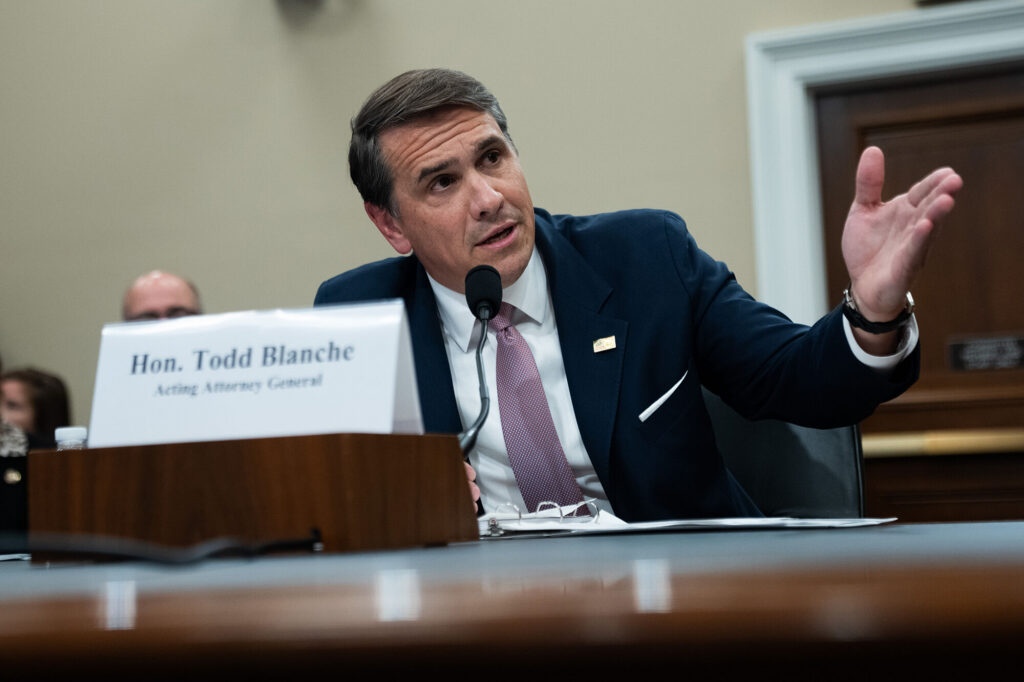
Federal judge wants Todd Blanche to swear in writing anti-weaponization fund won’t be revived
Jack Birle, Washington Examiner
jack.birle.washington.examiner@gazetteedit.wpenginepowered.com
Updated 19 hours ago
A federal judge maintained a block on the Department of Justice’s $1.776 billion anti-weaponization fund Friday, despite the DOJ claiming they have abandoned the planned fund aimed at compensating allies of President Donald Trump and others who say they were politically targeted by...
Colorado Supreme Court declines to loosen requirements for insurance company defendants
Michael Karlik
michael.karlik@coloradopolitics.com
Updated 14 hours ago
The Colorado Supreme Court declined last week to reconsider its longstanding expectations for insurance company defendants, and agreed that an insurer failed to properly raise its defenses against a policyholder’s breach-of-contract lawsuit. When an insured driver has an accident with...

Teen defendant properly transferred from youth detention to jail, Colorado justices conclude
Michael Karlik
michael.karlik@coloradopolitics.com
Updated 24 hours ago
Colorado law required the transfer of a teenage murder suspect from youth detention to the county jail when he turned 18, the state Supreme Court ruled last week. Prosecutors have accused Issac James Lawrence of killing a younger boy and attempting to...
PREV
PREVIOUS

GARCIA | We will weather the economic storm
As the Colorado General Assembly prepares to return to the Capitol on May 26, the remainder of the session will inevitably look much different than the first 67 days did. As legislators, we are facing a tough challenge. So much of what we hoped to accomplish for the people of Colorado is now on hold […]

BECKER | Nearly everyone will feel the impact
Two months ago, the General Assembly paused floor and committee work to help slow the spread of COVID-19 and protect the public, lawmakers and everyone who works in or visits the Capitol. During this pause, lawmakers have been helping constituents and connecting Coloradans with critical information, services and essential resources. House Democrats have held over […]