

Different positions, different leadership styles
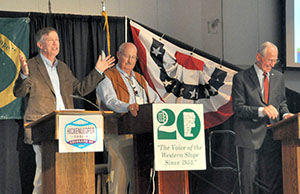
GRAND JUNCTION — While they disagreed plenty about policy, the candidates on stage on the evening of Saturday, Sept. 6 at the Club 20 gubernatorial debate differed most in the leadership styles they displayed.
Democratic Gov. John Hickenlooper stressed his approach of finding solutions collaboratively — “there’s no margin in making enemies” in the restaurant business, or governing a state, the one-time brewpub owner contended — while former U.S. Rep. Bob Beauprez, his Republican challenger, adopted a more pugnacious stance, slamming the incumbent for indecision and bowing to Washington on everything from water projects to a proposed out-of-state oil pipeline.
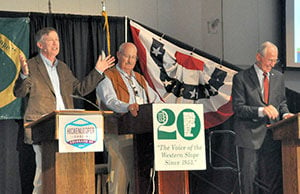
Gov. John Hickenlooper asks his Republican challenger, former U.S. Rep. Bob Beauprez, if he can count on his vote, since he’s cut regulations and overseen a rebounding economy, during the gubernatorial candidates’ first debate, moderated by Club 20 Chair Les Mergelman, on Sept. 6 in Grand Junction.

The two are locked in what looks to be a tougher reelection bid than Hickenlooper had planned, with recent polling showing a dead heat.
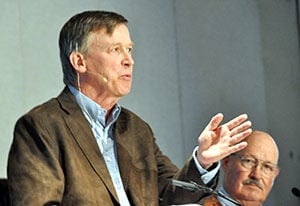
“If you’ve got bigger fish to fry, sometimes you don’t want to get into a battle over smaller things,” says Gov. John Hickenlooper as Club 20 Chair Les Mergelman, the debate moderator, looks on during Hickenlooper’s first debate with former U.S. Rep. Bob Beauprez on Sept. 6 in Grand Junction.

The one-hour debate was sponsored by Club 20, a venerable advocacy organization representing the interests of the Western Slope, and is part of a series of candidate matchups that has long been considered the kick-off to fall campaigning in Colorado. Legislative candidates squared off all morning at Two Rivers Convention Center and candidates for federal office followed the gubernatorial debate late into the night.
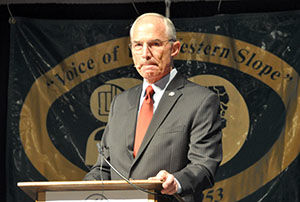
Former U.S. Rep. Bob Beauprez says that as he travels the state in his gubernatorial campaign, he hears from people angry that government is after their water, their way of life and their coal during a debate with Gov. John Hickenlooper on Sept. 6 in Grand Junction.

Beauprez and Hickenlooper painted contrasting pictures of the state, with the Republican repeatedly pointing to Utah as a state that has figured out how to spur growth by getting government out of the way and the Democrat touting an expanding economy that has persevered in the face of an unprecedented string of natural disasters and tragedies.
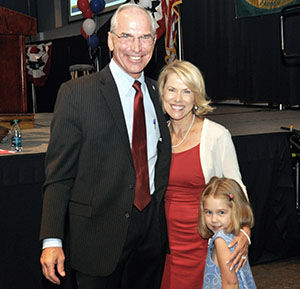
Gubernatorial candidate Bob Beauprez, his wife, Claudia, and one of their granddaughters are all smiles after he stepped from the stage following his first debate with Gov. John Hickenlooper on Sept. 6 in Grand Junction.

“The state I grew up in, the state I love, is better than what we’ve been getting,” said Beauprez in his opening remarks, claiming that Colorado’s job growth lags behind neighboring states, crushed by excessive regulations. The election, he posited, is about the question of whether “you believe and trust in government or do you believe and trust in people.”

Gov. John Hickenlooper gets a hug from his son Teddy as his wife, Helen Thorpe, looks on following a debate with former U.S. Rep. Bob Beauprez, his Republican challenger.

Despite rosy statistics the incumbent would cite, Beauprez maintained, Colorado has tumbled in recent years from second-place to 22nd-place in an annual ranking of economic opportunity in the states compiled by conservative economists for the American Legislative Exchange Council, or ALEC, an organization sponsored by major corporations and devoted to limiting government interference in the economy.
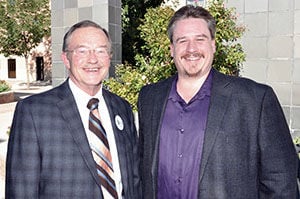
Colorado gubernatorial candidates Harry Hempy, the Green Party nominee, and Matt Hess, the Libertarian nominee, greet attendees at Club 20’s fall debates outside the Two Rivers Convention Center on Sept. 6 in Grand Junction. The two weren’t invited to take part in the debate later that evening between incumbent Democratic Gov. John Hickenlooper and his Republican challenger, former U.S. Rep. Bob Beauprez.Photos by Ernest Luning/The Colorado Statesman

Hickenlooper made a case that Colorado is doing better than Beauprez is willing to admit.When he took office, Hickenlooper said, Colorado faced a budget shortfall of nearly $1 billion and ranked 40th in the nation in job creation. Since then, he said, the state has balanced its books and seen 33 consecutive months of job growth, taking the state to fourth in the nation in job creation. Last month, he noted, its economy was ranked top in the nation by the publication Business Insider. “The only thing trending down is unemployment,” the governor said with a broad smile.
And this has all been achieved, Hickenlooper said, while facing droughts, wildfires and destructive floods, resulting in 13 federally declared disaster areas, more than any other state has endured in that short a time.
It’s about collaboration, Hickenlooper said, “not about picking fights and attacking people.”
But Beauprez sounded ready to pick some fights and go on the attack as soon as the questions from a panel of journalists and civic leaders began.
“High and dry is not a water plan,” Beauprez responded to a question about water storage. “We simply must put a shovel in the ground.”
Saying he supports building water storage, no question, Beauprez contended that regulation gets in the way of building the projects Coloradans need. “A governor needs to lead on behalf of the people to eliminate regulatory hurdles, not add to them,” he said.
Hickenlooper countered that any big water storage project will take decades to complete and that “Every conversation has to start with conservation.” He also declined to take a position on the Northern Integrated Supply Project, a proposal to build reservoirs on the northern Front Range. “I’m not allowed to take — if I took a stand on NISP, it would jeopardize the entire federal process,” he said.
“On my watch,” Beauprez rebutted, “we’re going to build”
“You should be running for Congress if you want to go back and tackle a federal issue,” Hickenlooper told Beauprez after the former congressman attacked him for embracing the federally funded Medicaid expansion, calling the deal a “Medicaid bomb” that will lead to “financial default” after the feds start requiring states to pick up some of the tab.
Beauprez tipped his hat to nearby Utah multiple times. On day one, he said, his administration plans to examine every state regulation, just as Utah’s Republican governor did when he took office. “If it isn’t pro-job, pro-economic growth, pro-opportunity, let’s get rid of it,” Beauprez said.
“These problems weren’t created in a day, and they’re not going to be fixed in four years or eight years,” Hickenlooper said in response to a question about education, but he could have been offering his take on any number of topics that came up in the debate.
Asked about hydraulic fracturing and other energy concerns, Beauprez blasted state regulations on oil and gas extraction touted by Hickenlooper as the strongest in the nation, arrived at in collaboration between energy companies and environmentalists.
“It’s chasing investment, it’s chasing jobs, it’s chasing energy development out of Colorado and punishing what we ought to be celebrating,” Beauprez said. “There’s an element of this argument that doesn’t want safe and clean energy development in Colorado,” he added. “They want nothing.”
Hickenlooper shot back that it was Beauprez who was fomenting uncertainty in the marketplace when he opposed a compromise brokered by Hickenlooper last month that led to the withdrawal of competing ballot measures and the creation of an 18-member commission tasked with proposing solutions to disputes over fracking.
On the question of returning federal lands to the state, Beauprez said he was ready for a fight, while Hickenlooper urged cooperation with the feds and neighboring states.
The state would have to come up with some $200 million annually to tend to federal lands inside Colorado’s border, Hickenlooper said. “I don’t like the federal government telling us what to do all the time more than anyone else does,” he said, but when it comes to land management questions, the best solution is to make sure the federal government does a better job, and that’s done by joining together with other western states to figure out what works.
“This is a fight we have to wage if you believe in state sovereignty, if you believe this is the way the republic is supposed to work,” Beauprez countered, adding, “You do need to stand up and push back on the federal government. This is supposed to be Colorado’s land, not the federal government’s.”
“You can pick these fights and keep going on, it’s certainly the way it’s always been done,” Hickenlooper responded. Long term, he said, the state benefits more by getting the federal government to handle its lands better.
In the fast-paced “cross-examination” portion that capped the debate, a feisty Hickenlooper emerged, pressing Beauprez on his voting record in Congress and his willingness to let the fracking measures go to the ballot rather than head them off with a compromise.
Last year, Hickenlooper said, 98 percent of the bills passed the Legislature with bipartisan support, but when he was in Congress, Beauprez voted with his party 98 percent of the time. “How is that leading?” he asked. “Because we were in the majority,” Beauprez shot back.
Then Hickenlooper asked why Beauprez was happy to see competing fracking measures head to the ballot, risking investment in the meantime, rather than broker a compromise.
Beauprez said the governor’s commission was just “kick[ing] the can down the road, as you have a habit of doing.”
Kicking the can down the road would be letting the question go to the ballot, Hickenlooper responded, “and spending $60 million on a food fight, and then have the same thing in two years, and the same thing in two years.” Doesn’t it make more sense, Hickenlooper asked, to “take the time to really hear each other” and work toward a solution where communities and energy extractors can live side by side?
When it came his turn to question the governor, Beauprez bored in on Hickenlooper’s decisions to stay the execution of death-row inmate Nathan Dunlap and to sign contentious gun-control legislation.
However the election turns out, Beauprez pressed, will Hickenlooper say that he won’t grant clemency to Dunlap, as he suggested he might in interview footage that surfaced late last month?
“My decision stands,” Hickenlooper said. “My opinion, still, is that the government shouldn’t be in the business of taking people’s lives.”
“What I have is a very firm maybe,” Beauprez grinned.
Only the most devoted politico could have followed Beauprez’s next line of questioning, well into the weeds over a discussion Hickenlooper had about gun legislation with Colorado sheriffs.
“Why did you let a staffer decide whether or not you should sign one of the gun bills?” Beauprez asked. He also asked why Hickenlooper claimed he didn’t talk with then-New York Mayor Michael Bloomberg during the gun debates, when phone records showed otherwise.
Calling Beauprez’s attacks “the Washington way,” Hickenlooper countered, “There was no decision made by a staffer” and claimed he talked to Bloomberg after, not before he made the decision to sign the bills.
“I haven’t been in politics, Bob,” Hickenlooper added, drawing hoots from the audience. (Hickenlooper served eight years as Denver mayor and is finishing his fourth year as governor, nearly three times the duration Beauprez served in Congress before losing a race for governor in 2006.)
— Ernest@coloradostatesman.com
See the September 12 print edition for full photo Coverage.
Colorado Politics Must-Reads:

Atop taxes, here’s how much each Colorado resident pays in fees
Marissa Ventrelli
marissa.ventrelli@coloradopolitics.com
Updated 1 hour ago
Each Colorado resident paid nearly $5,000 in state-sanctioned fees last year, according to a report by a policy think tank. The report, which analyzed how fees have affected Colorado’s economy, found that fee revenue has more than tripled since 2008...

Colorado National Guard, Swiss Armed Forces celebrate partnership
Marissa Ventrelli
marissa.ventrelli@coloradopolitics.com
Updated 2 hours ago
Colorado’s National Guard marked a year of partnership with the Swiss Armed Forces at the Governor’s Mansion on Monday. “This anniversary marks one strong year of friendship and collaboration between the State of Colorado and Switzerland,” said Gov. Jared Polis....
Judge allows Trump to refile $15 billion lawsuit against the New York Times
Emily Hallas
emily-hallas@coloradopolitics.com
Updated 3 hours ago
A federal judge declined to dismiss President Donald Trump’s multibillion-dollar lawsuit against the New York Times on Monday, giving him roughly four weeks to amend his case after the outlet moved to toss it on First Amendment grounds. District Judge...

Gov. Polis celebrates Colorado’s first-place education ranking by U.S. News
Marianne Goodland
marianne.goodland@coloradopolitics.com
Updated 37 minutes ago
Colorado officials said they have something to celebrate this week, in addition to the state’s sesquicentennial birthday on Saturday. U.S. News & World Report on Tuesday gave Colorado its top ranking for education efforts from pre-K to postsecondary, though it...
Denver detox center did not violate man’s rights with 10-hour hold, 10th Circuit says
Michael Karlik
michael.karlik@coloradopolitics.com
Updated 40 minutes ago
The Colorado-based federal appeals court concluded on Tuesday that Denver’s detoxification facility did not violate a man’s rights by holding him against his will for 10 hours until his blood alcohol content was projected to reach zero. Unusually, Brian Garrett’s...

Federal judge clarifies ex-GOP treasurer candidate’s burden to prove defamation claims
Michael Karlik
michael.karlik@coloradopolitics.com
Updated 39 minutes ago
A federal judge clarified last week that businessman and former Republican statewide candidate Brian Watson will need to surmount a higher hurdle in proving his claim that a party guest’s alleged description of him as a “criminal” amounted to defamation....
Denver City Council sends Xcel franchise deal to voters
Deborah Grigsby
deborah.smith@denvergazette.com
Updated 5 hours ago
This November, Denver voters will decide whether to renew the city’s longstanding franchise agreement with Xcel Energy. Members of the Denver City Council approved on Monday sending a proposed 20-year franchise agreement with Xcel that would deliver more than $180...
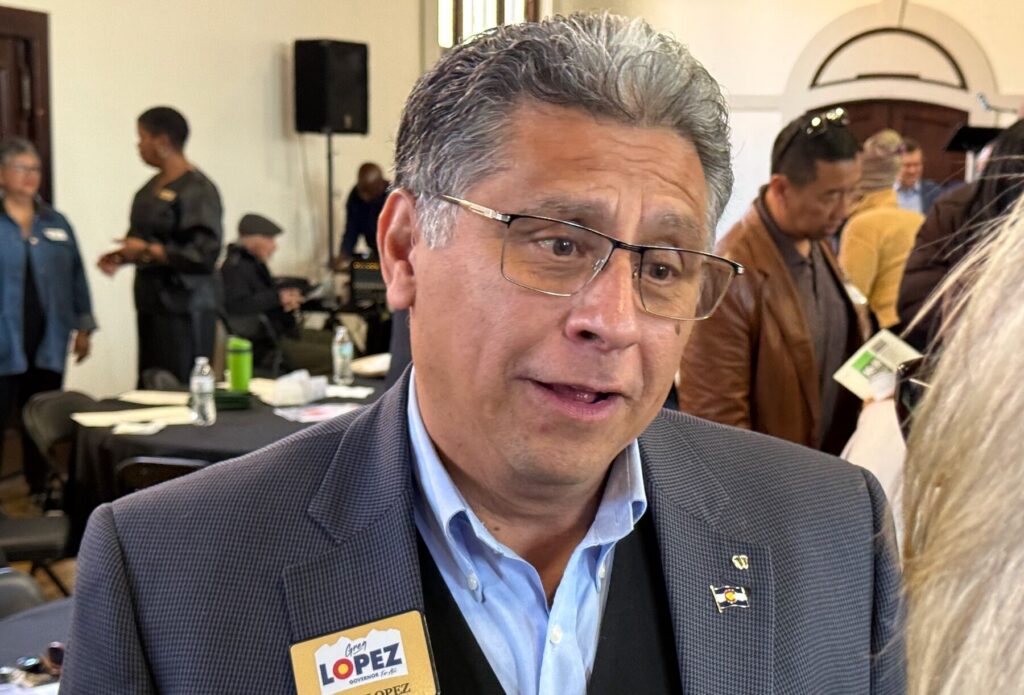
Independent gubernatorial candidate Greg Lopez, a former GOP congressman, qualifies for Colorado ballot
Ernest Luning
ernest.luning@coloradopolitics.com
Updated 58 minutes ago
Unaffiliated gubernatorial candidate Greg Lopez, a former Republican congressman from Elizabeth who left the GOP to run as an independent, has qualified for the ballot by submitting enough petition signatures, the Colorado Secretary of State’s Office said Tuesday. He’ll face...
At Colorado’s 150th anniversary, leaders offer birthday wishes
Thelma Grimes
thelma.grimes@coloradopolitics.com
Updated 7 hours ago
As Colorado’s 150th anniversary approaches, leaders from across the state reflect on the spirit that binds the plains, mountains, Western Slope and Front Range — a shared commitment, they underscored, to opportunity, community, stewardship and personal freedom. Their tributes highlight...
Fauci’s private COVID-19 diaries: Six takeaways on fame, prize money and the lab leak debate
The Washington Examiner
the-washington-examiner@coloradopolitics.com
Updated 10 hours ago
Anthony Fauci’s private writings from 2020 and beyond portray a public health official who was fixated on his growing celebrity while privately grappling with a pandemic response he believed was chaotic, leaderless and consumed by internal rivalries. The writings of...
PREV
PREVIOUS

Club 20 legislative debates run the gamut
GRAND JUNCTION — Club 20 sponsored seven legislative debates last Saturday punctuated with presentations from four candidates, three Republicans and one Democrat, who are running unopposed for re-election this year. The actual debates ranged from the overtly hostile to amiable exchanges between candidates who actually like each other. Breaks for the legislators running without opponents […]

Udall and Gardner agree on little in debate
GRAND JUNCTION – Democratic U.S. Sen. Mark Udall and his Republican challenger, U.S. Rep. Cory Gardner, clashed over the federal government’s role in virtually every aspect of life in Colorado on Saturday, Sept. 6, at their first debate, before a crowd of nearly 1,000 at Western Slope advocacy group Club 20’s fall meeting. The high-stakes, […]