

Club 20 legislative debates run the gamut

GRAND JUNCTION — Club 20 sponsored seven legislative debates last Saturday punctuated with presentations from four candidates, three Republicans and one Democrat, who are running unopposed for re-election this year. The actual debates ranged from the overtly hostile to amiable exchanges between candidates who actually like each other. Breaks for the legislators running without opponents allowed the audience to refill their coffee cups and run to the restroom. As you could expect these candidates emphasized their commitment to working across the aisle although the fact they are so secure that no one is willing to challenge them indicate that they can pretty much vote as they please.
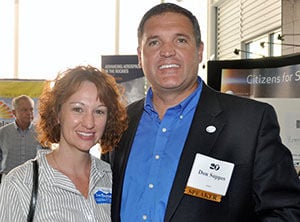
Colorado Senate District 5 Republican candidate Don Suppes, the mayor of Orchard City, and his wife, Beth, enter Two Rivers Convention Center during the annual fall meeting of Club 20 on Sept. 6 in Grand Junction.

The lucky quartet included Sen. Ellen Roberts, Republican of Durango from SD 7, and Reps. Don Coram, R-Montrose from HD 58, Bob Rankin, R-Carbondale, newly appointed to the Joint Budget Committee from HD 57, and KC Becker, Democrat of Boulder whose district also includes Clear Creek, Gilpin, Grand and Jackson counties. Several candidates had trouble with the headset microphones provided by the Two Rivers Convention Center and Roberts got a big laugh when she noted that she thought a previous debater had said, “‘I think I’m losing my mind’ when I know she hasn’t been to Denver yet; but I guess she was just losing her mike.”
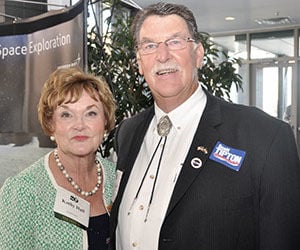
Former Mesa County Commissioner Kathy Hall and state Rep. Don Coram, R-Montrose, visit at the annual fall meeting of Club 20.

Roberts went on to recount that the Western Slope has “…different needs and different priorities” than the Front Range. She pointed out that even after 30 years of complaints, her constituents still only receive signals from Albuquerque television and the Denver Post only arrives on Sundays. She was the first speaker to hit the refrain about 85 percent of Colorado’s population living in the urban corridor along the Front Range. She bragged about carrying the bill that forced legislators into the State Water Plan process and pointed out that forest health, wildfire threat and preservation of family agriculture were her priorities.
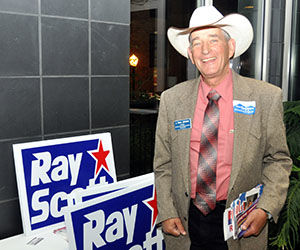
Former state Rep. J. Paul Brown, R-Ignacio, manages some campaign paraphernalia for state Rep. Ray Scott, R-Grand Junction, who is running for a state Senate seat, at Club 20’s fall meeting in Grand Junction.

Don Coram touted his role working with rural counties across the state through Club 20 to resolve the rural broadband access issue. He was the first of several to point out that Delta remains cut off from high-speed internet services. He also expressed concern that the state water discussion is proceeding too fast and ignoring the important role of forest health for capturing and retaining surface flows. As forest cover on the Uncompahgre plateau has been devastated recently, “…it is like losing a part of our reservoir system.”
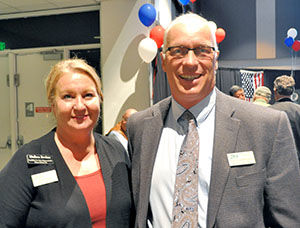
House District 61 Republican nominee Debra Irvine chats with Club 20 member Phil Chamberland between candidate debates at the western Colorado organization’s fall meeting.

Bob Rankin emphasized that he has only been a politician for five years, best known for trying to repeal the triangular Colorado LOGO recently adopted throughout state government. He expressed his intention to serve as a strong voice for Club 20 on the JBC where it has been decades since there was a West Slope legislator. He closed by proposing that Club 20 resolutions should be introduced as bills each year.
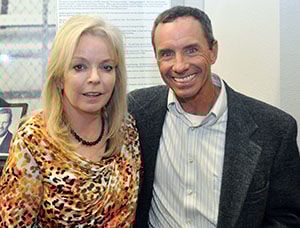
Colorado rancher Robbie LeValley and executive director of the state Department of Local Affairs Reeves Brown, a former director of Club 20, catch up during the Western Slope organization’s annual fall meeting in Grand Junction.Photos by Ernest Luning/The Colorado Statesman

KC Becker spoke to her concerns about transportation funding for the I-70 mountain corridor, which provides a critical economic ‘lifeline’ for Western Colorado. She also emphasized that water discussions should acknowledge that there is “…no such thing as new water.” Simply because water may not be allocated, or is not currently stored, does not make it ‘found water.’ She expressed concern about access and availability of health care facilities in rural counties, closing with her sentiment that it is simply too easy to amend Colorado’s constitution.
Senate District 7
Ray Scott, Republican incumbent vs. Claudette Kanola, Democrat
This debate kicked off the morning with substantial fireworks between current state Rep. Ray Scott, who is trying to move up to the Senate, and challenger Claudette Kanola. Although it didn’t get mentioned, this Senate seat is only open because of the recent resignation of Steve King, who was running for Mesa County Sheriff before a series of embarrassing expense account irregularities led to a criminal investigation. Kanola started with a litany of complaints about feeling ‘shut out of decisions’ in Mesa County during 25 years of Republican control. She pointed out that unemployment is a full percentage point higher than along the Front Range and that it was time for Scott to “…stop serving the interests of those who have failed us.”
Scott responded by indicating that he was “…taken aback by the comments from my opponent.” He pointed out that Colorado’s state government spends $2 billion a month. “We tax too much and spend too much!” However, during the question and answer period, Scott addressed an inquiry about funding for higher education by proposing that Colorado consider hiking its mineral severance taxes to levels like those in neighboring states Utah and Wyoming. Kanola appeared flummoxed by this proposal, musing that, “I find my opponent’s answer fascinating.” They were aligned, however, on the question of water and the need to protect the Western Slope from further diversions. Scott grumbled about the initial failure to involve the legislature in the development of the State Water Plan, but both agreed that the River Basin Roundtables had proved worthwhile.
On the question of fracking, Scott declared it did not require further study. Kanola agreed that, “We are sitting on a wonderful resource,” but argued that all stakeholders deserve to be heard in order to assure that drilling is performed safely. On the issue of ranching and grazing allotments, Scott argued that public lands should be managed by locals through MOUs with the federal government that limit the rights of federal land managers. Kanola countered that she was from a ranching family and believed the state role was to advocate on behalf of all public land users.
The cross examination periods, which are a unique feature of the Club 20 debate format, turned into nasty slugfests over the Second Amendment, the Colorado Sheriffs’ lawsuit, sexual harassment policy and personhood. Kanola charged that Amendment 67, a measure that would redefine the definitions of “person” and “child” in the state’s constitution to include unborn fetuses, would prompt criminal investigation of miscarriages.
House District 59
Mike McLachlan, Democratic incumbent vs. J. Paul Brown, Republican
The 2014 election is a re-run of the 2012 contest where Mike McLachlan defeated J. Paul Brown, who was the incumbent. Both men hail from La Plata County, where Brown has served on both his local school board in Ignacio and on the county commission, while McLachlan served as La Plata County attorney. They have obviously known each other for many years and agree about very little.
Brown complained about the fact that 50 percent of the roads in the district are rated in poor condition, and highlighted his public service during opening remarks. McLachlan indicated that he had replaced Brown because the district needs a legislator who can work in a bipartisan way. He then rattled off a long list of bills he had successfully carried regarding college affordability, geothermal development, renewable energy standards and veteran services. He pointed out that Brown frequently voted in a minority of one and failed to successfully advance any legislation.
One of the most conservative members of the House during his tenure, Brown couldn’t bring himself to say he was opposed to water sales because of “…the need to protect property rights.” Rather than raising taxes to address his number one priority, which is improving roads, Brown advocated transferring general fund dollars to CDOT. McLachlan pummeled him for being the only vote against background investigations for childcare workers and teen pregnancy prevention programs. Brown countered by saying that these issues were best left to local control by counties and school boards.
When McLachlan charged that Brown was a one-note candidate who claims that, “Damned Democrats are wrecking America,” the Republican replied that that word “damned” was not in his vocabulary. But he went on to say that when Barack Obama stated he would fundamentally change America during his first inaugural, that the President is in fact, “…moving us from a free society to socialism.”
Brown also labeled climate change as a hoax, pointing out that CO2 is the fuel that plants use to produce oxygen for us. The cross examination grew heated once again over guns, the economy and overweening government. McLachlan finally retorted, “I won’t tell you how to run sheep if you won’t lecture me about the law.”
Senate District 5
Republican Don Suppes vs. Democrat Kerry Donovan
Currently an open seat occupied by term-limited Democrat Gail Schwartz, this is the Senate race that may well determine the majority during the 2015 legislative session. One of the geographically largest legislative districts in the nation, it could not have produced two more contrasting or interesting candidates. Don Suppes serves as the mayor of Orchard City, outside Delta, and brags about being Colorado’s ‘most conservative’ mayor. Kerry Donovan serves on the Vail city council, has taught school there for seven years, and hails from a ranching family in Eagle County. Their political experience showed, with Donovan explaining that she “…wears both ski and cowboy boots.” She emphasized the diverse character of the district and her capacity to represent all of its communities. Suppes promised to reduce the burdens of regulation and the cost of unfunded mandates imposed from Denver, suggesting that rural school districts find themselves hiring unneeded administrators simply to fill out compliance paperwork.
Donovan, who appears remarkably young, highlighted the importance of being informed and persuasive in conversation over water, while Suppes raised concerns about the depletion of aquifers along the Front Range and predictable future raids on West Slope drainages as soon as they can claim a crisis exists. If elected he promised to ‘fix mistakes’ made by the legislature, such as the renewable energy management in SB 252. Donovan discussed the need to ‘lift up’ the middle class in order to create a vibrant economy; but pointed out that issues like broadband access can cripple rural communities, telling a story about a Hotchkiss businessman who has to drive over McClure Pass to the Roaring Fork Valley each week in order to download messages for his business.
Donovan countered Suppes’ call for making Colorado business friendly by pointing out that the state enjoys some of the lowest tax rates in the nation. During the cross examination Donovan questioned previous statements by Suppes regarding ‘creeping influence from Mexico’ and the Agenda 21 goals adopted by the United Nations in 1992 advocating sustainability priorities for national economies. Suppes explained he had attended a family wedding in Mexico and had seen a plaque (presumably in Spanish) that recounted the “…standard liberal playbook.” He objected to the fact that both of Colorado’s U.S. Senators supported the United Nations’ Small Arms Treaty controlling international weapons sales. He also charged that, “If I wanted to cripple the West Slope economy I would shut down both coal and fracking. That’s what the Democrats are doing.” On the gun issue Donovan defended background checks but criticized the gun clip limit as unenforceable. “I understand the culture of guns in the West and that we really do view them differently over here than they do in suburban and urban areas.”
House District 26
Democratic incumbent Diane Mitsch Busch vs. Republican Chuck McConell
This is a reprise of the 20012 election between two candidates who faced off in 2012 with former Routt County Commissioner Diane Mitsch Busch emerging as the victor. McConnell is a retired chemical engineer who moved to Steamboat Springs to help his daughter operate her mountain bike shop. Mitsch Busch successfully carried 13 bills during her first term including one with Republican Don Coram that dealt with low-head hydro installations. Truth be told there wasn’t that much difference between these candidates. Both are concerned about highway funding, federal rules that can conflict with Colorado jobs, strengthening Western Slope economies and building more water storage projects. During their questioning of each other, McConnell asked Mitsch Busch if her support for Amendment 66, which would have provided a billion dollars for public education but was soundly defeated last year, didn’t show she was out of touch with her constituents. She responded that this is the reason such questions are placed on the ballot. “Our decisions need to be based on facts, not on ideology or party line positions.”
House District 61
Democratic incumbent Millie Hamner vs. Republican Debra Irvine
This is another contest that pits the same contestants against each other from two years ago. One thing is abundantly clear: these women do not like each other. Hamner, the former superintendent of schools in Summit County, chairs the House Education Committee and carried 42 bills as a result. Irvine believes that Hamner focuses on educational matters to the exclusion of other matters that impact the West Slope. Hamner retorted that the Democratic majority in the House has actually focused on rural issues. Irvine rejected that claim, pointing out that Hamner has embraced state and federal rules that constrain the control of education by local school boards. Working with Sen. Michael Johnston of Denver, Hamner has helped pass an educational reform agenda aimed at strengthening teacher qualifications, classroom accountability and teacher evaluation. Hamner pointed to her work on hotel economics, I-70 mobility and medical insurance rates for residents of the mountain county.
Irvine countered with objections to the SB 252 renewable energy mandate, too much time and money spent on transportation studies and excessive student testing. She used her cross-examination opportunity to attack HB 1262, which would have provided stipends for ‘highly effective teachers,’ stripping local school boards of the right to make these determinations. The argument then wandered into the fiscal weeds regarding the use and implications of the ‘negative factor’ in calculating state school support, losing all but a handful of those in the audience. Irvine concluded by saying that the election is “…not about me. Our heritage and quality of life are at stake.” Hamner observed that she cannot please everyone with every decision she makes.
House District 55
Republican Dan Thurlow vs. Democrat Chris Kennedy
This is the Grand Junction seat currently held by Republican Ray Scott, now running for the Senate. Both candidates are long time Grand Junction businessmen. Both appeared thoughtful and well informed. They even seemed to respect each other, which was a refreshing change. Thurlow opened by explaining he didn’t see his job as one of either cutting or raising taxes, but of finding a different way to achieve legislative ends. Kennedy talked about putting the interests of working families ahead of those of special interests. He proposed that the best strategy was to create a robust business climate that created good jobs. Thurlow surprised many by indicating that he felt the state’s firefighting air fleet, approved last year, is likely ill advised and then criticized most tax incentives as nothing more than corporate welfare. In a district that leans heavily Republican, he could prove a refreshing voice in the caucus. He spoke strongly on behalf of immigration reform as a necessity for a thriving agricultural sector. We should “…recognize their contributions.” He also made it clear that the Western Slope needs to conserve water — that it wasn’t just a job for people living in Denver and Las Vegas. “That is our cheapest water!” he added. Chris Kennedy frequently found himself saying, “I agree with Dan.”
During the IR cross examination of each other, it became apparent that Grand Junction schools apparently suffer under current state funding formulas. Nonetheless, both Kennedy and Thurlow praised the quality and results produced by the local district, prompting the observation by Kennedy that success isn’t all about the money. Not to say, that both candidates would like to see a more equitable system. Thurlow promised to ‘set a high bar for myself’ if elected. “I intend to arrive trained and ready for work!” Kennedy closed by returning to the issue of working families in Mesa County and the fact that local Republicans should accept some responsibility for the failures they bemoan after three decades of political dominance.
House District 54
Republican Yeulin Willett vs. Democrat Brad Webb
The day’s final debate proved as acrimonious as any that preceded it. The seat is vacant following the departure of Republican Jared Wright under something of a cloud. Webb owns a winery in Palisade while Willett is a longstanding attorney who has also taught legal courses at several local colleges. Webb also pointed out that he used to work as a banker for JP Morgan in Denver before moving his family to the Grand Valley.
When asked what they saw as the greatest challenges facing the Western Slope over the next 10 years, Willett called out the continuing drought, which could soon threaten a loss of hydroelectric capacity on the Gunnison River. He also mentioned regulatory zeal against both coal and oil and gas production. Webb identified water and federal control of 70 percent of lands on the Western Slope, calling for greater state oversight of federal lands. He opposes any attempt to take full control pointing out that the PILT (payment in lieu of taxes) dollars received in Mesa County amount to 6 percent of local revenues. Willett called for a feasibility study to determine whether a transfer of title could ‘pay for itself,’ Webb pointed out that statewide this would cost $200-300 million annually.
Webb also concurred that School District 51 was doing a good job even though it remains underfunded by state standards. Willett expressed concern that economic pressure could lead agricultural water rights to slip into a “buy and dry” cycle that destroys the natural beauty of the region. During their questioning of each other, Willett bore in on tidbits from Webb’s Facebook page including his admiration for the late gonzo journalist Hunter Thompson and the movie The Big Lebowski, both of which take a wink-wink view of drug use. When Webb objected to the trivial nature of these queries, Willet responded, “I will withdraw the questions.” He then questioned a campaign contribution Webb received from Protect the Flows co-director Craig Mackey, whom he identified as a supporter of “in stream” water flows. Webb explained that his wife had worked with Mackey’s wife and he actually didn’t know him.
In closing, Webb pointed out that with the departure of Rep. Jerry Sonnenberg from the legislature because of term limits, he would be the only farmer in the House, if elected. Willet promised to fight radical environmentalists. They failed to shake hands as they departed.
Colorado Politics Must-Reads:

At Colorado’s 150th anniversary, leaders offer birthday wishes
Thelma Grimes
thelma.grimes@coloradopolitics.com
Updated 42 minutes ago
As Colorado’s 150th anniversary approaches, leaders from across the state reflect on the spirit that binds the plains, mountains, Western Slope and Front Range — a shared commitment, they underscored, to opportunity, community, stewardship and personal freedom. Their tributes highlight...
Fauci’s private COVID-19 diaries: Six takeaways on fame, prize money and the lab leak debate
The Washington Examiner
the-washington-examiner@coloradopolitics.com
Updated 4 hours ago
Anthony Fauci’s private writings from 2020 and beyond portray a public health official who was fixated on his growing celebrity while privately grappling with a pandemic response he believed was chaotic, leaderless and consumed by internal rivalries. The writings of...

Denver City Council sends Xcel franchise deal to voters
Deborah Grigsby
deborah.smith@denvergazette.com
Updated 3 hours ago
This November, Denver voters will decide whether to renew the city’s longstanding franchise agreement with Xcel Energy. Members of the Denver City Council approved on Monday sending a proposed 20-year franchise agreement with Xcel that would deliver more than $180...

Denver weighs permanent restriction on low-level traffic stops
Deborah Grigsby
deborah.smith@denvergazette.com
Updated 3 hours ago
A Denver City Council committee is considering permanently limiting certain types of low-level traffic stops used to investigate unrelated crimes and requiring better public reporting about why such stops happen. Members of the Budget and Policy Committee on Monday were...
Fort Carson soldiers develop app to plan convoys as part of Next Generation Command and Control
Mary Shinn
mary-shinn@coloradopolitics.com
Updated 3 hours ago
Planning the details of a military convoy with numerous vehicles, personnel, weapons, radios and other details can take a platoon leader three days. In addition to plotting a safe route, leaders need to map out checkpoints to track the convoy’s...
Penley fire near Sedalia reaches 75% containment
Nicholas Fogleman
nicholas.fogleman@denvergazette.com
Updated 3 hours ago
Fire crews battling the Penley fire west of Sedalia made significant progress overnight, holding the wildfire at about 3 acres and reaching 75% containment Monday, according to Douglas County officials. The fire, which sparked Sunday west of Sedalia, prompted evacuation...
Colorado board permits state to appeal injunction against arthritis drug price cap
Marissa Ventrelli
marissa.ventrelli@coloradopolitics.com
Updated 3 hours ago
A Colorado board voted Friday to allow the Attorney General’s Office to fight an injunction against a price cap on a drug that treats arthritis. A U.S. district court judge had granted the company Amgen a preliminary injunction, temporarily blocking...
Federal judge rejects constitutional claims, ‘expressions of hatred’ by Club Q defendant
Michael Karlik
michael.karlik@coloradopolitics.com
Updated 18 hours ago
A federal judge rejected a defendant’s claims that he received constitutionally ineffective assistance of counsel while facing federal hate crime and firearms charges for murdering five people at a Colorado Springs LGBTQ nightclub in 2022. Anderson Lee Aldrich is serving...

Divided 10th Circuit upholds Colorado congestion fee on car rentals
Michael Karlik
michael.karlik@coloradopolitics.com
Updated 15 hours ago
The Denver-based federal appeals court concluded on Monday that a 2024 “congestion impact fee” that lawmakers imposed on short-term vehicle rentals did not conflict with a federal prohibition on certain airport-related charges. Beginning in the 1970s, Congress began limiting the...

Space Force should measure workforce needs as it prepares to double in size, GAO report says
Mary Shinn
mary-shinn@coloradopolitics.com
Updated 24 hours ago
The Space Force needs more people. It’s just not precisely sure how many more. A Government Accountability Office report released earlier this month found that the youngest and smallest military branch does not have a process to consistently or accurately...
PREV
PREVIOUS
A sweet fundraiser for Hick in the heart of Grand Junction’s ‘Peach Country’
Deputy Attorney General Bernie Buescher, a former Democratic state representative and former secretary of state, and his wife Mary Beth hosted a fundraiser for Gov. John Hickenlooper in Grand Junction prior to the Club 20 debate Saturday afternoon. While Mesa County leans heavily Republican, 40 or 50 supporters of the Democratic incumbent enjoyed Palisade peaches […]

Different positions, different leadership styles
GRAND JUNCTION — While they disagreed plenty about policy, the candidates on stage on the evening of Saturday, Sept. 6 at the Club 20 gubernatorial debate differed most in the leadership styles they displayed. Democratic Gov. John Hickenlooper stressed his approach of finding solutions collaboratively — “there’s no margin in making enemies” in the restaurant […]