Proposal to cap Colorado income tax rate qualifies for November ballot

Election officials on Thursday confirmed that the proposal to cap the state’s income tax at the current rate submitted signatures and voters will consequently decide its fate this November.
The fight over tax rates is part of the tug and pull in Colorado between opposing political forces feuding over state revenue. One side of that fight argues that Colorado isn’t generating enough revenue to spend on state priorities, such as education. The competing side counters that the state already collects enough — but policymakers’ spending priorities are misplaced.
The Secretary of State’s Office on Thursday cleared Initiative No. 232 after Advance Colorado, the group behind it, submitted more than 184,000 signatures to get it on the ballot. The state’s Elections Division said the number of valid signatures exceeded the threshold required for qualification.
Initiative No. 232 would set a statutory cap on Colorado’s income tax rate at 4.4%, positioning itself as a counter to a separate proposal seeking to undo the state’s flat rate in favor of a graduated system.
Backers of the graduated tax proposal — which would marginally decrease the tax liability for the lower ends of the new bracket, while raising taxes for others — earlier turned in 157,000 signatures.
After submitting signatures for verification, Michael Fields of Advance Colorado said the tax cap measure intends to block efforts to raise taxes, thereby maintaining the state’s Taxpayer’s Bill of Rights framework.
Colorado is one of 15 states with a flat income tax, meaning all taxpayers pay the same percentage regardless of income.
The measure Advance Colorado is looking to counteract is Initiative No. 195, backed by the Bell Policy Center and the coalition Protect Colorado’s Future, which would replace Colorado’s flat rate with brackets.
Initiative No. 195 would set up a six-tier structure for state income taxes. Those making between $100,000 and 500,000 will get a tax cut on the first $100,000 of their annual income, though they’ll pay the same rate for income between $100-500k.
| Income $0-$25,000 | 3.7% |
| $25,001 to $100,000 | 4.2% |
| $100,001 to $500,000 | 4.4% (state’s current tax rate) |
| $500,001 to $750,000 | 7.4% |
| $750,001 to $1,000,000 | 7.9% |
| $1,000,001 and above | 8.4% |
For those with incomes above $500,000, they’ll only pay the higher rate on the amount of income exceeding those thresholds.
So, someone making over $1,100,000 per year, for example, will only pay 8.4% on the last $100,000 of income. The effective rate they’ll pay on their overall taxable net income would be 6.21%, according to the proponents.
Ballot measures need 124,238 valid signatures to qualify for the ballot, though constitutional amendments face an additional requirement — they must also obtain signatures from 2% of registered voters in each of the state’s 35 senate districts. To pass, constitutional amendments must be approved by 55% of voters.
Initiative No. 195 contains both a constitutional section and statutory provisions. The second part of the measure is statutory and contains the tiered income tax rates.
The state’s title board, which determines whether a ballot measure meets the constitutional rule that it contain only a single subject, concluded back in January that, while it changes the state constitution, it would not need approval from 55% of voters. However, it would need signatures from 2% of registered voters in Colorado’s 35 Senate districts.
If approved at the ballot box, it is expected to generate $2 billion more in tax revenue for the state.
Election officials still need to determine if Initiative No. 195 has met the signature threshold in order to appear on the November ballot.
So, if both pass, which one becomes law?
It’s the one with the most votes — even when one of them changes the state constitution.
Mario Nicolais, an attorney who specializes in election law, pointed out that most of No. 195 is statutory. The part that changes the state constitution only repeals a portion of Article 20 and doesn’t add language to the state constitution. That’s also the view of the title board.
Therefore, the measure with one more vote than the other will become law, he said.
Chris deGruy Kennedy, who heads the Bell Policy Center and is listed as one of two proponents for No. 195, weighed in on what happens if both measures pass — meaning each receives more than 50% of the vote.
“The precedent in the process is reasonably clear and then there’s a little bit that will be left up to judicial discretion later in the year,” deGruy Kennedy earlier told Colorado Politics.
The first step after the election, if both measures pass, is an analysis by the state Supreme Court. He said the court will look at which components of the ballot measure do not conflict with each other and can go into effect.
That will apply to his proposal, since the competing ballot measure has no constitutional impact.
One result of that, according to deGruy Kennedy, is that a future Colorado General Assembly would have the ability to refer tax measures to the ballot without needing a two-thirds vote of lawmakers.
After that, the court will look at the conflicts between the two ballot measures, he said.
That’s where it gets interesting and it goes back to the challenges to Initiative No. 195 that went to the state Supreme Court earlier this year.
Because the court decided that it met the single-subject requirement, it also means that its tax increase and tax cuts provisions are not severable. He said if the court decided in favor of Initiative No. 232, none of the changes in Initiative No. 195 would go into effect — not the tax hikes nor the tax cuts.
He added that his coalition would be “bummed” if the tax rates contained in No. 195 don’t go into effect.
Fields of Advance Colorado, meanwhile, believes that if both pass but his proposal gets more votes and therefore becomes the controlling law, the state’s income tax rate would be capped at 4.4% — and at the same time Initiative No. 195’s tax cuts for the lower brackets would take effect.
That would mean a loss of state revenue.
He told Colorado Politics that, if both pass, the competing measure’s increased rates above 4.4% would not happen but that the lower rates would go into effect, since there’s no conflict between the two initiatives on this specific issue.
“It isn’t all or nothing,” he said.
Reporter Marianne Goodland contributed to this article.


Healthcare Freefall: Telluride mother’s roadside birth underscores shrinking access to OB care in Colorado
Rachael Wright, Special to Colorado Politics
rachael.wright@coloradopolitics.com
Updated 4 hours ago
Editor’s Note: Colorado’s healthcare system is entering a period of accelerating instability — a “tsunami,” as multiple leaders describe it — driven by collapsing hospital finances, shrinking Medicaid reimbursements, disappearing services and a political fight over who is responsible for...

Healthcare Freefall: Longer drives, fewer options for maternity care in Colorado
Thelma Grimes
thelma.grimes@coloradopolitics.com
Updated 4 hours ago
Editor’s Note: Colorado’s healthcare system is entering a period of accelerating instability — a “tsunami,” as multiple leaders describe it — driven by collapsing hospital finances, shrinking Medicaid reimbursements, disappearing services and a political fight over who is responsible for...

Healthcare freefall: Breast cancer survivor shares strain of rural treatment travel
Hap Fry, Special to The Gazette
hap-fry@gazette.com
Updated 4 hours ago
Editor’s Note: Colorado’s healthcare system is entering a period of accelerating instability — a “tsunami,” as multiple leaders describe it — driven by collapsing hospital finances, shrinking Medicaid reimbursements, disappearing services and a political fight over who is responsible for...
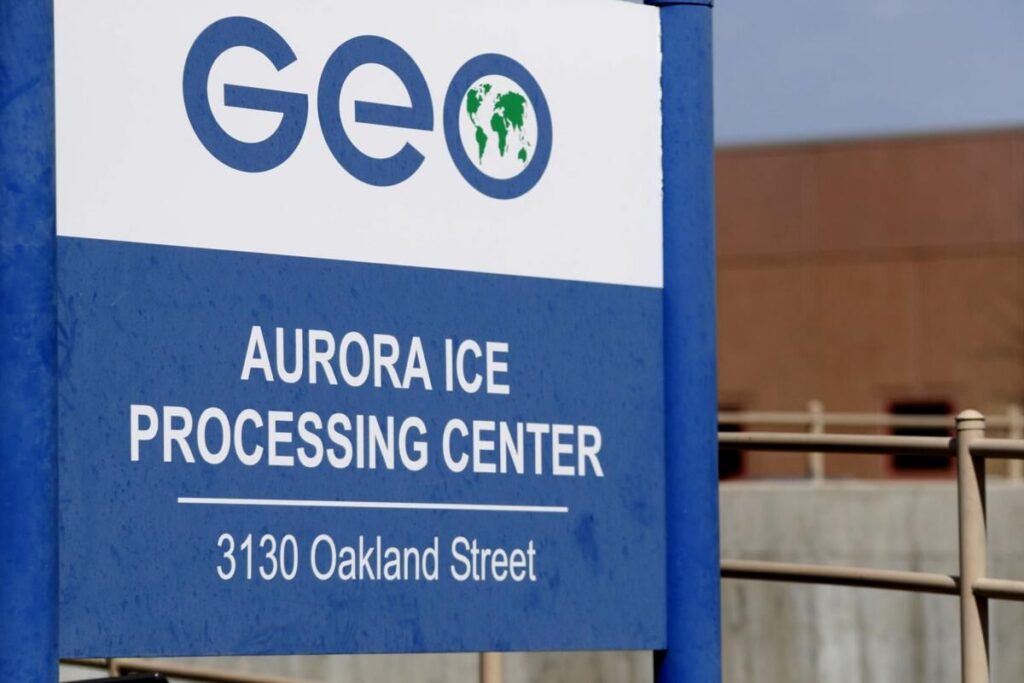
Judge grants partial injunction to GEO in fight against state health inspection law
Kyla Pearce
kyla.pearce@gazette.com
Updated 19 hours ago
A judge ruled Thursday that The GEO Group does not have to follow parts of a new state law requiring more frequent health and safety inspections at the U.S. Immigration and Customs Enforcement processing center in Aurora. Under the order...

Parker man faces 20 years to life for serial sexual assaults
Nicholas Fogleman
nicholas.fogleman@denvergazette.com
Updated 22 hours ago
A 25-year-old Parker man who sexually assaulted three women in 2025 pleaded guilty Wednesday and will serve 20 years to life in prison. Javier Rodriguez-Andrade pleaded guilty to charges stemming from three sexual assaults involving women ages 19 to 24. ...

Douglas County moves to Stage 1 fire restrictions following recent rain
Nicholas Fogleman
nicholas.fogleman@denvergazette.com
Updated 22 hours ago
Douglas County has downgraded its fire restrictions from Stage 2 to Stage 1 on Thursday following recent rainfall and moderate fire conditions, according to the Douglas County Sheriff’s Office. The change applies to unincorporated Douglas County, as well as the...

Democratic gubernatorial candidate Phil Weiser promises to appoint rural outreach director, water adviser
Marianne Goodland
marianne.goodland@coloradopolitics.com
Updated 3 hours ago
Democratic gubernatorial candidate and current Attorney General Phil Weiser told the Colorado Water Congress Thursday he intends to appoint a rural outreach director and a water policy adviser should he win the election in November. Weiser’s speech at the Steamboat...
Man charged in Northglenn homicide of wife
Matt Kyle
matt.kyle@denvergazette.com
Updated 22 hours ago
A man has been formally charged with murder and burglary relating to a homicide last week in Northglenn. Alexei Munive-Rodriguez, 48, was arrested Sunday after he was at large following the homicide, which occurred Friday. Police were dispatched around 10:30...

Attorney General candidates present priorities at Colorado Water Congress
Marianne Goodland
marianne.goodland@coloradopolitics.com
Updated 4 hours ago
The two major-party candidates for attorney general — Republican Michael Allen, the district attorney for Teller and El Paso counties, and Democratic Secretary of State Jena Griswold — on Thursday outlined their priorities at the Colorado Water Congress. Griswold attended...

Denver named finalist for 2028 Democratic Convention site
Thelma Grimes
thelma.grimes@coloradopolitics.com
Updated 20 hours ago
The Mile High City competes with Boston and Philadelphia The list of cities being considered to host the 2028 Democratic National Convention has narrowed even further, with Denver making the cut as one of the final three, along with Boston...