

The fight should be against corporate power, not local news | GUEST COLUMN

By Sara Almerri
Having practised competition and antitrust law for much of my professional career, I have litigated these issues, studied the doctrine, and watched competition policy evolve across two legal systems. It is from that perspective I offer a different view of the challenge to the proposed Nexstar–TEGNA merger brought by 13 state attorneys general, including Colorado, together with DirecTV.
I hold Attorney General Phil Weiser in the highest regard. His commitment to consumer protection and principled competition enforcement is well established. It is precisely because of that respect that I believe this case deserves a broader perspective.
The proposed transaction has already undergone extensive scrutiny by both the Federal Communications Commission and the Department of Justice. Following their respective reviews, the agencies permitted the merger to proceed, subject to the FCC’s requirement that Nexstar divest six television stations. In announcing the decision, the FCC Chairman observed the agency remained focused on empowering local broadcasters to serve their communities consistent with their public-interest obligations.
The present litigation contends the merger will increase prices, weaken local journalism, and substantially lessen competition. Yet that analysis relies heavily upon a regulatory framework developed for a broadcasting marketplace that no longer exists. The media landscape has been transformed by the emergence of global digital platforms — including Google, Meta, Amazon, Netflix and YouTube — which now command enormous audiences, advertising revenue and market influence. Any meaningful competitive analysis must account for that modern reality.
The retransmission-fee argument advanced by DirecTV likewise deserves careful examination. DirecTV, itself a significantly larger company than Nexstar, argues the combined entity would possess greater bargaining power in negotiations with distributors, ultimately resulting in higher prices for consumers. However, retransmission fees are not imposed unilaterally; they are the product of commercial negotiation between sophisticated market participants.
Viewed objectively, the dispute appears less about consumer welfare than about the relative bargaining positions of two large commercial enterprises. Competition law exists to protect the competitive process and consumers — not to shield market participants from robust commercial negotiation or from paying market value for content from which they derive substantial commercial benefit.
The preliminary injunction issued by the federal court in Sacramento halted integration pending trial; it did not determine the merger is unlawful. Such injunctions frequently reflect judicial prudence while the evidence is fully developed, rather than a final determination on the merits. At trial, the plaintiffs will bear the burden of demonstrating the transaction is likely to substantially lessen competition within properly defined markets — a demanding evidentiary burden.
Equally important is the broader context in which this case arises. According to Northwestern University’s Medill School of Journalism, more than 270,000 local news jobs have disappeared since 2005, while approximately 50 million Americans now live in communities with limited or no meaningful local news coverage. Those figures illustrate not simply an industry in transition, but one confronting profound structural change.
Against that backdrop, preventing a transaction that federal regulators have already examined and allowed to proceed risks producing precisely the opposite outcome that competition law seeks to achieve. If local broadcasters are denied the scale necessary to compete effectively, the principal beneficiaries are unlikely to be consumers. Rather, they may be the global technology companies that already dominate advertising markets and increasingly control the distribution of news and information.
Attorney General Weiser has earned a reputation for thoughtful and principled leadership. I respectfully encourage him to consider whether the greater competitive challenge today lies not with strengthening local broadcasters, but with the extraordinary concentration of economic power among a handful of digital platforms that have fundamentally reshaped — and in many respects diminished — America’s local media ecosystem.
Competition law is intended to preserve competition, not competitors. It should encourage markets to evolve where doing so ultimately benefits consumers. In today’s media environment, allowing responsible consolidation among local broadcasters may prove essential if local journalism is to survive and compete against trillion-dollar technology companies.
The Nexstar–TEGNA transaction is undeniably complex. Reasonable minds may differ on its competitive effects. Yet on balance, there is a compelling argument permitting the merger to proceed will better serve consumers, strengthen local journalism, and promote competition where it matters most — in the marketplace that exists today, rather than the one that existed generations ago.
Sara Almerri has been a practicing attorney for 26 years. She is a 2000 graduate of the College of Law at Oxford University and was admitted to the New York Bar in 2024. She currently resides in Denver.


The Denver Broncos are on the ballot this fall | Jon Caldara
Jon Caldara
jon-caldara@coloradopolitics.com
Updated 2 days ago
Do you want the Broncos to win the Super Bowl? Then you’d better hope Amendment 87 — which brings back Colorado’s economy-strangling “graduated” income tax — loses at the ballot box this fall. Seriously. Forget Republicans and Democrats. Forget tax...

Was there ever a Colorado city that required racial segregation by law? | BOB LOEVY
Bob Loevy
bob-loevy@coloradopolitics.com
Updated 1 day ago
The answer is “yes.” The Black Racial Equity Study Commission, led by Colorado Senate President James Coleman, has learned the city of Fruita had laws forbidding black people from being on the city streets at night and from being buried...

Immigration reporting measure fuels debate over Colorado’s role with ICE
Marissa Ventrelli
marissa.ventrelli@coloradopolitics.com
Updated 13 hours ago
A coalition of advocacy groups and several district attorneys rallied outside the Colorado Capitol on Thursday to oppose a ballot measure that, if approved by voters in November, would require state and local law enforcement to cooperate with federal immigration...

Ballot measure aims to shift Colorado sporting goods tax revenue to land, water and wildfire projects
Marissa Ventrelli
marissa.ventrelli@coloradopolitics.com
Updated 13 hours ago
Colorado voters this November will decide whether to direct a share of sales tax revenue from sporting goods — including bicycles and skiing equipment — toward land and water conservation, wildfire prevention and expanding outdoor recreation. Supporters say the measure...

Fighting for every Colorado rural hospital on the eastern plains | GUEST COLUMN
Colorado Politics
colorado-politics@coloradopolitics.com
Updated 2 days ago
By Lauren Boebert After touring Melissa Memorial Hospital in Holyoke and Wray Community District Hospital — two of more than a dozen rural hospitals in my district — I was again reminded why I fight for them in Washington. The...

Fix Colorado without shortchanging taxpayers | GUEST COLUMN
Colorado Politics
colorado-politics@coloradopolitics.com
Updated 2 days ago
By Lisa Frizell If we truly want to fix Colorado, we must respect taxpayers, demand accountability and prioritize classroom results. Proposition NN fails the test. The far left put forth this measure, presenting it as the only way to fund public...

New anti-gun legislation is about preventing firearm ownership, not safety | GUEST COLUMN
Colorado Politics
colorado-politics@coloradopolitics.com
Updated 2 days ago
By Ava Flanell It’s been a little more than a month since the most radical anti-gun legislation went into effect in Colorado history: Senate Bill 25-003. Originally intended as an “assault weapons ban,” Colorado Democrat sponsors settled for a complicated...
Denver sues Trump to block armed ICE agents from polling sites
Deborah Grigsby
deborah.smith@denvergazette.com
Updated 3 days ago
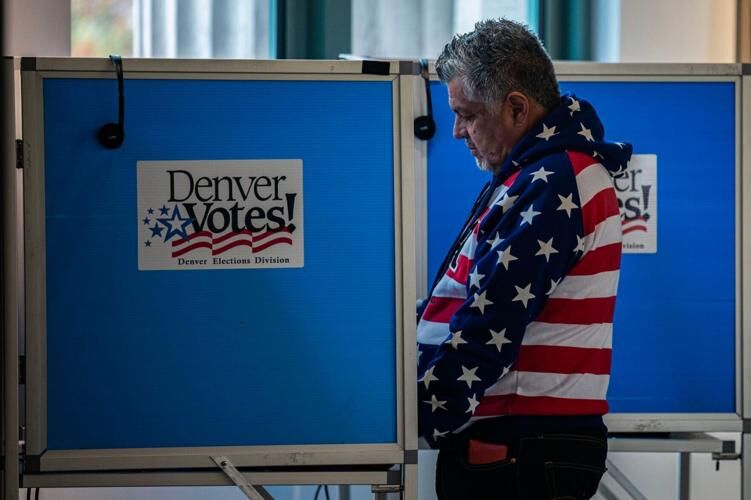
The city of Denver, along with several groups, sued the Trump administration Thursday, seeking to block U.S. Immigration and Customs Enforcement officers who are armed from polling sites during the upcoming midterm elections. In fact, there are no official orders...

Colorado doctors, dentists challenge state law on gender‑transition services in new federal lawsuit
Marissa Ventrelli
marissa.ventrelli@coloradopolitics.com
Updated 10 hours ago
A group of Christian doctors and dentists has filed a federal lawsuit challenging a Colorado law they say requires them to provide gender‑transition services that conflict with their religious and ethical beliefs. The lawsuit, filed by the Christian Medical and...

Colorado ed department must up its competence to prevent waste, fraud, abuse | Paula Noonan
Paula Noonan
paula-noonan@coloradopolitics.com
Updated 3 days ago
The Colorado Department of Education let $24 million fly from its checking accounts from January 2017 through June 2026 to CHE, aka Colorado Homeschool Enrichment. The details show how easily CHE and Education Re-Envisioned BOCES re-envisioned how to convert public...
PREV
PREVIOUS
Signatures submitted to cap Colorado’s income tax rate
The group behind a ballot measure aiming to cap the state’s income tax at the current rate has submitted signatures from voters to election officials for review, part of the tug and pull in Colorado between opposing political forces fighting over state revenue. That fight is taking shape as the contending sides push their diametrically […]

Energy security starts at home | GUEST COLUMN
By Carly West With Colorado’s legislative session behind us and a new group of lawmakers preparing to take office next year, now is a good time to step back and consider a broader question: What role should Colorado play in America’s energy future? For most Americans, energy security isn’t something they think about every day. […]