

Colorado Supreme Court: Redistricting plans for 2028 election cannot proceed under state constitution
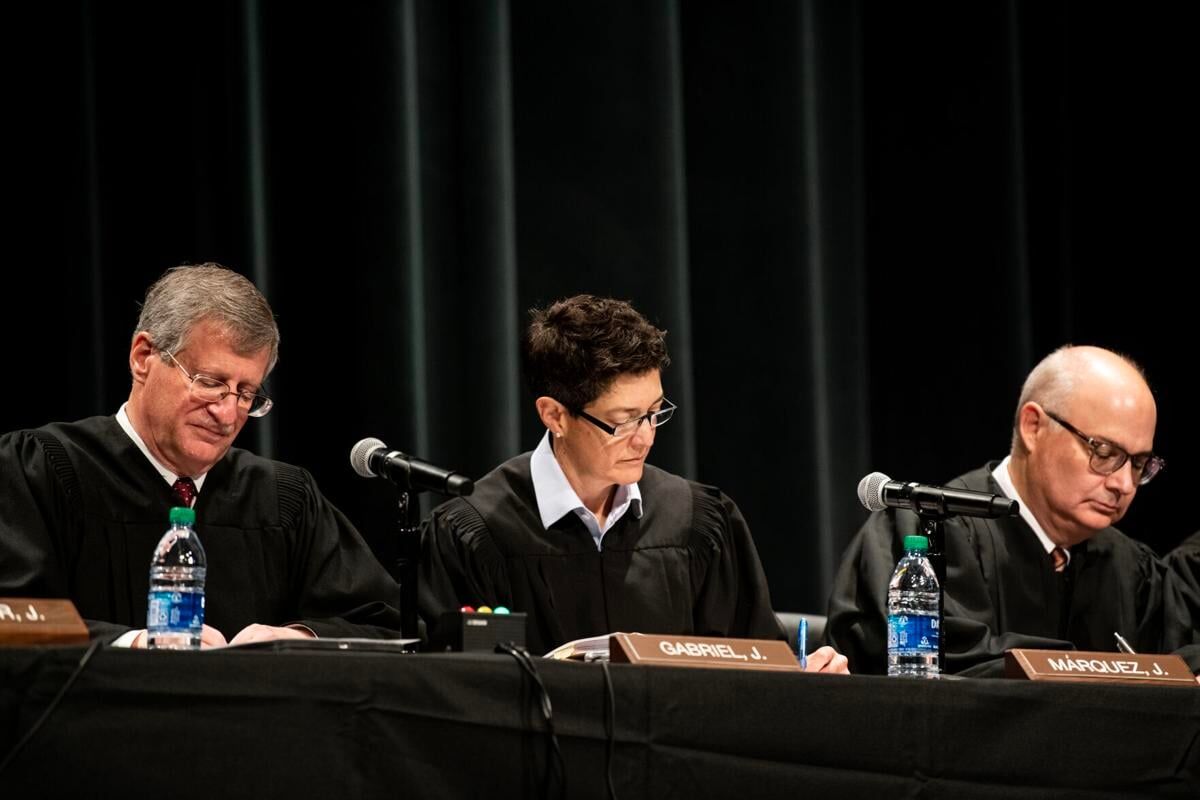
The Colorado Supreme Court blocked all attempts at redrawing congressional district boundaries for the 2028 election from reaching the ballot on Monday, concluding each of the proposed ballot measures violated the constitutional single-subject requirement.
The court considered five distinct but related ballot measures. Half of the proposals would have redrawn U.S. House of Representatives districts to give Democrats an overwhelming advantage, while the other half would have alternatively given Republicans a slightly larger advantage over the status quo. There was also a separate measure to alter the redistricting commission that drew the current boundaries.
The Supreme Court held that changing the state’s process for redistricting and approving new maps, either together or through separate interlocking initiatives, violated the Colorado Constitution.
“To conclude otherwise and to allow initiative proponents to proceed with interlocking measures like those at issue here would allow proponents to achieve indirectly what they could not achieve directly and would endorse an end run around the single subject requirement. This we cannot do,” wrote Justice Richard L. Gabriel in the June 29 opinion pertaining to the three interlocking ballot measures.
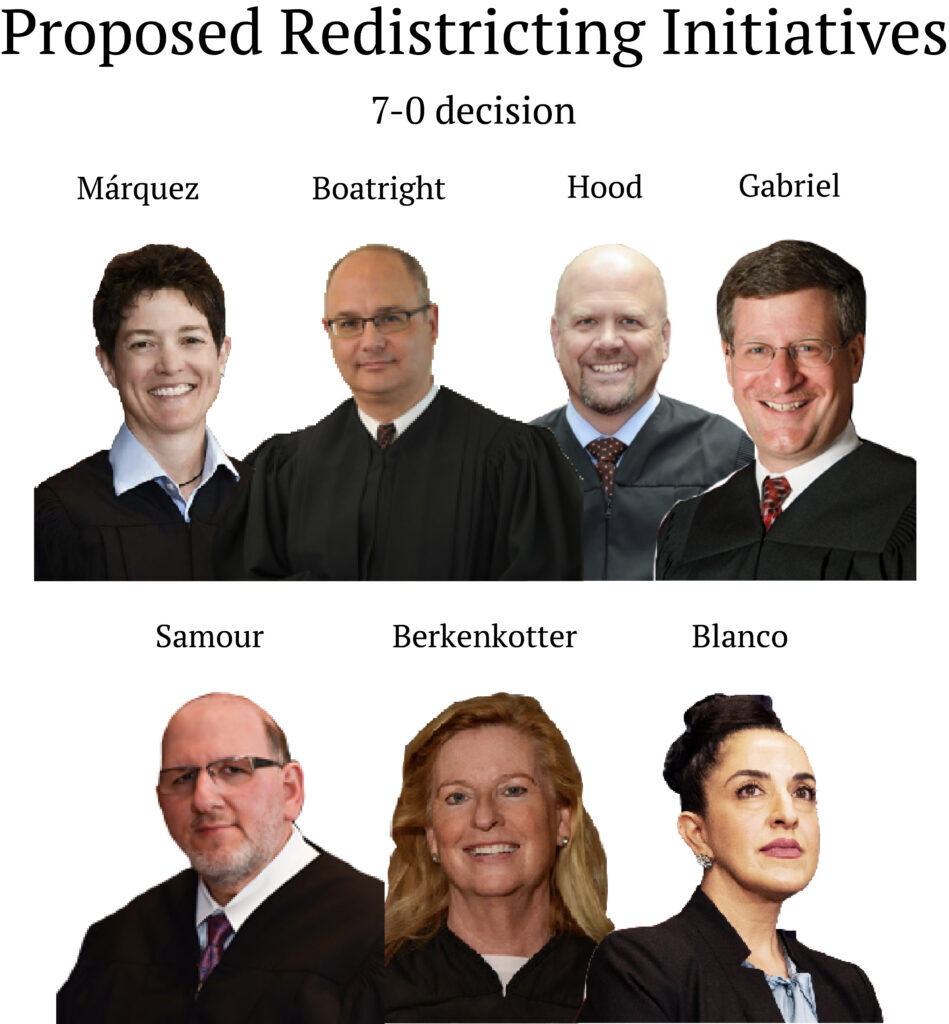
The proposed initiatives arose as part of an unprecedented national effort to redraw congressional districts for partisan advantage ahead of the 2026 and 2028 elections.
Last year, the Texas legislature, at the urging of President Donald Trump, redrew its House districts in advance of the next census to give Republicans the ability to win five more districts over the existing map. The move came as Democrats appeared, according to observers, likely to win a majority in this year’s elections for the U.S. House.
Then California voters approved a ballot measure in November to create a map with five additional seats favoring Democrats.
According to the National Conference of State Legislatures, 10 states have completed mid-decade redistricting to date, with more GOP-run states redrawing their districts. In some states, courts have rendered the ultimate decision.
For example, in Virginia, where voters narrowly approved a constitutional amendment that drew Democratic-leaning districts, the state Supreme Court’s majority struck down the change in May. In Utah, the state Supreme Court upheld a trial judge’s order to redraw boundaries to create one Democratic-leaning district.
Then, after the U.S. Supreme Court’s 6-3 decision in Louisiana v. Callais, multiple states in the South redrew their boundaries to eliminate districts with large populations of Black voters.
In Colorado, there were five measures proposed for the 2026 general election ballot that would alter district lines and the current 4-4 partisan split of the congressional delegation. Two of them were competing proposals that would comprehensively amend the state constitution to allow for mid-decade redistricting, circumvent the independent redistricting commission that approved the current boundaries, and adopt maps for the 2028 and 2030 elections — either favoring Democrats by 7-1 or favoring Republicans by 5-3.
The measures favoring Democrats were introduced first. In response, the map tilting toward Republicans was drawn, with Scott Gessler, a Republican former secretary of state, telling the Title Board they would only work to advance their map if one measure or a combination of initiatives favoring Democrats advances.
The other three proposals, backed by either Republicans or Democrats, would have accomplished the same goal in a multistep fashion. One initiative would have moved the language governing the redistricting commission out of the state constitution. The other two proposals would then implement new 2028 and 2030 maps, favoring either Democrats or Republicans. The parallel redistricting efforts would only take effect if voters approved the change to the commission on top of a new map.
In a pair of decisions addressing each method, the Supreme Court decided neither was permissible.
“We conclude that these are distinct and separate subjects. Temporarily allowing mid-decade redistricting is not merely the means to implement or effectuate the Initiatives’ central purpose of adopting a specific new congressional district map for the 2028 and 2030 election cycles,” wrote Chief Justice Monica M. Márquez in the decision addressing the two combined measures.
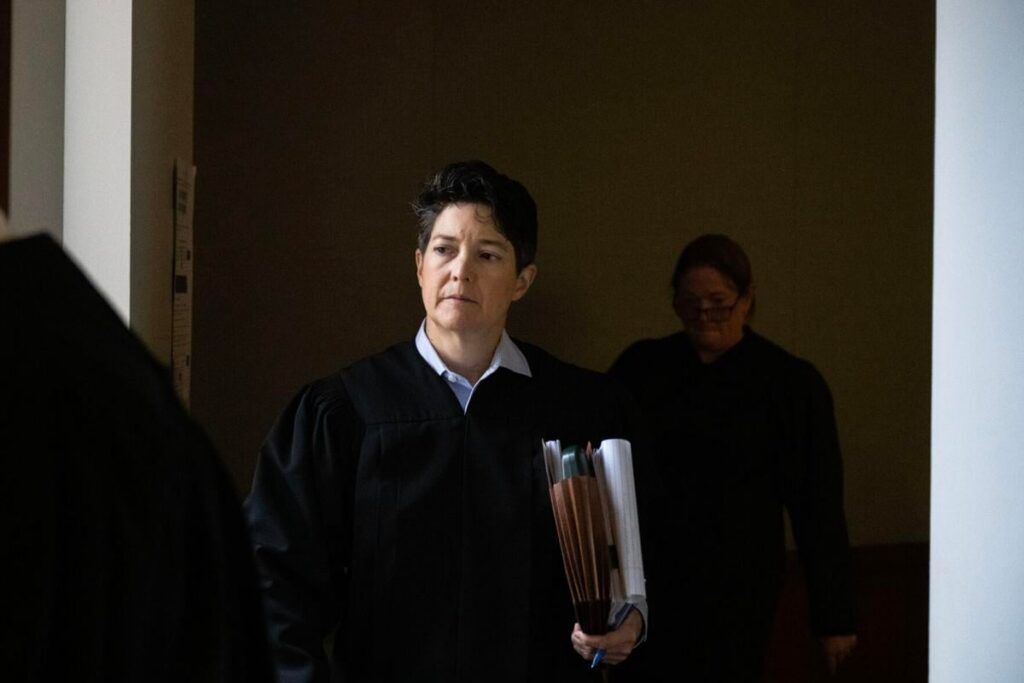
She added that authorizing mid-decade redistricting would be “a seismic shift,” and that some voters could prefer to redraw congressional district boundaries sooner or alter the redistricting commission’s power without supporting the specific maps envisioned.
“Conversely, other voters may support adopting one of the initiative’s specific maps to achieve partisan ends, but they might value the stability and continuity that comes with redistricting only once a decade,” wrote Márquez.
Gabriel, in the decision addressing the interlocking initiatives, wrote that breaking down the process into separate, but automatically connected, measures did not change the calculus.
“We conclude that the result is not different and that when a measure’s effectiveness is expressly contingent on the passage of a separate and independent measure, the measure contains multiple subjects, just as if the measures were combined into one,” he wrote.
Curtis Hubbard of Coloradans for a Level Playing Field, which advocated for the pro-Democratic measures, said the effort to counteract Trump’s national redistricting push has “been dealt a legal setback over a technicality.”
“The success of this partisan attempt to sideline Coloradans from responding to Donald Trump’s unprecedented mid-decade redistricting scheme is disappointing,” said Hubbard.
“Eight years ago, Colorado voters strongly supported an independent redistricting commission. Today, the court soundly rejected the Democratic efforts to manipulate the ballot process to overturn Colorado’s nonpartisan redistricting process,” said Gessler, who represented the proponents for the pro-GOP measures.
Gessler acknowledged that his clients’ proposals would have affected the redistricting process identically.

Colorado judge explores sanctions against DOJ, ICE for rearresting man 4 days after release on bond
Michael Karlik
michael.karlik@coloradopolitics.com
Updated 1 hour ago
A federal judge in Colorado is considering sanctions against the government after immigration agents rearrested a man four days after an immigration judge found him suitable for release on bond. On July 28, U.S. Magistrate Judge N. Reid Neureiter ordered...
Divided disciplinary panel censures Montezuma County judge after agreement reached
Michael Karlik
michael.karlik@coloradopolitics.com
Updated 8 hours ago
A disciplinary panel formally imposed a public censure, suspension, and further training on Montezuma County Court Judge Ian J. MacLaren on Tuesday by a 2-1 vote. Under constitutional Amendment H, which voters adopted in November 2024, MacLaren was set to...
Colorado’s Western Slope magistrate judges describe unique role in federal judiciary
Michael Karlik
michael.karlik@coloradopolitics.com
Updated 23 hours ago
Two of Colorado’s federal judges stationed on the Western Slope spoke to lawyers on Wednesday about their unique roles, the ways their workloads differ, and the need for more criminal defense lawyers to take cases outside the Front Range. “Here...

Denver sues Philip Morris, other tobacco companies over cigarette butt litter
Deborah Grigsby
deborah.smith@denvergazette.com
Updated 4 hours ago
Denver is demanding that some of the biggest tobacco companies in the world pay for the cleanup of discarded cigarette butts on its streets, following a similar campaign that cities in other states have pursued. Denver’s lawsuit, filed this week...

Federal judge rules that request for bond hearing not necessary to challenge immigration detention
Michael Karlik
michael.karlik@coloradopolitics.com
Updated 23 hours ago
A federal judge in Colorado ruled last week that it is not mandatory for a person to seek a bond hearing with an immigration judge before they challenge the lawfulness of their detention in federal court. For the past year,...

Boulder Valley School District introduces new policies following antisemitism lawsuit
Marissa Ventrelli
marissa.ventrelli@coloradopolitics.com
Updated 2 hours ago
The chief of Boulder Valley School unveiled new policies for the 2026-2027 school year following a lawsuit filed on behalf of a student alleging antisemitic harassment. In June, the Anti-Defamation League filed a federal civil rights complaint against the school...

Colorado NRA chapter seeks injunction against new gun‑training requirement
Marissa Ventrelli
marissa.ventrelli@coloradopolitics.com
Updated 6 hours ago
The Colorado chapter of the National Rifle Association is seeking an injunction to stop the state from enforcing a new law that took effect earlier this month. The new law requires anyone buying or selling certain firearms to first complete...
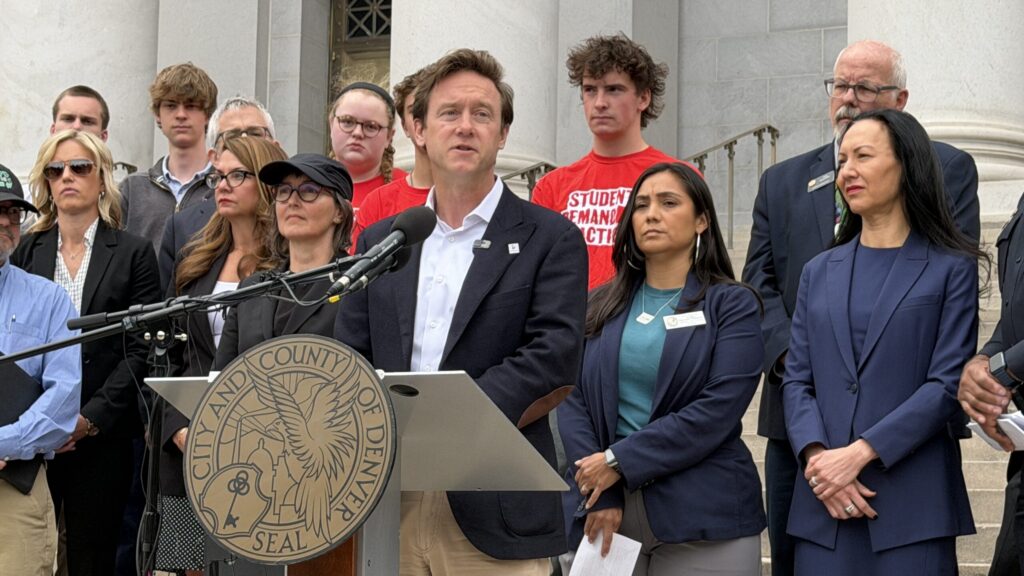
Denver moves to dismiss Trump challenge to ‘assault-style’ weapons ban
Deborah Grigsby
deborah.smith@denvergazette.com
Updated 10 minutes ago
Denver has filed a motion to dismiss a lawsuit brought by the Trump administration challenging the city’s ban on “assault-style” weapons and magazines exceeding a 15-round capacity. The U.S. Department of Justice filed a suit in federal court in May,...
Federal judge dismisses ex-Colorado judicial discipline director’s conspiracy lawsuit
Michael Karlik
michael.karlik@coloradopolitics.com
Updated 2 days ago
A federal judge dismissed a lawsuit from Colorado’s former judicial discipline director on Tuesday, finding that he failed to adequately state claims for conspiracy or constitutional violations. Christopher S.P. Gregory, who served as the executive director of the Colorado Commission on Judicial...
Federal judge allows retaliation claims to proceed against prison officials
Michael Karlik
michael.karlik@coloradopolitics.com
Updated 24 hours ago
A federal judge agreed last week that a man incarcerated at Sterling Correctional Facility had credibly alleged that employees retaliated against him for filing grievances, including by taking away his disability accommodations and turning off his electricity. Louis Peoples Jr.,...
PREV
PREVIOUS

3 firefighters who died fighting Snyder Mesa fire identified; one once worked as a snowmaker in Vail
Federal authorities on Monday identified the three firefighters who died responding to the Knowles Fire at the Colorado-Utah border, one of whom once worked for a resort in Vail. Across Colorado, several fires are burning, with zero containment in what had been a frantic and deadly start to the state’s wildfire season. The U.S. Department […]

Supreme Court rules states can count late-arriving mailed ballots, rejecting Trump-led challenge
WASHINGTON (AP) — The Supreme Court on Monday ruled that states can count ballots that arrive after Election Day, a persistent target of President Donald Trump. The 5-4 decision rejected a Republican-led attack on laws in more than half the states and the District of Columbia that permit mailed ballots to arrive and be counted […]