

Amid public pressure, Colorado candidates tackle social media regulations for minors

Following the accidental overdose of her daughter in 2020, Patti Lujan pursued a lawsuit against Snapchat, the social media platform that, she claimed, connected her daughter with a drug dealer.
In a news release announcing the lawsuit, Lujan alleged that Snapchat’s platform “‘purposefully obstructs parental supervision’ and ‘enables (drug) dealers to locate and access nearby minors and young adults.’”
The mother said she believes that Snapchat protects drug dealers by not identifying and removing them from the app, and she called for protective measures to be put in place for minors, according to news stories.
The regulatory push in Colorado is occurring all around the country, where state legislators are advancing regulations they said would protect children from social media platforms, which they accused of posing mental health and safety risks for youth.
Candidates for governor have also turned their attention to the issue, with some putting it high on their policy list.
Over the last several years, Colorado legislators tackled several measures. This year, they advanced one — Senate Bill 26-011, which requires that operators of platforms provide a system, such as a staffed hotline, for law enforcement to contact them with search warrants.
Under the new law, a “covered platform” refers to online sites or apps with at least a million monthly users that allow them to post or view content created by others or by artificial intelligence. The definition applies to chat rooms and message boards.
Two other proposals seeking more stringent regulations for social media platforms operating in Colorado also failed.
Senate Bill 25-086 would have required social media corporations to determine within 48 hours of an alleged policy violation whether the violation is valid, “and, if so, to remove the user from the applicable social media platform within 24 hours after the determination is made.”
Gov. Jared Polis vetoed the bill, saying it imposes “sweeping requirements that social media platforms, rather than law enforcement, enforce state law.”
The second bill, House Bill 26-1255, would have required social media platforms to acknowledge search warrants within eight hours and comply with them within 24 hours. Additionally, the platform would have been required to provide status updates on its compliance with the warrants.
Polis also vetoed this legislation, saying it delegates authority to social media platforms to decide what user speech qualifies as threatening.
“Determining what speech represents a true threat is a fact-intensive inquiry and one meant for our judicial process — not a private entity,” the governor said.
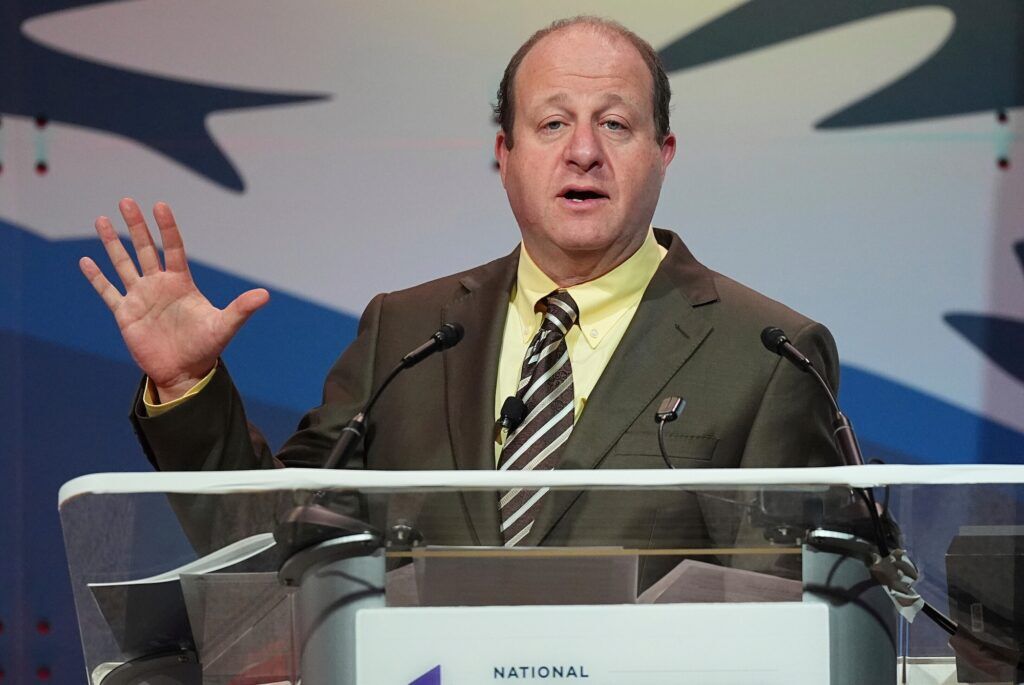
Candidates outline social media policies
Several candidates placed social media youth issues high on their priority list.
Victor Marx, a Republican candidate for governor, said he would “not repeat Jared Polis’ mistake” in vetoing one of the bills that reached his desk.
“I will work with Republicans, any Democrats willing to put kids before Big Tech and front-line law enforcement to fix the flaws in these bills and send a stronger, constitutional version back to my desk,” said Marx, a ministry leader. “When that bill truly protects kids and backs the badge, I will sign it. If the legislature sends me a weak, symbolic measure that does not actually protect children, I will veto it and demand better.”
In response to Polis’ rationale for vetoing SB25-086 — the governor said it would keep law enforcement from doing its job — Marx said: “I believe we can defend free speech and privacy while still giving parents, sheriffs and prosecutors real tools to shut down predators and dealers operating through social media.”
Attorney General Phil Weiser, who is vying for the Democratic Party’s gubernatorial nomination, said he would have signed SB 25-086, saying it would have been a big step toward saving kids from social media harm. Weiser told The Denver Gazette that he would have also signed HB 26-1255 into law.
Weiser said he would support bills to “regulate social media companies for failing to protect kids from illegal activities such as drug dealing, illegal sale of firearms, sex trafficking, and sexual exploitation.” He had joined other attorneys general in suing Meta, which owns Facebook and Instagram, alleging the company its platforms that deliberately make children and teens addicted to them.
In an email, U.S. Sen. Michael Bennet, who faces Weiser in their party’s primary, also said he would not have vetoed SB 25-086 and HB 26-1255.
“We’re facing a mental health crisis and social media is making it worse,” Bennet said through a spokesperson.
“As Governor, he’ll take on social media companies and fight for kids’ mental health. Michael is the only candidate in this race calling for a bell-to-bell ban on cellphones in schools,” the spokesperson said. “He will also support legislation to strengthen online protections for kids, including making social media accounts private by default, requiring social media companies to remove accounts targeting children, and placing stricter guardrails on AI chatbots.”
On his campaign page, Bennet also vowed to take cellphones out of classrooms, implement social media warnings and “ensure artificial intelligence is safe for kids.”
A focal point for Rep. Scott Bottoms, a Republican from Colorado Springs who is running for governor, is protecting children and defending parents’ rights, according to his campaign page.
Bottoms voted against SB 25-086. Though he did not explicitly state his reasoning for opposition, many critics argued that the bill impinged on the First Amendment.
Sen. Barbara Kirkmeyer, a Republican from Weld County who is running for governor, voted in favor of SB 25-086. She did not respond to The Denver Gazette’s request for comment.

Policymakers have been grappling with two difficulties with regulating social media platforms. First, it is difficult to prove clear, causal effects of harm from the platforms. Second, many have argued that social media platforms should not have to deal with a patchwork of regulations that’s different from state to state.
“Moving from 72 hours to 24 hours would also move Colorado out of alignment with other states, including California, who have established a 72 hour response requirement for law enforcement warrants,” Polis said when he vetoed HB 26-1255.
Critics have also argued the regulatory bills violate the First Amendment. SB 25-086, in particular, would have required social media companies to evaluate policy violation reports within 72 hours and promptly remove any users they deem guilty.
“The First Amendment does not tolerate the chilling or infringement of protected speech and the Fourth Amendment likely requires more than one report of a policy violation to trigger law enforcement searches and seizure. The loss of constitutional freedom, even for a moment, is an irreparable injury to an individual and to our democracy,” Polis said in his veto of HB 26-1255.
Some have countered that a user who engages in illegal activity forfeits First Amendment protections.
“A user who engages in illegal activity on a platform engages in conduct unprotected by the First Amendment,” wrote Weiser, who conducted a constitutional analysis at the request of the bill’s sponsors and concluded the measure is constitutionally sound.
“Unfortunately,” Sen. Lisa Frizell, R-Castle Rock, said, “the governor has chosen to take the narrative that it is a First Amendment right to sell drugs on social media or to sextort children on social media.”
“These are not First Amendment rights. Crime is not a First Amendment right,” she said, according to Denver7 News.
Meanwhile, Apple on June 8 announced new parental controls that will launch in the fall.
Parents will be able to create a “child account,” where they can choose what content their children have access to, who they can communicate with and how long they have access to the device, according to the company. The controls are customizable, so parents can tune the device to be age appropriate, Apple said.
Colorado parents who said their children were harmed by social media traveled to Washington, D.C. in April to press for more changes.
“The evidence is in. The verdict is now,” one Colorado mother said, according to CPR News. “We need action. We are calling on Congress to act. We need safety by design. We need a duty of care. We need transparency. And we need real accountability.”


Colorado can’t forget the lessons of COVID | Jon Caldara
Jon Caldara
jon-caldara@coloradopolitics.com
Updated 2 days ago
We are finally getting a clearer picture of what happened during COVID. Not because the people who locked us up, masked our faces and forced unproven chemicals into our bodies have suddenly become transparent, but because Anthony Fauci’s COVID-era diary...

Historic preservation supporters organize to oppose Trump changes | Bob Loevy
Tom Cronin
tom-cronin@coloradopolitics.com
Updated 1 day ago
Historic preservation organizations in Colorado Springs, the remainder of Colorado and across the nation are organizing to resist a recent effort to relax and weaken historic preservation laws in the United States. In Washington, D.C., the Advisory Council on Historic...

At conservative summit, Colorado Republican leaders concede Democrats’ election edge
Marissa Ventrelli
marissa.ventrelli@coloradopolitics.com
Updated 19 hours ago
Four Republican state lawmakers told attendees at a gathering of conservative leaders on Friday they doubt their party can win statewide races, noting that Colorado’s electorate has been shifting toward Democrats but adding they see an opening in several pockets....
Q&A with Mike Pence | Former vice president says GOP’s populist turn from conservatism isn’t permanent
Ernest Luning
ernest.luning@coloradopolitics.com
Updated 16 hours ago
Former Vice President Mike Pence says he’s concerned that the Republican Party has taken a populist turn away from bedrock conservative principles during President Donald Trump’s second term, but he believes the party will return to its roots when Trump...
Republican Victor Marx taps George Markert as his lieutenant governor pick in Colorado’s gubernatorial race
Ernest Luning
ernest.luning@coloradopolitics.com
Updated 2 days ago
Colorado Republican gubernatorial nominee Victor Marx named George Markert, a retired Marine colonel, as his running mate for lieutenant governor Friday morning, saying the former U.S. Senate candidate will bring “exceptional character, proven leadership and a lifetime of serving others”...
Pueblo mayor, council concoct Trumpian Texas Two-Step | Dennis Maes
Dennis Maes
dennis-maes@coloradopolitics.com
Updated 2 days ago
Several weeks ago, an article was published positing Pueblo Mayor Heather Graham is a disciple of the calamitous Donald Trump school of governance — specifically as it related to questionable ethical practices and the misuse of public funds. Recently, Graham...

Colorado can’t afford to turn its back on proven public safety technology | GUEST COLUMN
Colorado Politics
colorado-politics@coloradopolitics.com
Updated 2 days ago
By Samuel G. Michael I recently saw a report that said Colorado is leading the way in artificial intelligence adoption for businesses. Across our state, more business owners and employees than ever before use AI for their everyday functions —...

Colorado lawmakers start crafting strategy to manage $200 million in federal rural health funds
Marissa Ventrelli
marissa.ventrelli@coloradopolitics.com
Updated 3 days ago
Members of the Colorado legislature’s new Commission on Medicaid raised concerns Wednesday about the federal Rural Health Transformation Program created under H.R. 1. The bipartisan, bicameral commission, created in the last legislative session to guide implementation of Medicaid changes under...
Democrat Jessica Killin’s internal poll shows dead heat with U.S. Rep. Jeff Crank in Colorado’s 5th CD
Ernest Luning
ernest.luning@coloradopolitics.com
Updated 2 days ago
Jessica Killin, the Democratic nominee in Colorado’s 5th Congressional District, is in a statistical tie with Republican U.S. Rep. Jeff Crank, according to an internal poll released this week by Killin’s campaign. The poll of likely general election voters, conducted...

Colorado’s 72-hour social media warrant law takes effect Aug. 12
Marissa Ventrelli
marissa.ventrelli@coloradopolitics.com
Updated 3 days ago
A law requiring social media platforms to respond to search warrants within 72 hours goes into effect on Aug. 12. Senate Bill 011 also requires platforms to create a staffed hotline for Colorado law enforcement agencies to contact regarding pending...
PREV
PREVIOUS

Denver gets more time to answer FAA questions in probe regarding Key Lime lease denial
The City of Denver has asked the Federal Aviation Administration for additional time to gather information and prepare its response to the federal agency’s investigation of the city’s 2025 denial of a Denver International Airport ground lease expansion for Key Lime Air. The FAA has agreed to extend the deadline, a spokesperson for Denver Mayor […]

Federal judge declines to recuse from death penalty case after Supermax visit
A federal judge declined to recuse herself last month from a death penalty case arising out of Colorado’s “Supermax” prison, finding that her tour of the facility earlier this year did not bias her decision-making. U.S. District Court Judge Charlotte N. Sweeney is presiding over the federal murder prosecution of Ishmael Petty, who is accused […]