

State official says Fort Carson employed ‘unjustified threat’ in negotiations over historic sites

A Fort Carson training exercise set to start this weekend in southern Colorado at the Piñon Canyon Maneuver Site has put the state office charged with historic preservation at odds the Army officials, following what the state called an “unjustified threat” to end their working relationship.
Fort Carson said discussions to end the relationship were a necessary tool to adhere to strict timelines to ensure a planned monthlong training at Piñon Canyon Maneuver Site northeast of Trinidad could take place. During the training, soldiers will test a new communications system that could be rolled out across the whole Army.

For the first time at Piñon Canyon, soldiers will fire test artillery shells that are expected to damage two historic sheep ranching sites and three archaeological sites, including a area where scattered stone tools have been found.
The sites are just a handful of the 6,000 archaeological sites across the Piñon Canyon training area.
Under federal law, History Colorado staff help advise Fort Carson officials on the best way to mitigate expected damage to historic sites, but that relationship has been strained.
In a March letter to Fort Carson’s garrison commander, the State Historic Preservation Officer Dawn DiPrince said her office signed an agreement over how to mitigate expected damage to six archeological and historical sites “because of an unjustified threat” the Army would no longer work with the state on the issue.
The letter said Fort Carson’s tactics were unnecessarily aggressive and that state officials’ efforts to make suggestions and ask questions about proposed mitigation to the maneuvers “were met with disdain, excuses or a closed door.”
In a written statement provided to The Gazette, Fort Carson said the work was conducted in good faith and complied with federal law, but had to adhere to strict timelines because of the planned monthlong training in May.
“Discussions regarding the procedural option to ‘terminate consultation’ were used as a standard regulatory tool and a matter of transparency to ensure all parties understood the strict timelines required to successfully complete the consultation and support the mission,” the statement said.
From the state’s perspective, the threat demonstrated a lack of good faith to participate in a constructive dialogue, DiPrince said.
The Southern Ute Indian Tribe was disappointed with the process, according to the letter. The Southern Ute reservation is south of Durango, but the Utes and other tribes historically occupied what is now Piñon Canyon.
If the Army had decided to no longer work with History Colorado, the collaboration on the agreement that outlines mitigation efforts would have stopped, DiPrince said. The mitigation effort could include additional field work to better understand sites in Piñon Canyon, an area where History Colorado could add expertise.
To mitigate the expected damage, the Army may complete field work at other similar sites within Piñon Canyon but outside the area slated to see damage, the agreement said.
That field work could be used to help write two papers, one on the early Hispanic sheep ranching in the area and one on the Native Americans who lived in the area and their rock art.
Such papers can be a good research resource for future archaeological work, said Chris Johnston, the former president of the Colorado Council of Professional Archaeologists in an interview in March.
But DiPrince said she found the agreement lacking in detail. For example, the document does not describe when the field work will happen, or how, or who might be asked to participate.
“We remain uncertain if consulting parties will be included, if their recommendations will be considered and what research will be completed,” she said.
Fort Carson said it remains committed to consulting with Native American tribes and consulting with the State Historic Preservation Office, among other parties in the official statement.
The work on Piñon Canyon is also taking place as the Army revamps how it complies with the National Historic Preservation Act.
The Army states in a document outlining the changes that it needs to replace the project-by-project review criteria and overly restrictive historic preservation standards. The Army manages 122,000 historic buildings and 84,000 archaeological sites.
In a news release, an Army official said the new process would allow mission-critical activities to be on a fast track, while the most significant historic properties receive the highest standard of preservation.
Former federal archeologist Erwin Roemer, who retired from the Air Force Academy in 2024, said in his opinion the new process “eliminates the heart of the legal requirements” in the National Historic Preservation Act.
Under the old system, the Army would seek advice and information from the state historic preservation officer, tribes and others before taking action, a process that helps preserve the nation’s heritage and save money, Roemer said.
“With this new arrangement, it’s basically a “Trust us, the Army will notify the (state historic preservation office), et al., later after the Army has concluded internal planning and impacted the physical environment,” he said in an email.
A Washington D.C.-based law firm, Cultural Heritage Partners, a group that advocated against the change, also said it eliminates meaningful involvement in the historic preservation process.
“This Program Comment isn’t a small tweak. It hands the Army near-total control over historic sites across 14 million acres, including tens of thousands of archaeological sites, with no outside review,” said Ellen Chapman, a cultural resources specialist, with the firm.


Bennet settles campaign finance complaints, admits violating state law
Marianne Goodland
marianne.goodland@coloradopolitics.com
Updated 52 minutes ago
U.S. Sen. Michael Bennet’s gubernatorial campaign has agreed to pay a $7,433 fine for using his Senate campaign account to pay for gubernatorial campaign travel expenses. The July 31 settlement includes an admission by Bennet and his campaign that they...

Douglas County approves $7.5 million for Gold Crown Field House in Castle Rock
Nicholas Fogleman
nicholas.fogleman@denvergazette.com
Updated 9 hours ago
The Douglas County Board of Commissioners approved a $7.5 million funding agreement Tuesday to help build a new indoor sports facility in Castle Rock. The facility is the result of a partnership between the county, the Town of Castle Rock...

Former Parker police sergeant pleads guilty to unlawful sexual conduct, misconduct charge
Nicholas Fogleman
nicholas.fogleman@denvergazette.com
Updated 1 day ago
Former Parker Police Department Sgt. Troy Brienzo pleaded guilty Monday to a felony charge of unlawful sexual conduct by a police officer and first-degree official misconduct in Douglas County District Court. Brienzo entered the guilty pleas before Judge Ryan Stuart,...

U.S. News names Saint Joseph best hospital in Colorado, ending University of Colorado Hospital’s 13-year streak
Nico Brambila
nico.brambila@denvergazette.com
Updated 1 day ago
University of Colorado Hospital is no longer Colorado’s top-ranked hospital for the first time in more than a decade, with Intermountain Health Saint Joseph Hospital taking the No. 1 spot in U.S. News & World Report’s latest rankings. Located on...

Appeals filed to send Project Taurus decision to the Colorado Springs City Council
Brennen Kauffman
brennen-kauffman@coloradopolitics.com
Updated 1 day ago
At least one appeal has been filed over the proposed large-scale data center in Colorado Springs, sending the final decision to the Colorado Springs City Council. The filing seeks to overturn the Planning Commission’s decision on July 23 to deny...

Denver City Council keeps 2 a.m. nightlife cutoff, approves $18 million for George Floyd protest claims
Deborah Grigsby
deborah.smith@denvergazette.com
Updated 1 day ago
Nightlife establishments will not get a two-hour operating extension after the Denver City Council passed an amended version of a bill that keeps the current 2 a.m. closing time. As originally proposed, venues would have been able to keep music,...

Castle Rock launches Link On Demand rideshare service
Nicholas Fogleman
nicholas.fogleman@denvergazette.com
Updated 1 day ago
Residents in Castle Rock now have access to Douglas County’s app-based rideshare service Link On Demand. Link On Demand officially began serving Castle Rock Friday, expanding the transportation program which already operates in Highlands Ranch, Lone Tree and select areas...

Aurora police officer charged in Belt-Stubblefield shooting
Kyla Pearce
kyla.pearce@gazette.com
Updated 1 day ago
The Aurora police officer who shot and killed Rajon Belt-Stubblefield was charged with murder, the 18th Judicial District Attorney’s Office announced Monday morning. A grand jury returned an indictment charging APD Officer Matthew Neely with one count of second-degree murder,...

Tunnel to Towers brings 9/11 steel to Denver
Nicholas Fogleman
nicholas.fogleman@denvergazette.com
Updated 2 days ago
A nationwide tour commemorating the 25th anniversary of 9/11 brought a piece of the World Trade Center to Denver on Saturday as the Tunnel to Towers Foundation hosted a ceremony at the Wings Over the Rockies Air & Space Museum....
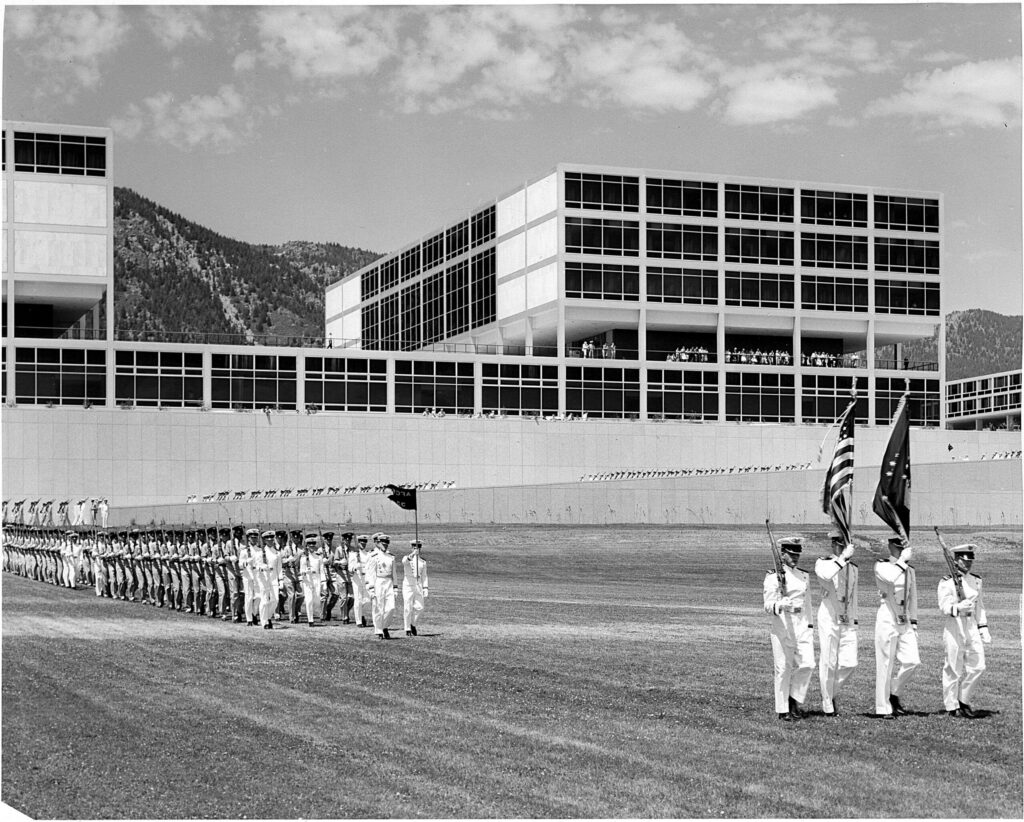
First Air Force Academy class of just 306 cadets started out in WWII barracks, faced high standards
Mary Shinn
mary-shinn@coloradopolitics.com
Updated 2 days ago
When the first class of the Air Force Academy arrived at Lowry Air Force in Denver, they were welcomed with an air show featuring bombers and fighter jets. “Most of us were overwhelmed,” recalled retired Col. Max Miller, the president...
PREV
PREVIOUS

Trump order aims to help more people get retirement savings plans in time for new federal match
WASHINGTON • President Donald Trump signed an executive order on Thursday calling for a new government website where people in the United States can find and compare private-sector retirement savings accounts, aiming to help millions of workers whose employers do not offer such plans. The order is intended to help more people gain access to retirement plans before […]

Wyoming judge blocks law that bans all but earliest abortions | OUT WEST ROUNDUP
WYOMING Judge blocks broad abortion ban A Wyoming judge has blocked a new state law that bans abortions beyond the earliest stages of pregnancy while a lawsuit challenging the provision moves ahead. It’s the first court ruling affecting the legal status of abortion in Wyoming since the state Supreme Court struck down sweeping abortion and […]