

Fight over credit card ‘swipe fees’ attracts nearly 200 lobbyists in Colorado
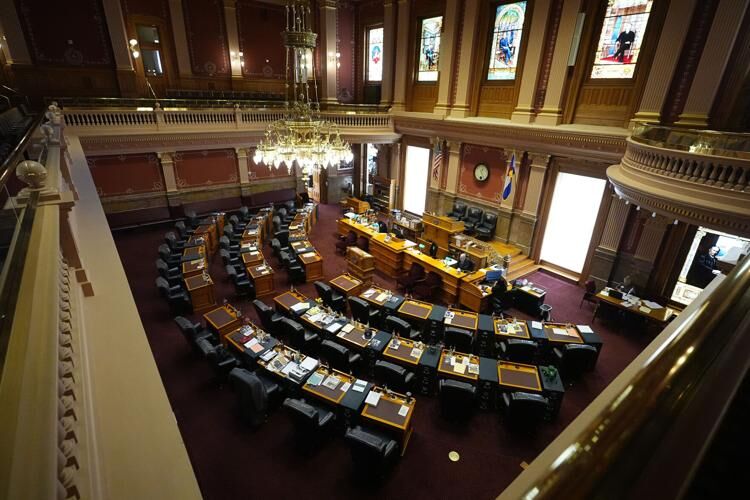
One of the most expensive fights of the 2026 session got a little closer to being over on Friday, when the Colorado Senate took a second final vote on the proposal to eliminate “swipe fees” on sales taxes.
It’s not exactly a David and Goliath story. It’s more like Goliath versus Goliath.
Also known as interchange fees, swipe fees refer to the 2% to 3% that credit card companies charge retailers every time a customer swipes a credit card to make a purchase.
Senate Bill 26-134 would prohibit credit cards from charging businesses a transaction fee based on the sales tax amount. That is, they may not include the sales tax portion of a transaction when calculating the percentage-based “swipe” fee.
Support for the legislation came from Colorado’s restaurants, breweries, small businesses and retailers, along with big box retailers, such as Walmart, Target and Home Depot.
Opponents — including the banks, credit card companies, unions, chambers of commerce and left-leaning groups such as the Bell Policy Center and Towards Justice — claim the big box retailers are the largest beneficiaries of the bill. Unions that oppose the legislation also point to the potential for loss of union jobs and angst over a bill that benefits anti-union retailers.
And now hundreds of lobbyists have been retained to join that fight.
The Secretary of State’s website showed 175 lobbyists and lobbying firms signed up to work on the bill, including a dozen who did so just since Monday.
About half of them support the legislation; the other half oppose it.
Such last-minute signups usually mean a major push is coming.
The amount spent on lobbyists by both sides is likely in the hundreds of thousands of dollars, based on disclosure reports filed with the Secretary of State in March.
On Wednesday, SB 134 passed on an 18-16 vote — with one lawmaker, Sen. Jessie Danielson, D-Wheat Ridge, absent.
But that third reading vote, which usually means the bill moves on to the House, didn’t actually send the bill to the other chamber. A procedural maneuver kept the measure in the Senate.
Introduced on March 4, the bill had gone through the Senate Business, Labor and Technology Committee on March 12.
And then it sat for six weeks, until the beginning of this week.
On Monday, the bill went through Senate debate, along with a substantial amendment that would require businesses with more than 500 employees to use the savings they get from not having to pay swipe fees on sales tax, and put that toward reducing consumer prices or using it for employee wages or benefits.
The Senate finally voted Wednesday, but Senate Majority Robert Rodriguez, D-Denver, asked shortly after for a reconsideration of the vote, which can be requested by anyone who votes in favor of it.
But he had nothing to say when the bill came up on Friday. Instead, it was Sen. Julie Gonzales, D-Denver, who had also voted in favor, who had plenty to say about what had been going on outside the Senate chambers.
Gonzales said SB 134 was supposed to be a straightforward policy that asked if an institution with more than $60 billion in assets should be prohibited from charging swipe fees on sales tax.
“Yet this policy has become wrapped up in an incredible amount of lobbying efforts,” Gonzales said, adding that she’d been bombarded over the last few days.
She fielded calls from restaurant owners, desperate for relief that could come from the bill, she said. The calls came from nonprofits, opposed to the bill, who were anxious that, if the corporations that make donations had to tighten their belts, they would suffer.
There were threats, she said. If she voted a certain way, her bills could be in trouble, she added.
What she heard from the proponents is that the bill would provide relief for restaurant owners, she said.
What she heard from opponents is that it would get tied up in litigation, a threat tied to the federal Office of Comptroller of the Currency, which issued interim rules last week on interchange fees tied to a similar law coming out of Illinois.
To Gonzales, the question came down to this: Would it mean consumers would pay less? Would it save Coloradans money?
“The simple fact is that it doesn’t,” she said.
What SB 134 represents is a proxy battle both in Colorado and nationwide between financial services institutions and big — or small — businesses, she said.
“The fact that there has been so many resources paid into the lobbying on this bill is telling in and of it itself,” she told the Senate.
But she also thought “it was important we all show up and vote on this today,” which appeared to be a dig at Danielson, who was absent during the first vote.
“If you’re a Colorado consumer and you want to help your local coffee shop, consider paying with cash,” Gonzales said.
SB 134 passed on the narrowest of votes: 18-17, with five Democrats voting against.
That included Rodriguez, who had voted for it on Wednesday.
Gonzales voted for it. So did Danielson.
SB 134 now moves on to the House, where it is cosponsored by House Speaker Julie McCluskie, D-Dillon and House Majority Leader Monica Duran, D-Wheat Ridge.


July 1 brings new Colorado rules on gun ammo, wildfire-risk scoring, wildlife enforcement
Marissa Ventrelli
marissa.ventrelli@coloradopolitics.com
Updated 11 hours ago
Colorado will usher in a new set of laws on July 1 that affect everything from ammunition sales to insurance transparency and wildlife trafficking enforcement. Here is a look at some of the state’s new laws: Ammunition sales House Bill...

When having fun gets a little, or a lot, messy | NONPROFIT REGISTER
Joanne Davidson Special to Colorado Politics
joanne-davidson-special-to-colorado-politics@coloradopolitics.com
Updated 3 days ago
CHILDREN’S MUSEUM OF DENVER AT MARSICO CAMPUS Denver News: If your child’s definition of a good time is to dive head-first into a giant mound of mud, or to dance their hearts out in pools of fluffy foam, consider paying a visit...

A graduated tax plan could undercut Colorado’s business competitiveness, analysis warns
Marissa Ventrelli
marissa.ventrelli@coloradopolitics.com
Updated 1 day ago
A proposal to move Colorado to a graduated income tax — taxing individuals and businesses at different rates based on their earnings — could generate more than $2 billion in its first year, but it could also weaken the state’s...

Central City Flower Girls: A treasured tradition marks its 94th year | NONPROFIT REGISTER
Joanne Davidson Special to Colorado Politics
joanne-davidson-special-to-colorado-politics@coloradopolitics.com
Updated 8 hours ago
CENTRAL CITY OPERA Central City News: The 94th presentation of the Central City Flower Girls got off to its usual booming start, thanks to a perfectly timed dynamite blast that reverberated from an undisclosed location within earshot of the Teller House Garden. The window-rattling boom may startle those unfamiliar with the time-honored tradition, but it generates knowing...

Colorado State Shooting Association files constitutional challenge to firearms dealer law
Marissa Ventrelli
marissa.ventrelli@coloradopolitics.com
Updated 4 days ago
A firearms group has filed a lawsuit challenging a recently signed law expanding regulations for firearms dealers in Colorado. House Bill 26-1126 clarifies that firearms dealers must hold both a federal and state license to operate. The bill also allows the...

Grand Junction roundtable spotlights public access while Interior faces scrutiny over targeted land sales
Scott Weiser
scott.weiser@gazette.com
Updated 3 days ago
U.S. Health and Human Services Secretary Robert F. Kennedy Jr. and Interior Secretary Doug Burgum joined Bureau of Land Management Director Steve Pearce in Grand Junction Wednesday for a roundtable focused on linking public land access to improved physical activity...

Debutante Cotillion celebrates a rich past, exciting futures | NONPROFIT REGISTER
Joanne Davidson Special to Colorado Politics
joanne-davidson-special-to-colorado-politics@coloradopolitics.com
Updated 7 days ago
OWL CLUB OF DENVER Denver News: For the past several months, the Owl Club of Denver has filled its social media platforms with salutes to, and testimony from, the women who, following their presentation at the club’s annual Debutante Cotillion, have gone on to excel, achieve and...

58th Le Bal de Ballet gave its honorees an evening in Wonderland | NONPROFIT REGISTER
Joanne Davidson Special to Colorado Politics
joanne-davidson-special-to-colorado-politics@coloradopolitics.com
Updated 1 week ago
DENVER BALLET GUILD Denver News: In its 58th year, Le Bal de Ballet honored 58 college-bound teens: 35 debutantes and 23 Young Men of Distinction, all of whom have graduated high school with top grades and impressive achievements in sports, campus life and community service. They were...
Flat or graduated income tax? Colorado groups push dueling measures for November election
Marissa Ventrelli
marissa.ventrelli@coloradopolitics.com
Updated 1 week ago
Colorado voters could face two opposing income-tax measures on the November ballot, with the dueling campaigns seeking to advance proposals that would take the state in sharply different fiscal directions. One initiative seeks to replace Colorado’s flat income tax with...

Colorado governor signs bill requiring pollution controls, cost reporting for extended coal operations
Scott Weiser
scott.weiser@gazette.com
Updated 1 week ago
Gov. Jared Polis signed into law a bill in reaction to orders from the U.S. Department of Energy to keep older coal units online. The federal government’s instructions applied to Craig Unit 1 in Colorado, one of five coal units...
PREV
PREVIOUS

Veto likely as union-backed bill heads to Colorado governor's desk — again
For the second year in a row, a bill that would make it easier for labor organizations to impose fees on all workers, regardless of union membership, is headed for Gov. Jared Polis’ desk. The governor, who vetoed the legislation last year, has indicated he would do so again — unless business representatives and labor […]

Committee approves reworked version of previously vetoed rideshare bill
Members of the Colorado House Business Affairs and Labor Committee voted across party lines to pass a modified version of a bill establishing regulations on rideshare companies. Last year, Reps. Jenny Willford, D-Northglenn, and Meg Froelich, D-Englewood, introduced House Bill 1291, which proposed a number of new safety requirements for rideshare drivers and customers. The […]