

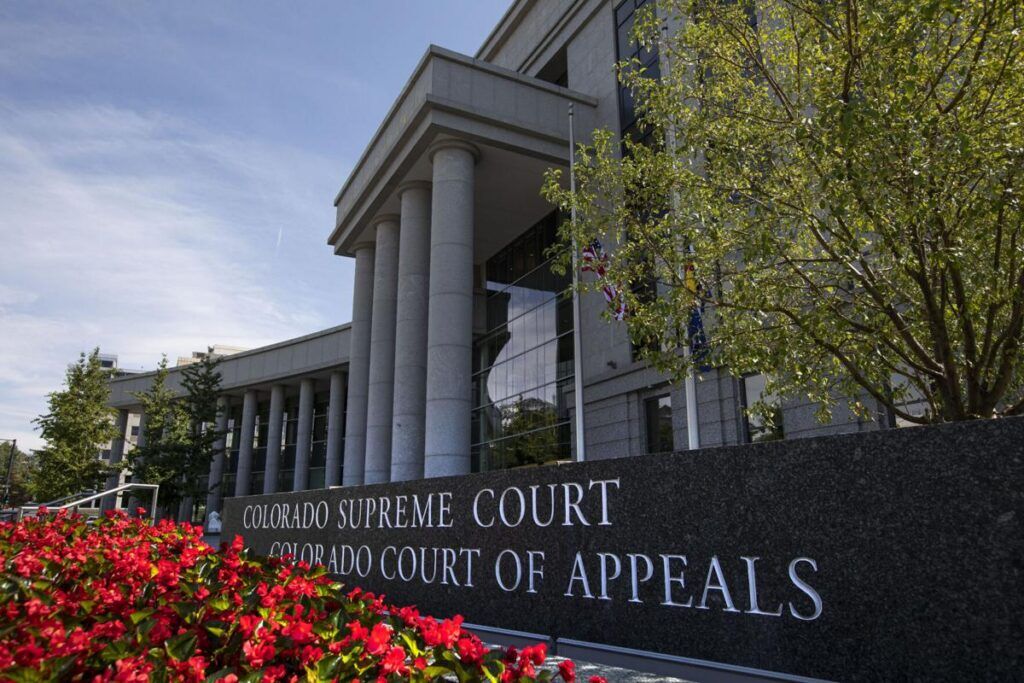
Colorado Supreme Court intervenes in 4 ongoing cases

The Colorado Supreme Court recently moved to intervene in four ongoing cases, including two criminal prosecutions, a civil lawsuit, and a child welfare proceeding.
At least four of the court’s seven members must agree to hear a case outside of the normal appellate process.
The issues raised before the justices include the ability of prosecutors to treat juvenile defendants as adults when filing charges, the prosecution’s obligation to turn over trial transcripts when the victim in one case is the defendant in another, and the deadline for civil litigants to request a jury trial.
In one case in the 13th Judicial District in northeastern Colorado, the nature of the proceedings and underlying filings are shielded from public view. However, according to the brief description on the court’s website, the case questions whether a birth mother in a child welfare case is entitled to anonymity under Colorado’s “safe haven law,” which allows parents to surrender a newborn.
Prior convictions
Prosecutors alleged that in February 2024, Jose Rodriguez-Estrada attempted to rob a victim at High Meadows Park in Colorado Springs. The victim shot back, killing one of Rodriguez-Estrada’s associates.
More than one year later, police arrested Rodriguez-Estrada. Prosecutors initially filed the case as a juvenile delinquency matter because Rodriguez-Estrada was 17 years old at the time of the alleged offense. They then filed the case directly in district court, with counts of attempted aggravated robbery and possession of a handgun.
The defense sought to dismiss the case, noting that the option to directly file in district court and treat a juvenile as an adult is available when the defendant is “found to have a prior adjudicated felony offense.” By the time prosecutors filed charges against Rodriguez-Estrada, he had already pleaded guilty to felony offenses. However, those cases were resolved after his alleged offense in High Meadows Park.
In other words, the defense believed that lawmakers intended for charges to be filed against juveniles in district court only if they had a felony adjudication at the time of the offense. Rodriguez-Estrada did not.
“If the intent was to require a prior felony adjudication on the date of offense, the legislature could have included such language,” responded Deputy District Attorney Jacqueline Markwood.
District Court Judge Diana May declined to dismiss the case, as the law did not require a juvenile to have a prior felony adjudication at the time of the alleged crime.
Rodriguez-Estrada turned to the Supreme Court, arguing the law’s framework supported the notion that a child can be tried as an adult for recidivist behavior only after receiving the benefit of the juvenile justice system.
“The overarching idea is to present children with the opportunity to learn and grow and give them the structure and control to avoid harsher punishment,” wrote public defender Rachel B. Armstrong. “By interpreting ‘prior adjudications’ in a manner that more severely punishes delinquent behavior that occurred before the youth had access to the rehabilitative services provided by the juvenile justice system, the court would be not simply ignoring the legislative intent, but actively working contrary to it.”
The Supreme Court ordered the district attorney’s office to respond.
The case is People v. Rodriguez-Estrada.
Disclosure of materials
Boulder County prosecutors charged Charles Burkat-Dukes with assault and introducing contraband into the jail after he stabbed a pretrial detainee in January 2025. The victim, Andres Eloy Martinez-Perez, was facing murder charges and Burkat-Dukes indicated he planned to invoke self-defense at trial.
Shortly before Burkat-Dukes’ own trial, a jury found Martinez-Perez guilty. Immediately, Burkat-Dukes’ attorney filed a motion for the prosecution to turn over the transcript or recording from Martinez-Perez’s trial of witness testimony and opening statements.
“The State cannot, in one courtroom, rely on evidence that Mr. Perez engaged in extreme violence and admitted to it, and in another, present him as a credible victim,” wrote attorney Glen “G” Matthews.
Shortly afterward, District Court Judge J. Chris Larson granted the motion and ordered the prosecution to turn over the trial materials.
The district attorney’s office asked Larson to reconsider, noting Burkat-Dukes’ trial was scheduled to start in one business day and it was difficult, if not impossible, to obtain a transcript that quickly. Moreover, the rules of criminal procedure only obligate the prosecution to disclose materials in its possession or the possession of people who have “participated in the investigation” and “regularly report” to the prosecutor.
“Here, neither this Court nor the court reporter participated in the investigation of any case — Defendant’s, Mr. Martinez-Perez’s, or any other. Nor do this Court or the court reporter regularly report to the Office of the District Attorney,” wrote Senior Deputy District Attorney Ryan Day.
Larson spoke with the parties and directed them to negotiate a resolution, but did not reverse his order. After Matthews indicated he was only interested in the prosecution providing the trial materials at its own expense, the district attorney’s office sought the Supreme Court’s intervention.
“Defendant is the only party who wants the Martinez-Perez transcript, and he has both the legal obligation and means to acquire it on his own,” wrote Day.
The Supreme Court directed the defense to explain why it should not overturn Larson’s order.
The case is People v. Burkat-Dukes.
Civil jury trial
The owners of the Source Hotel in Denver filed a civil complaint against nearby Mountain Cement Company for dust emissions that allegedly infiltrated the hotel’s property. Neither side asked for a jury trial.
Seven months after the plaintiffs’ deadline to amend their complaint passed, they moved to amend and, among other things, to include a demand for a jury trial.
On March 4, District Court Judge Sarah B. Wallace permitted the amendment. She acknowledged that Colorado’s rules appeared to give parties a “a second chance to file a jury demand.”
“We have litigated this case and prepared the case as if it’s going to be tried to the bench,” attorney Mark E. Champoux, representing Mountain Cement, argued to Wallace. “It’s a very, very different thing to now prepare this case for a jury.”
Wallace dismissed the concern, but added that, “if I was master of the universe, there wouldn’t have been an amendment.”
Mountain Cement turned to the Supreme Court, alleging the plaintiffs had waited to change course until Wallace denied their motion for a preliminary injunction and after the defense made critical decisions in anticipation of a trial to Wallace.
“Moreover, litigants can exploit that uncertainty by acting opportunistically,” wrote the company’s attorneys, “after first auditioning the court as a potential trier of fact and allowing the opposing party to develop their defense on the presumption that the case will be tried to the court.”
The Supreme Court directed the owners of the Source Hotel to respond.
The case is SCP 3330 Brighton OpCo, LLC v. Mountain Cement Company LLC.


Parenting from prison: Inmates hope to be present in their children’s lives, while physically absent
Marianne Goodland
marianne.goodland@coloradopolitics.com
Updated 6 hours ago
The room was decorated with balloons, the tables sparking bright with colors as the smell of pizza and cake wafted through the air. As did music. This was, after all, a father-daughter dance. Except this was not a typical father-daughter...
Appeals court confirms Colorado judges can compel electronic records from out of state
Michael Karlik
michael.karlik@coloradopolitics.com
Updated 2 days ago
Colorado’s second-highest court clarified on Thursday that judges are empowered to compel out-of-state companies to produce electronic records under state law. El Paso County jurors convicted Mischa Jargowsky on three counts of money laundering and one violation of Colorado’s organized...

10th Circuit upholds finding of no racial discrimination against family at Denver Chili’s
Michael Karlik
michael.karlik@coloradopolitics.com
Updated 3 days ago
The Denver-based federal appeals court agreed on Wednesday that a Black plaintiff failed to show that a Chili’s manager’s request for her family to provide valid payment at the outset of their meal amounted to racial discrimination. Markesha Futrell-Smith filed...

Appeals court reinstates Mesa County defendant’s request for DNA testing under new Colorado law
Michael Karlik
michael.karlik@coloradopolitics.com
Updated 4 days ago
Colorado’s second-highest court revived a Mesa County defendant’s petition for DNA testing in his three-decade-old attempted murder case on Thursday, concluding that a trial judge wrongly interpreted a recent Colorado law in dismissing the request outright. Jurors convicted Billy Joe...
Appeals court reverses Denver juvenile’s conviction due to improper expert testimony
Michael Karlik
michael.karlik@coloradopolitics.com
Updated 2 days ago
Colorado’s second-highest court reversed a juvenile defendant’s conviction for unlawful sexual contact on Thursday after an expert witness’s testimony improperly suggested the child victim was telling the truth. The defendant, identified as S.H-S., was around 16 years old when he...

Judge orders home confinement for Barry Morphew
Dennis Huspeni
dennis.huspeni@gazette.com
Updated 4 days ago
An Alamosa County district judge has ordered home confinement for Barry Morphew, who is accused of murdering his wife. Barry Morphew, 59, faces a first-degree murder charge in the death of his wife, Suzanne Morphew, who disappeared Mother’s Day weekend...
Appeals court says jury does not need to view porn to determine if it’s ‘obscene’
Michael Karlik
michael.karlik@coloradopolitics.com
Updated 2 days ago
Colorado’s second-highest court ruled for the first time on Thursday that a jury does not always need to view pornographic material to determine if it meets the criteria for obscenity. Mesa County jurors found Shayla Ann Simpson guilty of child...
10th Circuit disagrees Sterling officer had no basis to arrest motorist who lacked insurance details
Michael Karlik
michael.karlik@coloradopolitics.com
Updated 5 days ago
The Denver-based federal appeals court disagreed on Tuesday with a trial judge’s decision to bar evidence from a pat-down search from being used against a defendant. Federal prosecutors obtained an indictment of Jorge Sigala-Baray for being a felon in possession of a...

Colorado Springs officers’ tasing, threats prompt federal judge to block use of suspect’s statements
Michael Karlik
michael.karlik@coloradopolitics.com
Updated 5 days ago
A federal judge blocked the government last month from using some of a defendant’s statements as evidence, reasoning that the defendant made them involuntarily as Colorado Springs officers tased him five times and one officer threatened to kill him. Officers...

Appeals court rejects CDOT employee’s discrimination, retaliation claims
Michael Karlik
michael.karlik@coloradopolitics.com
Updated 3 days ago
Colorado’s second-highest court agreed last week that a Colorado Department of Transportation employee had not shown that his employer discriminated and retaliated against him due to his religion and national origin. Ayman Salloum, who described himself as a 70-year-old Muslim...
PREV
PREVIOUS

Colorado ski resorts announce early closures amid historic snowpack lows, high temperatures
Vail Resorts is the latest area to announce season closure Wednesday As Colorado’s historically low snowpack year comes to a close and spring conditions take over the mountains, the state’s major ski resorts are announcing closing dates — some of which are weeks before historic closing dates. Most of Colorado’s ski resorts did not get […]

Federal judge sides with Mesa County school district in ex-student's First Amendment claims
A federal judge concluded last week that Mesa County Valley School District 51 and three of its administrators did not violate the First Amendment rights of a former student when they imposed minor discipline in response to disruptive behavior. In the landmark 1969 decision of Tinker v. Des Moines Independent Community School District, the U.S. Supreme Court […]