

Denver’s violent crime has dropped — but not everywhere in the city
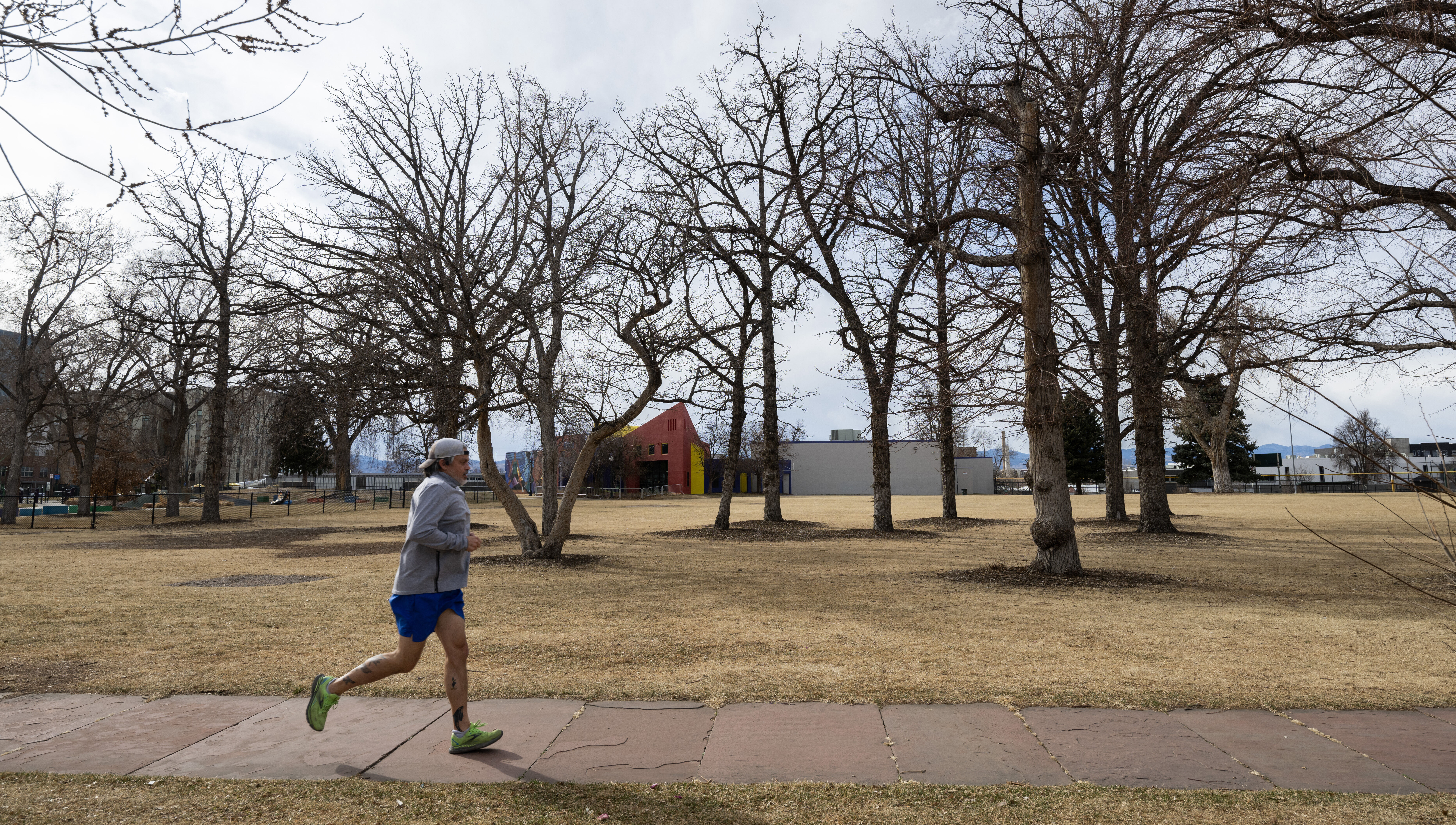
On April 27, 2022, Garry Arellano, a longtime Denver resident, stepped in to break up a fight between two teen girls.
Court documents show the girls had started the fight downtown, but texted each other to continue fighting that night at La Alma-Lincoln Park at 13th Avenue and Osage Street.
Arellano, a 63-year-old man described by the police as a “good Samaritan,” tried to separate the girls, but the boyfriend of one of the girls, 24-year-old Trahavonie Smith, pulled out a gun and shot and killed Arellano.
With roots dating back to the 1870s, La Alma-Lincoln Park is among Denver’s oldest residential neighborhoods. Shaped by the neighboring rail yards, the historically working-class area has seen recurring crime over the years, including drug use, vandalism and gun violence.
In 2024, for example, youth and adult programming in the park and its associated recreation center had to temporarily shut down due to increases in violence and gun-related crimes, as well as homeless encampments.
In response, the city designated the La Alma-Lincoln Park neighborhood as a Place Network Investigation (PNI) site, a concept that Denver Mayor Mike Johnston has embraced as the city’s flagship strategy to make neighborhoods safer.
The mayor said the strategy is working.
“Last year, we launched the effort to work collaboratively on safety here, and a year later, the outcomes were working,” Johnston said of La Alma-Lincoln Park, where he delivered his 2026 goals for the city, citing aspirations of a 10% decrease in gun-related homicides and a 20% reduction of shootings in “high-risk” areas.
“This site, where we’re standing, has now gone 452 days since the last shooting,” Johnston said on Jan. 26. “That’s almost a year and a half.”
Indeed, Denver recorded just 37 homicides in 2025, nearly a 48% drop from 2024 — one of the sharpest declines among major U.S. cities.
It was the largest year-over-year drop in homicides in Denver since 1990, and resulted in the city’s lowest recorded homicide total in over a decade.
Johnston attributed the overall drop in Denver to a combination of targeted policing efforts, increased community engagement, and technology. In particular, the mayor credits collaboration between the police, city agencies, and community stakeholders with helping bring the city’s crime numbers down to historic lows in what he calls “high-risk” areas.
Legislation also appears to have made an impact.
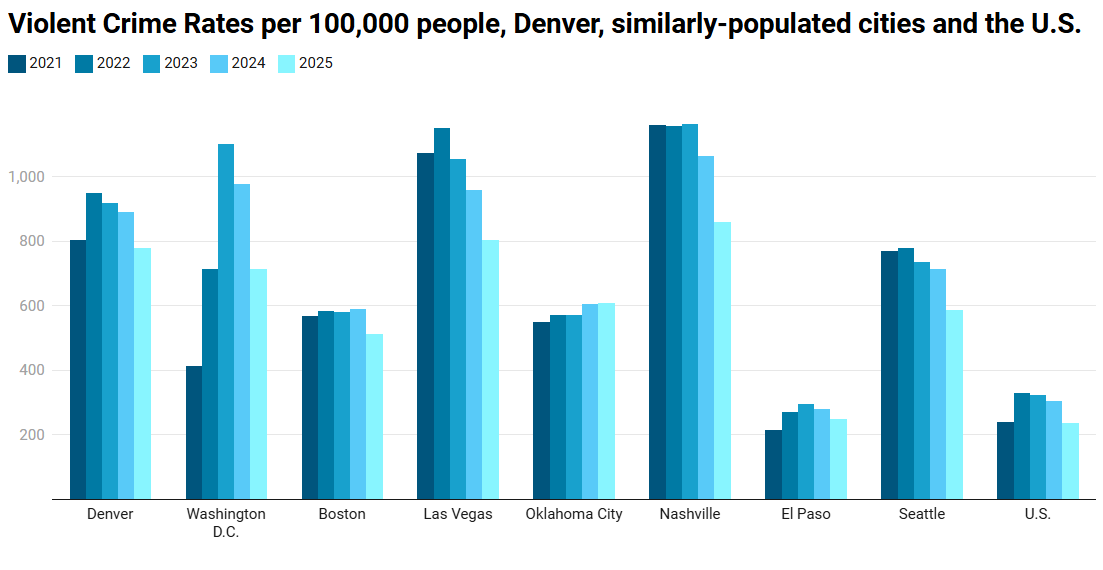
But while violent crime in Denver is down overall, the decline is not spread evenly across the city.
Data shows that crime in Denver’s Union Station and northern Capitol Hill areas bucked the downward trend, up nearly 5.5% from 2024 to 2025.
Violent crime varies by location
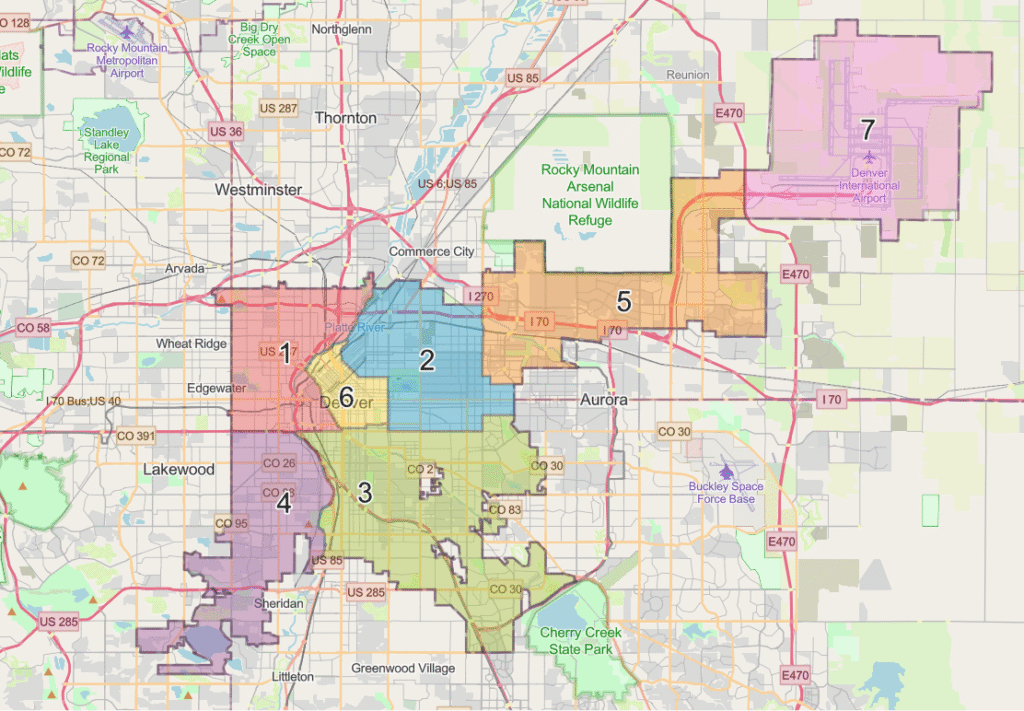
While all crimes, including violent crime, generally trended downward between 2024 and 2025, not all Denver police districts saw the same results.
After ranking as the district with the most overall, albeit declining, crime numbers in 2021, 2022 and 2023, District 3 lost that status to District 6 in 2024 and further dropped in 2025. District 3 covers southeast of downtown.
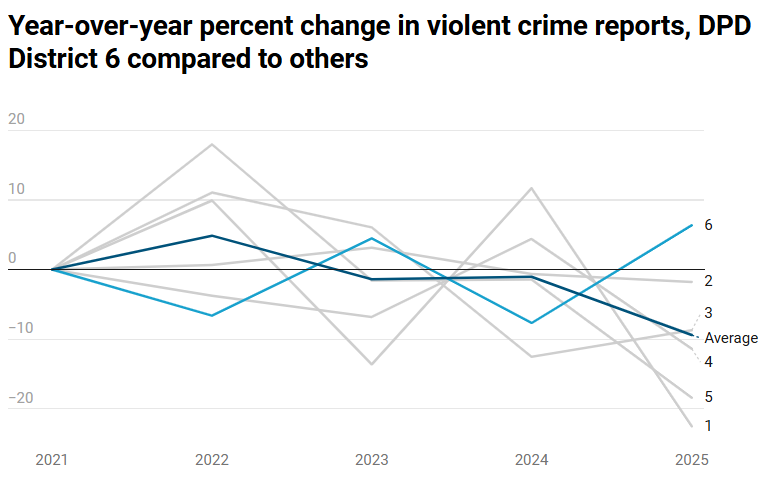
Denver Police District 6, which covers Denver’s downtown area, Union Station and northern Capitol Hill, saw one of the largest year-over-year increases of any district since 2022.
Police District 7, which is limited to Denver International Airport, was not included in the Denver Gazette’s analysis. Denver’s seven police districts are drawn along different borders than its 11 City Council districts.
Last April, Johnston announced the creation of a police unit focused on downtown safety, with an official saying it would bring “significant changes in the crime map” in the corridor within a year.
But not only did overall crime in District 6 spike from 2024 to 2025 — violent crime did, as well.
Notably, in January 2025, a man stabbed four people in a 16th Street attack that killed two, including a flight attendant in a layover in Denver. The suspect, who has a history of mental illness, has been arrested 15 times since 2018 in metro Denver on charges that included criminal mischief, disturbing the peace, robbery, menacing and twice for sex assault.
A spokesperson for the city’s technology services department told The Denver Gazette that it does not track year-by-year population numbers broken out by police districts, making it difficult to determine the violent crime rate relative to the number of people living in a given district.
Because District 6 is a denser area of the city, it could have higher overall crime numbers but a lower rate per 100,000 people than other districts that are more physically spread out. Any violent crime in downtown Denver — the focal point of a revitalization drive to the tune of hundreds of millions of dollars — will attract the public’s attention.
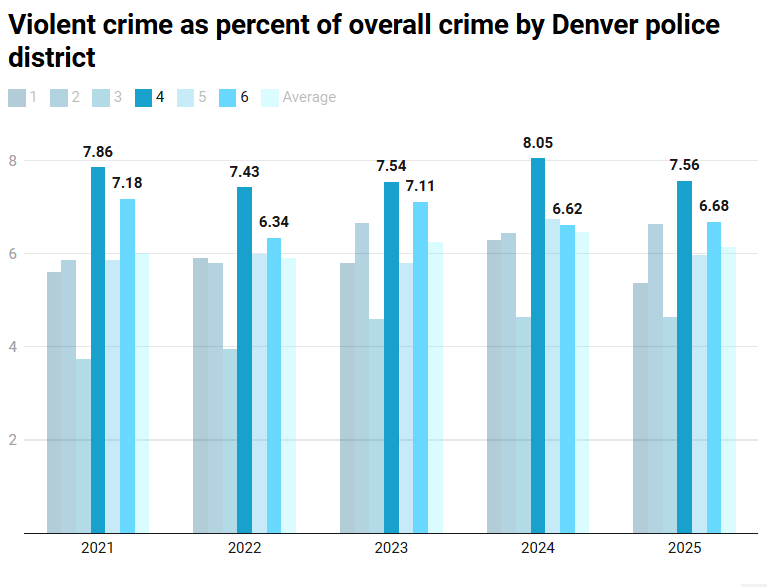
Additionally, while District 6 continues to see the greatest share of overall violent crime of any single police district, it ranks a distant second to District 4 in terms of violent crime as a percent of overall crime.
A focus on crime ‘clusters’
Crime in large metropolitan cities is usually concentrated in certain areas, committed by a small number of individuals, and often involves criminal networks, according to a 2025 study published in the Justice Evaluation Journal.
The idea of creating Place Network Investigation sites or PNIs, according to experts, is to use intelligence-driven efforts to concentrate resources and disrupt criminal activity, whether through increased police presence or community outreach and assistance.
For Johnston, this “intersection of safety and homelessness” is a key ingredient in his recipe for reducing crime.
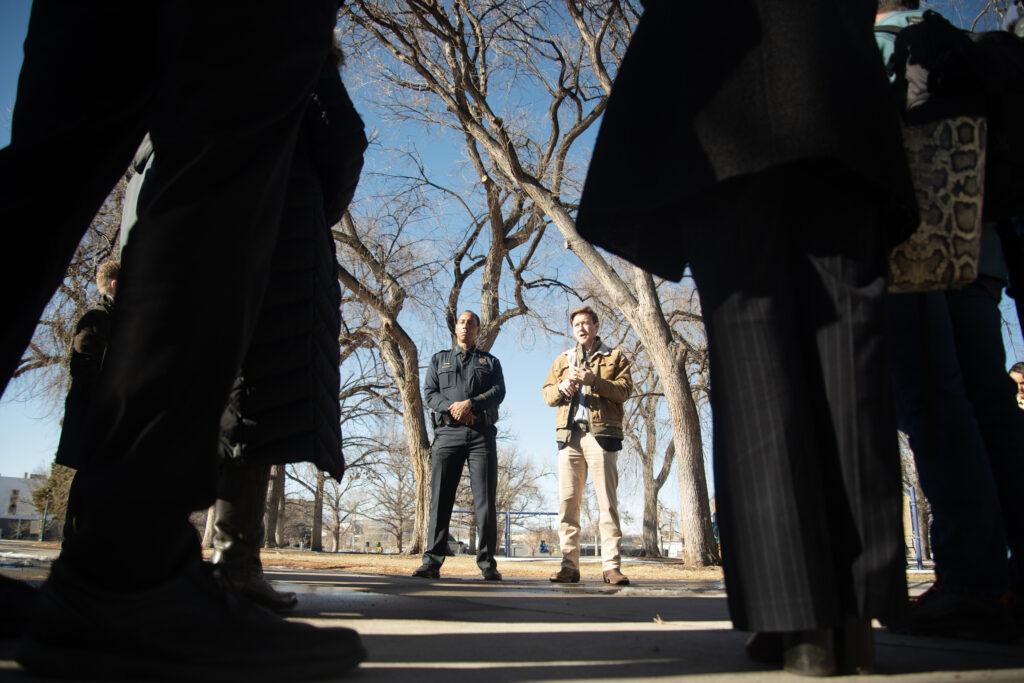
“Those high-risk areas have been part of our broader place network investigation efforts — efforts like La Alma and Lincoln Park — where we saw neighborhoods where there were increased risks of violence, and to solve that, we needed all of our departments to work together,” Johnston said.
Those departments include Denver Parks and Recreation, Economic Development, Excise and Licensing, and the Office of Children’s Affairs.
PNIs focus on violent-crime “hot spots,” concentrating investigations, police presence, and city services on specific areas where such crimes “cluster.”

“Denver park rangers implemented scheduled patrols throughout park hours and increased patrols during curfew,” Stephanie Figueroa, a spokesperson for Denver Parks and Recreation, told The Denver Gazette.
Figueroa said park rangers collaborated with recreation center officials on how best to reopen the park. They reported that many of the encounters during the closure were with “people experiencing homelessness with substance misuse.”
“About a year and a half ago, we had a number of large (homeless) encampments around this park and up and down these streets,” Johnston said. “We had high levels of shooting activity and of violent crime, and then we launched this as a Place Network Investigation site. We provided a bunch of wraparound services, and the change is now dramatic.”
By housing the homeless, building strong community relationships, and “restoring trust between police and community,” the mayor said, “our strategies are proven.”
On Nov. 13, 2024, the LaAlma-Lincoln Park Neighborhood Association held a safety meeting with local government and organizations to address residents’ worries.
Denver police efforts in 2024 to reduce crime in the area included 332 arrests — 84 from narcotics operations from Sept. 16 to Oct. 27, according to minutes from the meeting.
Police also seized nine firearms and executed two narcotics-related search warrants related to drug distribution.
Static patrols by the DPD increased, and police and city officials put pressure on a Circle K convenience store at 1300 W. Colfax Ave. to clean up its act.
The city cited the store, located near the park, for trash violations and for being a public nuisance for selling restricted items to underage buyers.

Laws have helped drive crime numbers down
While it’s difficult to prove how much any single ordinance or law has contributed to the city’s drop in crime, Denver — and the Colorado state government — have taken several actions credited with reducing high-volume crimes.
Notably, lawmakers, at the urging of Gov. Jared Polis, passed a law that made all car thefts a felony. That decoupled the severity of the crime from the car’s value and tied it instead to behavior, in which the penalty becomes more severe for repeat offenders.
It also created a lower criminal charge for “joy rides,” in which there is no damage to the vehicle, no crime has been committed while the vehicle is in possession, and it is returned within 24 hours.
Denver police said the most significant reduction in crimes was reported in automobile thefts, with over 36% fewer in 2025 than in 2024. Reported non-fatal shootings also saw a substantial decrease of 33.5%.

Colorado also tightened rules on commodity metal transactions, requiring sellers of detached catalytic converters as scrap metal to prove they are the legitimate owners.
Along the same lines, Denver recently passed an ordinance banning cash payments to scrap metal sellers.
It also requires junk dealers to meet additional requirements, including maintaining detailed records of transactions and recording the driver’s name and license plate number before accepting or purchasing scrap metal, and using traceable payment methods, such as a credit card.
Technology helps catch criminals
Staffing shortages among law enforcement agencies are a top concern for many municipalities, and recruitment and retention numbers are also suffering, according to a 2023 study by the Police Executive Research Forum, an independent research organization.
As a result, many agencies, including the DPD, are investing heavily in technology to help fill critical gaps and clear cases.
Denver police officials credit the notable reduction in auto theft to the city’s network of automated license plate reading cameras.
In 2023, auto thefts in the Mile High City topped more than 12,000.
After the city’s Flock camera pilot program began, that number dropped to 8,550.
During Denver’s 12-month pilot program with Flock, there were 289 arrests made and 170 vehicles recovered. DPD also recovered 29 firearms, DPD Commander Jacob Herrera told a Denver City Council committee last year.
While not all of the solved cases can be attributed solely to the cameras, officials said they play a contributing role.
The city recently decided to end its contract Flock amid pressure from the council and other critics, who suggested that information captured by the company is being shared to target immigrants illegally staying in the U.S. Flock itself has insisted it does not work with immigration authorities and the data its cameras collect is controlled by the client — be it a city, school or a private organization.
Denver officials are considering a new contract with Arizona-based camera vendor Axon.
Mayor is cautious about crime drop
Denver has seen a dramatic decrease in violent crime, but Johnston cautioned that such drops are not normal and that only two times in the city’s history have homicide rates been this low — in 2000 and 2014.
In the years immediately following, the city’s crime stats saw a “regression to the mean,” or a stabilization of crime numbers back to a “normal” level, meaning that “you can see 30% to 40% increases,” Johnston said.
In the year following the city’s 2000 crime drop, Denver saw a 45% increase, and in the year following 2014, a 62% increase.
That trend is not unique to Denver. Boston saw a historic drop in its homicide rate in 2024, but it went up by more than 30% in 2025.
Johnston said he wants to maintain Denver’s new low crime baseline and incrementally reduce it.
“If we deliver another 10% drop (in crime), we will be at or among the lowest violent crime rates of any city in the country,” the mayor said. “Our goal is to reach that level and try to stabilize at that level, but I want you to know we’re facing headwinds to do that.”


CSI study reviews impacts of Colorado’s mandatory sex‑trafficking sentencing measure
Marissa Ventrelli
marissa.ventrelli@coloradopolitics.com
Updated 1 day ago
A new report by the think-tank Common Sense Institute examines what could happen if Colorado voters approve Initiative 108, which establishes mandatory life sentences for offenders convicted of sexual trafficking of a minor. The measure is backed by Protect Kids...

White House deploys private companies to help crack down on cybersecurity breaches
David Zimmermann
david-zimmermann@coloradopolitics.com
Updated 3 days ago
The White House intends to use private companies in the United States to help crack down on cybersecurity breaches perpetrated by transnational criminal organizations. President Donald Trump signed a memorandum on Wednesday, directing his administration to employ the private sector...

U.S. Rep. Lauren Boebert’s son arrested, faces charges of sexual exploitation of minor
Matt Kyle
matt.kyle@denvergazette.com
Updated 5 days ago
U.S. Rep. Lauren Boebert’s son Tyler Jay Boebert has been arrested and accused of recording and sharing a video depicting himself having intercourse with a minor, according to court records. The case originated in Garfield County in Western Colorado and...

Colorado’s troubled guardianship office pursues ‘cultural reset’
Marianne Goodland
marianne.goodland@coloradopolitics.com
Updated 5 days ago
Colorado’s guardianship program, long criticized for mismanagement and high staff attrition, is undergoing a “cultural reset,” as its new director works to repair partnerships and prepare for a major expansion under recent legislation. Created by lawmakers in 2017, the Office...
Colorado Springs mother Deborah Nicholls’ murder conviction overturned
Nick Smith
nick-smith@coloradopolitics.com
Updated 1 week ago
A Colorado Springs mother convicted in 2008 of murdering her three children in a house fire might get a new trial after a judge ruled that prosecutors withheld key evidence that could have impacted the jury’s verdict. Deborah Nicholls, whose...
Defendant’s competency in question in El Paso County case involving slain Army police officer
Nick Smith
nick-smith@coloradopolitics.com
Updated 1 week ago
It will be another 60 days before a 4th Judicial District court determines if a man charged in the shooting death of an Army police officer is competent to proceed in his case. Judge Erin Sokol granted a request Wednesday...
Violent and property crimes decreased in Colorado in 2025, according to new data
Marissa Ventrelli
marissa.ventrelli@coloradopolitics.com
Updated 2 weeks ago
Violent and property crime rates in Colorado decreased significantly in 2025, according to data from the state’s public safety agency. The violent crime rate decreased by 10.7% from 2024 to 2025, resulting in over 3,300 fewer crimes reported statewide, while...
Jeffco taxpayers could be on the hook for a possible child sex assault settlement
Matt Kyle
matt.kyle@denvergazette.com
Updated 2 weeks ago
Taxpayers may end up on the hook for a child sexual assault settlement, possibly worth up to $15 million, after Jeffco Public Schools failed to notify its insurance company in a timely manner about the case. The incident stems from...

Gov. Polis celebrates Colorado’s first-place education ranking by U.S. News
Marianne Goodland
marianne.goodland@coloradopolitics.com
Updated 2 weeks ago
Colorado officials said they have something to celebrate this week, in addition to the state’s sesquicentennial birthday on Saturday. U.S. News & World Report on Tuesday gave Colorado its top ranking for education efforts from pre-K to postsecondary, though it...

Denver weighs permanent restriction on low-level traffic stops
Deborah Grigsby
deborah.smith@denvergazette.com
Updated 3 weeks ago
A Denver City Council committee is considering permanently limiting certain types of low-level traffic stops used to investigate unrelated crimes and requiring better public reporting about why such stops happen. Members of the Budget and Policy Committee on Monday were...
PREV
PREVIOUS

With new medical school set to open, Feinstein will step down as UNC president
GREELEY • Dr. Andrew “Andy” Feinstein, the charismatic president of the University of Northern Colorado, has announced that he will step down from his leadership role just on the cusp of what is perhaps his signature accomplishment being realized. He’ll leave office Aug. 1. Colorado’s third medical school — UNC’s College of Osteopathic Medicine — […]

Appeals court decides free speech cases, error-prone judge reversed again | COURT CRAWL
Welcome to Court Crawl, Colorado Politics’ roundup of news from the third branch of government. The state’s Court of Appeals decided multiple cases implicating free speech rights, plus Colorado’s most error-prone judge was reversed on appeal yet again. Heard on appeal • The Colorado Supreme Court agreed a defendant couldn’t be faulted for failing to cooperate […]