

U.S. energy secretary warns Colorado’s energy policies could drive up prices, deter businesses

U.S. Energy Secretary Chris Wright on Monday warned that Colorado’s energy policies could lead to higher electricity prices and deter businesses, such as data centers, from locating in the state.
Wright, a former executive of a Colorado-based energy company tapped by the Trump White House to lead the energy department, urged state policymakers to focus on natural gas and nuclear power during a news conference with U.S. Rep. Gab Evans at Xcel Energy’s Fort St. Vrain Generating Station on Monday.
State policymakers have maintained that Colorado’s energy policy is balanced, taking into accounts the needs of consumers in their push for “net zero” carbon in just a few decades. Democrats have also argued that Colorado should take advantage of “clean” energy technology to achieve its carbon goals.
Last January, Gov. Jared Polis touted Colorado’s progress in reaching his goal of a carbon-free state, saying that, by 2030, “more than 70% of Colorado’s electricity will come from low-cost wind and solar” and adding that emerging technologies, such as geothermal or carbon capture, would get the state to “100%.”
At the Fort St. Vrain plant, Wright highlighted the need to lower energy costs to attract investment and raise wages, criticizing state mandates that he said have stifled oil and gas production and grid expansion.
Evans, who represents Colorado’s 8th District, attributed the policies to $61 billion in added cost for zero-carbon goals, based on a Colorado Energy Office study.
“We do not want to see Colorado go down the California energy policy route,” he said, arguing that California’s policies have driven up prices and forced an exodus of companies.
“We want Colorado to be a great place to live and raise a family,” he said.
Evans described his district as an energy mecca, home to the state’s largest natural gas facilities and its only oil refinery.
From his seat on the U.S. Energy and Commerce Committee, Evans said he works to ensure energy workers have the resources they need amid what he described as bad policies from previous federal and state administrations.
He pointed to three public safety power shutoffs along the Front Range in recent months, citing inadequate investment.
“The cities in the district that I talked to tell me that power is the biggest limiting factor that they have to be able to grow the economy of Colorado, even above water,” Evans said.
Federal projections from the Energy Information Administration and utility reports submitted to the Federal Energy Regulatory Commission show electricity use could grow rapidly in the coming years due to expanding data centers and artificial intelligence needs.
“In the next four years, we need 165 more gigawatts, and that’s just the current projection,” Evans said. “That’s enough for 50 million homes.”
Evans has co-sponsored a proposal to codify a Supreme Court ruling for science-based project reviews and an “informed bureaucracy.” Another bill makes changes to air quality permitting to exclude out-of-state wildfire smoke or sound forest management emissions, avoiding penalties on local jobs.
Domestic energy production secures jobs, lowers rates and protects the environment better than in China, Evans said.
“I’ve been to the Middle East,” Evans said. “I’ve seen how other parts of the world make energy. We do it better here in the United States.”
Wright noted that states with renewable standards, such as Colorado, have electricity prices that are on average 50% higher.
He credited keeping coal plants open last year with saving hundreds of lives during winter storm Fern, which created chaos across 22 states.
“We stopped the closure of 17 gigawatts of coal power plants last year,” Wright said. “If we had let those coal power plants close … hundreds of people would have died.”
The federal government has issued emergency orders to prevent closures of several coal plants nationwide, including in Colorado, saying it would ensure grid reliability amid high demand and weather events.
In filings with the Public Utilities Commission, Xcel Energy has proposed extending the operations of its coal units in Pueblo and Hayden beyond their original retirement dates, potentially running them until 2030, to address projected electricity supply shortfalls.
Wright said Colorado is the fourth-largest oil-producing state in the country, but bad governance has offset those advantages. Natural gas is by far the fastest-growing energy source, and nuclear should be the second fastest-growing, he added.
“The biggest future of energy and electricity grid, how we’re going to win the AI race is going to be dominated by natural gas and nuclear,” Wright said in the interview. “Those are the fastest-growing energy sources. Gas is by far the fastest-growing energy source. Nuclear should be the second fastest growing.”
Colorado’s shift from reliable sources to intermittent wind and solar follows failures in the United Kingdom, Germany and Denmark, where industry was exported, and there was no growth for 15 years, according to Wright.
“Why would anyone want to follow that path?” he said in an interview with The Denver Gazette, adding data centers shun Colorado over unstable policies and delayed electricity.
“If you’re going to locate and spend tens of billions of dollars for a large investment, you’ve got to believe that state not only can deliver you electricity as quickly as possible … that it’ll be a good long-term policy on energy and business conditions and all that,” Wright said.
Indiana requested a rate reduction, while Georgia and Alabama froze rates for three years due to data centers, he pointed out.
“We should do that here in Colorado,” Wright said.
In the interview, Wright labeled what he called a Colorado-California alignment a “train wreck.”
“It’s a train wreck policy,” said Wright. “California had everything going forward, and today has the highest adjusted poverty rate in the nation. It produces meaningfully less energy than it did 10 years ago. It’s impoverishing its citizens and having jobs flee, negative population outflow except for immigration.”
“In fact, Colorado’s crossed that threshold with more people leaving than coming in from the other states in Colorado,” Wright pointed out.
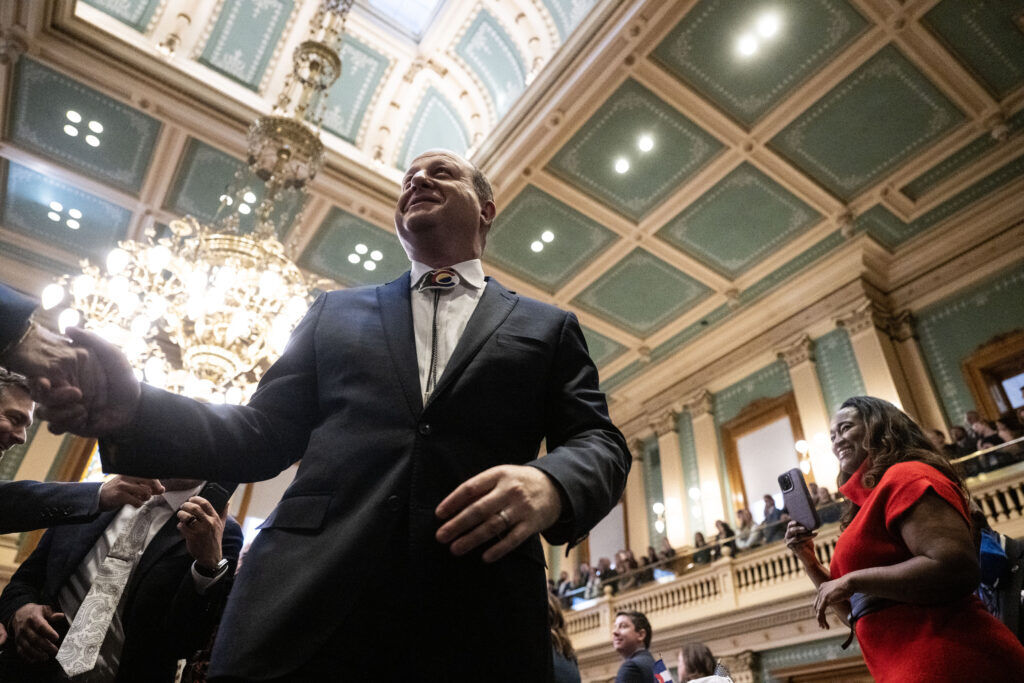
Colorado officials have maintained that the state’s approach to energy is balanced, advancing emissions cuts while holding costs manageable.
In February, Colorado Energy Office Executive Director Will Toor emphasized continued progress, regardless of shifts in Washington, citing a report that, he said, shows that, regardless of the federal landscape, “we are charging forward in ensuring that all Coloradans have clean air and cost-efficient clean energy and transportation options.”
The office’s latest implementation report put the state at 87.5% toward its 2030 goal based on actions completed through 2023, with full achievement still expected before 2031 — even without new legislation.
Toor pointed to November 2023 modeling that projected 98.5% reductions in electric-sector emissions by 2040 at no additional cost beyond plans already approved.
“The really big surprise in this study was just how far we are able to reduce emissions at no incremental cost from currently approved plans,” he had said.


DU acknowledges those who’ve made ‘indelible impacts’ at 2026 Founders Celebration | NONPROFIT REGISTER
Joanne Davidson Special to Colorado Politics
joanne-davidson-special-to-colorado-politics@coloradopolitics.com
Updated 2 hours ago
UNIVERSITY OF DENVER Denver News: El Pomar Foundation and four individuals who have made what Chancellor Jeremy Haefner described as “indelible impacts” on the University of Denver were honored at the 2026 Founders Celebration. The March 4 dinner celebration was held in Seawell Ballroom, with the 400 guests including...

Colorado Democrats pass union fee bill, even after Polis signals another veto
Marissa Ventrelli
marissa.ventrelli@coloradopolitics.com
Updated 20 seconds ago
The Colorado House on Monday advanced along party lines legislation repealing a longstanding labor law governing a requirement before a unionized workplace can collect fees on all workers, regardless of whether they are union members. The House voted, 42-22, to...

Bill to roll back Colorado lottery credit card purchases clears Senate committee in tight vote
Marianne Goodland
marianne.goodland@coloradopolitics.com
Updated 22 hours ago
A bill seeking to reverse the Colorado Lottery’s recent move to allow credit card purchases for tickets narrowly cleared its first legislative hurdle last week, advancing on a 5-4 vote after hours of debate over gambling addiction, consumer debt and...

Is work flex slowing downtown’s recovery? | ANALYSIS
Mark Samuelson Special to The Denver Gazette
mark.samuelson@denvergazette.com
Updated 22 hours ago
Work-from-home and “flex work” policies, widely adopted five years ago as a hedge against the spread of the COVID-19 pandemic, have lingered on — well after the virus retreated. But flex work may be running counter to downtown Denver’s efforts...

Colorado health equity funder’s redirection debated
DEBBIE KELLEY
debbie-kelley@coloradopolitics.com
Updated 4 days ago
A redirection in grantmaking that began two years ago for The Colorado Trust, a 40-year-old Denver-headquartered funder, has led some employees to now voice concerns, which has reportedly put their jobs in jeopardy. The vice president of communications for the...

Colorado House committee advances bills regulating AI in therapy, insurance decisions
Marissa Ventrelli
marissa.ventrelli@coloradopolitics.com
Updated 4 days ago
Colorado lawmakers are moving to place guardrails on the growing use of artificial intelligence in mental health care and insurance decisions. The House Health and Human Services Committee on Thursday approved two bills that would limit how therapists and insurers...
Colorado Attorney General, environmental groups challenge EPA rejection of state’s haze plan
Scott Weiser
scott.weiser@gazette.com
Updated 2 hours ago
Colorado Attorney General Phil Weiser and several environmental organizations have filed separate petitions in the U.S. Court of Appeals for the Tenth Circuit, challenging the U.S. Environmental Protection Agency’s decision to reject Colorado’s regional haze plan. The plan included proposals...
Colorado’s outdoor economy slowing down
Bernadette Berdychowski
bernadette.berdychowski@denvergazette.com
Updated 1 day ago
The post-pandemic boom in the outdoor recreation world appears to have slowed, according to new federal data. The industry is still growing nationwide, but it’s been slower than in past years. The trend is evident in Colorado, as well, though...

A grand celebration of Denver’s ‘First Lady of Opera’ and the venue named for her | NONPROFIT REGISTER
Joanne Davidson Special to Colorado Politics
joanne-davidson-special-to-colorado-politics@coloradopolitics.com
Updated 4 days ago
OPERA COLORADO Denver News: For some, it may seem like only yesterday, but the reality is that 20 years have passed since the Ellie Caulkins Opera House opened in the Denver Performing Arts Complex. To celebrate that milestone anniversary, Opera Colorado dedicated its 2026 Grand...

50th Wells Fargo Ski Cup brings a six-figure income for the NSCD | NONPROFIT REGISTER
Joanne Davidson Special to Colorado Politics
joanne-davidson-special-to-colorado-politics@coloradopolitics.com
Updated 5 days ago
NATIONAL SPORTS CENTER FOR THE DISABLED Winter Park News: The 50th annual Wells Fargo Ski Cup, held Feb. 19-21 at Winter Park Resort, has raised $932,500 for the National Sports Center for the Disabled. “This milestone year was especially meaningful as we...
PREV
PREVIOUS

Split vote by Colorado Title Board stops ballot push to privatize Pinnacol Assurance
The Colorado Title Board, a three-member panel that sets the language for ballot measures, recently reversed a prior decision and blocked a proposal to privatize Pinnacol Assurance from moving forward. The main issue decided by the title board is whether a ballot measure meets the state’s constitutionally mandated single-subject law and whether its content fits […]

10th Circuit dismisses challenge to Colorado legislature's decorum rules
The Denver-based federal appeals court concluded on Tuesday that Colorado lawmakers cannot be sued for creating and enforcing rules of decorum that circumscribe the public commentary allowed at legislative committee hearings. A three-judge panel of the U.S. Court of Appeals for the 10th Circuit agreed that the concept of legislative immunity extends to the establishment […]