

Colorado Supreme Court to hear cases on insurance coverage for COVID, witness credibility

The Colorado Supreme Court announced on Tuesday that it will decide the degree to which a virus or other hazard must affect a commercial property before it can trigger loss-or-damage coverage under an insurance policy.
At least three of the court’s seven members must agree to hear a case on appeal. Currently, there is one vacancy on the court that will be filled in February.
The justices will also consider whether a trial judge properly admitted evidence of a defendant’s past abuse of a witness, to illustrate why jurors should believe the witness’s shifting account of what happened.
INSURANCE COVERAGE FOR COVID ‘DAMAGE’
In 1968, more than 50 years before the COVID-19 pandemic, the state Supreme Court decided Western Fire Insurance Company v. First Presbyterian Church. A fire department closed a church building after gasoline seeped into the soil around it. The leak contaminated the interior of the church, “making the use of the building dangerous.”
At the time, the Supreme Court acknowledged that the inability to use the church might not qualify as a “direct physical loss” on its own. However, the saturation of gasoline in the church rendered the building uninhabitable, entitling it to insurance coverage.
Fast-forwarding half a century, Spectrum Retirement Communities, LLC paid Continental Casualty Company for a policy covering direct physical loss or damage to its properties. It detailed how public health orders during the COVID-19 pandemic forced it to close, limit access to or alter certain physical spaces within its senior living facilities at a financial loss to the company. Continental denied coverage for those alleged losses.
A trial judge originally allowed the case to proceed based on the Western Fire precedent. However, as federal appellate judges and the state Supreme Court began issuing decisions rejecting commercial property owners’ COVID-19 related theories, the case ultimately resolved in Continental’s favor.
A divided three-judge Court of Appeals panel cautioned that it might be possible for COVID-19 to cause a direct physical loss, but Spectrum had not alleged that to be the case for its properties.
“Rather, a direct physical loss may result from the existence of airborne materials that accumulate to such a degree that they render a property completely uninhabitable,” wrote Judge Timothy J. Schutz for himself and Judge W. Eric Kuhn. “Here, Spectrum did not allege that there was a buildup of COVID-19 to such a degree that it rendered Spectrum’s properties ‘uninhabitable.’ Indeed, it could not have made such an allegation in good faith because it is undisputed that Spectrum’s facilities remained open.”

“I acknowledge that this is a close case that poses serious difficulties in drawing clear lines,” wrote Judge Craig R. Welling in dissent. Still, he believed Spectrum “adequately alleged that sufficient portions of its facilities were rendered ‘uninhabitable and highly dangerous’ by COVID-19.”
Spectrum appealed to the Supreme Court, arguing its Western Fire decision does not require a property to be “completely uninhabitable” for insurance coverage to kick in. The non-profit group United Policyholders also weighed in on Spectrum’s behalf, asking the Supreme Court to walk back the appellate panel’s decision.
“If a policyholder suffers a fire, damage from a fallen tree, or loss of use from a gas leak that affects only part of the insured property or its functionality, it has suffered physical loss of or damage to that part and rightly expects corresponding coverage, even if other parts remain undamaged and fully usable,” wrote the group.
The Supreme Court will review the Court of Appeals’ analysis.
The case is Spectrum Retirement Communities, LLC et al. v. Continental Casualty Company.
WITNESS CREDIBILITY
Pueblo County jurors heard that Romando Marquis Jones was carrying 14-month-old Aiden Seeley by the ankles and bouncing him while the child was whimpering. Minutes later, the child’s foster mother, Dacey Spinuzzi, saw Aiden gasping for air and appearing limp. Jones told her he “just tossed him down” and had “done it before.”
As Spinuzzi called 911, Jones warned her to “f—ing fix this” and to not disclose that he was present. Jones left the house and Spinuzzi told a dispatcher Aiden had fallen. Aiden later died of his injuries.
Both adults changed their stories over the course of the investigation, with Jones admitting to being at the house and Spinuzzi taking a plea deal that required her to testify truthfully against Jones for murder.
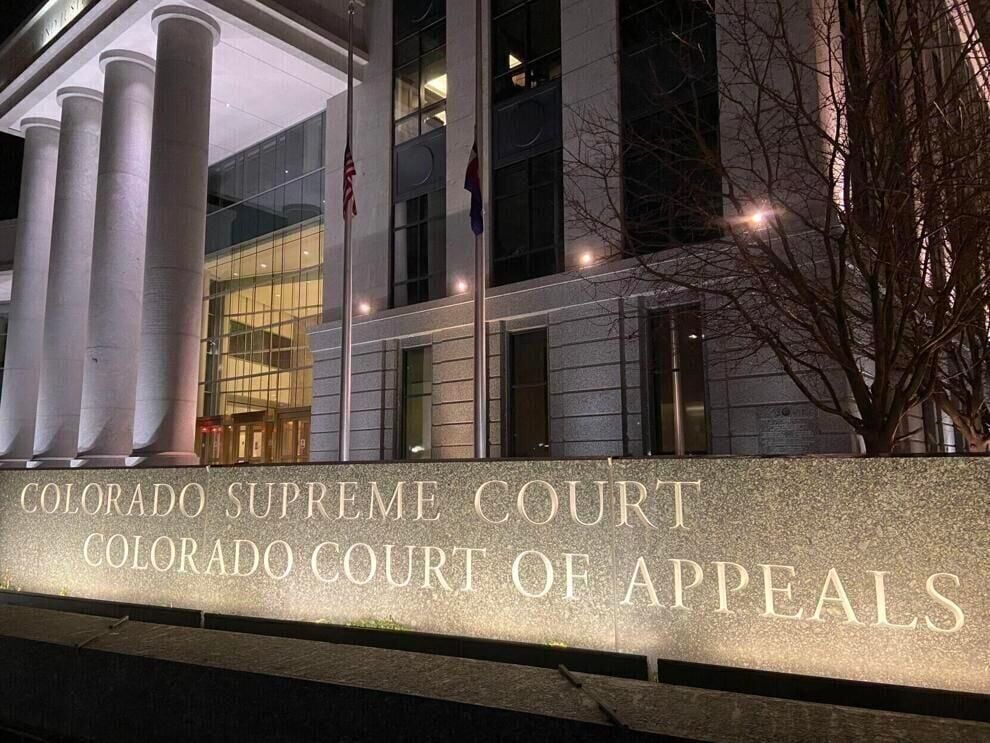
At trial, in response to the prosecution’s questioning, Spinuzzi admitted to having repeatedly lied to law enforcement. The prosecution then asked District Court Judge Thomas Flesher to permit the jury to hear evidence of Jones’ prior acts of abuse toward Spinuzzi to illustrate how Spinuzzi had learned to “make things up.”
Flesher granted the prosecution’s request, telling jurors they were only to use the evidence to assess Spinuzzi’s credibility as a witness. The jury convicted Jones of murder.
A Court of Appeals panel ruled that the evidence of Jones’ prior conduct was properly aimed at helping the jury decide whether to believe the version of events Spinuzzi recounted on the witness stand.
Spinuzzi’s “credibility was crucial in this case. She was the prosecution’s primary witness at trial, and discussions of her inconsistent testimony dominated opening statements and closing arguments,” wrote Judge Jerry N. Jones, who is not related to Romando Jones.
To the Supreme Court, Romando Jones argued the decision “encourages gamesmanship” by allowing the prosecution to probe the credibility issues of its own witness, then introduce inflammatory evidence of other misconduct to explain away those issues.
The justices will decide if the evidence was properly admitted.
The case is Jones v. People.


Colorado justices, by 5-2, say Longmont detective did not violate suspect’s Miranda rights
Michael Karlik
michael.karlik@coloradopolitics.com
Updated 2 hours ago
The Colorado Supreme Court’s majority ruled on Monday that a Longmont detective did not coerce a suspect into talking by making references to how a judge would look at his character, and by suggesting he may get out of prison...
Colorado justices find Fort Collins police lacked probable cause to arrest suspect in park
Michael Karlik
michael.karlik@coloradopolitics.com
Updated 4 hours ago
The Colorado Supreme Court agreed on Monday that Fort Collins police lacked probable cause to arrest a man for a child sex offense based on his presence in a public park around the time they intended to meet with their...

Supreme Court to hold oral arguments, discipline commission releases report | COURT CRAWL
Michael Karlik
michael.karlik@coloradopolitics.com
Updated 5 hours ago
Welcome to Court Crawl, Colorado Politics’ roundup of news from the third branch of government. The state Supreme Court is holding oral arguments this week, plus Colorado’s judicial discipline commission released its annual report. Colorado Supreme Court news • The Supreme...
Federal judge dismisses developer’s challenge to Denver affordable housing ordinances
Michael Karlik
michael.karlik@coloradopolitics.com
Updated 3 days ago
A federal judge dismissed a homebuilder’s constitutional challenge on Tuesday to a pair of Denver ordinances that impose obligations on developers related to the affordable housing demands created by new construction. Two related companies, redT Homes and redT Capital Partners,...
10th Circuit distances itself from prior decision making it easier to toss prisoner lawsuits
Michael Karlik
michael.karlik@coloradopolitics.com
Updated 3 days ago
The Denver-based federal appeals court distanced itself on Wednesday from its own recent decision that made it easier for prison officials to end civil lawsuits by transferring incarcerated plaintiffs between facilities. A three-judge panel of the U.S. Court of Appeals...

Appeals court overturns Douglas County vehicular homicide conviction due to faulty jury instructions
Michael Karlik
michael.karlik@coloradopolitics.com
Updated 1 day ago
Colorado’s second-highest court overturned a defendant’s vehicular homicide conviction and 12-year prison sentence on Thursday after determining a Douglas County judge omitted key language from the jury instructions that could have resulted in a different outcome. James Paul McDonald was...
Federal judge dismisses malicious prosecution claim against former Denver prosecutor
Michael Karlik
michael.karlik@coloradopolitics.com
Updated 3 days ago
A federal judge concluded on Monday that a former Denver prosecutor could not be sued for allegedly causing the arrests of two plaintiffs after they failed to appear for trial on the scheduled date, even though the trial had been...
Judicial discipline commission reports increased transparency, increased submissions
Michael Karlik
michael.karlik@coloradopolitics.com
Updated 2 days ago
The Colorado Commission on Judicial Discipline received 473 misconduct complaints about judges in 2025, which was nearly 29% higher than in 2024 and substantially greater than any time in the past decade. However, only 31 complaints were referred to the commission...
Colorado Gov. Jared Polis ignites fierce debate after raising clemency questions in Tina Peters case
Marianne Goodland
marianne.goodland@coloradopolitics.com
Updated 5 days ago
Gov. Jared Polis ignited a political firestorm Tuesday night after weighing in on the prison sentences of two former Colorado officials — a Democrat and a Republican — convicted of attempting to influence a public servant. The comments quickly fueled...

Colorado Supreme Court signals intervention in dispute over treatment for trans children
Michael Karlik
michael.karlik@coloradopolitics.com
Updated 6 days ago
The Colorado Supreme Court ordered Children’s Hospital Colorado on Tuesday to explain why it should not direct the organization to resume providing certain types of services to transgender children in compliance with the state’s non-discrimination law. Last month, a Denver...
PREV
PREVIOUS

Colorado halts wolf releases for 2026 as federal pressure mounts
Colorado Parks and Wildlife, facing mounting criticism from the Trump administration over its management of the wolf reintroduction program, announced Wednesday they will not bring in any new wolves to the state for the 2026 winter season. CPW was turned down in November by Washington state’s Department of Fish and Wildlife, and Washington residents criticized Colorado for […]
Gov. Polis, Democratic lawmakers introduce trio of housing affordability bills
Democratic lawmakers were joined by housing advocates and Gov. Jared Polis at the Capitol on Wednesday to announce a trio of bills they say will increase affordable housing in Colorado. “This session, Colorado Democrats are focused on lowering costs, and these three bills will spur more housing now that Coloradans can afford,” said Speaker of […]