

Trump admin’s maiming of renewables agencies an energy affront | HUDSON

NREL has a rhythmic resonance that won’t be matched by NLR, Colorado’s newly christened National Laboratory of the Rockies. Nearly lost to memory is how the National Renewable Energy Laboratory authorized by President George H. W. Bush in 1991 was preceded by the Solar Energy Research Institute (SERI), which opened in 1977 on the mesa east of Golden. It was Chris Wright, a Colorado oil-and-gas fracking mogul appointed as the Secretary of Energy by the Trump White House, who announced this most recent name change. Originally created in the wake of the Arab oil embargo of 1973, NREL’s research focus has been development of ever more efficient energy alternatives to fossil fuels. Nearly every president during the past 35 years has made at least one visit to this premiere sustainable energy research facility.
It’s apparent more than a name change is now in store for the laboratory. DOE’s announcement explains, “The energy crisis we face today is unlike the crisis that gave rise to NREL. We are no longer picking and choosing energy sources.” It seems likely this means much of the lab’s current work enabling a sustainable energy future will be mothballed in favor of “clean coal” and petroleum technologies reflecting… the Trump administration’s broader vision for the lab’s applied energy research.” This policy trajectory from pioneering the search for an environmentally sound energy strategy to a “burn it while you have it” philosophy represents a Republican about-face over the past half-century, both nationally and here in Colorado. It was President Richard Nixon and congressional Republicans who created the Environmental Protection Agency in 1970, proudly pointing out the joint origin of the terms conservative and conservation. It was Ronald Reagan who observed, “Preservation of our environment is not a liberal or conservative challenge, it’s common sense.”
In 1979 both chambers of the Colorado legislature, which each enjoyed a two-thirds Republican majority, created the Colorado Energy Research Institute (CERI) located at the School of Mines in Golden. It was another legislative response to long lines statewide at gas pumps resulting from the Arab embargo and was initially focused on conservation measures, including social behavioral programs like carpooling. At the federal level, the Environmental Protection Agency was focused primarily on pollution clean-ups following the 1969 fires on the surface of the Cuyahoga River in Ohio, and a decade later the Love Canal poisoning of domestic water supplies detected in 1980. At the same time, acid rain destruction of northeastern forests followed by the 1981 Montreal protocol to protect and restore the ozone holes over the poles enhanced the credibility of environmental regulation. This attention was abruptly reversed with the arrival of the Reagan administration and the appointment of another Coloradan, Anne Gorsuch (mother of Supreme Court Justice Neil), as the administrator of the EPA.
Gorsuch cut the agency’s budget by 20% and its staff by 25%. Rita Lavelle, her deputy, so mismanaged the superfund program she would later be sent to a federal prison. Resigning in 1983, Anne Gorsuch was replaced with the original EPA administrator appointed by Nixon in 1969, well-regarded former Republican Congressman Willam Ruckelshaus with a charge to restore environmental competency for the Reagan administration. Although there had been sporadic scientific indications since mid-century carbon dioxide build-up in the atmosphere was likely contributing to climate change and/or “global warming,” it wasn’t until the 1990s national attention turned to this economic and public health threat. Early in the decade, Colorado’s Republican legislators quietly shuttered CERI, although its remnants live on in comparable research efforts at CSU and the University of Colorado. The United Nations began to pay attention in the 1980s to climate issues, convening a periodic policy roundelay that has mostly sounded alarms with little concrete action.
As the public debate between environmental groups and the fossil fuel industry heated up, along with annual average temperatures, congressional Republicans began to migrate toward climate skepticism while Democrats placed renewable energy and sustainable policy as centerpieces of their political agenda. Nonetheless, it was George W. Bush’s administration when EPA identified carbon dioxide as a pollutant shortly after the turn of the 21st century. This designation was affirmed by the Supreme Court, although it is expected to be challenged again now that the Supreme Court has overturned its Chevron precedent. Stripping the EPA of the authority to regulate CO2 in our atmosphere would throw open the door to unlimited fossil-fuel emissions. With a president who labels climate change a hoax and a Democratic “con”, and his Department of Energy claiming, “Our highest priority is to invest in the scientific capabilities that will restore American manufacturing, drive down costs and help this country meet its energy demand. The National Laboratory of the Rockies will play a vital role in those efforts,” We can guess where national energy policy is headed.
I suspect a sizeable share of Republicans harbor doubts about this change in direction. At the same time, some Democrats have begun to question whether voters really care about climate change. That may be a misreading of polls where an overwhelming majority express their concern even if they don’t make it a priority. When 95% of climate scientists confirm climate change is real, our planet is warming, it seems there would be wisdom in taking the side of caution. Even if this prediction proves wrong, there seems to be both logic and prudence in pursuing sustainable energy technologies. NREL and its partners have already driven the cost of renewable energy generation substantially cheaper than fossil-fuel power.
Since 1973, the United States has become the world’s largest petro-carbon producer, so we no longer face the risk of fuel shortages from an embargo. Good for us, we’re now energy independent. My advice to the NLR staff is to save their NREL letterhead. It won’t be long before a new president restores their name and international reputation for excellence.
Miller Hudson is a public affairs consultant and a former Colorado legislator.

Ain’t Polis’ Peters commutation a pity? | Hal Bidlack
Hal Bidlack
hal-bidlack@coloradopolitics.com
Updated 7 hours ago
I am hoping that, yet again, my long-suffering and very forgiving editor will pardon my rambling thoughts today, as there are too many open tabs on my computer that deal with issues I want to talk about (Ed: pretty used...
Colorado House Democrats’ caucus finances under scrutiny as ethics case against leader advances
Marianne Goodland
marianne.goodland@coloradopolitics.com
Updated 12 hours ago
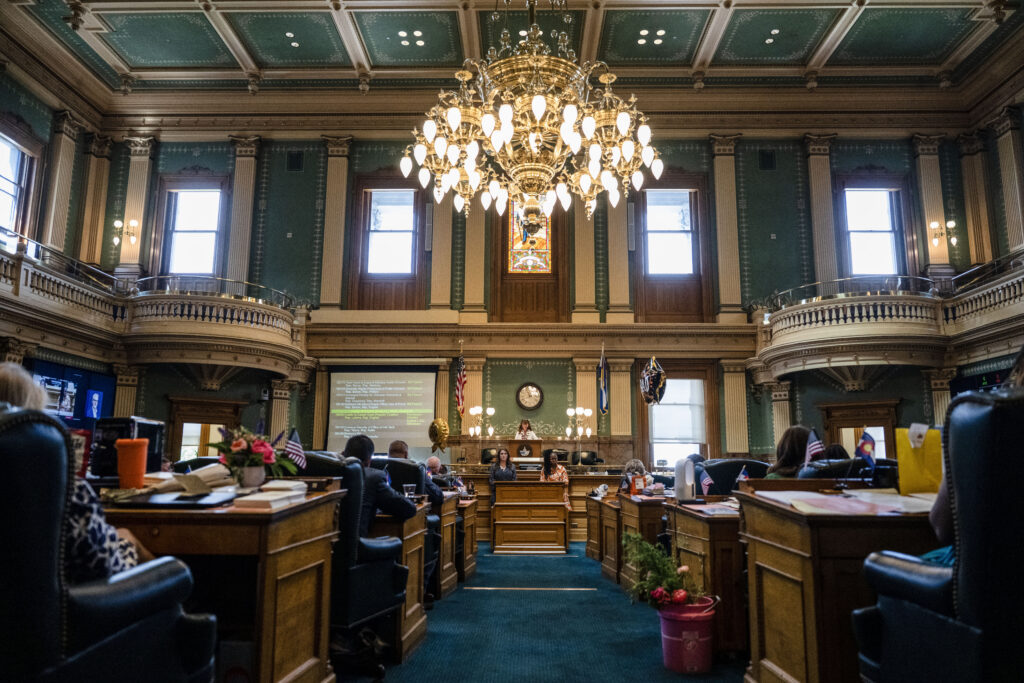
Democratic lawmakers told a legislative ethics panel that a leader’s management of caucus finances left them with unanswered questions, disputed reimbursements and a breakdown in communication that ultimately triggered a formal complaint. The House Ethics Committee is examining a complaint...

Colorado River crisis: Lake Mead, Lake Powell inch closer to ‘dead pool’
Marianne Goodland
marianne.goodland@coloradopolitics.com
Updated 11 hours ago
In the past 10 days, both Lake Mead on the Arizona-Nevada border and Lake Powell roughly 300 miles northeast on the Utah-Arizona line have recorded their lowest water levels since the reservoirs were first filled. Lake Mead, the nation’s largest...

Colorado lieutenant governor candidate Markert says early discipline and key mentors set his course
Marianne Goodland
marianne.goodland@coloradopolitics.com
Updated 18 hours ago
Editor’s note: This is the first installment in a three-part series examining Colorado’s candidates for lieutenant governor. In this piece, Colorado Politics speaks with George Markert, the Republican running mate to gubernatorial candidate Victor Marx. Marx is competing against Democrat...

Colorado, like America, past due for generational change in politics | Miller Hudson
Miller Hudson
miller-hudson@coloradopolitics.com
Updated 2 days ago
I was 27 before I ever voted for president. At 19, in 1964, the Constitution had not yet been amended establishing 18-year-old voting eligibility. In 1968, I was serving overseas with the U.S. Navy at a time when there was...

Farmers and ranchers win on NIETC cancellation | Rachel Gabel
Rachel Gabel
rachel-gabel@coloradopolitics.com
Updated 2 days ago
The Department of Energy rolled into Lamar last week and Office of Electricity Assistant Secretary Katie Jereza stood in her neat, green suit in front of a room filled with farmers, ranchers and landowners. The crowd was filled with straw...

Going after the wrong butts | Jon Caldara
Jon Caldara
jon-caldara@coloradopolitics.com
Updated 4 days ago
Mayor Mike Johnston proclaimed, “It is past time Big Tobacco cleaned up the big mess it’s created.” Yep. Denver is suing tobacco companies for the cigarette butts littering the city. Because Denver’s Big Mess couldn’t possibly be the fault of...

Jeff Crank, Jessica Killin set to face off in 2 debates in Colorado’s 5th Congressional District
Ernest Luning
ernest.luning@coloradopolitics.com
Updated 3 days ago
Republican U.S. Rep. Jeff Crank and Jessica Killin, his Democratic challenger, have agreed to debate twice in the weeks leading up to the general election in Colorado’s 5th Congressional District, their campaigns have said. Crank is seeking a second term...

CSI study reviews impacts of Colorado’s mandatory sex‑trafficking sentencing measure
Marissa Ventrelli
marissa.ventrelli@coloradopolitics.com
Updated 12 hours ago
A new report by the think-tank Common Sense Institute examines what could happen if Colorado voters approve Initiative No. 108, which establishes mandatory life sentences for offenders convicted of sexual trafficking of a minor. The measure is backed by Protect...
Three districts that will answer key Colorado political questions | Paula Noonan
Paula Noonan
paula-noonan@coloradopolitics.com
Updated 5 days ago
Colorado’s legislature used to be a place where neither party was dominant. Dozens of seats were competitive and House and Senate majorities switched regularly. From 2010 to 2020, the House was predominantly Democratic with one two-year assembly under Republicans. The...
PREV
PREVIOUS

Ranchers are not an endangered species, nor an invasive one | GABEL
Animal agriculture, ranching, hunting and farming are not dying ways of life. The cowboy is not about to ride off into the sunset and certain extinction. Beef is not going to be replaced by cultured meat, any variety of bugs, or salad (though we grow that, too). Artificial intelligence or niche small-scale production methods are […]

Colorado Democrat Julie Gonzales launches U.S. Senate primary challenge to incumbent John Hickenlooper
Declaring that Colorado “needs a fighter, not a bystander,” state Sen. Julie Gonzales, a Denver Democrat, on Monday launched her long-anticipated primary challenge to U.S. Sen. John Hickenlooper. Pitching her campaign as a departure from “old-playbook politics,” Gonzales said she’s appealing to voters who are “sick and tired of Democrats trying to manage primaries from […]