

Judges speak about mentorship and bench trials, federal court revises jury selection protocol | COURT CRAWL

Welcome to Court Crawl, Colorado Politics’ roundup of news from the third branch of government.
Colorado’s judges spoke to lawyers about mentorship and how to approach bench trials, plus the federal trial court made revisions to its plan for randomly selecting jurors across the state.
Heard on appeal
• The Colorado Supreme Court will decide whether the definition of “reasonable doubt” adopted in a 2023 update to the template jury instructions is constitutional, and will adjudicate a corporate contract dispute.
• The justices may also decide whether defendants who mount postconviction challenges can receive the same evidence their original trial lawyers received from the prosecution.
• The state’s Court of Appeals concluded prosecutors across three separate criminal cases had not purposefully removed jurors of color because of their race.
• An Arapahoe County magistrate said he couldn’t find his notes, didn’t remember a divorce case and wasn’t ready to rule. He ruled anyway. The Court of Appeals overturned his ensuing inscrutable orders.
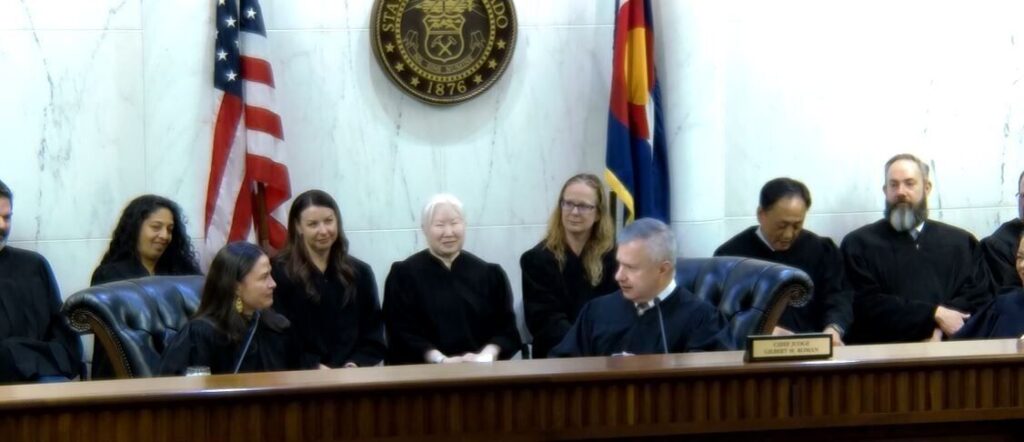
• A Denver judge gave illogical reasons for refusing to reduce a defendant’s sentence, prompting the Court of Appeals to order a redo.
• One member of the Court of Appeals pushed the Supreme Court to consider what the correct standard should be when deciding if a spouse is required to continue paying alimony to their ex-partner even after the person has remarried.
• The Court of Appeals clarified that voters don’t have the constitutional right to pursue referendums of county policies.
• Caseworkers testifying as experts in child neglect cases are held to the same safeguards for reliability as other scientific testimony, the Court of Appeals ruled.
In federal news
• The U.S. Court of Appeals for the 10th Circuit ruled, by 2-1, that Vail had identified a sufficient safety reason for banning delivery vehicles from pedestrian areas.
• The 10th Circuit determined a plaintiff could proceed with his constitutional challenge to Colorado’s law prohibiting the posting of certain personal information about law enforcement online.
• Colorado may be sued for its 2023 law regulating the pricing of EpiPens under certain circumstances, the 10th Circuit concluded.
• A federal judge agreed Denver could be sued for its role in an officer’s use of force against someone outside a Lower Downtown bar.
• The University of Colorado Colorado Springs and some of its employees can’t be sued for their roles in a math professor’s alleged sexual misconduct toward a student.
• A judge dismissed a motel operator’s constitutional claim against a Greenwood Village detective for his criminal investigation into a potential zoning violation, which allegedly had discriminatory motivations.
• U.S. Magistrate Judge Susan Prose and multiple attorneys spoke about how to approach bench trials, as compared to jury trials.
• On Tuesday, the 10th Circuit will honor Senior Judge Stephanie K. Seymour as the longest-serving member of that court.
Jury selection revisions
• Last month, Colorado’s federal trial court implemented its revised plan for jury selection. Under the law, each district court must have a written plan for randomly selecting people for grand and petit (meaning trial) juries.
• The district court adopted its latest revision in June, which the 10th Circuit approved. Aug. 11 was the implementation date. Colorado Politics compared the new and prior jury selection plans and found a couple of key differences.
• Unlike the prior plan adopted in 2017, the new policy includes gender identity as one of the grounds for which no one should be excluded from jury service:

• The new policy specifies that jurors are drawn from both active and inactive voter lists — meaning those who automatically receive mail ballots and those who don’t. Earlier this year, the 10th Circuit determined that the practice of summoning jurors only from the ranks of active voters didn’t violate a defendant’s constitutional rights based on alleged racial disparities:

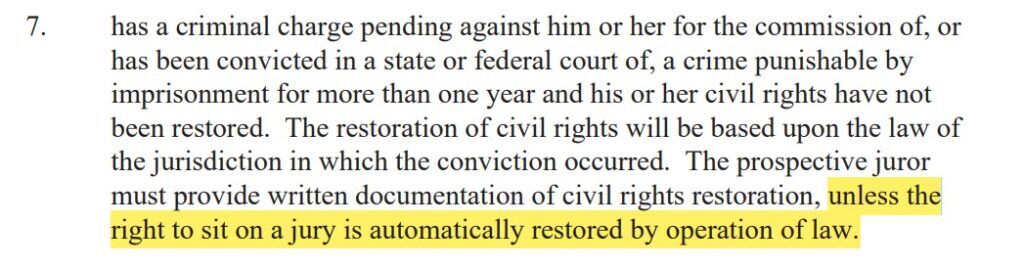
• The new plan clarifies that people whose crimes made them ineligible for jury service, but whose rights have since been restored, don’t need to provide documentation if a law has automatically reinstated their right to sit on a jury:
• The plan now specifies that judges may not only order jurors’ names withheld, but any personal identifying information, too:

• Finally, the plan divides Colorado into different geographic divisions where jurors are picked. There’s a Denver division, which summons from 24 counties and stretches from northeastern Colorado to the mountains, a Durango division, a Grand Junction division and a Pueblo division. The new plan shifts Conejos and Ouray counties out of the Durango division and into the two other rural divisions.
Vacancies and appointments
• The governor appointed civil litigator Susan M. Ryan, who has a background in water law, to the Ninth Judicial District (Garfield, Pitkin and Rio Blanco counties), where she will succeed retiring Chief Judge John Neiley.
• The governor also selected public defender Alexander R. Haynes to succeed retiring District Court Judge Denise Lynch, also of the Ninth Judicial District.
• The governor named Douglas County Magistrate Donna M. Stewart to succeed retiring District Court Judge Robert Lung in the 23rd Judicial District (Douglas, Elbert and Lincoln counties).
• The governor picked prosecutor Jennifer A. Viehman to succeed retiring District Court Judge David Shakes in the Fourth Judicial District (El Paso and Teller counties).
• Applications are due by Oct. 20 to succeed retiring District Court Judge Mary E. Deganhart in the Seventh Judicial District (Delta, Gunnison, Hinsdale, Montrose, Ouray and San Miguel counties).
• Applications are due by Sep. 24 to succeed retiring Chief Judge Jeffrey R. Wilson in the Sixth Judicial District (Archuleta, La Plata and San Juan counties). That is the same deadline for a vacancy on the Archuleta County Court, caused by the recent appointment of Judge Justin P. Fay to the district court bench.
Miscellaneous proceedings
• Justice Richard L. Gabriel and other judges spoke to Colorado attorneys about the proper approach to mentorship and the ways that mentoring can assist those in the legal profession.
• Approximately $3 million are available from the Colorado Underfunded Courthouse Facility Cash Fund, which assists less populous and less wealthy counties in paying for courthouse renovations. The deadline to apply is Sept. 30.

Colorado’s chief federal judge orders return of wrongfully deported man, second judge to explore ‘series’ of violations
Michael Karlik
michael.karlik@coloradopolitics.com
Updated 4 hours ago
Colorado’s chief federal judge took the extraordinary step of directing the government on Tuesday to do everything it can to return a man it deported in violation of his order. At the same time, Colorado’s chief magistrate judge has set...
Denver murder, assault convictions reversed due to faulty jury instructions
Michael Karlik
michael.karlik@coloradopolitics.com
Updated 2 hours ago
Colorado’s second-highest court reversed a defendant’s convictions for murder and assault last week after concluding a Denver judge incorrectly omitted key jury instructions that could have affected the verdict and sentencing. Stephen C. Swainson fatally stabbed Israel Casillas in downtown...
‘Understand people for who they are’: 2 federal judges talk about compassion in courtroom
Michael Karlik
michael.karlik@coloradopolitics.com
Updated 10 hours ago
Before taking the bench in 2022, U.S. District Court Judge Charlotte N. Sweeney was an employment discrimination attorney. While the cases could be emotionally charged, they were different from the criminal proceedings she is now handling. “It wasn’t necessarily affecting...
Denver murder conviction reversed for incomplete self-defense instruction
Michael Karlik
michael.karlik@coloradopolitics.com
Updated 1 day ago
Colorado’s second-highest court reversed a defendant’s murder conviction last week because a Denver judge gave an incomplete instruction to the jury about the man’s right to self-defense. Donald R. Gonzales and Gary McLaughlin met up in a Capitol Hill parking...
Colorado lawmaker, House leaders named in workplace-retaliation lawsuit
Marianne Goodland
marianne.goodland@coloradopolitics.com
Updated 1 day ago
A former legislative aide has filed a lawsuit alleging she was mistreated, illegally directed to perform campaign work and harmed by a House leadership structure she charged was fragmented, politicized and ineffective at protecting employees. The lawsuit, filed by Jennifer...
Federal judge hears arguments about Colorado’s 3-day gun purchase waiting period
Michael Karlik
michael.karlik@coloradopolitics.com
Updated 1 day ago
A federal judge heard arguments on Monday about the constitutionality of a 2023 Colorado law that generally imposes a three-day waiting period on firearm purchases after the initiation of a background check. The test that the U.S. Supreme Court created...
Colorado Supreme Court intervenes in Weld County prosecution dismissed due to Missy Woods misconduct
Michael Karlik
michael.karlik@coloradopolitics.com
Updated 1 day ago
The Colorado Supreme Court ordered a Weld County trial judge last week to respond to the district attorney’s claim that he improperly dismissed a criminal case because of “outrageous” conduct by the Colorado Bureau of Investigation. Daniel Lee Eatinger stood...
Schoolchildren’s presence at child sex-related trial did not harm Arapahoe County defendant, appeals court says
Michael Karlik
michael.karlik@coloradopolitics.com
Updated 4 days ago
Colorado’s second-highest court decided on Thursday that the presence of a group of schoolchildren on the first day of a child sexual exploitation trial did not violate an Arapahoe County defendant’s constitutional right to a fair trial. Prosecutors charged Jerry...
Appeals court cites week-old Colorado law to reinstate child neglect case at child, father’s request
Michael Karlik
michael.karlik@coloradopolitics.com
Updated 4 days ago
Colorado’s second-highest court invoked a new state law for the first time on Thursday and reinstated a child neglect case that both the child and her father wished to reopen. House Bill 1227 took effect on Aug. 12, reversing a...
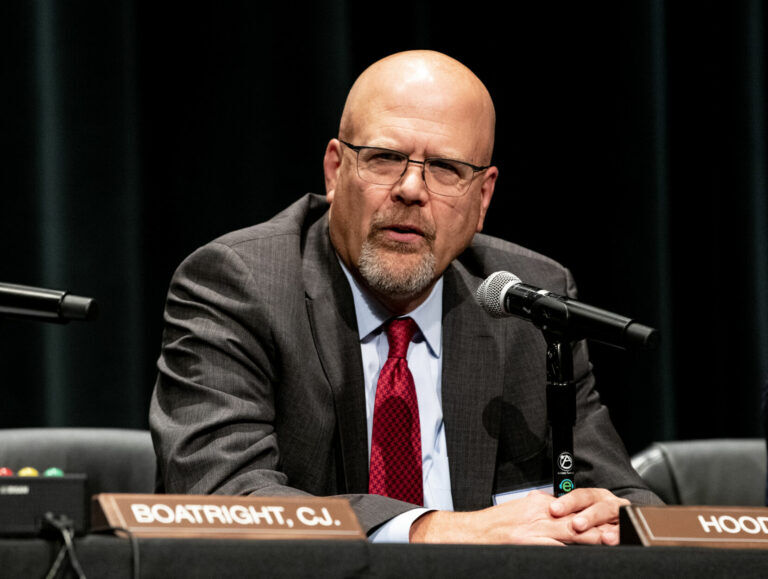
Colorado Supreme Court names William Hood as next chief justice
Michael Karlik
michael.karlik@coloradopolitics.com
Updated 5 days ago
The Colorado Supreme Court has selected Justice William W. Hood III to be the next chief justice, the judicial branch announced on Friday. Hood will succeed Chief Justice Monica M. Márquez, who took over the role in July 2024. “I...
PREV
PREVIOUS

Divided Colorado Supreme Court upholds disbarment of ex-DA Linda Stanley
The Colorado Supreme Court, by 4-2, upheld the rare disbarment of an elected district attorney on Monday, concluding disciplinary officials correctly barred Linda Stanley from practicing law as a result of her inappropriate comments to the media and her improper attempt to remove a judge from a high-profile murder case. Voters of the 11th Judicial […]

The National Guard operating in Denver? Unlikely, experts say
President Donald Trump recently inked an executive order creating a series of specialized military units within the National Guard that, under the direction of Secretary of Defense Pete Hegseth, would be “specifically trained and equipped to deal with public disorder issues.” Is such a deployment of the National Guard a possibility in Denver, where Mayor […]