

10th Circuit says judge erred in denying immunity to Denver officers who arrested man for recording
The Colorado-based federal appeals court sided with two Denver police officers on Tuesday, finding they were entitled to immunity outright or to a second look at their arguments in a lawsuit over a man’s arrest for video recording at a police station.
There was no dispute that a sign was posted on the window of the District 5 station in northeast Denver prohibiting video recording “in” the facility. The question was whether Officers Sergey Gurevich and Julie Weinheimer had grounds to arrest Kevin Detreville while he was standing in an enclosed entryway leading to the lobby and recording on his cell phone.
Previously, a judge advanced three of Detreville’s claims to a jury trial. He concluded the defendants did not explicitly argue they were entitled to qualified immunity, which is a judicial doctrine shielding government employees from civil lawsuits unless they violate a person’s clearly established rights.
But a three-judge panel of the U.S. Court of Appeals for the 10th Circuit believed the officers had, in fact, argued they were immune on every claim. The panel returned two of the claims to the trial court for further analysis, and decided outright that Gurevich and Weinheimer could not be liable on Detreville’s claim that he was arrested in retaliation for exercising his free speech rights.
It was “not clearly established that arresting Mr. Detreville would violate his right to be free from First Amendment retaliatory arrest,” wrote Judge Scott M. Matheson Jr. in the panel’s July 8 order.
On the night of Nov. 10, 2019, as depicted on his cell phone footage, Detreville arrived at the District 5 station along Peoria Street. The complex houses other government offices in addition to police. After walking around, he said he was going to see if police would respect his First Amendment right to record.
He continued to a walkway leading up to the station. Outside of the reception area was an enclosure, described by the parties as an awning, vestibule or entryway. As Detreville entered the vestibule and stood outside the station door, Weinheimer stepped out and started speaking with Detreville.
“What’s your name and badge number?” Detreville asked her. Weinheimer handed him her card. She asked if she could help Detreville with anything, and he repeated his demand for her name and badge number.
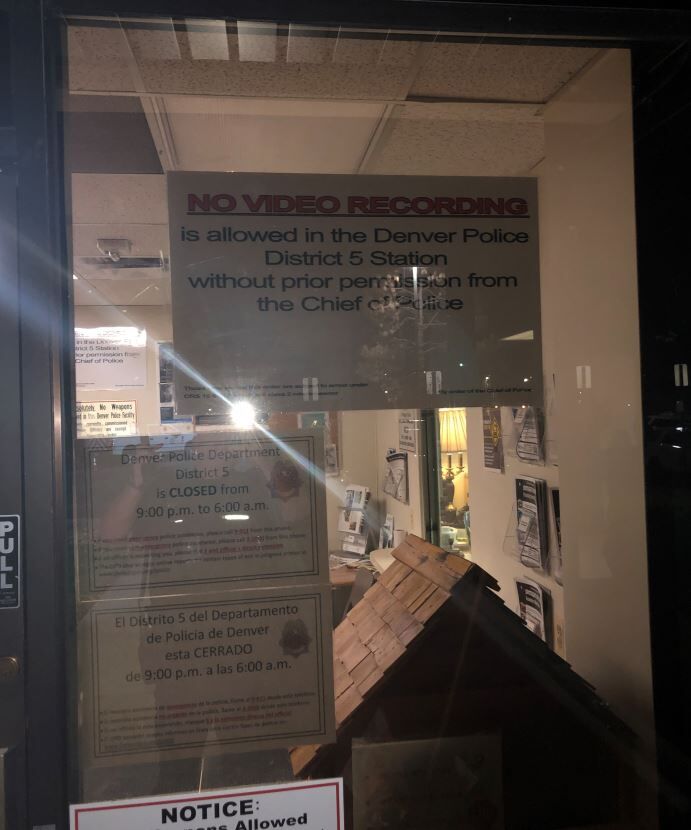
A sign prohibiting video recording posted in the window of the Denver Police Department's District 5 station. Source: Detreville v. Gurevich et al.

“Yes, I literally just handed you my card,” Weinheimer responded. “I walked out the door, you put a camera in my face, I’m asking how I can help you.”
Gurevich then arrived, informing Detreville that recording was not allowed “on our property. If you don’t stop recording, we’ll have to arrest you.” Weinheimer pointed to a sign in the vestibule, affixed to the reception area’s window, that read, “No video recording allowed in the Denver District 5 Station without prior permission from the Chief of Police.”
Gurevich gave Detreville a “second warning” to stop recording, to which Detreville replied that recording was his First Amendment right.
“It’s not, actually,” Weinheimer said, placing him in handcuffs. The officers took him inside to be booked. Detreville stayed in jail for three days. Prosecutors subsequently dismissed the charges.
Both parties moved to end the lawsuit in their favor, in whole or in part, without a trial. Most of Detreville’s claims hinged on whether he was, in fact, doing something prohibited by the sign when recording in the entryway outside the front door.

A screenshot of the Denver District 5 police station taken from the video of Kevin Detreville on Nov. 10, 2019.

In September, U.S. District Court Chief Judge Philip A. Brimmer believed the officers did not have probable cause to arrest Detreville for his conduct. But Brimmer simultaneously found an officer “could have made a reasonable mistake” in thinking the sign applied to the vestibule. Therefore, there was “arguable” probable cause to arrest.
Brimmer granted the officers qualified immunity on Detreville’s claim of unlawful arrest. But in Brimmer’s view, the defendants neglected to invoke qualified immunity on Detreville’s remaining claims, which included retaliatory arrest, malicious prosecution and an equal protection violation. The final claim hinged on evidence that a White man recorded video at the station shortly after the arrest of Detreville, who is Black. Although Gurevich was allegedly aware of the White man, he did not arrest him.
The officers immediately appealed to the 10th Circuit, arguing Brimmer’s finding of arguable probable cause should have been sufficient to resolve the case in their favor. Detreville, meanwhile, warned against letting “‘reasonable mistake’ simply become a magic phrase for officers to exclaim when they find themselves in trouble.”
“Are you questioning qualified immunity as a doctrine? Its legitimacy? Are you questioning that before us?” asked Judge Allison H. Eid during oral arguments.
When courts excuse officers’ constitutional violations because they were mistaken about the law, responded attorney Zachary L. Shiffler for Detreville, “we are necessarily weighing these judicially created immunities more than constitutional rights. That’s something we need to be cognizant of.”
Ultimately, the panel agreed Brimmer incorrectly denied immunity to the defendants on Detreville’s retaliatory arrest claim because the officers believed there was probable cause of an offense.
As for the malicious prosecution claim, the panel ordered Brimmer to look again at whether qualified immunity applied, and specifically whether the evidence in Detreville’s ensuing criminal case could have established probable cause.
Finally, Matheson noted probable cause was not a factor at all in Detreville’s claim that Gurevich arrested him, but not a White man, for similar conduct. Instead, the panel directed Brimmer to examine “whether Mr. Detreville’s right to equal protection against racially selective law enforcement was clearly established when the officers arrested him.”
The case is Detreville v. Gurevich et al.
Colorado Politics Must-Reads:

10th Circuit overturns framework for sentencing probation violators by 11-1
Michael Karlik
michael.karlik@coloradopolitics.com
Updated 2 hours ago
In a rare decision by all 12 of its full-time judges, the Denver-based federal appeals court ruled in a lopsided vote on Friday that one of its members created a sentencing process for probation violators that was out of step...
Federal judge dismisses excessive force lawsuit against Colorado Springs, officer
Michael Karlik
michael.karlik@coloradopolitics.com
Updated 6 hours ago
A federal judge concluded last week that a Colorado Springs police officer could not be held liable for shooting a suspect three times after the man menaced two victims with a gun and fled the scene. Al’morion Germany was involved...
Weld County man sentenced to 236 years for sexually assaulting 9-year-old girl
Kyla Pearce
kyla.pearce@gazette.com
Updated 1 day ago
A Weld County man was sentenced to 236 years in prison for repeatedly sexually assaulting a 9-year-old girl. Joshua Andrews, 41, was charged in June with 12 counts of sexual assault on a child by a person in a position...
Wrongfully deported man to be returned to U.S., Colorado federal judge orders
Michael Karlik
michael.karlik@coloradopolitics.com
Updated 2 days ago
Colorado’s chief federal judge took the extraordinary step of directing the government on Tuesday to do everything it can to return a man it deported in violation of his order. At the same time, Colorado’s chief magistrate judge has set...
Denver murder, assault convictions reversed due to faulty jury instructions
Michael Karlik
michael.karlik@coloradopolitics.com
Updated 1 day ago
Colorado’s second-highest court reversed a defendant’s convictions for murder and assault last week after concluding a Denver judge incorrectly omitted key jury instructions that could have affected the verdict and sentencing. Stephen C. Swainson fatally stabbed Israel Casillas in downtown...
‘Understand people for who they are’: 2 federal judges talk about compassion in courtroom
Michael Karlik
michael.karlik@coloradopolitics.com
Updated 20 hours ago
Before taking the bench in 2022, U.S. District Court Judge Charlotte N. Sweeney was an employment discrimination attorney. While the cases could be emotionally charged, they were different from the criminal proceedings she is now handling. “It wasn’t necessarily affecting...
Denver murder conviction reversed for incomplete self-defense instruction
Michael Karlik
michael.karlik@coloradopolitics.com
Updated 4 days ago
Colorado’s second-highest court reversed a defendant’s murder conviction last week because a Denver judge gave an incomplete instruction to the jury about the man’s right to self-defense. Donald R. Gonzales and Gary McLaughlin met up in a Capitol Hill parking...
Colorado lawmaker, House leaders named in workplace-retaliation lawsuit
Marianne Goodland
marianne.goodland@coloradopolitics.com
Updated 4 days ago
A former legislative aide has filed a lawsuit alleging she was mistreated, illegally directed to perform campaign work and harmed by a House leadership structure she charged was fragmented, politicized and ineffective at protecting employees. The lawsuit, filed by Jennifer...
Federal judge hears arguments about Colorado’s 3-day gun purchase waiting period
Michael Karlik
michael.karlik@coloradopolitics.com
Updated 4 days ago
A federal judge heard arguments on Monday about the constitutionality of a 2023 Colorado law that generally imposes a three-day waiting period on firearm purchases after the initiation of a background check. The test that the U.S. Supreme Court created...
Colorado Supreme Court intervenes in Weld County prosecution dismissed due to Missy Woods misconduct
Michael Karlik
michael.karlik@coloradopolitics.com
Updated 4 days ago
The Colorado Supreme Court ordered a Weld County trial judge last week to respond to the district attorney’s claim that he improperly dismissed a criminal case because of “outrageous” conduct by the Colorado Bureau of Investigation. Daniel Lee Eatinger stood...