

Appeals court clarifies defendant need not prove relationship with own children to modify restraining order
Colorado’s second-highest court clarified on Thursday that a defendant did not need to demonstrate the nature of his relationship with his biological children in order to argue that a no-contact order infringed on his constitutional rights.
Last year, the Colorado Supreme Court issued a decision in Salah v. People, addressing what should happen when a convicted sex offender wants to continue interacting with his minor relatives. The court noted that familial relationships fall on a “spectrum of protection,” with parent-child relationships requiring the greatest degree of safeguarding and those with no parental or custodial aspect entitled to less protection.
The justices, in evaluating the defendant’s right to contact his nephew, noted he did not “present any evidence demonstrating the nature of his relationship.” Therefore, his constitutional right to familial association was not violated with the no-contact order with his nephew.
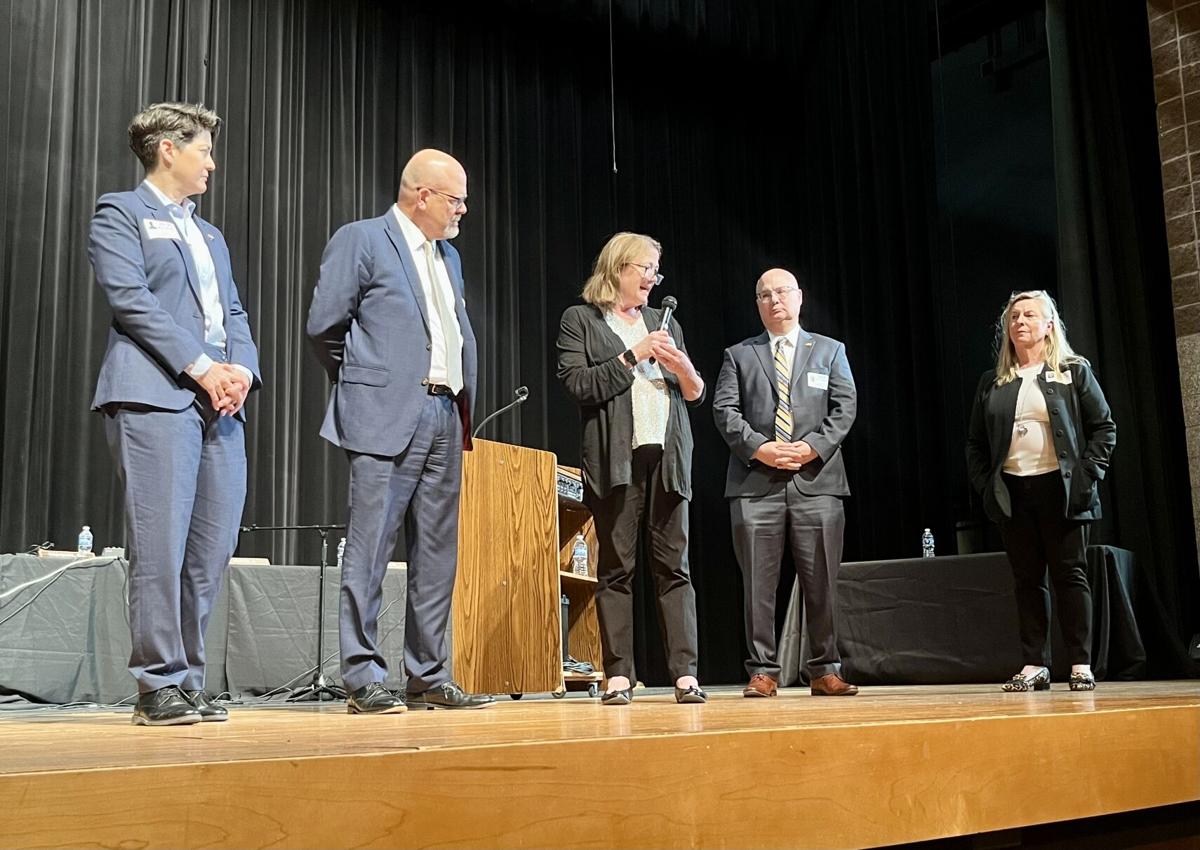
Members of the Colorado Supreme Court during a "Courts in the Community" visit to Falcon High School in Peyton, Colo. on May 15, 2025. From left to right: Chief Justice Monica M. Márquez and Justices William W. Hood III, Melissa Hart, Brian D. Boatright and Maria E. Berkenkotter.
Michael Karlik michael.karlik@coloradopolitics.com

At the time the Supreme Court decided Salah, the appeal of Donald Joseph Manzanares Jr. was pending. Manzanares is serving a prison sentence for various offenses, including domestic violence. There is a mandatory protection order, also known as a restraining order, barring Manzanares from contacting his adult victim and his two biological children.


Manzanares sought to modify the protection order on multiple occasions, in one instance proposing that he be allowed to send his children letters through an intermediary.
Then-Jefferson County District Court Judge Robert Lochary declined to modify the order, citing Manzanares’ criminal history, the mother’s objection to any modification and Lochary’s “serious concerns regarding the victims’ mental, emotional and physical safety were defendant allowed to contact them.”
“For over nine years, Mr. Manzanares has been forbidden from contacting his biological sons. He has not been accused of physically abusing his children, and none of his convictions lists either son as a victim,” argued public defender Leah Scaduto on appeal.
In response, the government invoked the recently decided Salah case, arguing Manzanares’ familial rights were not implicated because he failed to demonstrate he had a relationship with his biological children.
“Here, despite being the children’s father, defendant had no discernible parental-like relationship with his boys, defendant was incarcerated for most of his boys’ lives, defendant didn’t provide for the emotional, physical and mental well-being of his boys or act in their best interests, and defendant violently attacked the (adult victim) while they watched,” wrote Senior Assistant Attorney General Katharine Gillespie. Therefore, “there is simply no basis to find that the constitution protects defendant’s relationship with his children to the same degree as it does a father whose relationship with his child society recognizes as worthy of respect and protection.”
However, a three-judge Court of Appeals panel pointed out the Supreme Court had specifically acknowledged that parent-child relationships have the strongest degree of protection in its Salah decision. Notwithstanding his criminal conduct, wrote Judge Craig R. Welling in the July 3 opinion, Manzanares’ fitness as a parent was never legally in doubt.
“(W)e can’t say that Manzanares was required to affirmatively demonstrate a substantial relationship with his own children when his right to familial association was never questioned in the first place,” Welling wrote.
The panel found Lochary had not specifically addressed Manzanares’ claim of a constitutional violation through the no-contact order. Further, Lochary had not made findings about whether the order deprived him of his right to familial association and whether there was a narrower way to protect the children while allowing some contact.
“Because of the lack of complete findings and the trial court didn’t directly consider this issue,” Welling wrote, “we can’t determine on this record whether compelling circumstances then existed or currently exist that warrant the imposition of conditions prohibiting or limiting Manzanares’s right to familial association with the children.”
The panel returned the case to the trial court to re-examine the scope of the protection order.
The case is People v. Manzanares.
Colorado Politics Must-Reads:

Colorado’s chief federal judge orders return of wrongfully deported man, second judge to explore ‘series’ of violations
Michael Karlik
michael.karlik@coloradopolitics.com
Updated 7 hours ago
Colorado’s chief federal judge took the extraordinary step of directing the government on Tuesday to do everything it can to return a man it deported in violation of his order. At the same time, Colorado’s chief magistrate judge has set...
Denver murder, assault convictions reversed due to faulty jury instructions
Michael Karlik
michael.karlik@coloradopolitics.com
Updated 5 hours ago
Colorado’s second-highest court reversed a defendant’s convictions for murder and assault last week after concluding a Denver judge incorrectly omitted key jury instructions that could have affected the verdict and sentencing. Stephen C. Swainson fatally stabbed Israel Casillas in downtown...
‘Understand people for who they are’: 2 federal judges talk about compassion in courtroom
Michael Karlik
michael.karlik@coloradopolitics.com
Updated 13 hours ago
Before taking the bench in 2022, U.S. District Court Judge Charlotte N. Sweeney was an employment discrimination attorney. While the cases could be emotionally charged, they were different from the criminal proceedings she is now handling. “It wasn’t necessarily affecting...
Denver murder conviction reversed for incomplete self-defense instruction
Michael Karlik
michael.karlik@coloradopolitics.com
Updated 1 day ago
Colorado’s second-highest court reversed a defendant’s murder conviction last week because a Denver judge gave an incomplete instruction to the jury about the man’s right to self-defense. Donald R. Gonzales and Gary McLaughlin met up in a Capitol Hill parking...
Colorado lawmaker, House leaders named in workplace-retaliation lawsuit
Marianne Goodland
marianne.goodland@coloradopolitics.com
Updated 1 day ago
A former legislative aide has filed a lawsuit alleging she was mistreated, illegally directed to perform campaign work and harmed by a House leadership structure she charged was fragmented, politicized and ineffective at protecting employees. The lawsuit, filed by Jennifer...
Federal judge hears arguments about Colorado’s 3-day gun purchase waiting period
Michael Karlik
michael.karlik@coloradopolitics.com
Updated 2 days ago
A federal judge heard arguments on Monday about the constitutionality of a 2023 Colorado law that generally imposes a three-day waiting period on firearm purchases after the initiation of a background check. The test that the U.S. Supreme Court created...
Colorado Supreme Court intervenes in Weld County prosecution dismissed due to Missy Woods misconduct
Michael Karlik
michael.karlik@coloradopolitics.com
Updated 1 day ago
The Colorado Supreme Court ordered a Weld County trial judge last week to respond to the district attorney’s claim that he improperly dismissed a criminal case because of “outrageous” conduct by the Colorado Bureau of Investigation. Daniel Lee Eatinger stood...
Schoolchildren’s presence at child sex-related trial did not harm Arapahoe County defendant, appeals court says
Michael Karlik
michael.karlik@coloradopolitics.com
Updated 4 days ago
Colorado’s second-highest court decided on Thursday that the presence of a group of schoolchildren on the first day of a child sexual exploitation trial did not violate an Arapahoe County defendant’s constitutional right to a fair trial. Prosecutors charged Jerry...
Appeals court cites week-old Colorado law to reinstate child neglect case at child, father’s request
Michael Karlik
michael.karlik@coloradopolitics.com
Updated 4 days ago
Colorado’s second-highest court invoked a new state law for the first time on Thursday and reinstated a child neglect case that both the child and her father wished to reopen. House Bill 1227 took effect on Aug. 12, reversing a...
Colorado Supreme Court names William Hood as next chief justice
Michael Karlik
michael.karlik@coloradopolitics.com
Updated 5 days ago
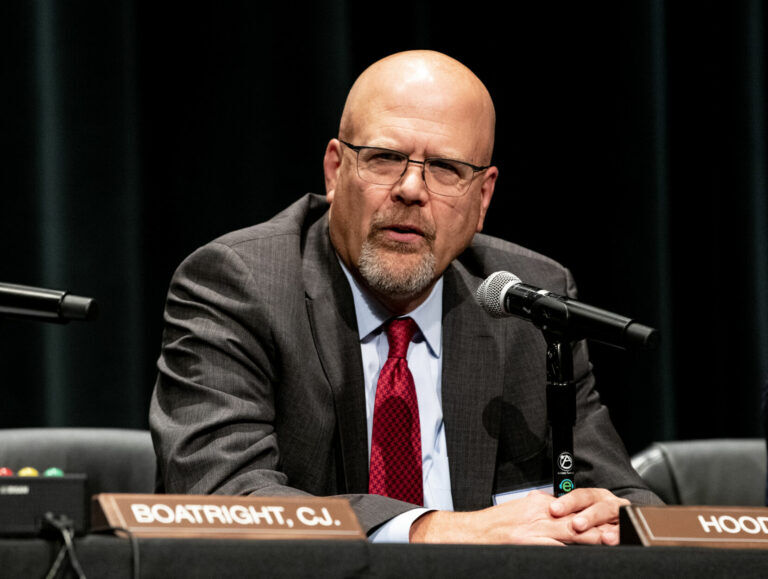
The Colorado Supreme Court has selected Justice William W. Hood III to be the next chief justice, the judicial branch announced on Friday. Hood will succeed Chief Justice Monica M. Márquez, who took over the role in July 2024. “I...