

Appeals court overturns carjacking-related convictions after evidence error
Colorado’s second-highest court overturned some of a defendant’s carjacking-related convictions on Thursday, finding Arapahoe County prosecutors failed to establish that his text messages apparently confessing to the crime were admissible as evidence.
The three-judge Court of Appeals panel also concluded the search warrant used to obtain information from T-Mobile was unconstitutionally broad, with some judges warning during oral arguments that they were running out of patience for unconstrained police demands for cell phone records.
There was no dispute that Phillip Michael Dent carjacked a woman’s minivan while she was at a Littleton car wash in January 2021. For that conduct, jurors convicted him of robbery and assault. Instead, Dent challenged his related convictions for aggravated motor vehicle theft and arson. Specifically, prosecutors alleged Dent kept the van for 24 hours and/or changed its license plates, and also set it on fire.
While attempting to locate Dent, police obtained a search warrant for his cell phone records through T-Mobile. Among other things, Dent had texted after the carjacking that he “got this car new plates,” “wiped it down really well for prints” and that he “just torched” the vehicle because “I had to get rid of all the evidence.”
In the trial court, the defense moved to exclude the T-Mobile records as evidence because the search warrant was too broad. Although there were 19 paragraphs describing the information police sought, the first paragraph demanded “any and all records for the subject telephone.” The defense also challenged the data T-Mobile provided as hearsay, meaning an out-of-court statement aimed at proving the truth.
Then-District Court Judge Elizabeth A. Weishaupl sided against the defense on both counts.
Shortly before oral arguments in Dent’s case, a different Court of Appeals panel decided a case involving a similarly broad search warrant for all cell phone records. Although that panel upheld law enforcement’s reliance on the warrant, Judge Karl L. Schock wrote separately to warn police against conducting fishing expeditions through a suspect’s cell phone provider.
“In light of the long line of case law recognizing that cell phones are ‘entitled to special protections from searches,’ a reasonable officer should by now be well on notice that a cell phone warrant may not seek all (or even most) data on a phone simply because the owner of the phone may have committed a crime,” he concluded.
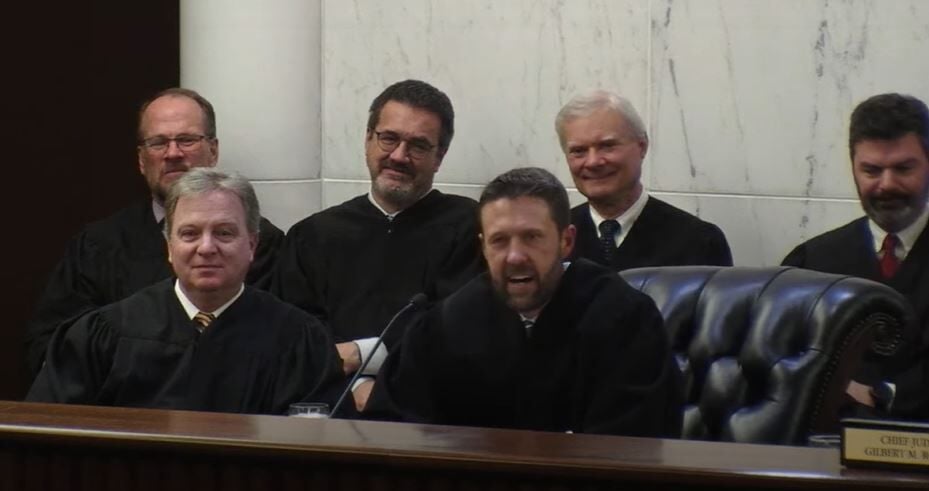
Judge Karl L. Schock speaks at his ceremonial swearing-in on Jan. 19, 2023. At left is Judge Jerry N. Jones. In the back row, from left to right, are Judges Timothy J. Schutz, Ted C. Tow III, Lino S. Lipinsky de Orlov and Matthew D. Grove.
The appellate panel hearing Dent’s case voiced similar concern that law enforcement’s request for “any and all records” from T-Mobile should trigger the exclusion of the evidence.
“It feels to me like we’ve reached a point where the exclusionary rule needs to do its work to deter this conduct,” said Judge Craig R. Welling. “Why isn’t it time to put our foot down and say, ‘We’re done. Just putting in this overly broad language is a practice that’s no longer gonna be saved?'”
“The real problem with having the breadth of the language,” added Judge Matthew D. Grove, is that the detective “could have, if he wanted to, gone to T-Mobile if he didn’t get everything on the phone. He could have said, ‘Hey, look at paragraph one. It says, “any and all records” and you didn’t give me that.’ What could T-Mobile have done?”
On the other hand, the judges were more skeptical about Dent’s claim that the data produced by T-Mobile was hearsay. The judges noted that evidence generated completely by machine is not hearsay, and there would only be a problem if there was unexplained human involvement in handing over the text message logs.
“I just don’t see a world in which these are typed out by a person,” said Welling.
The defense “would probably concede that it’s unlikely that T-Mobile has a thousand people working on a thousand typewriters transcribing these things to comply with the warrant,” said Grove. “But what evidence do we have in the record that they didn’t do that?”
Ultimately, the panel agreed the search warrant served on T-Mobile was unconstitutionally broad in its request for “any and all records.” However, wrote Grove in the July 3 opinion, police relied on the warrant in “good faith,” so excluding the evidence from Dent’s trial was unwarranted.
The panel agreed with the defense, however, that the prosecution failed to establish at trial how the T-Mobile records were generated. The fact that the logs appeared entirely machine generated was not enough.
“Without some information from the source of the records about how they were compiled, the trial court was not in a position to determine that they were machine generated and thus outside the scope of the hearsay rule,” Grove wrote.
Because the text messages were the key evidence that Dent burned the stolen car, the panel reversed the challenged convictions.
The case is People v. Dent.
Colorado Politics Must-Reads:

Federal judge green-lights civil trial against ex-Fort Collins DUI officer
Michael Karlik
michael.karlik@coloradopolitics.com
Updated 2 days ago
A federal judge ruled on Thursday that Fort Collins’ former “DUI officer” will face a civil trial for allegedly investigating a motorist for impaired driving without any reasonable suspicion to do so. In recent years, several people arrested by Officer...

Colorado Supreme Court suspends Mesa County judge pending misconduct investigation
Michael Karlik
michael.karlik@coloradopolitics.com
Updated 1 day ago
The Colorado Supreme Court suspended Mesa County Court Judge Michael J. Grattan on Thursday amid a misconduct investigation. The court’s Sept. 10 order gave Grattan 21 days to explain why his paid suspension should not continue through the end of...
Colorado Supreme Court changes course, dismisses case about special district bonds
Michael Karlik
michael.karlik@coloradopolitics.com
Updated 1 day ago
The Colorado Supreme Court declined on Friday to decide a dispute between a large-scale Commerce City development and the various districts financing it, after initially showing interest in the ongoing case. Colorado has roughly 2,800 special districts, which are local...
10th Circuit tosses GEO Group’s pretrial appeal in human trafficking lawsuit
Michael Karlik
michael.karlik@coloradopolitics.com
Updated 3 days ago
The Denver-based federal appeals court dismissed an attempt by The GEO Group on Wednesday to appeal a trial judge’s non-existent decision two months before the company is scheduled to face a civil trial over alleged trafficking violations at the Aurora...
Denver sues Trump to block armed ICE agents from polling sites
Deborah Grigsby
deborah.smith@denvergazette.com
Updated 3 days ago
The city of Denver, along with several groups, sued the Trump administration Thursday, seeking to block U.S. Immigration and Customs Enforcement officers who are armed from polling sites during the upcoming midterm elections. In fact, there are no official orders...
Federal judge takes no action against ICE in Colorado after hearing about mistakes, not ‘blatant violations’
Michael Karlik
michael.karlik@coloradopolitics.com
Updated 24 hours ago
A federal judge declined to take action against U.S. Immigration and Customs Enforcement on Thursday after hearing that a pattern of alleged lawbreaking amounted to mistakes and a misunderstanding of the government’s position in court. For nearly a year, Colorado’s...
Colorado doctors, dentists challenge state law on gender‑transition services in new federal lawsuit
Marissa Ventrelli
marissa.ventrelli@coloradopolitics.com
Updated 21 hours ago
A group of Christian doctors and dentists has filed a federal lawsuit challenging a Colorado law they say requires them to provide gender‑transition services that conflict with their religious and ethical beliefs. The lawsuit, filed by the Christian Medical and...
Federal judge directs plaintiff to revise complaint alleging Denver officers’ constitutional violations
Michael Karlik
michael.karlik@coloradopolitics.com
Updated 23 hours ago
A federal judge directed a plaintiff to revise his allegations on Wednesday to more precisely state what two Denver officers and the city itself allegedly did to violate his constitutional rights by facilitating his prosecution for murder until prosecutors dropped...
Lawsuit challenges Douglas County commissioners’ ballot actions
Nicholas Fogleman
nicholas.fogleman@denvergazette.com
Updated 3 days ago
A new lawsuit against Douglas County commissioners seeks to invalidate the board’s intervention in efforts to expand the commission from three members to five and restore the original ballot language approved by more than 20,000 petition signers. The suit marks...
Federal judge explores new sanctions against ex-Colorado judicial discipline director
Michael Karlik
michael.karlik@coloradopolitics.com
Updated 1 day ago
A federal judge on Wednesday directed Colorado’s former judicial discipline director, for the third time this year, to explain why she should not sanction him for his latest conduct in his litigation against the state’s judiciary. Christopher S.P. Gregory, who served...