

Colorado justices reject unusual appeal by analogy in community corrections sentencing case
The Colorado Supreme Court concluded on Tuesday that state law did not entitle a man to receive credit for the time he spent in non-residential community corrections, notwithstanding the court’s own 34-year-old analogy suggesting a deduction was possible.
When Ryan Wallace Bonde was terminated from a non-residential community corrections program and resentenced to prison, his trial judge declined to credit him for his time spent in the non-residential program. Bonde appealed that decision, raising an unusual argument constructed from an unrelated legislative change and a key passage in a 1991 Supreme Court decision.
According to the state, approximately 3,600 people are serving sentences in community corrections at any given time. Designed to be stricter than probation but not as harsh as prison, community corrections allows defendants to live in the community and receive support, while still being confined in a residential facility.
Defendants may progress into non-residential community corrections, where they live on their own but still experience supervision and abide by program rules. In Larimer County, where Bonde served his sentence, there were 1,042 people in the community corrections program in 2019. Non-residential participants had a higher success rate than those serving in residential facilities.


In 1991, the Supreme Court addressed the question of what happens when a defendant serves time in non-residential community corrections, but violates the terms and is resentenced to prison. By 5-2, the court ruled such defendants are not entitled to have their non-residential time deducted from their prison sentence.
Then-Chief Justice Joseph R. Quinn noted defendants can only benefit from time served in “confinement.” The court’s majority viewed defendants serving non-residential sentences as “not substantially different from an offender paroled from a prison,” whose circumstances are unlike confinement.
“To credit the community correctional offender with time served on nonresidential status would result in the anomaly of granting credit for presentence ‘confinement’ for a period of time during which the offender was never actually ‘confined’ in any meaningful sense of that term,” Quinn wrote in People v. Hoecher.
Fast-forwarding to May 2020, Bonde had served 1.5 years of his sentence — first in residential community corrections and then non-residential community corrections — when Larimer County terminated him for a violation. District Court Judge Laurie K. Dean resentenced Bonde to four years in prison, the same length as his community corrections sentence.
While she gave him some credit for his time in community corrections, she did not deduct the entirety of his non-residential time from the new sentence.
Bonde appealed, arguing the Supreme Court’s conclusion in Hoecher was no longer valid. Because the court likened people serving non-residential sentences to parolees, and the legislature changed the law in 1995 to allow time-served deductions for nonviolent parolees, Bonde argued the court’s underlying logic led to a different result three decades later.
A three-judge panel for the Court of Appeals waved aside that claim.
“We read Hoecher as doing no more than analogizing a nonresidential offender to a parolee to frame the court’s analysis,” wrote Judge W. Eric Kuhn, “not binding the outcome to how a parolee’s time is treated.”
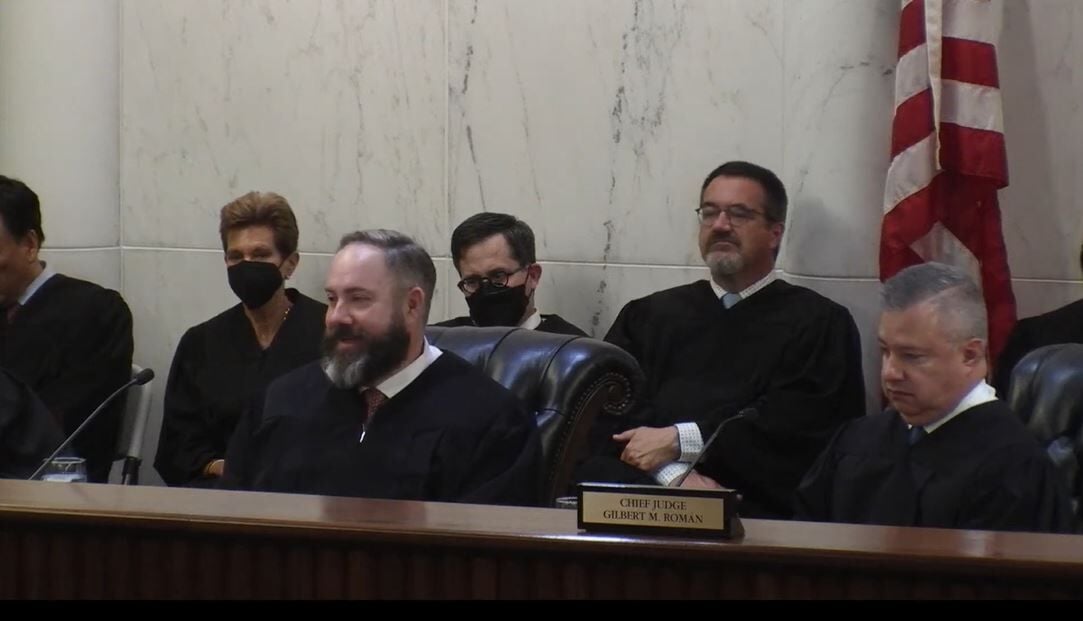
FILE PHOTO: Judge W. Eric Kuhn speaks following his swearing-in ceremony to the Court of Appeals on July 22, 2022. Also pictured, from left to right, are Judges Rebecca R. Freyre, Craig R. Welling and Ted C. Tow III, and Chief Judge Gilbert M. Román.
The Denver Gazette

Bonde appealed to the Supreme Court, arguing Hoecher‘s analogy to parolees meant that if they were now granted time-served credit, so should he. Alternatively, he argued non-residential community corrections does constitute confinement — specifically, confinement to Colorado’s 104,000 square miles.
In its May 27 opinion, the Supreme Court stood by its broader point from three decades earlier: that non-residential community corrections involves a degree of freedom not equivalent to “confinement.” Therefore, a person in Bonde’s shoes is not entitled to presentence confinement credit.
“Compared to their residential counterparts, offenders serving nonresidential community corrections sentences are allowed to pursue regular employment, enroll in academic courses, participate in vocational training programs, and meet with family members,” wrote Chief Justice Monica M. Márquez.
She added that lawmakers had changed the community corrections provisions multiple times since 1991, and none of the amendments granted presentence confinement credit to defendants like Bonde.
“In sum, any policy-based request to grant comparable PSCC for nonresidential community corrections sentences is better directed to the legislature,” Márquez concluded.
The case is Bonde v. People.
Colorado Politics Must-Reads:

Schoolchildren’s presence at child sex-related trial did not harm Arapahoe County defendant, appeals court says
Michael Karlik
michael.karlik@coloradopolitics.com
Updated 14 hours ago
Colorado’s second-highest court decided on Thursday that the presence of a group of schoolchildren on the first day of a child sexual exploitation trial did not violate an Arapahoe County defendant’s constitutional right to a fair trial. Prosecutors charged Jerry...
Appeals court cites week-old Colorado law to reinstate child neglect case at child, father’s request
Michael Karlik
michael.karlik@coloradopolitics.com
Updated 10 hours ago
Colorado’s second-highest court invoked a new state law for the first time on Thursday and reinstated a child neglect case that both the child and her father wished to reopen. House Bill 1227 took effect on Aug. 12, reversing a...
Colorado Supreme Court names William Hood as next chief justice
Michael Karlik
michael.karlik@coloradopolitics.com
Updated 2 days ago
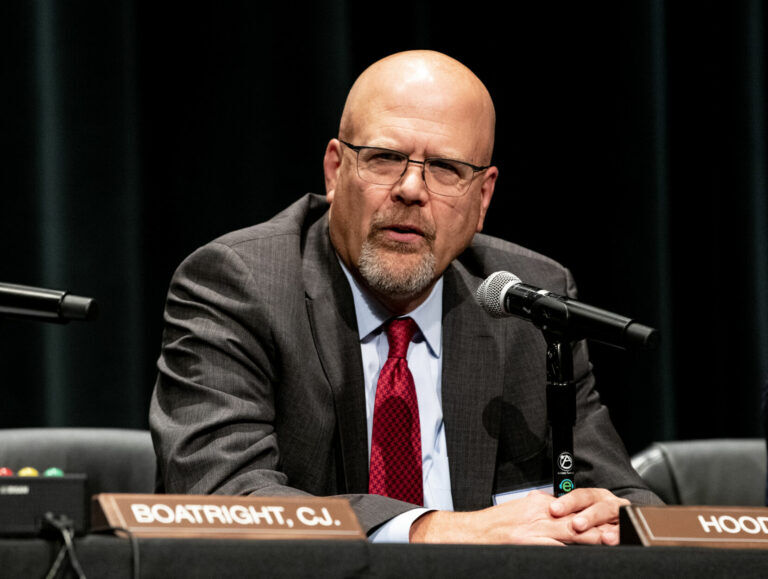
The Colorado Supreme Court has selected Justice William W. Hood III to be the next chief justice, the judicial branch announced on Friday. Hood will succeed Chief Justice Monica M. Márquez, who took over the role in July 2024. “I...

Appeals court upholds Park County trophy hunting conviction
Michael Karlik
michael.karlik@coloradopolitics.com
Updated 1 day ago
Colorado’s second-highest court clarified on Thursday that a defendant may stand convicted under the state’s trophy hunting laws if he abandons a bear carcass but returns later to remove the meat. Under Colorado law, it is a felony to detach...

Judge grants partial injunction to GEO in fight against state health inspection law
Kyla Pearce
kyla.pearce@gazette.com
Updated 3 days ago
A judge ruled Thursday that The GEO Group does not have to follow parts of a new state law requiring more frequent health and safety inspections at the U.S. Immigration and Customs Enforcement processing center in Aurora. Under the order...

Parker man faces 20 years to life for serial sexual assaults
Nicholas Fogleman
nicholas.fogleman@denvergazette.com
Updated 3 days ago
A 25-year-old Parker man who sexually assaulted three women in 2025 pleaded guilty Wednesday and will serve 20 years to life in prison. Javier Rodriguez-Andrade pleaded guilty to charges stemming from three sexual assaults involving women ages 19 to 24. ...
Divided appeals court upholds warrantless DNA collection in Colorado cold case, cautions of government overreach
Michael Karlik
michael.karlik@coloradopolitics.com
Updated 3 days ago
Colorado’s second-highest court upheld the warrantless collection of a suspect’s DNA from a discarded soda can as constitutional on Thursday, while warning about potential abuse of DNA privacy in the absence of further guardrails. By 2-1, a three-judge Court of...

Man charged in Northglenn homicide of wife
Matt Kyle
matt.kyle@denvergazette.com
Updated 3 days ago
A man has been formally charged with murder and burglary relating to a homicide last week in Northglenn. Alexei Munive-Rodriguez, 48, was arrested Sunday after he was at large following the homicide, which occurred Friday. Police were dispatched around 10:30...

10th Circuit grants immunity to officers for fatal Manitou Springs shooting
Michael Karlik
michael.karlik@coloradopolitics.com
Updated 2 days ago
The Denver-based federal appeals court ruled on Wednesday that responding officers from Manitou Springs and El Paso County cannot be held constitutionally liable for shooting and killing a man after a 20-minute standoff. Wilford Deweese allegedly pulled out a gun...
10th Circuit rejects invitation for full-court review of tax-avoidance case
Michael Karlik
michael.karlik@coloradopolitics.com
Updated 3 days ago
The Denver-based federal appeals court declined to reconsider the standards for holding entities liable for their tax-avoidance schemes, with a majority of judges voting against full-court review on Monday. In April, a three-judge panel of the U.S. Court of Appeals...