

10th Circuit clears path for Elizabeth School District to return restricted books to shelves as ordered
The Denver-based federal appeals court declined on Monday to put a trial judge’s order on hold, instead clearing the path for Elizabeth School District to return 19 restricted books to its library shelves as directed earlier this month.
In March, U.S. District Court Judge Charlotte N. Sweeney found the elected school board had likely violated the First Amendment rights of students and authors by removing books with “sensitive” topics based on political ideology. The titles included “The Kite Runner” by Khaled Hosseini and “Beloved” by Toni Morrison, as well as “#Pride: Championing LGBTQ Rights” by Rebecca Felix, “The Hate U Give” by Angie Thomas and “Thirteen Reasons Why” by Jay Asher.
After the district asked Sweeney to pause, or stay, her order to return the books while it sought relief in the U.S. Court of Appeals for the 10th Circuit, Sweeney refused, instead ordering the books returned by April 5.
The district requested the 10th Circuit’s intervention, and a two-judge panel originally agreed to stay Sweeney’s order while it reviewed the arguments in depth. But after hearing from both sides, the panel opted against intervening and let Sweeney’s order stand while the appeal unfolds.
“Having carefully considered the parties’ arguments, we find Appellant has not carried its burden to show the circumstances justify a stay,” wrote Chief Judge Jerome A. Holmes, a George W. Bush appointee, and Judge Nancy L. Moritz, a Barack Obama appointee, in an April 28 order.
In December, the parents of two district students, the local NAACP chapter and The Authors Guild — representing authors of the removed books — sued the Elbert County district alleging a violation of the First Amendment and its counterpart provision of the Colorado Constitution.
Previously, the district identified several books for potential removal. Parents could fill out forms explaining why they wanted the books to either be “returned to the library and listed on the sensitive topic list” — meaning parents would get an alert if their child checked out the book — or “removed from the library collection.” There was no option to restore the books to libraries unconditionally.
Parents who submitted comments cited religious, political and LGBTQ-based objections to the content.
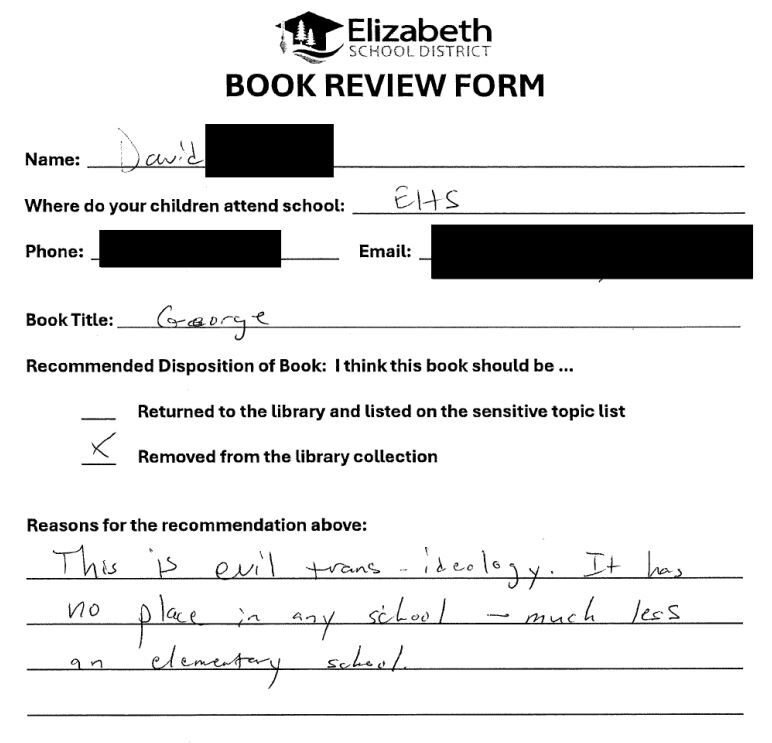
One Elizabeth School District parent's submission to remove a book from school library shelves. Source: Crookshanks v. Elizabeth School District

Emails between board of education members suggested they were thinking about the book removals in political terms. Board President Rhonda Olsen wrote that “We were very vocal about getting a superintendent and legal representation with conservative values.” Vice President Heather Booth wrote that “As an elected official committed to conservative values for our children, I feel a strong obligation to honor the promises made during my campaign.”
Although the board members submitted statements during the litigation disputing that they acted out of political motivations, Sweeney opted to use the emails as evidence of the board’s intent.
“The Court questions what could be more partisan or political than removing books to further the Board’s self-described conservative values,” wrote Sweeney, a Joe Biden appointee. “That parents want to remove books for partisan reasons does not permit government officials to do the same.”
The district asked Sweeney to stay her order while it appealed, characterizing her decision as unfair, “breathtakingly broad” and requiring whole new library policies. It also disclosed for the first time that it had already discarded the books entirely, prompting Sweeney to admonish the district for not being forthcoming with her.
Instead, on April 3, she reiterated the books should return to the shelves by the end of the week.
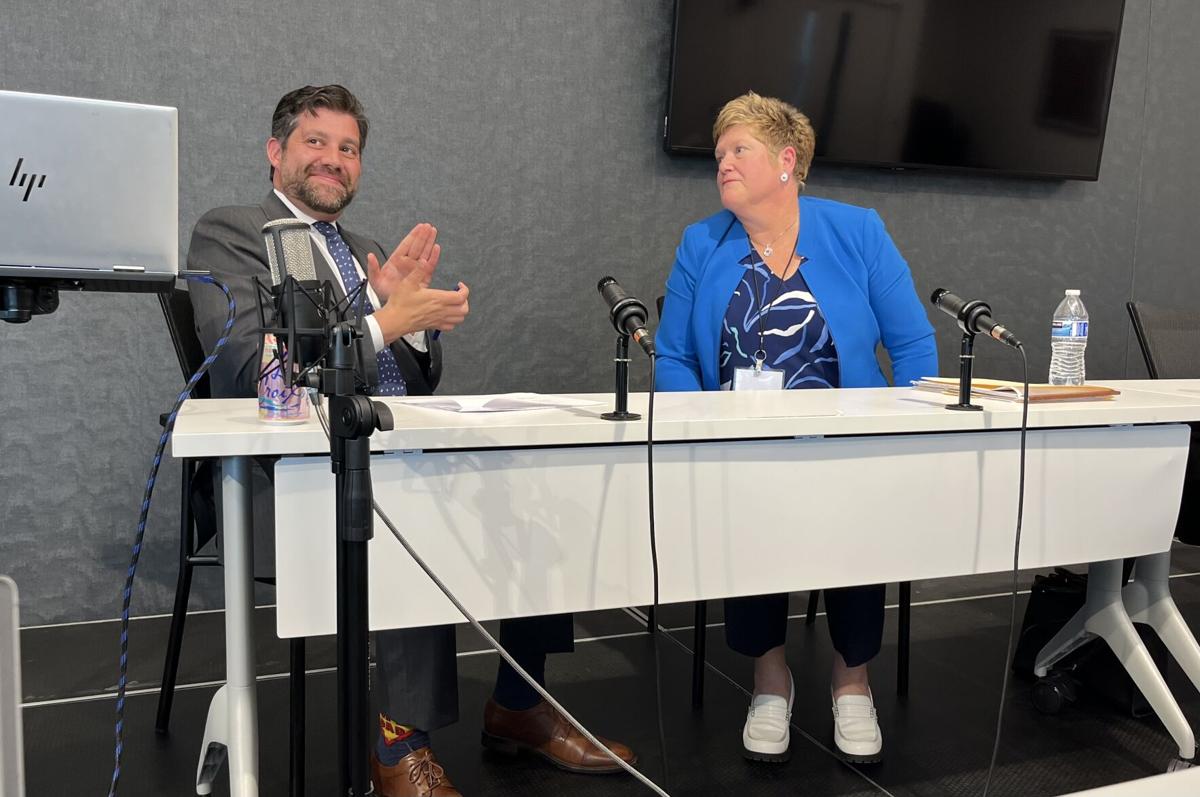
Attorney David Gartenberg applauds for U.S. District Court Judge Charlotte N. Sweeney at a legal event in Denver on July 21, 2023.
Michael Karlik michael.karlik@coloradopolitics.com

The district successfully got the 10th Circuit to temporarily halt that directive while the appellate judges examined Sweeney’s preliminary injunction. The district faulted Sweeney for crediting the board members’ emails instead of holding a hearing to weigh the evidence, and described her order as “forcing the District to spend resources to buy titles.”
“Any decision to weed a book for a facially valid reason could be subject to second-guessing by the court,” wrote the district’s lawyers. “The court is now the District’s de-facto library czar.”
The challengers pointed out that their lawyers, in fact, recently offered all of the restricted books to the district free of charge, but the board rejected those. The plaintiffs’ lawyers also rejected the argument that Sweeney was wrong to find political motivations behind the board’s decision.
“Viewpoint discrimination is not permitted no matter the viewpoint,” they wrote.
In addition to letting Sweeney’s order take effect, the 10th Circuit also declined to expedite the district’s appeal.
The case is Crookshanks et al. v. Elizabeth School District.

Local party leaders, incoming judge among members of judicial performance commission that violated law
Michael Karlik
michael.karlik@coloradopolitics.com
Updated 46 minutes ago
A local Democratic leader and 2024 presidential elector. A legislative aide and leader in the Young Republicans. An incoming county court judge freshly appointed by the governor. They are among the eight members of the northeastern Colorado judicial performance commission...
Judge dismisses lawsuit seeking records from Colorado Democratic group
Marianne Goodland
marianne.goodland@coloradopolitics.com
Updated 1 hour ago
A lawsuit seeking to obtain records from Democratic lawmakers affiliated with a caucus has been thrown out by a Denver District Court judge. On July 17, Judge Ericka Englert dismissed the April lawsuit filed by progressive activist Derrick Blanton, who...
Colorado Springs mother Deborah Nicholls’ murder conviction overturned
Nick Smith
nick-smith@coloradopolitics.com
Updated 22 hours ago
A Colorado Springs mother convicted in 2008 of murdering her three children in a house fire might get a new trial after a judge ruled that prosecutors withheld key evidence that could have impacted the jury’s verdict. Deborah Nicholls, whose...
Colorado court overturns illegal $7,000 restitution order
Michael Karlik
michael.karlik@coloradopolitics.com
Updated 1 hour ago
Colorado’s second-highest court overturned a Weld County defendant’s obligation to pay more than $7,000 in crime victim restitution on Thursday because a trial judge failed to issue a legally compliant restitution order at the time of sentencing. In Colorado, as...
Appeals court rejects former DougCo commissioner’s legal fee claim
Nicholas Fogleman
nicholas.fogleman@denvergazette.com
Updated 9 hours ago
The Colorado Court of Appeals rejected a former Douglas County commissioner’s bid for reimbursement of attorney fees she incurred while responding to multiple investigations into her conduct. The dispute stemmed from a 2019 anonymous letter sent to county officials alleging...
Appeals court orders second look at Denver Water’s immunity for cyclist’s injury
Michael Karlik
michael.karlik@coloradopolitics.com
Updated 22 hours ago
Colorado’s second-highest court ordered another look at a bicyclist’s negligence lawsuit against Denver Water on Thursday, concluding that a trial judge needed to evaluate the utility’s potential immunity using the state Supreme Court’s new guidance. Joseph A. “Joey” Scott alleged...
Labels, duration not definitive proof of ‘intimate relationship,’ Colorado court rules in domestic violence case
Michael Karlik
michael.karlik@coloradopolitics.com
Updated 2 hours ago
Colorado’s second-highest court clarified on Thursday that the length of a couple’s relationship and the labels they attach to it are not conclusive evidence of whether it is an “intimate relationship” that can give rise to a domestic violence prosecution....

Colorado AG urges Supreme Court to let Boulder climate lawsuit proceed
Marissa Ventrelli
marissa.ventrelli@coloradopolitics.com
Updated 1 day ago
Colorado Attorney General Phil Weiser has filed a court brief with the U.S. Supreme Court in a lawsuit brought by Boulder city officials seeking to hold oil companies liable for their environmental impact. The case began in 2018, when the...
10th Circuit says landowner cannot sue ex-Routt County judge for statements in decision
Michael Karlik
michael.karlik@coloradopolitics.com
Updated 2 days ago
A Routt County landowner cannot sue a former judge for his allegedly inaccurate statements in a case where the landowner was not a party, the Denver-based federal appeals court decided on Wednesday. Anne Fitzsimmons, who lives in Germany, owns a...
Defendant’s competency in question in El Paso County case involving slain Army police officer
Nick Smith
nick-smith@coloradopolitics.com
Updated 1 day ago
It will be another 60 days before a 4th Judicial District court determines if a man charged in the shooting death of an Army police officer is competent to proceed in his case. Judge Erin Sokol granted a request Wednesday...