

Colorado justices rule trunk search constitutional in Arapahoe County shooting case
The Colorado Supreme Court reversed an Arapahoe County judge on Monday who found law enforcement conducted an unconstitutional search of a man’s trunk, with the justices instead concluding police had grounds to believe a recently fired gun was inside.
Prosecutors have charged Sheron Mario Furness with seven criminal counts related to drug and weapon possession, stemming from an August 2022 incident outside a Centennial hotel.
Late that night, a sheriff’s deputy happened to be driving by at the same time someone fired four gunshots. After talking with people in front of the hotel, the deputy went around back. He and a second deputy looked around for shell casings and also spoke with Furness, who was standing near a vehicle with a friend.
The deputies did not locate any shell casings, but Furness claimed he had seen someone shoot a gun and leave on foot. During the encounter, the deputies observed:
• Furness allegedly smelled like alcohol
• Furness was missing the keys to his car, which the deputies found in the grass where they had been searching for shell casings
• The windows on his car were down at first, but at some point were rolled up
• Furness volunteered there was “no gun in” the vehicle
• An empty whiskey bottle and gun case were visible from outside the car


The deputies learned Furness had a restraining order prohibiting him from consuming alcohol, and they arrested him on suspicion of violating that order. Another deputy who joined the investigation then spoke with a witness who identified Furness as the shooter.
The deputies decided they had probable cause to search Furness’ vehicle for evidence of the shooting. Inside the occupants’ compartment, they found suspected bags of cocaine and methamphetamine. The gun case contained an empty magazine. In the trunk was a handgun with four rounds missing from the magazine.
The defense then moved to exclude the trunk evidence from trial, alleging law enforcement violated Furness’ Fourth Amendment right against unreasonable searches and seizures. District Court Judge LaQunya L. Baker acknowledged police may search an entire vehicle without a warrant if they believe it contains evidence of a crime, including the trunk.
However, Baker wrote that she “cannot find a single fact that would support a probable cause finding for a warrantless search of Mr. Furness’ trunk.”
Baker elaborated there was no access to the trunk from the occupants’ compartment, so it was unreasonable to think the evidence of illegal activity seen in the car would extend to the trunk. She also believed the “level of controlled substances” found in the occupants’ compartment did not suggest there were more drugs or weapons elsewhere.
The prosecution appealed directly to the Supreme Court, arguing Baker’s focus on the trunk access and the amount of drugs was too narrow. Furness’ lawyers responded that it was illogical to think Furness could have stashed a weapon in the trunk without the deputies’ knowledge, as he did not have his keys and no one saw Furness open the trunk.
“Assuming something is possible is not evidence,” wrote his public defenders.


The district attorney’s office countered that no evidence existed that the car was locked — and the fact the windows were open when the first deputies arrived suggested Furness could open the trunk without his keys.
“It is reasonably believable that Furness shot the gun, returned to his vehicle, and placed the gun in the trunk in the same time period it took (the first deputy) to report gunshots, arrive at the front hotel from a block away, speak to witnesses, and then drive to the rear of the hotel,” wrote Deputy District Attorney Laura Wood.
The Supreme Court agreed.
“The district court’s ruling is premised on the notion that Furness could not have hidden a gun in the trunk after the shots were fired because he did not have access to the trunk. Based on our review of the record, that premise is unfounded,” wrote Justice Maria E. Berkenkotter in the April 14 opinion.
She echoed the prosecution’s observation that it was possible Furness’ car was unlocked and he placed the gun in the trunk before the deputies located his keys. Even if the car was locked, the rolled-down windows could have allowed someone to open the trunk from inside before law enforcement showed up.
“Accordingly, we conclude that under the totality of the circumstances, it was reasonable for the officers to believe that there was a gun in the trunk,” Berkenkotter wrote.
The case is People v. Furness.

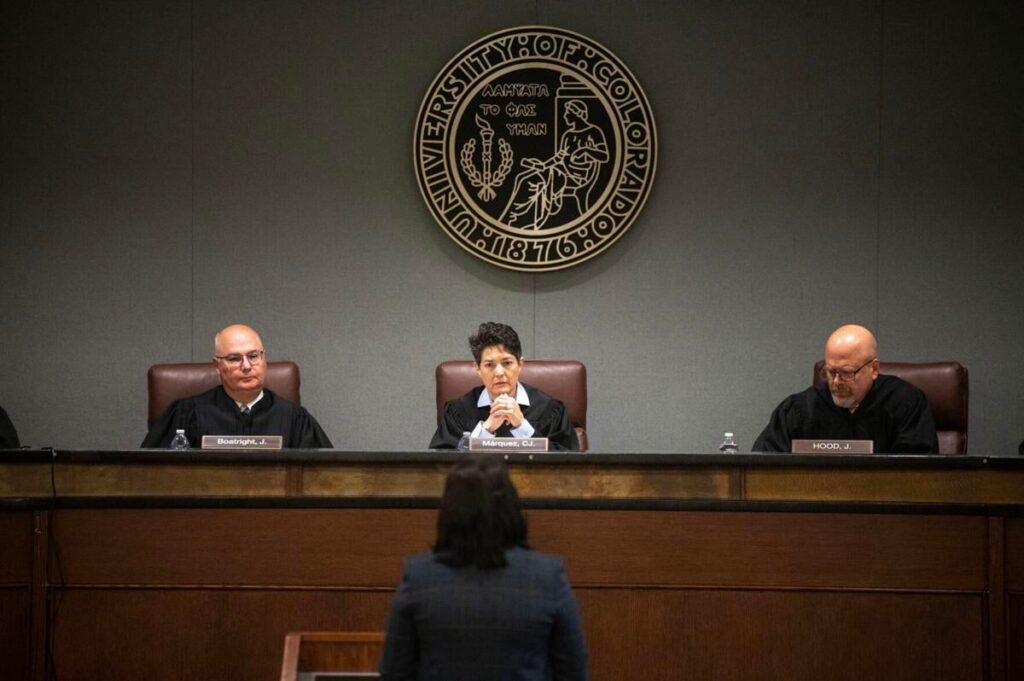
Colorado Supreme Court intervenes in Weld County prosecution dismissed due to Missy Woods misconduct
Michael Karlik
michael.karlik@coloradopolitics.com
Updated 3 hours ago
The Colorado Supreme Court ordered a Weld County trial judge last week to respond to the district attorney’s claim that he improperly dismissed a criminal case because of “outrageous” conduct by the Colorado Bureau of Investigation. Daniel Lee Eatinger stood...
Schoolchildren’s presence at child sex-related trial did not harm Arapahoe County defendant, appeals court says
Michael Karlik
michael.karlik@coloradopolitics.com
Updated 2 days ago
Colorado’s second-highest court decided on Thursday that the presence of a group of schoolchildren on the first day of a child sexual exploitation trial did not violate an Arapahoe County defendant’s constitutional right to a fair trial. Prosecutors charged Jerry...
Appeals court cites week-old Colorado law to reinstate child neglect case at child, father’s request
Michael Karlik
michael.karlik@coloradopolitics.com
Updated 2 days ago
Colorado’s second-highest court invoked a new state law for the first time on Thursday and reinstated a child neglect case that both the child and her father wished to reopen. House Bill 1227 took effect on Aug. 12, reversing a...
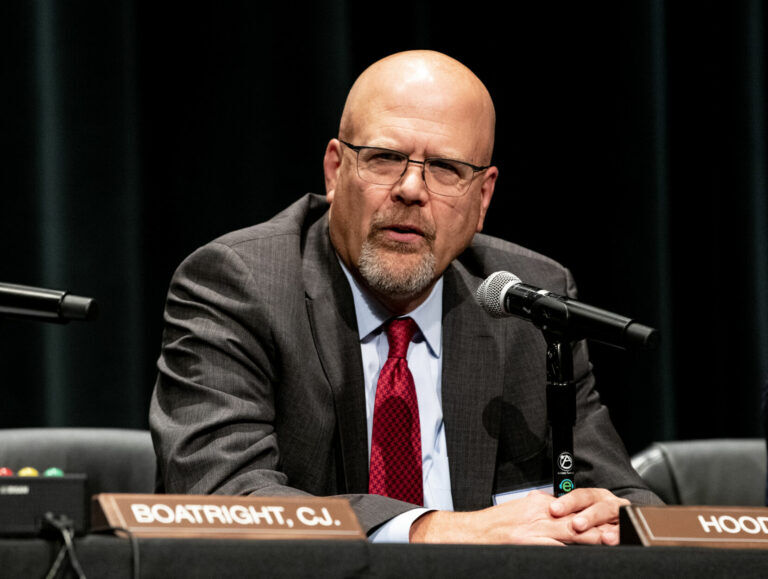
Colorado Supreme Court names William Hood as next chief justice
Michael Karlik
michael.karlik@coloradopolitics.com
Updated 3 days ago
The Colorado Supreme Court has selected Justice William W. Hood III to be the next chief justice, the judicial branch announced on Friday. Hood will succeed Chief Justice Monica M. Márquez, who took over the role in July 2024. “I...
Family of slain Lakewood teacher releases statement as murder suspect makes first court appearance
Matt Kyle
matt.kyle@denvergazette.com
Updated 5 hours ago
Patrick Theodore Barnett, the Lakewood man accused of killing his wife, a Jeffco Public Schools art teacher, made his first court appearance Friday morning as his wife’s family looked on. The status conference hearing was held before District Court Judge...

Appeals court upholds Park County trophy hunting conviction
Michael Karlik
michael.karlik@coloradopolitics.com
Updated 3 days ago
Colorado’s second-highest court clarified on Thursday that a defendant may stand convicted under the state’s trophy hunting laws if he abandons a bear carcass but returns later to remove the meat. Under Colorado law, it is a felony to detach...

Judge grants partial injunction to GEO in fight against state health inspection law
Kyla Pearce
kyla.pearce@gazette.com
Updated 4 days ago
A judge ruled Thursday that The GEO Group does not have to follow parts of a new state law requiring more frequent health and safety inspections at the U.S. Immigration and Customs Enforcement processing center in Aurora. Under the order...

Parker man faces 20 years to life for serial sexual assaults
Nicholas Fogleman
nicholas.fogleman@denvergazette.com
Updated 4 days ago
A 25-year-old Parker man who sexually assaulted three women in 2025 pleaded guilty Wednesday and will serve 20 years to life in prison. Javier Rodriguez-Andrade pleaded guilty to charges stemming from three sexual assaults involving women ages 19 to 24. ...
Divided appeals court upholds warrantless DNA collection in Colorado cold case, cautions of government overreach
Michael Karlik
michael.karlik@coloradopolitics.com
Updated 4 days ago
Colorado’s second-highest court upheld the warrantless collection of a suspect’s DNA from a discarded soda can as constitutional on Thursday, while warning about potential abuse of DNA privacy in the absence of further guardrails. By 2-1, a three-judge Court of...
Man charged in Northglenn homicide of wife
Matt Kyle
matt.kyle@denvergazette.com
Updated 4 days ago
A man has been formally charged with murder and burglary relating to a homicide last week in Northglenn. Alexei Munive-Rodriguez, 48, was arrested Sunday after he was at large following the homicide, which occurred Friday. Police were dispatched around 10:30...