

Appeals court rejects allegations of racial discrimination in jury selection in 2 cases
Colorado’s second-highest court ruled last month that prosecutors in two cases did not engage in intentional racial discrimination when they dismissed two women of color from the jury pool.
Under longstanding U.S. Supreme Court precedent, purposeful race-based discrimination in jury selection is unconstitutional. Normally, parties may exercise “peremptory strikes” of jurors without citing a reason. But when a prosecutor tries to dismiss a juror of color, the defendant may raise a “Batson challenge,” named after the Supreme Court’s Batson v. Kentucky decision. Such a challenge forces the prosecutor to justify the removal with a “race-neutral” reason.
The challenge proceeds in three steps. First, the defense must state a plausible case that a juror is being removed on account of their race. Second, the prosecution must offer a race-neutral explanation. Finally, the trial judge analyzes whether discrimination is likely happening.
A proposed rule change is pending before the Colorado Supreme Court that would, if enacted, make it more difficult for prosecutors to strike jurors of color for demeanor-based reasons. However, the proposal has been sitting on the justices’ desks for an unusually long period — more than two years — with no action taken.
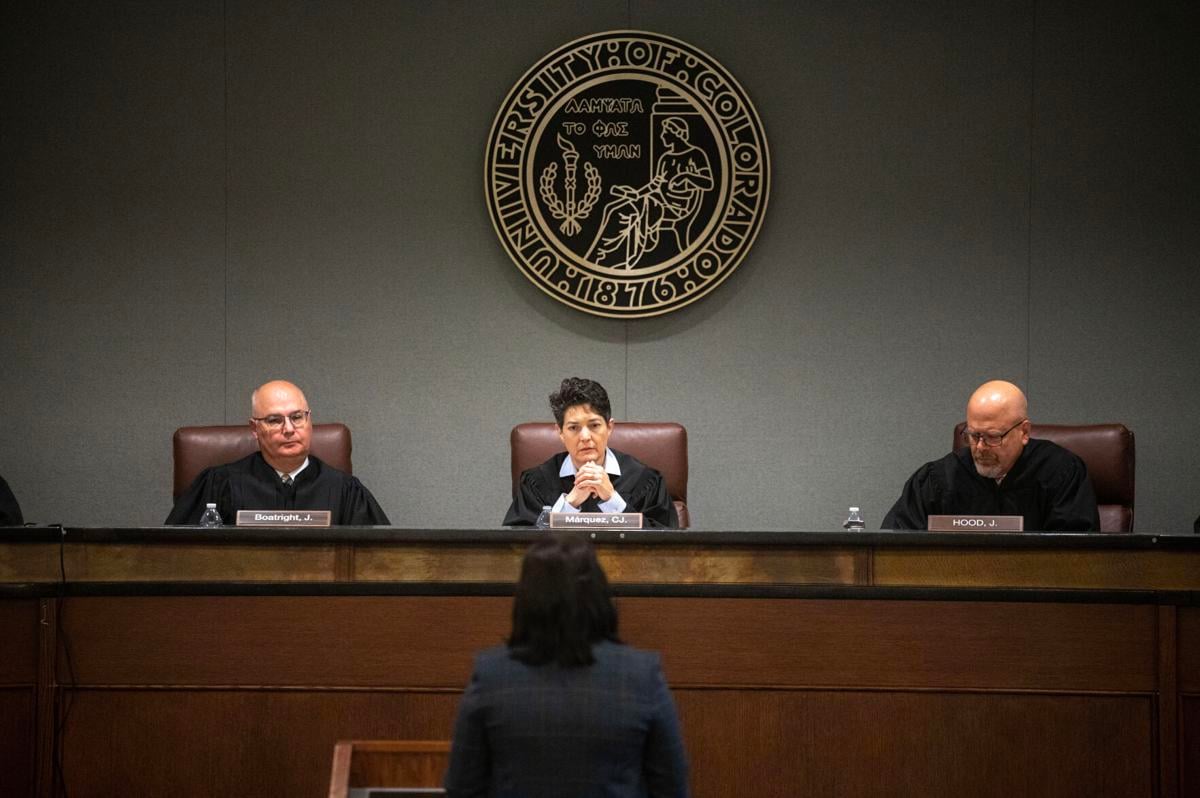
(From left) Colorado Supreme Court Justice Brian D. Boatright, Chief Justice Monica M. M á rquez and Justice William W. Hood III listen to arguments from Assistant Attorney General Caitlin E. Grant during the People v. Rodriguez-Morelos case as part of Courts in the Community at the Wolf Law building at University of Colorado Boulder on Thursday, Oct. 24, 2024. The semi-annual event entails the Colorado Supreme Court hearing arguments before an audience of students throughout the state. (Stephen Swofford, Denver Gazette)
Stephen Swofford Denver Gazette

(From left) Colorado Supreme Court Justice Brian D. Boatright, Chief Justice Monica M. Márquez and Justice William W. Hood III listen to arguments from Assistant Attorney General Caitlin E. Grant during the People v. Rodriguez-Morelos case as part of Courts in the Community at the Wolf Law building at University of Colorado Boulder on Thursday, Oct. 24, 2024. The semi-annual event entails the Colorado Supreme Court hearing arguments before an audience of students throughout the state. (Stephen Swofford, Denver Gazette)
In the first case out of Boulder County, a jury convicted Sean Daniel Souders of vehicular homicide and related offenses. During jury selection for his 2022 trial, a woman identified as Juror V spoke relatively briefly. She provided the standard disclosures about her age, occupation and family background. When the prosecutor later asked the jury pool how many people drove to the courthouse, District Court Judge Thomas F. Mulvahill pointed out Juror V had not raised her hand.
“I walked here,” she said.
“OK. Is it a long walk?” the prosecutor asked.
“Not really, no,” Juror V responded.
Neither the prosecution nor the defense spoke further with Juror V. When the prosecution moved to dismiss Juror V, the defense raised a Batson challenge. Souders’ lawyer noted Juror V was “clearly” a person of color and “she gave no indication at all that she had any difficulty with any of the rules of law that were articulated.”
The prosecutor responded that there was “no inappropriate or improper reason” for striking Juror V. Rather, Juror V was “on the quiet side” and “did not offer much information.”
“This is a challenge that’s based on the fact that I know very little about her,” the prosecutor said, compared to more “vocal” jurors in the pool.
Mulvahill allowed the prosecution to remove Juror V. He agreed she was “particularly quiet,” “physically reserved” and “didn’t give a whole lot of information.”
“She’s just really quiet and she is non-emotive in making her responses,” Mulvahill concluded.
On appeal, Souders argued the prosecutor’s race-neutral explanation should not be believed because the prosecution, itself, never engaged in any “meaningful” discussion with Juror V.
But a three-judge Court of Appeals panel disagreed. Judge Lino S. Lipinsky de Orlov noted the prosecutor’s justification at the time was “more nuanced than how Souders frames it.”
The prosecutor’s “motivation for the strike was Juror V’s quiet and unforthcoming demeanor compared to that of other jurors, and not merely that he lacked information about her,” Lipinsky wrote in a Feb. 20 opinion.
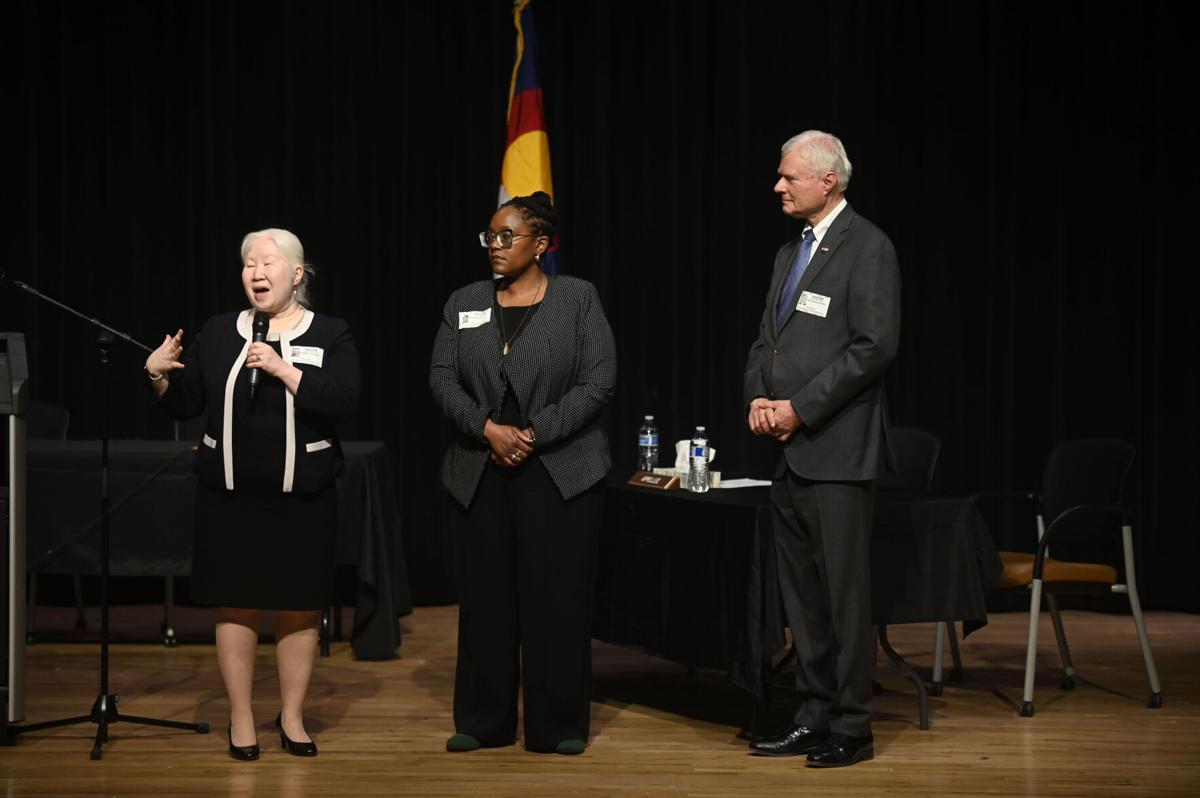
Colorado Court of Appeals Judges (from left) Sueanna P. Johnson, Pax L. Moultrie, and Lino S. Lipinsky de Orlov answer questions from students in the Green Mountain High School auditorium after hearing oral arguments in two cases as part of a "Courts in the Community" event on Thursday, Feb. 27, 2025. The Colorado Court of Appeals and Supreme Court hold Courts in the Community events multiple times per year in which they conduct oral arguments in real cases before an audience of students. (Stephen Swofford, Denver Gazette)
Stephen Swofford/ Denver Gazette

Colorado Court of Appeals Judges (from left) Sueanna P. Johnson, Pax L. Moultrie, and Lino S. Lipinsky de Orlov answer questions from students in the Green Mountain High School auditorium after hearing oral arguments in two cases as part of a “Courts in the Community” event on Thursday, Feb. 27, 2025. The Colorado Court of Appeals and Supreme Court hold Courts in the Community events multiple times per year in which they conduct oral arguments in real cases before an audience of students. (Stephen Swofford, Denver Gazette)
While the appellate judges could not confirm Mulvahill’s assessment of Juror V’s demeanor, her brief statements in court supported the idea that she was not forthcoming.
“Because the court was able to view Juror V’s demeanor, and nothing in the record indicates the prosecutor’s and the court’s observations were contrary to the court’s findings,” Lipinsky wrote, “we conclude that this case does not present the ‘exceptional circumstances’ that permit an appellate court to second-guess a trial court’s step-three Batson analysis.”
The case is People v. Souders.
In the second case out of Adams County, the government filed a child neglect case against a mother, identified as D.R.P. After a trial, jurors ultimately determined she mistreated or abused her children.
On appeal, D.R.P. challenged the county’s dismissal of a woman identified as Juror Y.C. The juror only engaged once with the county’s attorney, when they briefly discussed the burden of proof in a child neglect case.
During the Batson challenge, the county’s attorney said he “couldn’t get a read on” some of Juror Y.C.’s written answers to questions. Also, the woman “seemed unwilling or unwanting to thoroughly engage” and was “speaking softly.”
District Court Judge Caryn A. Datz, in allowing the county to strike Juror Y.C., initially noted there was nothing besides the woman’s dark hair and last name to suggest she was a person of color. But Datz found no “sufficient evidence of purposeful discrimination.”
A different appeals panel noted it would have been better for Datz to verify whether Juror Y.C. was, in fact, a person of color before going through the Batson process. Nonetheless, the county’s attorney’s reasons for the strike — he “couldn’t get a read on” her and was put off by her demeanor — were race-neutral.
It was “apparent that the court was simply not persuaded that mother met her burden to prove purposeful racial discrimination,” wrote Judge Dennis A. Graham in the Feb. 20 opinion.
The case is People in the Interest of J.R.M. et al.

Federal judge green-lights civil trial against ex-Fort Collins DUI officer
Michael Karlik
michael.karlik@coloradopolitics.com
Updated 19 hours ago
A federal judge ruled on Thursday that Fort Collins’ former “DUI officer” will face a civil trial for allegedly investigating a motorist for impaired driving without any reasonable suspicion to do so. In recent years, several people arrested by Officer...

Colorado Supreme Court suspends Mesa County judge pending misconduct investigation
Michael Karlik
michael.karlik@coloradopolitics.com
Updated 22 hours ago
The Colorado Supreme Court suspended Mesa County Court Judge Michael J. Grattan on Thursday amid a misconduct investigation. The court’s Sept. 10 order gave Grattan 21 days to explain why his paid suspension should not continue through the end of...
Colorado Supreme Court changes course, dismisses case about special district bonds
Michael Karlik
michael.karlik@coloradopolitics.com
Updated 18 hours ago
The Colorado Supreme Court declined on Friday to decide a dispute between a large-scale Commerce City development and the various districts financing it, after initially showing interest in the ongoing case. Colorado has roughly 2,800 special districts, which are local...

10th Circuit tosses GEO Group’s pretrial appeal in human trafficking lawsuit
Michael Karlik
michael.karlik@coloradopolitics.com
Updated 2 days ago
The Denver-based federal appeals court dismissed an attempt by The GEO Group on Wednesday to appeal a trial judge’s non-existent decision two months before the company is scheduled to face a civil trial over alleged trafficking violations at the Aurora...
Denver sues Trump to block armed ICE agents from polling sites
Deborah Grigsby
deborah.smith@denvergazette.com
Updated 2 days ago
The city of Denver, along with several groups, sued the Trump administration Thursday, seeking to block U.S. Immigration and Customs Enforcement officers who are armed from polling sites during the upcoming midterm elections. In fact, there are no official orders...
Federal judge takes no action against ICE in Colorado after hearing about mistakes, not ‘blatant violations’
Michael Karlik
michael.karlik@coloradopolitics.com
Updated 16 hours ago
A federal judge declined to take action against U.S. Immigration and Customs Enforcement on Thursday after hearing that a pattern of alleged lawbreaking amounted to mistakes and a misunderstanding of the government’s position in court. For nearly a year, Colorado’s...
Colorado doctors, dentists challenge state law on gender‑transition services in new federal lawsuit
Marissa Ventrelli
marissa.ventrelli@coloradopolitics.com
Updated 13 hours ago
A group of Christian doctors and dentists has filed a federal lawsuit challenging a Colorado law they say requires them to provide gender‑transition services that conflict with their religious and ethical beliefs. The lawsuit, filed by the Christian Medical and...
Federal judge directs plaintiff to revise complaint alleging Denver officers’ constitutional violations
Michael Karlik
michael.karlik@coloradopolitics.com
Updated 18 hours ago
A federal judge directed a plaintiff to revise his allegations on Wednesday to more precisely state what two Denver officers and the city itself allegedly did to violate his constitutional rights by facilitating his prosecution for murder until prosecutors dropped...
Lawsuit challenges Douglas County commissioners’ ballot actions
Nicholas Fogleman
nicholas.fogleman@denvergazette.com
Updated 2 days ago
A new lawsuit against Douglas County commissioners seeks to invalidate the board’s intervention in efforts to expand the commission from three members to five and restore the original ballot language approved by more than 20,000 petition signers. The suit marks...
Federal judge explores new sanctions against ex-Colorado judicial discipline director
Michael Karlik
michael.karlik@coloradopolitics.com
Updated 2 days ago
A federal judge on Wednesday directed Colorado’s former judicial discipline director, for the third time this year, to explain why she should not sanction him for his latest conduct in his litigation against the state’s judiciary. Christopher S.P. Gregory, who served...