

3 Colorado justices shrug off Trump decision, scandal fallout to cruise to retention
Three Colorado Supreme Court justices easily won their retention elections on Tuesday, brushing off a recent controversial decision to disqualify the Republican presidential candidate and disapproval of how the court handled a contracting scandal.
Chief Justice Monica M. Márquez, Justice Brian D. Boatright and Justice Maria E. Berkenkotter were poised to secure new 10-year terms, according to the unofficial results from Election Day.
In contrast to other states that elect judges in contested races, Colorado’s governor appoints judges and justices after receiving a shortlist from a citizen-led commission. Generally, judges are prohibited from campaigning for their retentions. It is rare for voters to reject any judge — especially if they receive a positive performance review, as each of the justices did this year.
However, there was a potential for 2024 to be an outlier after certain key developments. In December, the Supreme Court voted, 4-3, to remove Donald Trump from the state’s primary ballot under Colorado’s election laws. Based on the evidence presented in the trial court, the majority believed he was constitutionally ineligible because he engaged in insurrection. Márquez sided with the majority while Boatright and Berkenkotter dissented.
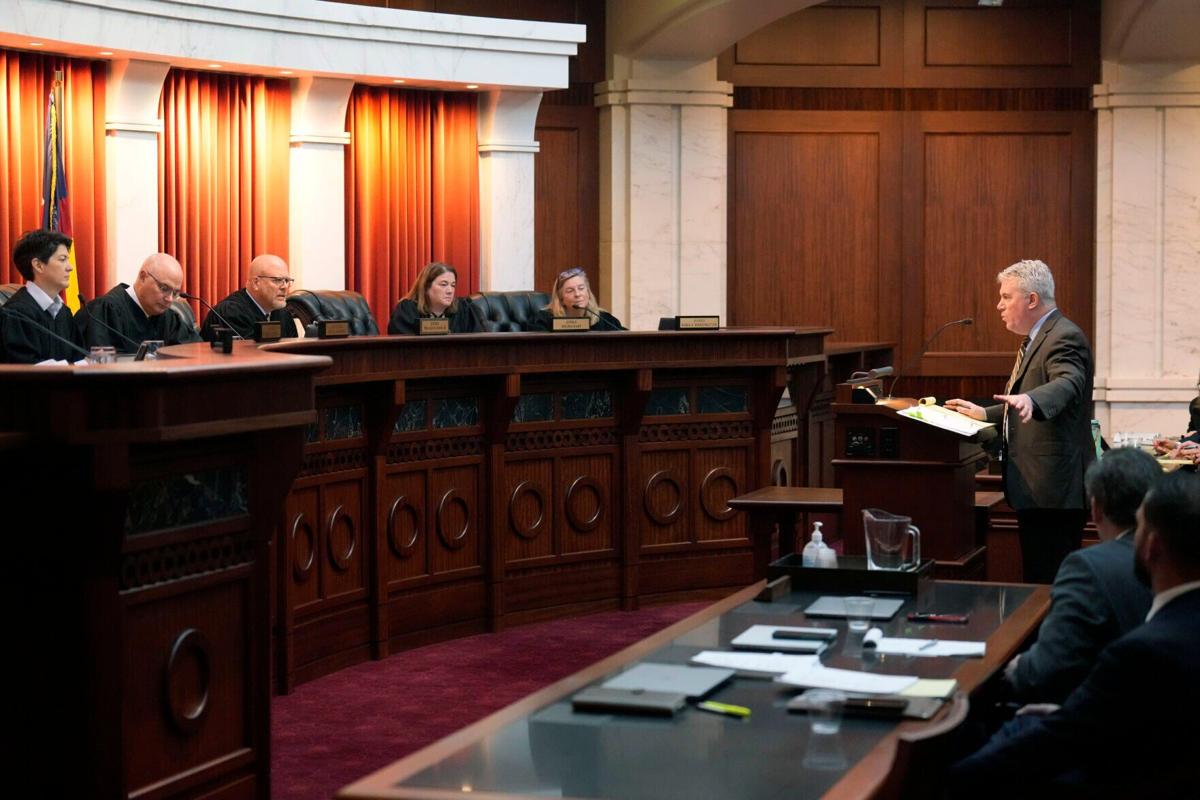
Attorney Scott Gessler argues before the Colorado Supreme Court on Dec. 6, 2023, in Denver. The oral arguments before the court were held after both sides appealed a ruling by a Denver district judge on whether to allow former President Donald Trump to be included on the state’s general election ballot.
associated press file

Attorney Scott Gessler argues before the Colorado Supreme Court on Dec. 6, 2023, in Denver. The oral arguments before the court were held after both sides appealed a ruling by a Denver district judge on whether to allow former President Donald Trump to be included on the state’s general election ballot.
Further, this was the first Supreme Court retention election following news reports that the judicial branch allegedly entered into a contract with an employee to prevent a “tell-all” lawsuit about judicial misconduct. The chief justice at the time, Nathan B. Coats, was subsequently censured for exhibiting poor judgment and relying on untrustworthy subordinates. Berkenkotter succeeded him after his retirement in 2020.
Although some opinion articles advocated against the justices’ retention based on the contract scandal, one entity took aim at Márquez for her vote in the Trump decision, which the U.S. Supreme Court later reversed on the grounds that states cannot disqualify presidential candidates.
The Article III Project, founded by Trump defender Mike Davis, launched an advertisement accusing Márquez of taking Trump off the ballot “illegally” to “disenfranchise over 550,000 Trump primary voters.”
“Márquez doesn’t respect Colorado voters. She doesn’t respect democracy. It’s time to fire her,” the voiceover continued.
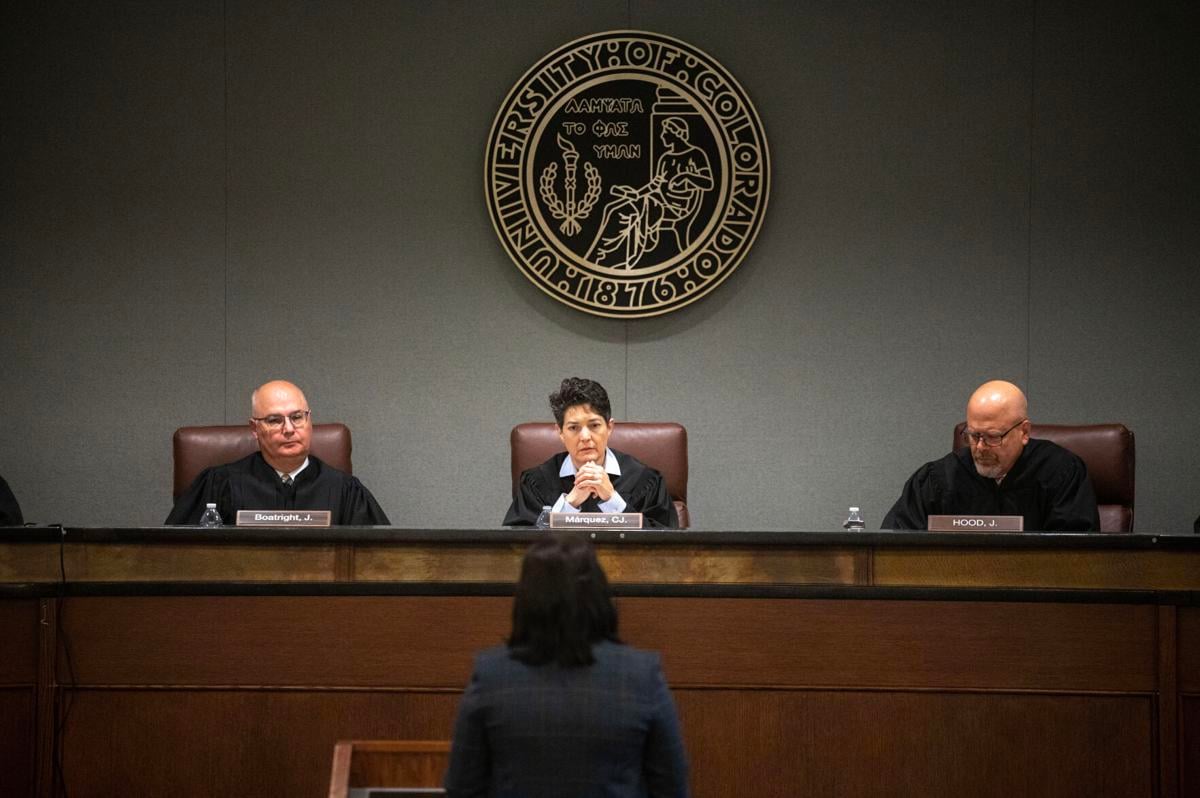
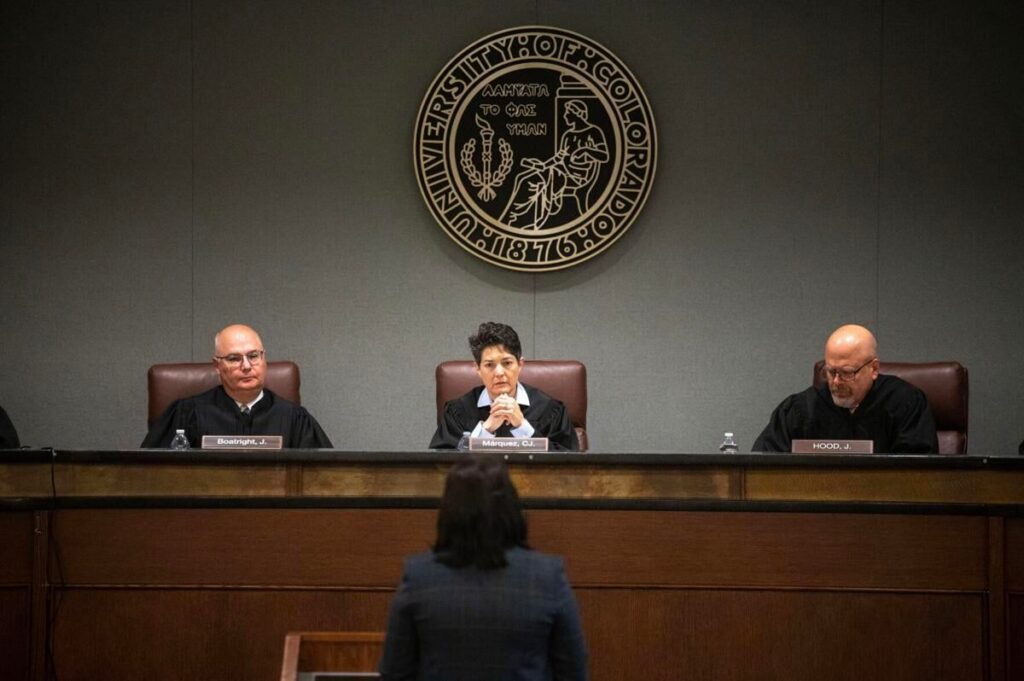
(From left) Colorado Supreme Court Justice Brian D. Boatright, Chief Justice Monica M. M á rquez and Justice William W. Hood III listen to arguments from Assistant Attorney General Caitlin E. Grant during the People v. Rodriguez-Morelos case as part of Courts in the Community at the Wolf Law building at University of Colorado Boulder on Thursday, Oct. 24, 2024. The semi-annual event entails the Colorado Supreme Court hearing arguments before an audience of students throughout the state. (Stephen Swofford, Denver Gazette)
Stephen Swofford Denver Gazette

(From left) Colorado Supreme Court Justice Brian D. Boatright, Chief Justice Monica M. Márquez and Justice William W. Hood III listen to arguments from Assistant Attorney General Caitlin E. Grant during the People v. Rodriguez-Morelos case as part of Courts in the Community at the Wolf Law building at University of Colorado Boulder on Thursday, Oct. 24, 2024. The semi-annual event entails the Colorado Supreme Court hearing arguments before an audience of students throughout the state. (Stephen Swofford, Denver Gazette)
Davis, a rumored candidate for attorney general in a second Trump administration whose goal for the Article III Project has been to make the judiciary “a hell of a lot more conservative,” published an opinion article on Oct. 24 saying Márquez and the other justices who voted to disqualify Trump “defiled” democracy.
That message prompted a handful of legal groups to issue statements condemning “politically motivated advocacy.”
“Political pressure and intimidation tactics threaten the independent judiciary that underpins our democratic system and erode the protections it provides to all Coloradans,” wrote the Colorado Bar Association.
The Colorado Defense Lawyers Association and the Colorado Judicial Institute, a nonprofit that advocates for the judiciary, “support the First Amendment right to free speech, but the recent attacks go beyond simply exercising that right,” the groups wrote. “If such efforts succeeded, they would send a chilling message to judges in Colorado and elsewhere: rule against powerful political interests at your peril.”
A campaign committee in Colorado for the Article III Project registered with the secretary of state’s office on Oct. 14 and reported spending $2,000 on the anti-Márquez ad, plus additional ad expenditures on social media.
And yet, there did not seem to be substantial appetite among Republican organizations locally in signal boosting the advocacy against Márquez’s — or any justice’s — retention. Some local parties, like the Weld County GOP, recommended against retaining Márquez, citing her vote in the Trump case.
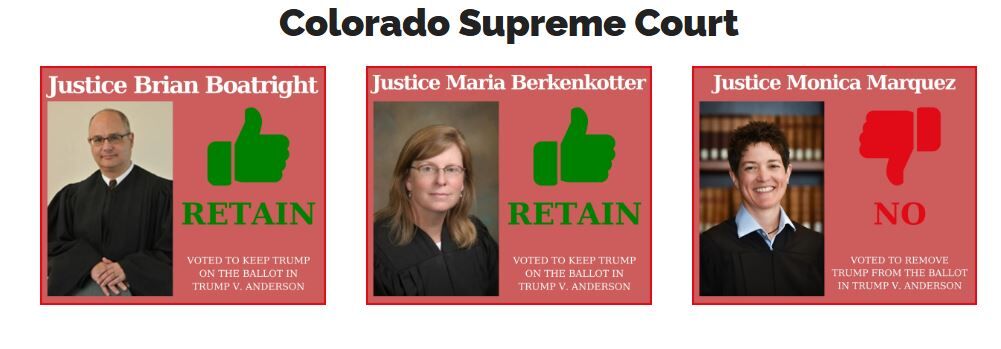
A screenshot from the Weld County GOP's website about the 2024 election.

A screenshot from the Weld County GOP’s website about the 2024 election.
The Jefferson County GOP, in contrast, recommended retaining all judges, otherwise Gov. Jared Polis “gets to appoint even more radical judges & justices.”
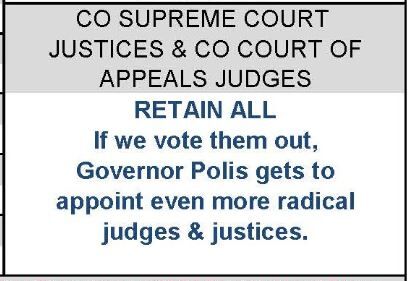
A screenshot from the Jefferson County GOP's website about the 2024 election.

A screenshot from the Jefferson County GOP’s website about the 2024 election.
Ultimately, while roughly two-thirds of voters chose to retain Márquez, Boatright and Berkenkotter, the margins of victory were lower than those their colleagues enjoyed in recent years. Márquez and Boatright also performed slightly worse than in their first retention election in 2014.
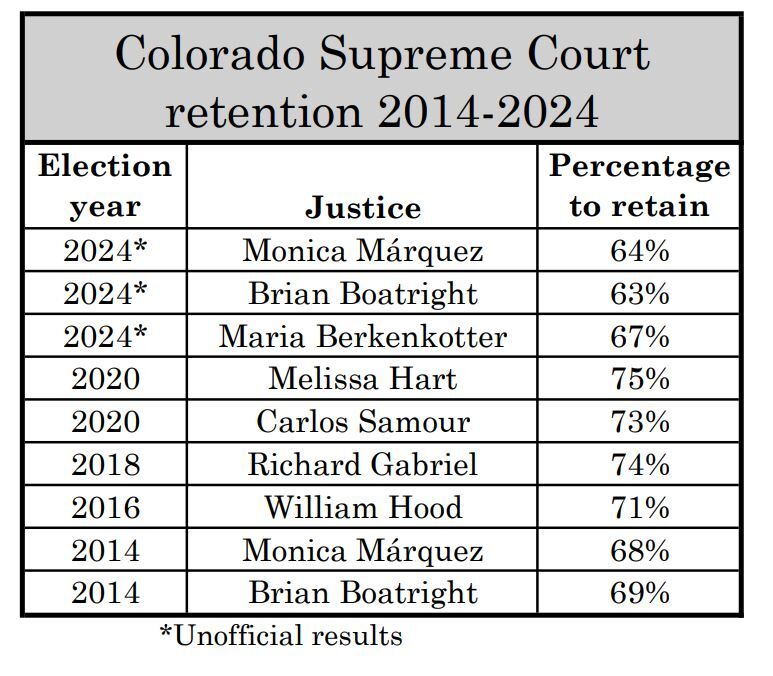

The quiet nature of Colorado’s Supreme Court retention races stands in contrast to other state supreme court elections this year. The candidates for a contested North Carolina seat raised approximately $6.5 million for their race and the ACLU of Montana and Michigan invested millions of dollars into educating voters about candidates’ positions on civil rights issues in their respective states.
“Colorado voters long ago rejected the influence of politics in our courts, and generally speaking the retention results seem to reflect that still holds true,” said Jeff Rupp, the Colorado Judicial Institute’s executive director.

Federal judge green-lights civil trial against ex-Fort Collins DUI officer
Michael Karlik
michael.karlik@coloradopolitics.com
Updated 1 day ago
A federal judge ruled on Thursday that Fort Collins’ former “DUI officer” will face a civil trial for allegedly investigating a motorist for impaired driving without any reasonable suspicion to do so. In recent years, several people arrested by Officer...

Colorado Supreme Court suspends Mesa County judge pending misconduct investigation
Michael Karlik
michael.karlik@coloradopolitics.com
Updated 13 hours ago
The Colorado Supreme Court suspended Mesa County Court Judge Michael J. Grattan on Thursday amid a misconduct investigation. The court’s Sept. 10 order gave Grattan 21 days to explain why his paid suspension should not continue through the end of...
Colorado Supreme Court changes course, dismisses case about special district bonds
Michael Karlik
michael.karlik@coloradopolitics.com
Updated 13 hours ago
The Colorado Supreme Court declined on Friday to decide a dispute between a large-scale Commerce City development and the various districts financing it, after initially showing interest in the ongoing case. Colorado has roughly 2,800 special districts, which are local...
10th Circuit tosses GEO Group’s pretrial appeal in human trafficking lawsuit
Michael Karlik
michael.karlik@coloradopolitics.com
Updated 2 days ago
The Denver-based federal appeals court dismissed an attempt by The GEO Group on Wednesday to appeal a trial judge’s non-existent decision two months before the company is scheduled to face a civil trial over alleged trafficking violations at the Aurora...
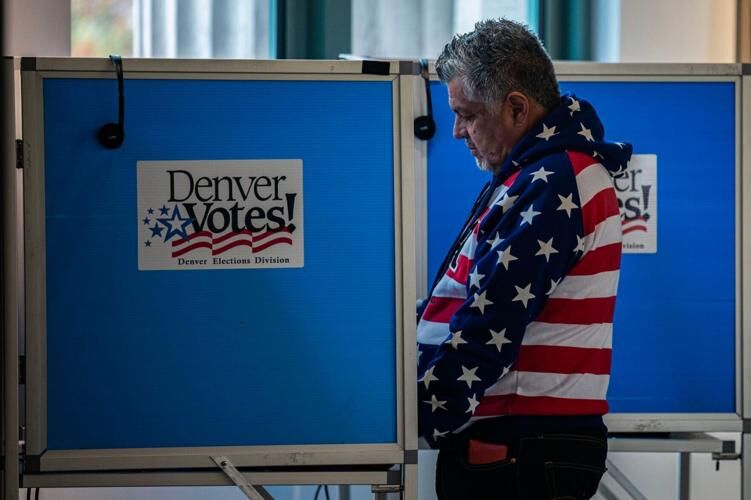
Denver sues Trump to block armed ICE agents from polling sites
Deborah Grigsby
deborah.smith@denvergazette.com
Updated 2 days ago
The city of Denver, along with several groups, sued the Trump administration Thursday, seeking to block U.S. Immigration and Customs Enforcement officers who are armed from polling sites during the upcoming midterm elections. In fact, there are no official orders...
Federal judge takes no action against ICE in Colorado after hearing about mistakes, not ‘blatant violations’
Michael Karlik
michael.karlik@coloradopolitics.com
Updated 10 hours ago
A federal judge declined to take action against U.S. Immigration and Customs Enforcement on Thursday after hearing that a pattern of alleged lawbreaking amounted to mistakes and a misunderstanding of the government’s position in court. For nearly a year, Colorado’s...
Colorado doctors, dentists challenge state law on gender‑transition services in new federal lawsuit
Marissa Ventrelli
marissa.ventrelli@coloradopolitics.com
Updated 7 hours ago
A group of Christian doctors and dentists has filed a federal lawsuit challenging a Colorado law they say requires them to provide gender‑transition services that conflict with their religious and ethical beliefs. The lawsuit, filed by the Christian Medical and...
Federal judge directs plaintiff to revise complaint alleging Denver officers’ constitutional violations
Michael Karlik
michael.karlik@coloradopolitics.com
Updated 10 hours ago
A federal judge directed a plaintiff to revise his allegations on Wednesday to more precisely state what two Denver officers and the city itself allegedly did to violate his constitutional rights by facilitating his prosecution for murder until prosecutors dropped...
Lawsuit challenges Douglas County commissioners’ ballot actions
Nicholas Fogleman
nicholas.fogleman@denvergazette.com
Updated 3 days ago
A new lawsuit against Douglas County commissioners seeks to invalidate the board’s intervention in efforts to expand the commission from three members to five and restore the original ballot language approved by more than 20,000 petition signers. The suit marks...
Federal judge explores new sanctions against ex-Colorado judicial discipline director
Michael Karlik
michael.karlik@coloradopolitics.com
Updated 13 hours ago
A federal judge on Wednesday directed Colorado’s former judicial discipline director, for the third time this year, to explain why she should not sanction him for his latest conduct in his litigation against the state’s judiciary. Christopher S.P. Gregory, who served...