

Colorado Supreme Court tiptoes around prior edict forbidding prison plus probation
Five years ago, the Colorado Supreme Court interpreted state law to prohibit judges from imposing a sentence of prison plus probation in a single criminal case. But on Wednesday, the justices appeared to endorse the idea that judges could resentence affected defendants in a fashion that preserves the same — illegal — punishment.
In its 2019 decision of Allman v. People, the Supreme Court ruled that state law treats probation as an alternative to incarceration and judges must choose one or the other. Further, a person who is released from prison on parole would be under the simultaneous supervision of their parole officer and a probation officer, with potentially conflicting conditions.
Fast forwarding to 2021, Bradford Wayne Snedeker appeared in Boulder County for resentencing. At the time, he had been serving a sentence outlawed by Allman. Snedeker already completed the prison portion and was in the process of serving 20 years of probation.
Chief Judge Ingrid S. Bakke resentenced Snedeker, imposing 20 years of probation again with credit for his prison time. Snedeker’s attorney objected that he had already served the incarceration piece, so it was still a prison-plus-probation sentence that violated Allman.
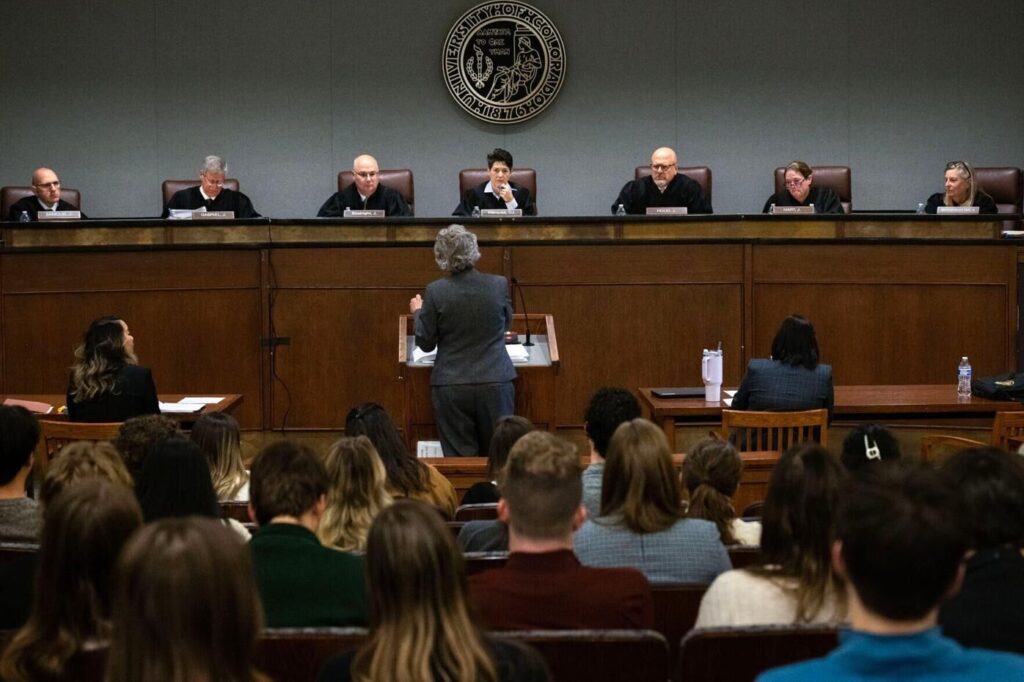
During oral arguments, members of the Supreme Court attempted to reconcile their prior ruling with Snedeker’s new sentence. Justice Carlos A. Samour Jr. suggested Allman strictly governed what judges could do, not what defendants end up experiencing.
“On resentencing, the judge is not doing what we said could not be done in Allman. The judge is not, on one count in the same case, sentencing the defendant to probation and on another, prison. The judge is simply saying, ‘I have to start over again. I have to impose a new sentence,'” Samour said.
“The defendant is still experiencing the thing that he’s not supposed to experience under Allman,” responded Kimberly Alderman Penix, the attorney for Snedeker.

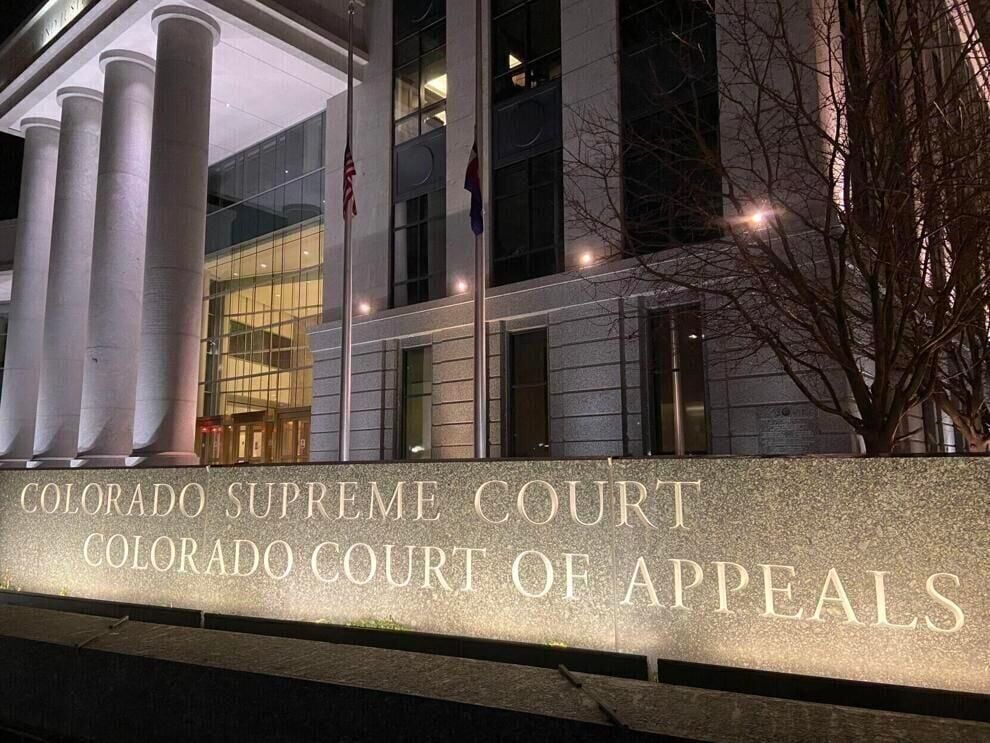
The Ralph L. Carr Colorado Judicial Center in downtown Denver houses the Colorado Supreme Court and Court of Appeals.
A three-judge panel for the Court of Appeals previously upheld Snedeker’s new sentence, observing that resentencing someone in Snedeker’s shoes could be a net benefit for the defendant or potentially impose a less-desirable punishment. In Snedeker’s case, he received a new sentence that was shorter than the original and did not technically have a prison component.
“Under these circumstances, the entire original sentence is void,” wrote Judge Jerry N. Jones, “and the proper remedy isn’t ‘lopping off’ the probation sentence — the proper remedy is resentencing and imposing a legal sentence.”
The Supreme Court similarly cautioned that Snedeker’s logic could lead judges to resentence defendants to time served in prison, as Snedeker wanted, or to require additional incarceration to make up for their inability to impose probation on a given charge.
“If the court added more prison time, I think you’d be here arguing it would be vindictive,” said Justice Richard L. Gabriel. “If the court just said time served, then Mr. Snedeker doesn’t have to serve any sentence on one of the counts he was convicted on. That seems troubling.”
“Someone gets a windfall one way or the other,” responded Penix, “in the respect that he either walks away like, ‘Whew, that was pretty sweet. The law changed and now my sentence is better than it was before.’ Or he walks away thinking, ‘Wow, that is really weird. They gave me a new piece of paper but nothing really changed for me.'”

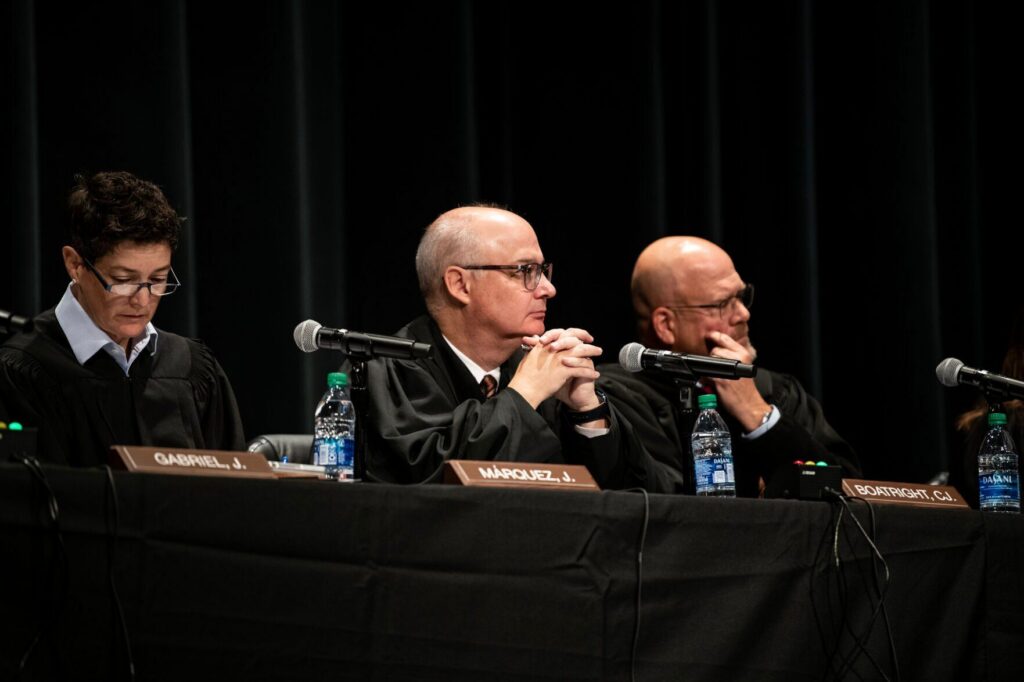
Justice Richard L. Gabriel speaks during oral arguments at the Colorado Supreme Court’s “Courts in the Community” event on May 9, 2024 at Central High School in Pueblo. (Photo by Jerilee Bennett, The Gazette)
The justices also addressed another complication: At the time Snedeker received a new, probation-only sentence, he stood charged with violating the probationary terms of a separate sentence. Bakke simultaneously imposed the probation-only sentence in the original case and sentenced Snedeker to prison for the probation violation case.
The Court of Appeals took no issue with that approach, noting Allman only concerned prison plus probation in a single case. Penix reiterated that practically speaking for Snedeker, the problem of dual supervision raised in Allman would still exist.
“Let’s say he had separate cases in separate jurisdictions with the same result,” said Chief Justice Monica M. Márquez. “A case in Adams and a case in Jefferson. One results in prison and one results in probation. Does that run afoul of Allman?”
Penix suggested sentencing judges could comply with Allman so long as they considered “what they can see in front of them.”
Trina K. Kissel of the Colorado Attorney General’s Office told the court there are likely many defendants who have sentences of prison and probation in separate cases, which cannot practically be served at the same time.
To the extent those scenarios create tension with state law, “my only answer, and I don’t know that it’s particularly satisfying, is that the General Assembly was not thinking about this across cases,” she added.
Justice Maria E. Berkenkotter is not participating in the appeal. As a Boulder County judge prior to joining the Supreme Court, she briefly handled Snedeker’s case in 2015.
The case is Snedeker v. People.
Editor’s note: This story has been updated to correct the description of Snedeker’s probation revocation.

Divided Colorado Supreme Court rejects defendant’s claim of deficient DNA investigation
Michael Karlik
michael.karlik@coloradopolitics.com
Updated 2 hours ago
The Colorado Supreme Court decided on Tuesday, by 4-2, that a defendant failed to allege how uninvestigated, inaccessible DNA evidence would have shown he was wrongly convicted. When Jamale D. Townsell filed a petition from prison seeking postconviction relief, he...
Colorado justices uphold shooting conviction despite jury saying defendant not the shooter
Michael Karlik
michael.karlik@coloradopolitics.com
Updated 15 hours ago
The Colorado Supreme Court ruled on Tuesday that a man can stand convicted of murder, even though jurors found he was not the one who shot the victim and the evidence suggested he was not present for the shooting. There...

Susan Blanco new Colorado Supreme Court justice
Michael Karlik
michael.karlik@coloradopolitics.com
Updated 13 hours ago
Chief Judge Susan Blanco of Larimer and Jackson counties is the newest member of the Colorado Supreme Court, Gov. Jared Polis announced on Tuesday. “A few words come to mind: Innovation. Excellence. Creativity. Hard work. These are values we need...
Appeals court clarifies what materials judges may rely on for postconviction decisions
Michael Karlik
michael.karlik@coloradopolitics.com
Updated 2 days ago
Colorado’s second-highest court clarified on Thursday that trial judges who are deciding whether to grant relief to convicted defendants may rely on the materials attached to, or referenced in, the parties’ arguments. In contrast to direct appeals of criminal convictions,...

Colorado Supreme Court accepts cases about reliability of gun-to-bullet matching
Michael Karlik
michael.karlik@coloradopolitics.com
Updated 4 days ago
The Colorado Supreme Court announced on Monday that it will hear two cases questioning the reliability of expert testimony that purports to identify whether a specific bullet was fired from a specific gun. At least three of the court’s seven...

Colorado District Attorneys unveil 2026 legislative priorities | WHAT’S YOUR AGENDA?
Marissa Ventrelli
marissa.ventrelli@coloradopolitics.com
Updated 6 days ago
Welcome to What’s Your Agenda?: The Colorado Politics’ weekly publication of trade association priorities for the state’s 2026 legislative session. The Colorado District Attorneys’ Council provides training, resources, and legislative support to every prosecutor in the state. In order to...
Colorado justices skeptical of challenge to water enterprises’ eminent domain power
Michael Karlik
michael.karlik@coloradopolitics.com
Updated 4 days ago
Members of the Colorado Supreme Court appeared receptive on Wednesday to the notion that water-related enterprises have the legal authority to exercise the governmental power of eminent domain over private property. An enterprise is a government-owned business that provides fee-based...
Colorado justices skeptical that intimate messages relevant to assault case
Michael Karlik
michael.karlik@coloradopolitics.com
Updated 5 days ago
Members of the Colorado Supreme Court seemed to agree on Tuesday that a Douglas County judge acted reasonably by blocking evidence of a defendant’s BDSM-related conversations with the victim in his trial for assault and false imprisonment. Jurors found Donald Louis...
Second appeals judge voices concerns about new ‘reasonable doubt’ instruction
Michael Karlik
michael.karlik@coloradopolitics.com
Updated 6 days ago
Another member of Colorado’s second-highest court registered his concern on Thursday that a portion of the recently revised “reasonable doubt” definition improperly lowers the prosecution’s burden to prove a defendant guilty. Judge Daniel M. Taubman wrote that the current instruction...
Colorado Supreme Court blocks ‘child-to-parent violence’ testimony in Boulder County case
Michael Karlik
michael.karlik@coloradopolitics.com
Updated 7 days ago
The Colorado Supreme Court concluded on Friday that a Boulder County judge incorrectly green-lit a psychologist’s expert testimony when the defendant had not laid the necessary groundwork for the evidence. State law requires criminal defendants to provide notice and undergo...