

Colorado justices agree ‘nature of relationship’ with minor relatives governs sex offender restrictions
The Colorado Supreme Court decided on Monday that a person on sex offender probation does not have his constitutional rights violated anytime his contact is restricted with minor relatives who are not his children.
Instead, the Supreme Court decided such relationships fall on a “spectrum of protection,” with parent-child relationships requiring the greatest degree of safeguarding and those with no parental or custodial aspect entitled to less protection.
“Courts have looked to the nature of the relationship in question to determine whether a probationer has established a right to familial association with an extended family member. Why the nature of the relationship?” wrote Justice Maria E. Berkenkotter in the June 24 opinion. “Because the right to familial association is rooted in the objective characteristics of a given relationship. That is what determines where on a spectrum — from the most intimate to the most attenuated — of personal attachments the relationship lies.”

Abdullahi Salah, whose case the Supreme Court considered, previously warned the justices against a rule requiring inquiry into a familial relationship, contending it would invite judges to make subjective determinations about which relationships from which cultures deserve greater constitutional protection.
Adams County jurors found Salah guilty in 2018 of sexually assaulting a teenage girl, among other offenses. He received sex offender probation for 20 years to life, with a prohibition on contacting or living with children. There was an exception for those children with whom he had a “parental role.”

The Adams County Justice Center
After sentencing, Salah’s probation officer alleged Salah violated those terms by moving in with his sister and her infant. Salah countered there was no reason to believe the crime against his female victim would make him a danger to a 1-year-old male child.
Then-District Court Judge Roberto Ramirez heard testimony that in Salah’s Somali culture, individuals “are expected to help other members of the Somali community” and Salah “would have had a parent-like role” with his nephew.
However, Ramirez found “no evidence before this court that as it relates to defendant and his nephew, that there is a parental-like role.” He agreed Salah violated his probation, reinstated the original sentence and added 90 days in jail.
A three-judge panel for the Court of Appeals cautioned that for parent-child relationships, the right to familial association can be infringed upon if there are compelling circumstances. But a defendant on probation has no unconditional right to live with family members generally.
“Salah had no parental or custodial role with his nephew, and he otherwise failed to demonstrate the nature of his relationship with his sister and nephew,” wrote Judge Jerry N. Jones.
During oral arguments to the Supreme Court earlier this year, Salah argued blood relationships are constitutionally protected and the government should need to show compelling circumstances to prohibit contact. Some members of the court acknowledged the diversity of family configurations should be a consideration, but so should the government’s need to protect potential child victims.

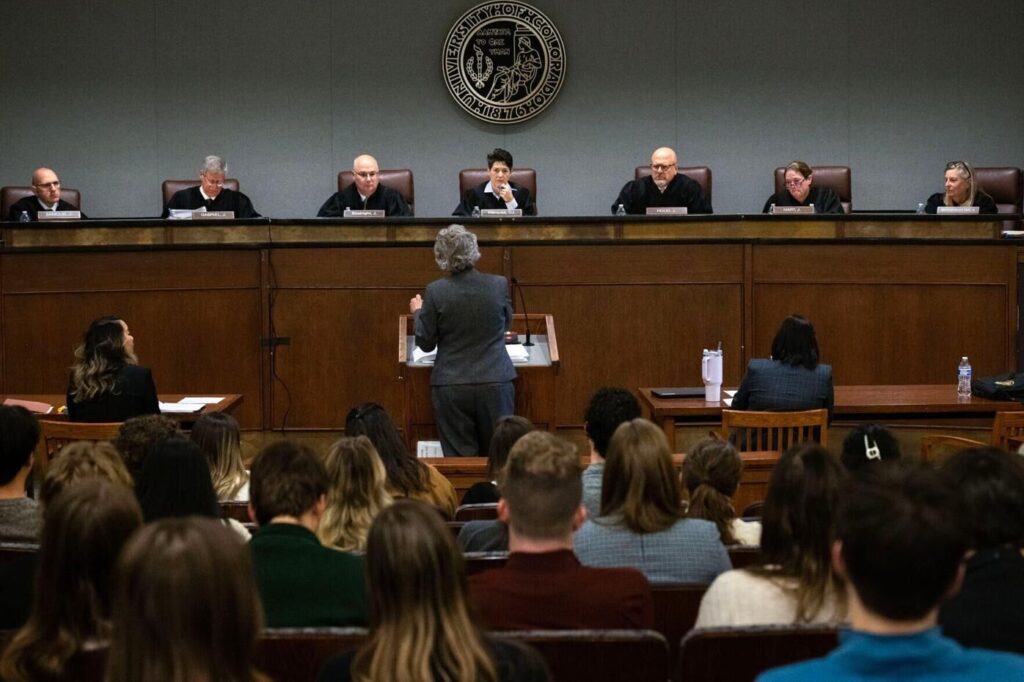
FILE PHOTO: Members of the Colorado Supreme Court listen to arguments from attorney Julian R. Ellis, Jr. during “Courts in the Community” at Pueblo’s Central High School on Thursday, May 9, 2024. (Photo by Jerilee Bennett, The Gazette)
“I certainly recognize that not all families meet a nuclear mother-father-child sort of setup. We have blended families. We have families blended through marriage. We have LGBTQ families,” said Justice Monica M. Márquez. “Where is the line properly drawn here?”
In the court’s opinion, Berkenkotter explained most courts that have addressed the question have settled on the requirement for a probationer to demonstrate the nature of their relationship with a minor relative who is not their child. That way, judges can determine “where on the spectrum of protection” the relationship lies.
“Because Salah didn’t present any evidence demonstrating the nature of his relationship with his nephew, his right to familial association wasn’t implicated,” she wrote, “and the trial court therefore didn’t err by prohibiting him from contacting or living with his nephew or by failing to make specific findings regarding the compelling circumstances justifying the imposition of these probation conditions.”
Berkenkotter conceded that in one instance, the federal appeals court based in Denver overturned a similar restriction on a defendant’s contact with minor male relatives because it was overly broad in light of his sex offense against a female victim. But most other courts, she concluded, require the probationer to show their relationship resembles a “parental or custodial one” to establish a right of association.
The case is Salah v. People.


Colorado Supreme Court accepts cases about reliability of gun-to-bullet matching
Michael Karlik
michael.karlik@coloradopolitics.com
Updated 17 hours ago
The Colorado Supreme Court announced on Monday that it will hear two cases questioning the reliability of expert testimony that purports to identify whether a specific bullet was fired from a specific gun. At least three of the court’s seven...

Colorado District Attorneys unveil 2026 legislative priorities | WHAT’S YOUR AGENDA?
Marissa Ventrelli
marissa.ventrelli@coloradopolitics.com
Updated 3 days ago
Welcome to What’s Your Agenda?: The Colorado Politics’ weekly publication of trade association priorities for the state’s 2026 legislative session. The Colorado District Attorneys’ Council provides training, resources, and legislative support to every prosecutor in the state. In order to...
Appeals court clarifies what materials judges may rely on for postconviction decisions
Michael Karlik
michael.karlik@coloradopolitics.com
Updated 2 days ago
Colorado’s second-highest court clarified on Thursday that trial judges who are deciding whether to grant relief to convicted defendants may rely on the materials attached to, or referenced in, the parties’ arguments. In contrast to direct appeals of criminal convictions,...
Colorado justices skeptical of challenge to water enterprises’ eminent domain power
Michael Karlik
michael.karlik@coloradopolitics.com
Updated 17 hours ago
Members of the Colorado Supreme Court appeared receptive on Wednesday to the notion that water-related enterprises have the legal authority to exercise the governmental power of eminent domain over private property. An enterprise is a government-owned business that provides fee-based...
Colorado justices skeptical that intimate messages relevant to assault case
Michael Karlik
michael.karlik@coloradopolitics.com
Updated 2 days ago
Members of the Colorado Supreme Court seemed to agree on Tuesday that a Douglas County judge acted reasonably by blocking evidence of a defendant’s BDSM-related conversations with the victim in his trial for assault and false imprisonment. Jurors found Donald Louis...
Second appeals judge voices concerns about new ‘reasonable doubt’ instruction
Michael Karlik
michael.karlik@coloradopolitics.com
Updated 2 days ago
Another member of Colorado’s second-highest court registered his concern on Thursday that a portion of the recently revised “reasonable doubt” definition improperly lowers the prosecution’s burden to prove a defendant guilty. Judge Daniel M. Taubman wrote that the current instruction...
Colorado Supreme Court blocks ‘child-to-parent violence’ testimony in Boulder County case
Michael Karlik
michael.karlik@coloradopolitics.com
Updated 4 days ago
The Colorado Supreme Court concluded on Friday that a Boulder County judge incorrectly green-lit a psychologist’s expert testimony when the defendant had not laid the necessary groundwork for the evidence. State law requires criminal defendants to provide notice and undergo...
Colorado justices concerned about retrying defendant after jury signaled acquittal
Michael Karlik
michael.karlik@coloradopolitics.com
Updated 3 days ago
Some members of the Colorado Supreme Court appeared uncomfortable on Tuesday with allowing a criminal defendant to stand trial a second time after a Larimer County jury signaled it was deadlocked on some counts but had found him not guilty...
Missy Woods pleads not guilty; trial set for fall
Jenny Deam
jenny-deam@coloradopolitics.com
Updated 3 days ago
The former Colorado Bureau of Investigation DNA expert charged with more than 100 felonies entered a plea of not guilty to all of them Wednesday in a packed Jefferson County courtroom. The plea was entered by her defense attorney Tom...
Colorado justices question process for parole board appeals
Michael Karlik
michael.karlik@coloradopolitics.com
Updated 2 days ago
The Colorado Supreme Court considered on Tuesday whether criminal defendants whose parole is revoked must appeal the decision internally to the state’s parole board before seeking review by a judge. The process for returning someone to incarceration for violating the...