

What to fund and what not to fund — that is the question | NOONAN
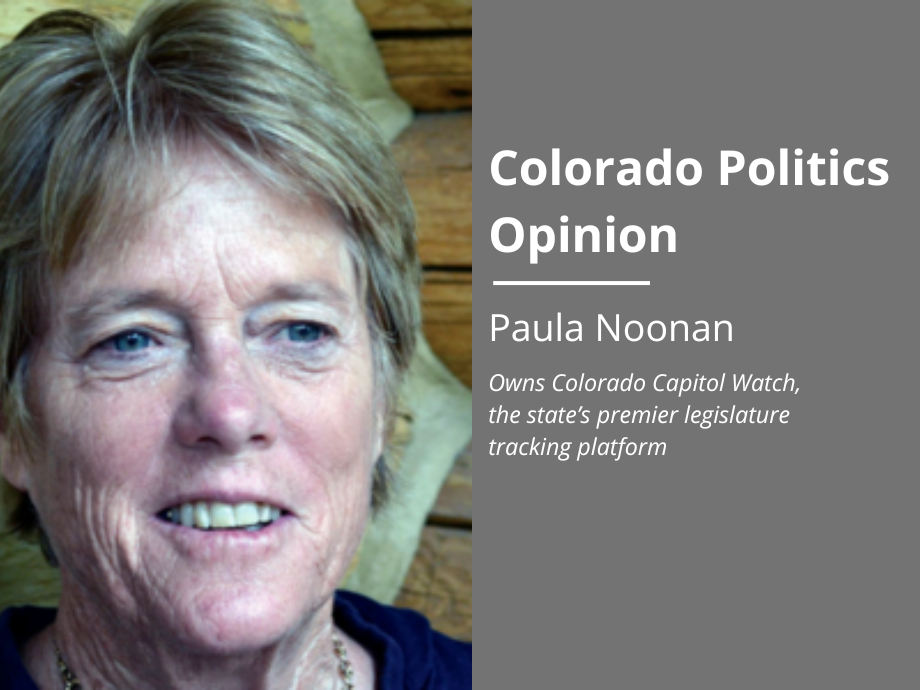
Paula Noonan

Paula Noonan
Every year legislators face a dilemma: there are more bills that need money than there is money. What to do? Since 2019, Democrats used a “quadratic” voting system that kept their appropriations decisions anonymous. A judge declared that system violated the state’s open meetings rules because voters couldn’t see what bills their legislators selected for funding.
This year, Democratic legislators were reduced to using an Excel spreadsheet that became their testament to public records and meetings. It reveals the choices many, but not all, Democrats made related to bills needing appropriations. Joint Budget Committee members weren’t included in this bill ranking project.
What’s unknown is whether and how this Excel spreadsheet of bills will inform appropriations decisions. If the data is examined by individual votes for bills, decisions go one way. If appropriations are decided by a 5-4-3-2-1 point system, rather like rank-choice voting, decisions can go another way.
Stay up to speed: Sign up for daily opinion in your inbox Monday-Friday
First in line are tax credits where there appears to be consensus. Three bills rank high by points and votes in both chambers. Families with children may catch a break on two fronts: number of children by family income and child care relief through HB24-1311 and HB24-1334. Seniors may get help with their housing with HB24-1052. After these three, HB24-1312, on a tax credit for care workers, and HB24-1313, on housing in transit-oriented communities, appear as possibilities. Those bills show the challenge of balancing competing priorities that address very different problems.
There’s some consensus on funding bills with an appropriations under $200,000. HB24-1030 on Railroad Safety and HB24-1129 on Protections for Delivery Network Company Drivers appear in the top-three for both House and Senate. “Wage Claims Construction Industry Contractors,” HB24-1008, scores high in the House but does not hit the top-10 in the Senate.
From there, consensus on funding bills with fewer than $200,000 isn’t obvious. Several safety bills are in contention, including protections for minor workers, educator safety and “social media protection for juveniles.” Also close are “Disproportionately Impacted Community Air Pollution” in the House and “Lodging Property Tax Treatment” in the Senate. These are very different priorities.
The jumble comes with bills that need more than $200,000 for funding. Legislators posted their top-20 bills. The bill that received the most first-place votes in the House, HB24-1009 on “Bilingual Child Care Licensing Resources,” does not make the top-10 by points in either chamber. The bill that has the most points in the House, HB24-1045, “Treatment for Substance Use Disorder,” does not appear among the top-10 on points in the Senate. Second in line for points in the House is HB24-1066, “Prevent Workplace Violence in Healthcare Settings,” to prepare for and manage violence directed at health care workers, sometimes by the people targeted for help in “Treatment for Substance Use Disorder” (see above). That’s how some of these bills connect, whether intentionally or not.
Twelve bills tie for first place by votes in the Senate, as they each received one vote. The bill that comes out tops by points in the Senate is HB24-1260, “Prohibition against Employee Discipline.” This bill hits fifth place by points in the House, so it’s probably in the final list for funding. “Air Quality Permitting,” HB24-1330, holds third-place position in the House on points with some separation to the fourth-place bill, “Analysis of Universal Health-Care Payment System,” HB24-1075.
As legislators negotiate the allocations, fiscal notes come into play. They determine how much above $200,000 a piece of legislation will cost. “Prohibition against Employee Discipline,” a bill that will prevent giving employees a hard time about not attending meetings at work with religious or political content, comes in at about $250,000. “Treatment for Substance Use Disorders” starts out at a relatively modest $5.4 million, considering the size and difficulty of treating individuals with substance abuse problems. But the bill grows to $86.5 million by 2027-2028. The 2027-2028 year will be subsidized with federal funds, but a large chunk will also come from the General Fund. This example shows how far out legislators have to predict to understand the financial impact of bills.
Another issue involves differences between how the legislative council calculates fiscal impact and how state departments calculate impact. According to the fiscal note branch of legislative council, “Air Quality Permitting” implementation will cost about $5.6 million spread over two years. That amount jumps to $24 million when calculated by the Colorado Department of Public Health and Environment, a whopping difference that depends on definitions of air quality modelling and how many employees may be needed to do it. Or does the department’s estimate indicate how much the department doesn’t want to do what the bill requires?
The fiscal debate over the air quality bill makes “Analysis of Universal Health-Care Payment System” look like a bargain at about $400,000 that can be spread over two years.
Not much is easy at the Capitol. When it comes to money, so many interests are hanging on a thread. It’s up to the JBC and leadership, along with bill sponsors in both chambers, to put those threads through the needle.
Paula Noonan owns Colorado Capitol Watch, the state’s premier legislature tracking platform.


Weiser’s leadership crucial for rural win-win | Rachel Gabel
Rachel Gabel
rachel-gabel@coloradopolitics.com
Updated 3 days ago
Attorney General Phil Weiser is going to win the gubernatorial election. That said, Colorado agriculture and rural communities have a 30-year track record of finding the win-win be it for species or industries or habitat. Former Governor Roy Romer possessed...

A Colorado history lesson for Victor Marx | Dick Wadhams
Dick Wadhams
dick-wadhams@coloradopolitics.com
Updated 3 days ago
Victor Marx, who narrowly won the Republican nomination for governor by one half 1% after boasting of a massive 44-point lead, is just as misguided on Colorado political history. During the primary, Marx made a clumsy attempt to denigrate his...

‘Be prepared to march in the streets’ | Miller Hudson
Miller Hudson
miller-hudson@coloradopolitics.com
Updated 3 days ago
It was early in 1974 when I first met Tim Wirth as he announced his candidacy for Congress, challenging Republican incumbent Don Brotzman. Although I had only resided in Colorado two years, I was drafted to serve as a Democratic...

‘CoCo’ would take taxpayers for a ride | Jon Caldara
Jon Caldara
jon-caldara@coloradopolitics.com
Updated 2 hours ago
Colorado wants taxpayers to spend another $4.73 billion on passenger rail. Don’t worry. They have a plan. Which is a little like your brother-in-law announcing he’s launching another exciting restaurant venture after his last three restaurants ended in bankruptcy. Please....

The through line from Donald Trump to Victor Marx | SONDERMANN
By Eric Sondermann
by-eric-sondermann@coloradopolitics.com
Updated 5 days ago
Over 10 years ago, before Donald Trump could ever defeat Hillary Rodham Clinton, he had to first engineer a hostile takeover of the Republican Party. Prior to his descent of that golden escalator, the previous seven Republican presidential nominees had...
Primary voters rejected big money in politics | Paula Noonan
Paula Noonan
paula-noonan@coloradopolitics.com
Updated 3 days ago
While we’re in an election campaign lull between now and Labor Day, we have time to consider the impact of $102 million in campaign contributions in the primary. In the general election, more money will fill candidate campaign coffers, and...
Colorado’s primary proved in this political climate money doesn’t buy electoral happiness | Paula Noonan
Paula Noonan
paula-noonan@coloradopolitics.com
Updated 4 days ago
To catch you up, campaign committees from this 2026 election cycle already collected and shoveled out a lot of cash: $102.64 million. That’s contributions in all forms — dollars, in kind, loans, etc. — from December 2024 to now. Total...

Protecting Colorado from wildfire starts before fire arrives | PODIUM
Colorado Politics
colorado-politics@coloradopolitics.com
Updated 5 days ago
By Rick Cables Colorado is once again being reminded of how significantly wildfires can affect the people and places we love. In southern Colorado, the Aspen Acres fire has burned through the Wet Mountains near Beulah and Rye, quickly becoming...
Stop making business the health care scapegoat | GUEST COLUMN
Colorado Politics
colorado-politics@coloradopolitics.com
Updated 1 week ago
By John Carson It is perhaps a sad commentary in the wake of our nation’s 250th birthday to note even in this hyper-polarized age, one thing nearly every American can agree on is American health care is a mess. But...

Could an independent win CD-1?
Greg Fulton
greg-fulton@coloradopolitics.com
Updated 6 days ago
Turnout in Colorado’s 2026 primary election should concern many citizens. Only 36% of active registered voters participated, meaning a relatively small share of the electorate effectively determined the choices voters will see on the November ballot. Low participation has allowed...