

Winners and losers stack up in Colorado’s Super Tuesday presidential primary
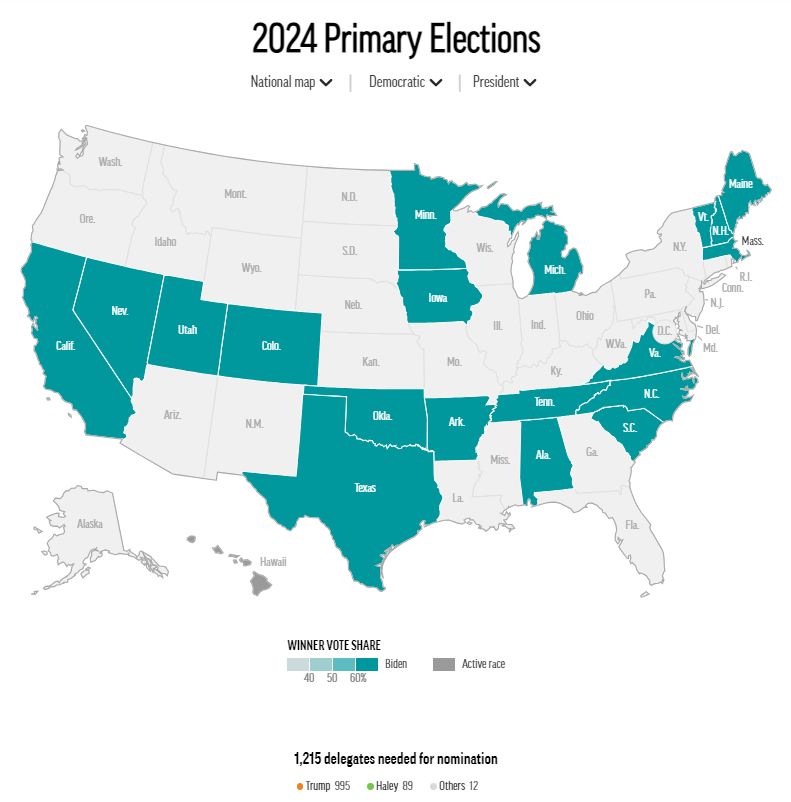
As the dust settles on Colorado’s fifth-ever presidential primary, a few clear winners and losers have emerged, led by the top-ticket candidates, President Joe Biden and former President Donald Trump, who clinched their respective party’s 2024 nominations on Super Tuesday by romping to wins across the country, while at the same time exposing cracks in their coalitions that could spell trouble in November.
Here’s a look at what’s up and what’s down after more than 1.36 million votes were counted in Colorado on March 5, capping a brief and mostly uneventful primary.
Winners: Biden and Trump
Losers: Trump and Biden
The current and former presidents became their parties’ presumptive White House nominees on Super Tuesday, with their performances in Colorado roughly mirroring the collective results in the other 15 states and one territory that voted on the biggest primary day of the year.
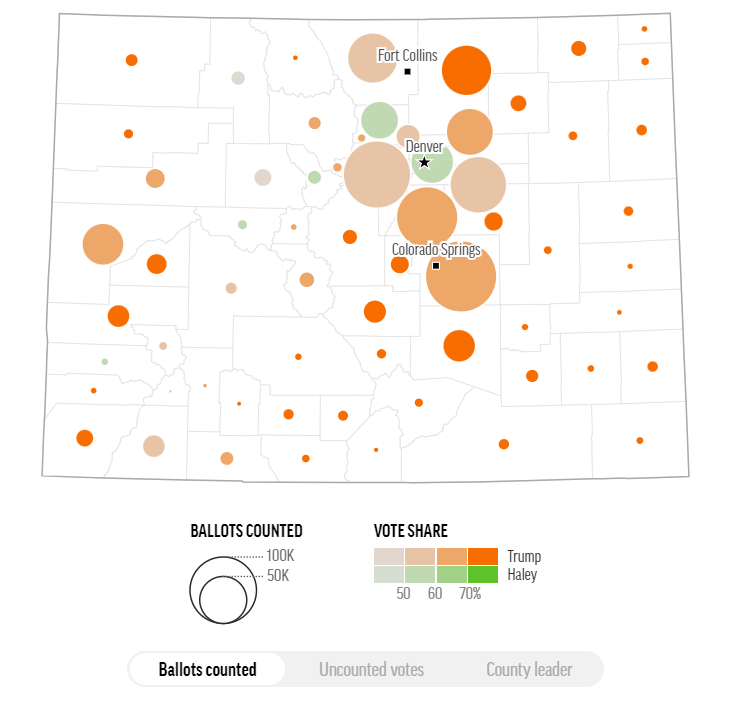
This map reflects the share of votes by county of Donald Trump, who easily won Colorado's presidential primary on Super Tuesday, and Haley, who secured pockets of victories in a few places, including the counties of Denver and Boulder. (GRAPHIC: Associated Press)

With all Colorado counties reporting unofficial results, Biden won 84% of the vote against nominal opposition, ahead of an 8% vote for “uncommitted delegate,” with Minnesota Rep. Dean Phillips and self-help author Marianne Williamson trailing at about 3% apiece. Trump got 63% of the GOP vote, running 30 points ahead of former South Carolina Gov. Nikki Haley, with a smattering of votes going to other Republicans who had already suspended their campaigns.
Haley won just seven of Colorado’s 64 counties — carrying Denver by about 10 points, Boulder by about 15 points and prevailing in five Western Slope counties — but it wasn’t enough to turn back the tide of Trump supporters.
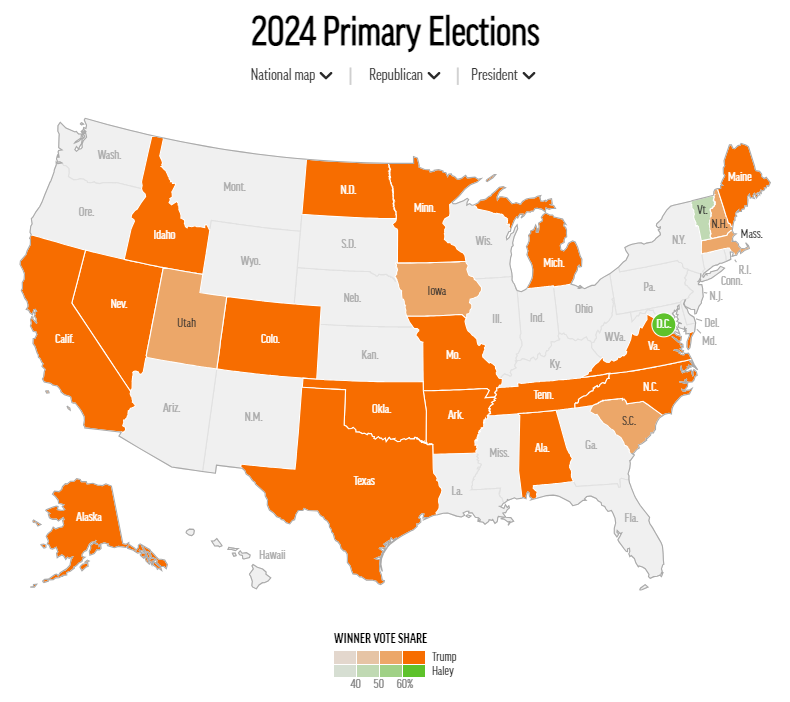
Biden and Trump each lost one Super Tuesday contest — Biden trailed dark horse Jason Palmer in American Samoa, where only a few dozen Democrats voted, and Trump lost Vermont to Haley, his lone remaining rival — but both racked up enough delegates in the other states to get within shouting distance of majorities at this summer’s national conventions.
Haley affirmed the night’s results when she suspended her campaign the next morning, telling Trump it was up to him to “earn the votes of those in our party and beyond it who did not support him,” adding that she hopes Trump does that.
Rather than extend an olive branch, Trump danced on the tattered remains of his opponent’s campaign in a statement issued just before Haley dropped out, declaring that his former U.N. ambassador “got TROUNCED last night, in record-setting fashion.”
“At its best, politics is about bringing people into your cause, not turning them away,” Haley said on Wednesday morning, urging her supporters to make up their own minds going forward.
Echoing Haley’s recent aggressive campaign-trail attacks on Trump, Biden made a bid for Haley’s voters in a statement that praised her for being “willing to speak the truth about Trump,” including what Biden described as “the chaos that always follows him” and Trump’s “inability to see right from wrong.”
“Donald Trump made it clear he doesn’t want Nikki Haley’s supporters,” Biden added. “I want to be clear: There is a place for them in my campaign.”
Although polling in primaries can be fraught — it’s tough to predict who will cast ballots in lower-turnout elections — this year’s polls have consistently overestimated Trump’s share of the vote and underestimated Biden’s.
Considering those factors, coupled with a persistent but varying share of Democratic voters who have expressed trepidation over a second Biden term — in polling and votes for the equivalent of “none of the above” — expect the race to reshuffle in coming weeks, as it sinks in that it’s Biden vs. Trump..
Winners: Voters who like to plan ahead
Loser: Colorado’s reputation for curveballs
There’s little doubt that the prospect of a rematch between the 81-year-old Biden and 77-year-old Trump leaves a lot of voters discouraged, but after Super Tuesday, that’s what they’re facing with almost exactly eight months to go until the Nov. 5 General Election.
Democrats and Republicans alike expect the contours of the Biden-Trump race to firm up quickly, now that it’s no longer merely likely but certain.
On the other hand, when they voted for the solid frontrunners on March 5, in line with the national Super Tuesday results, Colorado voters veered from the state’s tradition of often breaking from the crowd to back candidates in presidential nominating contests who won’t go the distance.
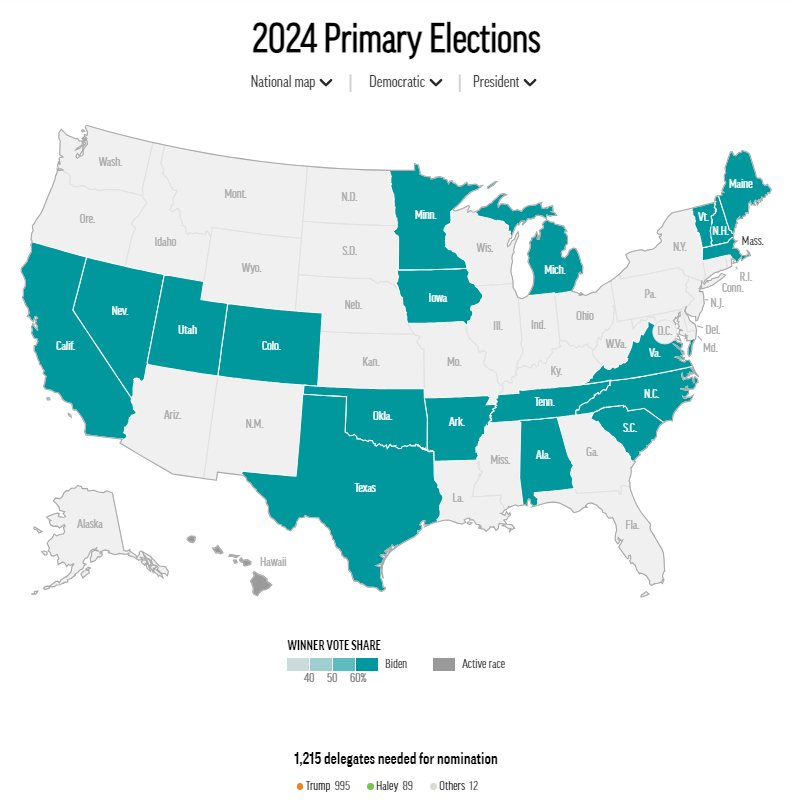
This map reflects the share of vote for Joe Biden in the Democratic presidential primary across Super Tuesday states as of 9 a.m. on Tuesday, when the president handily won the contests. (GRAPH: Associated Press)

Stretching back to Colorado’s first presidential primary in 1992, held on what was dubbed Mini Super Tuesday, the state’s voters have sometimes gone one way when the bulk of voters elsewhere are going another. That year, Colorado Democrats handed a rare win to former California Gov. Jerry Brown, who barely edged out then-Arkansas Gov. Bill Clinton, who went on to win the nomination and unseat the first Republican President George Bush in the fall.
Colorado’s voters went with the presumptive nominees in succeeding years when the contests were all but over by the time the state voted, but they went their own way as often as not when the nominations were still in flux.
Among the state’s Republican picks: Mitt Romney over John McCain in 2008, about a week before Romney withdrew from the race; Rick Santorum over Mitt Romney in 2012, just before Romney won the nomination; and, Ted Cruz over Trump in 2016, provoking the eventual nominee to attack Colorado’s complicated caucus system as “rigged.” Democrats, likewise, voted twice for Vermont Sen. Bernie Sanders, in 2016 and 2020, as Hillary Clinton and Biden, respectively, marched toward their party’s nominations.
Winner: Colorado’s mail ballot system
Losers: Fans of campaign rallies
Once again, Colorado’s election officials drew nods of approval for running a near-seamless vote, with winners declared less than 15 minutes after polls closed.
In place since 2013, the state’s all-mail election system worked without any noticeable hiccups, cementing Colorado’s reputation as one of the easiest places in the country to vote.
Unlike in other states, where voters endure long lines and can await results for weeks, voters in Colorado have gotten used to voting at their kitchen tables before returning ballots at their convenience. The recent statewide adoption of a ballot tracking system lets voters track their ballots’ progress through the process, enabling alerts via text message and email when their ballots go in the mail, when they’re delivered and when they’ve been accepted for voting. The same system lets voters address discrepancies right away, making it more likely their votes will count.
In one measure of the system’s popularity, by mid-day on Super Tuesday, just over 8,000 Coloradans had opted to cast their votes in person at voter service centers, compared to more than 1.36 million who returned their ballots by mail or by dropping them off — less than 1% of the total votes cast.
Different from four years ago, however, political junkies didn’t have the chance to rub shoulders with thousands of their compatriots at the massive gatherings held throughout Colorado ahead of its 2020 Super Tuesday primary.
With the Democratic nomination up for grabs in the months before Coloradans voted, nearly every major presidential candidate rallied supporters by the thousands, starting almost a year before the primary.
The biggest rallies drew tens of thousands to cheer Vermont’s Sanders, who won the crowded Democratic primary, and Trump, who filled an arena on his way to an overwhelming win in the GOP primary against minimal opposition, but others also turned out throngs, including Massachusetts Sen. Elizabeth Warren, future Vice President Kamala Harris, former New York Mayor Michael Bloomberg and former Indiana Mayor Pete Buttigieg.
This year was different, with only Haley making an appearance in the state, for a small fundraiser followed by a speech before hundreds of supporters a week before Super Tuesday.

This map reflects the share of vote for Donald Trump and Nikki Haley in the Republican presidential primary across Super Tuesday states as of 9:30 a.m. on Tuesday. Trump easily defeated Haley in Colorado and elsewhere in the country. Haley decided to suspend her campaign on Wednesday. (GRAPH: Associated Press)
Winners: Down-ballot Democrats
Losers: Republican candidates not named Trump
Colorado Democrats had two things to celebrate on Super Tuesday: Biden’s overwhelming win among the party’s voters and the certainty that Trump will carry the GOP banner this fall in a state that hasn’t voted for a top-ticket Republican in a decade and hasn’t elected a GOP candidate statewide since Trump won the presidency.
While the Super Tuesday results demonstrate Trump’s popularity among Colorado Republicans, he’s considered a drag on fellow GOP candidates in all but the deepest red parts of the state, potentially bolstering Democratic candidates in swing districts that could have been more competitive with someone else as the face of their opponents’ party.
Plenty of the Republican presidential candidates who fell by the wayside had to pay Colorado’s Republican Party for the privilege under a new rule adopted last year that required hefty payments to earn a spot on the state’s primary ballot.
Unlike the Democrats, who certified all the primary candidates who met the required qualifications — including several even the most hardcore political aficionados had probably never heard of — the state GOP charged between $20,000 and $40,000 apiece for a ballot line, winnowing out less serious candidates, while at the same time fattening the party’s coffers with funds from candidates who would soon drop out.
Those ranks included Haley, who stayed in the race until the day after Super Tuesday despite the Colorado party effectively turning on her by throwing its support behind Trump with an official endorsement and a flood of emails and even a mailer making the party’s preference clear.
Winners: The Colorado GOP
Losers: Noncommitted Democrats
Colorado’s Republican Party took a gamble in January, when its central committee voted by a wide margin to endorse Trump before a single ballot had been cast, but voters fell in line, demonstrating that the state’s once-reluctant GOP is now firmly Trump’s party.
Just eight years ago, Trump failed to win a single delegate from Colorado to the 2016 Republican National Convention, and the state became known as a hotbed of “Never Trumpers,” with nearly all of its delegates staging a high-profile walkout at the convention in Cleveland to protest Trump’s grip on the nomination.
It’s a different story this time around, with Trump critics complaining they’ve been banished to the wilderness as the state’s Republican Party lines up behind the former president.
A handful of groups on the left-most flank of Colorado’s Democratic Party, led by the Democratic Socialists of America, launched a last-minute campaign, urging voters to check the box for “noncommitted delegate” on the primary ballot.
Meant to express disapproval over the Biden administration’s support for Israel in the U.S. ally’s war against Hamas, the push was successful enough to win delegates in Michigan and Minnesota, where “uncommitted” or its equivalent got 13% and 19% of the vote, respectively, but fell short in Colorado with just an 8% share of the vote, shy of the 15% required to make a difference in delegate allocation.

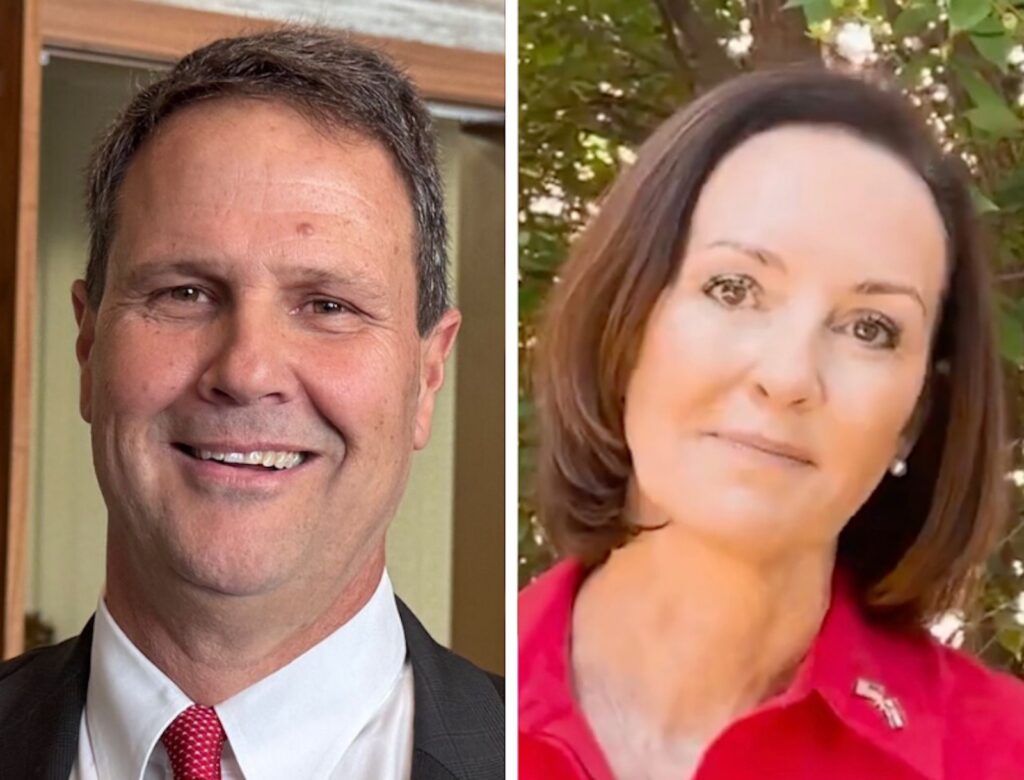
Democrat Jessica Killin’s internal poll shows dead heat with U.S. Rep. Jeff Crank in Colorado’s 5th CD
Ernest Luning
ernest.luning@coloradopolitics.com
Updated 4 hours ago
Jessica Killin, the Democratic nominee in Colorado’s 5th Congressional District, is in a statistical tie with Republican U.S. Rep. Jeff Crank, according to an internal poll released this week by Killin’s campaign. The poll of likely general election voters, conducted...
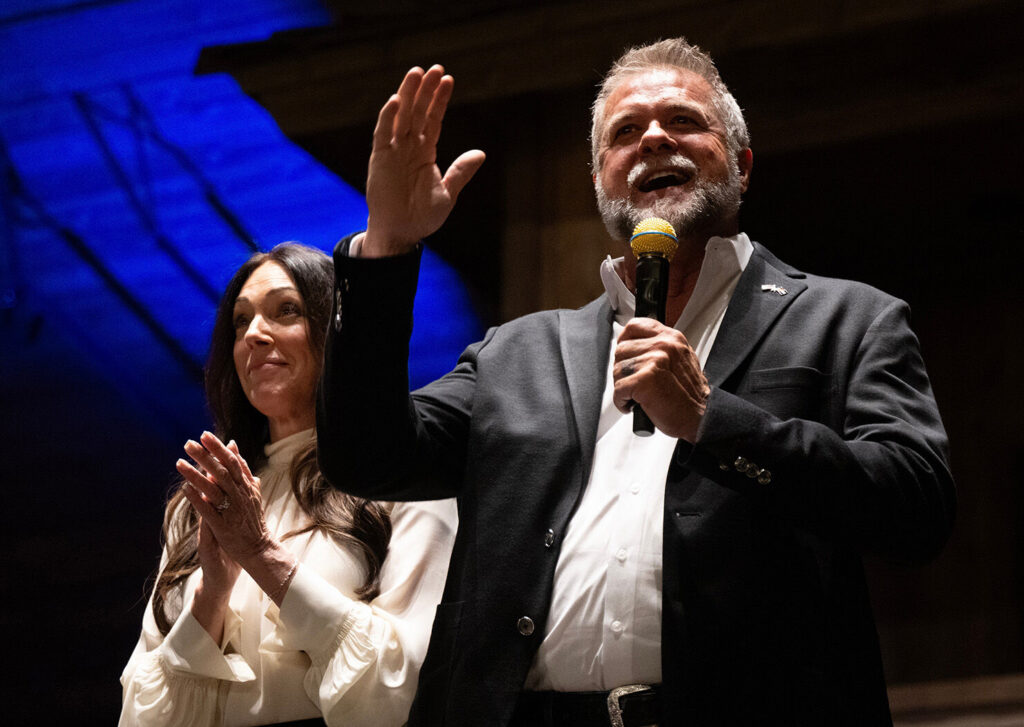
Victor Marx says he’ll only debate Phil Weiser once in Colorado governor’s race — without a moderator
Ernest Luning
ernest.luning@coloradopolitics.com
Updated 8 hours ago
Colorado Republican gubernatorial nominee Victor Marx said on Tuesday that he will participate in only one debate with Attorney General Phil Weiser before the November election — and he challenged the Democratic nominee to hold the event without a moderator....
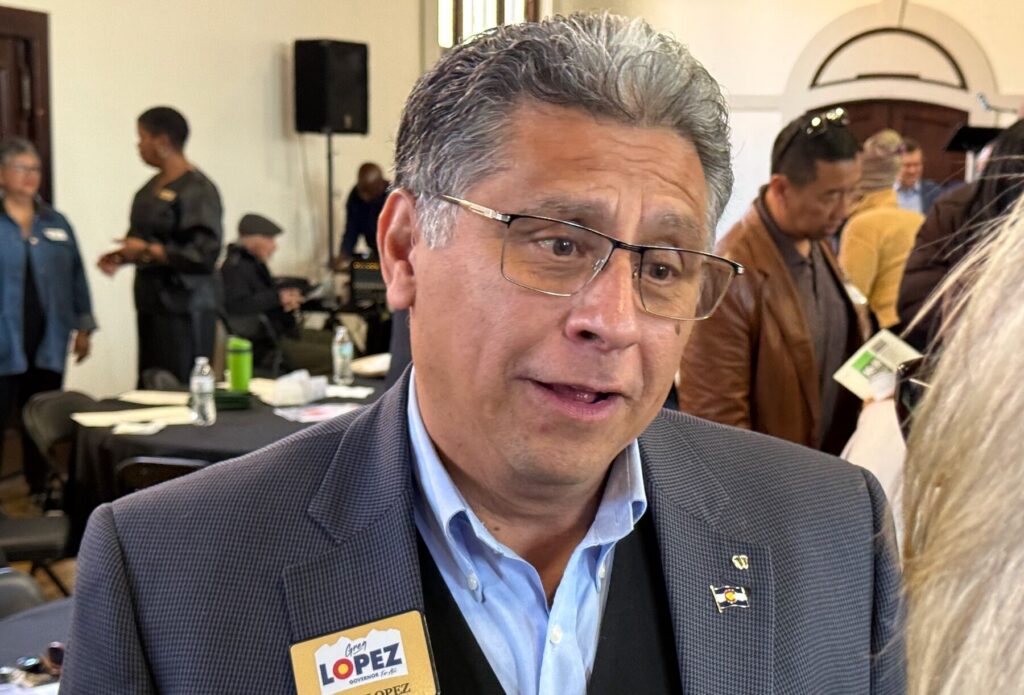
Independent gubernatorial candidate Greg Lopez, a former GOP congressman, qualifies for Colorado ballot
Ernest Luning
ernest.luning@coloradopolitics.com
Updated 2 days ago
Unaffiliated gubernatorial candidate Greg Lopez, a former Republican congressman from Elizabeth who left the GOP to run as an independent, has qualified for the ballot by submitting enough petition signatures, the Colorado Secretary of State’s Office said Tuesday. He’ll face...
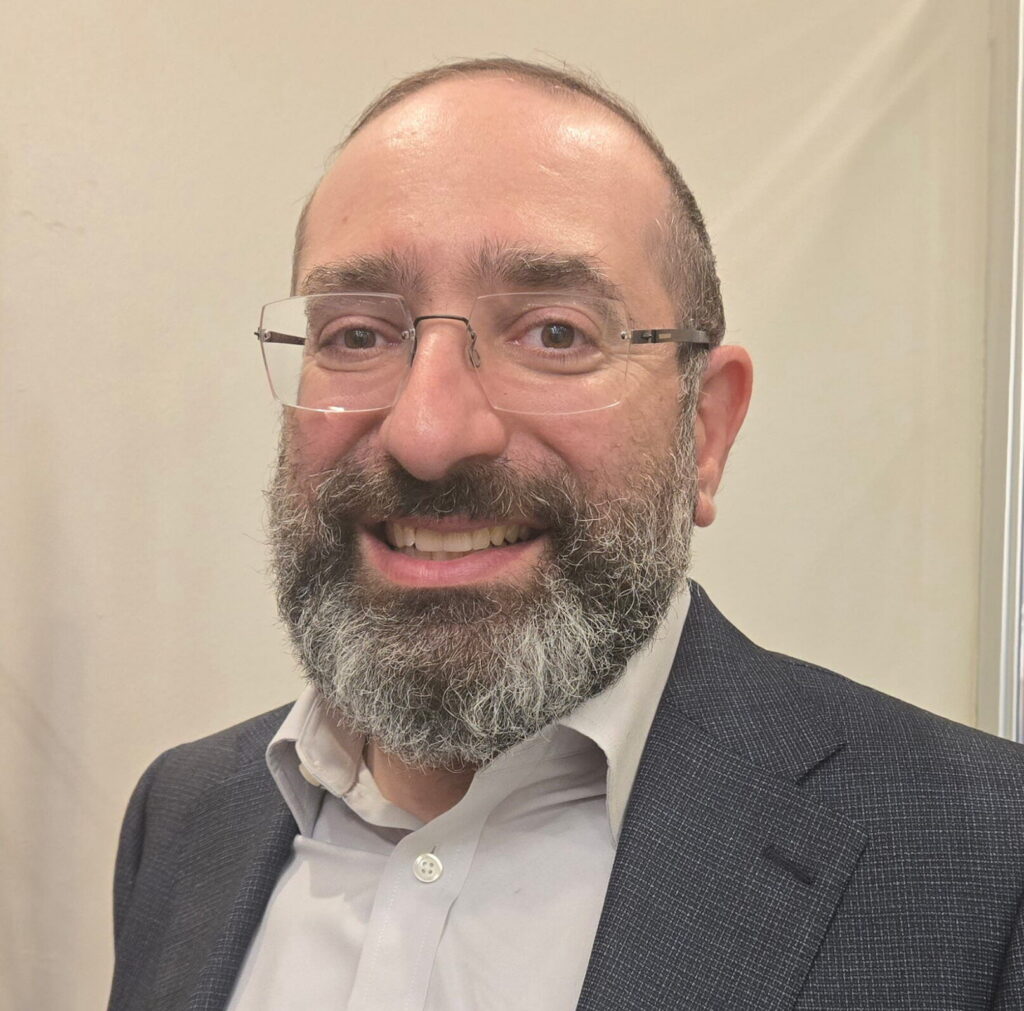
Surprise candidate Shimon Blau cleared to face off against Melat Kiros in November
Ernest Luning
ernest.luning@coloradopolitics.com
Updated 6 days ago
Unaffiliated congressional candidate Shimon Blau, a Denver doctor, has qualified by petition for the general election in Colorado’s 1st District, where Democrat Melat Kiros defeated 15-term U.S. Rep. Diana DeGette in last month’s primary, the Colorado Secretary of State’s Office...
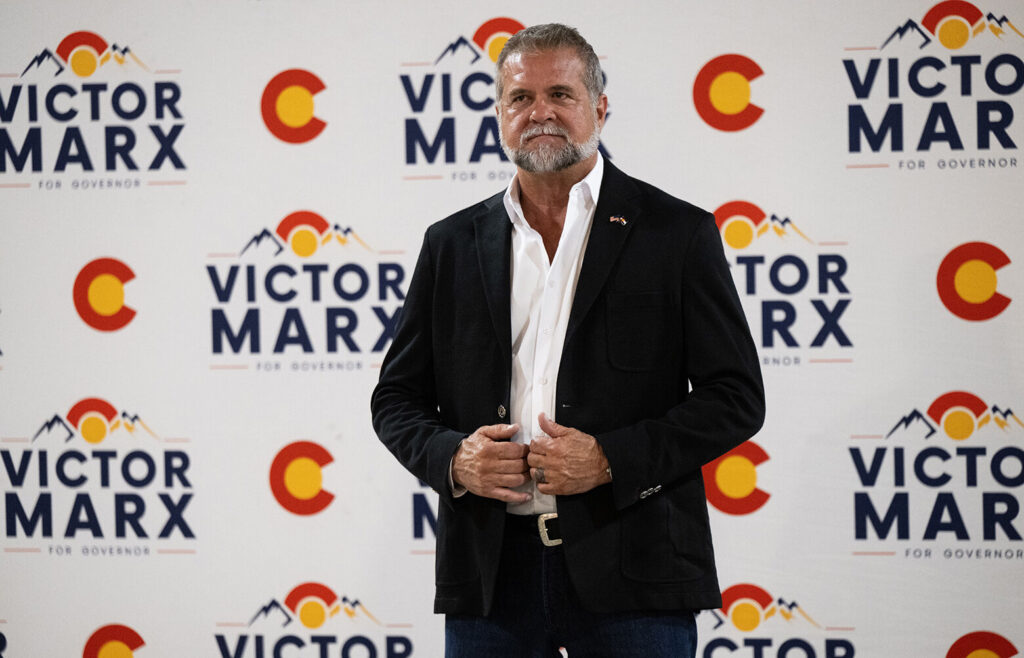
Victor Marx, GOP candidate for governor, faces 100-plus campaign finance complaints
Marianne Goodland
marianne.goodland@coloradopolitics.com
Updated 3 days ago
Victor Marx’s gubernatorial campaign has been hit with more than 140 campaign finance complaints, although most have been consolidated by the state’s election office because they follow similar alleged violations. Marx faces Attorney General Phil Weiser, who won the Democratic...
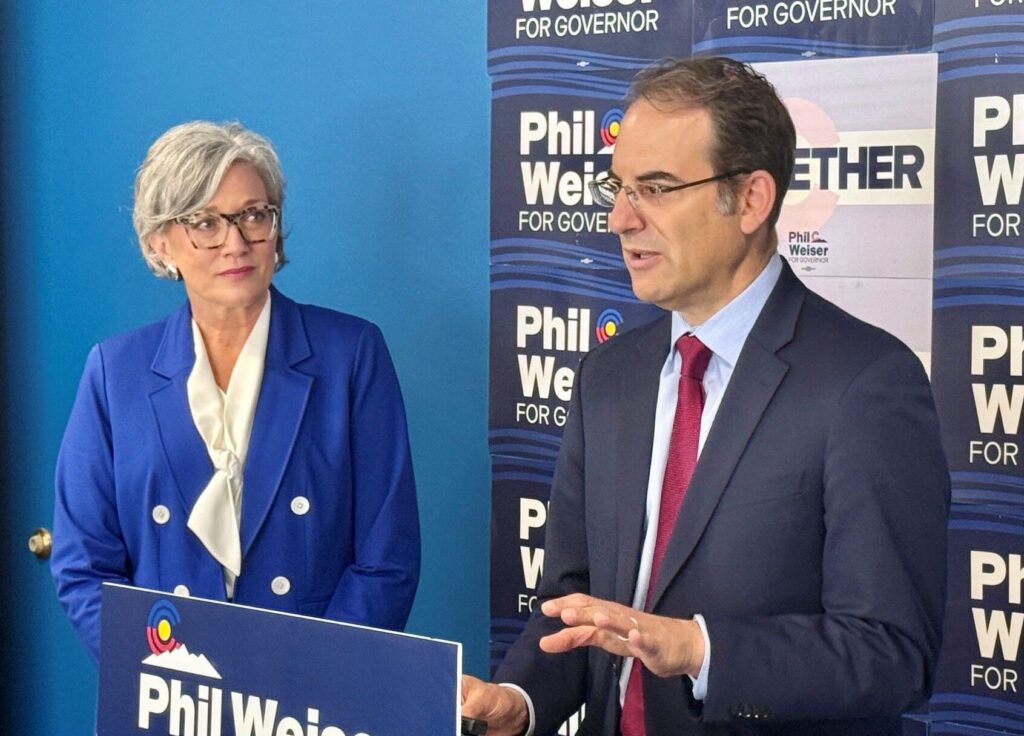
Jefferson County to fill commissioner vacancy after Dahlkemper tapped for lieutenant governor
Matt Kyle
matt.kyle@denvergazette.com
Updated 1 week ago
Democratic gubernatorial nominee Phil Weiser on Wednesday announced that Jefferson County Commissioner Lesley Dahlkemper would be his lieutenant governor, meaning she would be leaving her commissioner seat open should he win the race in November. However, Dahlkemper’s term was already...
Democrat Phil Weiser names Jeffco Commissioner Lesley Dahlkemper as his gubernatorial running mate
Ernest Luning
ernest.luning@coloradopolitics.com
Updated 1 week ago
Colorado Attorney General Phil Weiser, the Democratic nominee for governor, on Wednesday named Jefferson County Commissioner Lesley Dahlkemper to be his lieutenant governor running mate in the general election. Calling her “someone who can be a governing partner,” Weiser said...
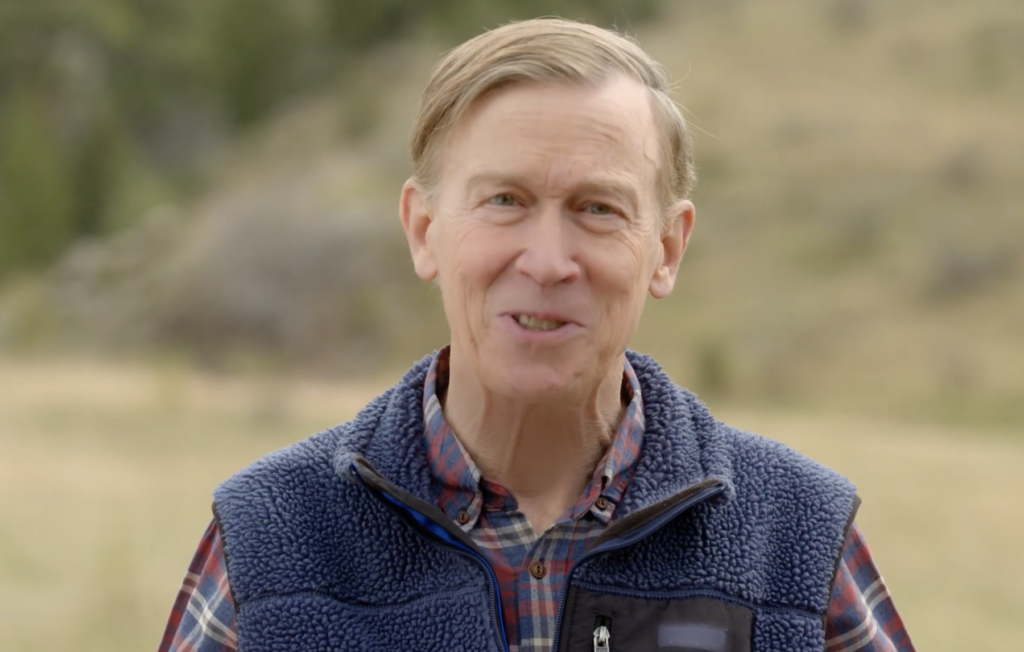
Democrat John Hickenlooper hauls in $1.3 million in 2nd quarter in Colorado’s U.S. Senate race
Ernest Luning
ernest.luning@coloradopolitics.com
Updated 2 weeks ago
U.S. Sen. John Hickenlooper’s reelection campaign raised just over $1.3 million in the year’s second quarter and finished the period with $2 million in the bank, leaving the first-term Democrat with nearly 80 times as much cash on hand as...
Campaign launched to redirect $1 billion in TABOR refunds to education
Marissa Ventrelli
marissa.ventrelli@coloradopolitics.com
Updated 1 week ago
A coalition that includes the state teachers’ union on Tuesday launched a campaign for a ballot proposal that would reduce more than $1 billion in taxpayer refunds and spend the money on education. The measure is among several campaigns taking...
WATCH: Trump speaks on elections in primetime address
The Associated Press
the-associated-press@coloradopolitics.com
Updated 2 weeks ago
WASHINGTON (AP) — President Donald Trump will deliver a primetime address Thursday that he says will include a focus on elections. The speech comes as he’s escalated calls for Republicans to pass tighter federal voting rules for November’s midterm elections....
PREV
PREVIOUS

Trump beats Haley as Biden sweeps vote in Colorado's Super Tuesday presidential primary
Donald Trump took an early lead over Nikki Haley in Colorado’s Republican presidential primary and kept it as returns posted on Tuesday night. At the same time, President Joe Biden cruised to a win against long-shot opponents in the state’s Democratic primary. The Associated Press called the state for Trump and Biden less than 15 […]
Colorado House Republicans push move to impeach Jena Griswold after SCOTUS keeps Trump on ballot
Colorado House Minority Leader Rose Pugliese and a fellow Republican legislator on Wednesday called on the chamber’s Democratic speaker to bring to the floor a resolution to impeach Secretary of State Jena Griswold, arguing that Griswold’s “partisan political ideology” has prevented the Democrat from carrying out her duties. In a letter delivered late Wednesday to […]