

10th Circuit, prosecution, defense all agree federal judge wrongly calculated sentence
After the prosecution and defense were in unusual agreement that a trial judge misapplied the law when determining if a prior conviction amounted to a violent crime, the federal appeals court based in Denver agreed this month that the defendant’s sentence could not stand.
Kenneth Devereaux pleaded guilty in 2022 to the federal offense of being a felon in possession of a firearm and ammunition after Larimer County law enforcement investigated a domestic violence dispute and found a shotgun with an obliterated serial number in Devereaux’s home. Heading into his sentencing hearing, Devereaux’s imprisonment range was 57 to 71 months.
Even though all parties believed Devereaux’s prior assault conviction did not qualify as a violent crime increasing his sentencing range, U.S. District Court Senior Judge Raymond P. Moore disagreed with everyone — boosting the maximum possible sentence by 16 months.
On Feb. 6, a three-judge panel of the U.S. Court of Appeals for the 10th Circuit confirmed the parties were correct and Moore was mistaken.
Devereaux’s prior assault conviction “categorically does not have as an element the use, attempted use, or threatened use of physical force,” wrote Senior Judge David M. Ebel in concluding the offense was not a violent crime after all.
The disagreement between Moore and the parties stemmed from how the U.S. Supreme Court’s precedent treats prior convictions that may be violent. Judges must strictly look to the legally-defined elements of the prior offense to see whether they fit the definition of a violent crime — known as the “categorical approach.”
The purpose, Justice Elena Kagan wrote in a 2016 Supreme Court decision, is to prevent judges from looking into the facts of a prior conviction — which is the jury’s role — and determining what happened for themselves. Furthermore, a defendant may decline to challenge non-essential details when agreeing to a plea deal, meaning the underlying narrative could contain inaccuracies that only gain significance during a subsequent conviction.
“Such inaccuracies should not come back to haunt the defendant many years down the road by triggering a lengthy mandatory sentence,” Kagan wrote.
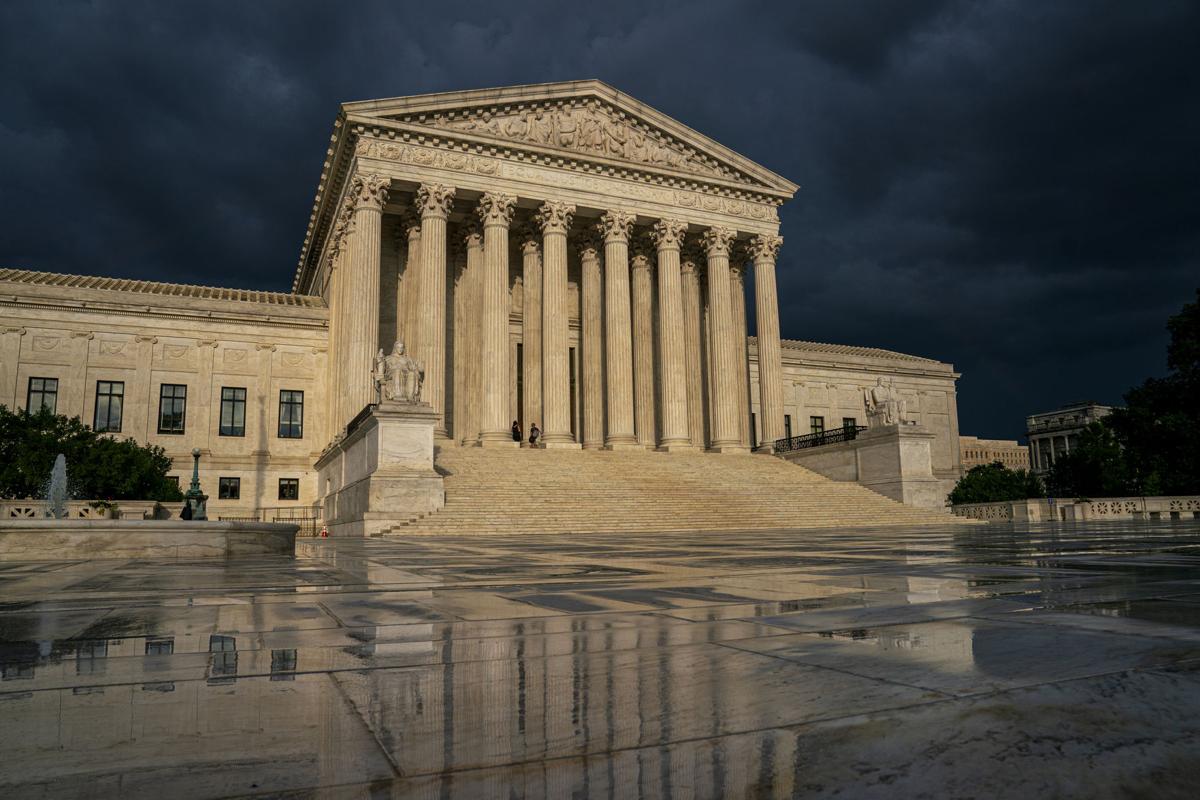
The U.S. Supreme Court is seen under stormy skies in Washington on June 20, 2019.
J. Scott Applewhite / AP

However, the Supreme Court acknowledged that if there are alternative elements to the crime, judges employ a “modified” approach, looking at the underlying documents in the prior case to determine the scope of the defendant’s conviction and whether it amounted to violent crime.
In Devereaux’s case, he previously pleaded guilty to the federal offense of assault. Appearing at his sentencing for the subsequent gun crime, the prosecution and the defense understood the prior conviction did not amount to a violent crime. A pre-sentencing report from probation officials confirmed as much.
“What bothers me, and what bothered me in this case, is that there were a couple of matters that might be considered to be crimes of violence,” Moore told the parties.
He elaborated that assault, to him, takes on “a variety of different meanings,” ranging from “intentional striking” to “unwanted touching.”
Moore suggested he could take the modified approach, looking at documentation from Devereaux’s assault case. Doing so would “not come out in a way that Mr. Devereaux would want,” Moore said, due to the seriousness of the charge.
Devereaux’s lawyer responded that the 10th Circuit had already concluded, as a categorical matter, the specific assault offense at issue was not a violent crime.
“It is rare that I am in a position where there’s a 10th Circuit opinion that seems to definitively offer an answer, and everyone in the court is in agreement with it,” said public defender Stephanie Snyder.
Moore ultimately elected to view the prior conviction as a violent crime and increased Devereaux’s sentencing range. After accounting for various factors, Moore handed down a five-year sentence.
Devereaux appealed to the 10th Circuit, arguing Moore should have found, as a categorical matter, the assault was not a violent crime. Although there are means of committing an assault that are more serious than others, the elements of the offense remain the same. The U.S. Attorney’s Office agreed with that logic.
Because Devereaux’s prior conviction was “a single indivisible assault offense,” Ebel wrote, the parties were correct that it was categorically not a violent crime. The panel ordered a resentencing for Devereaux without the violent crime enhancement.
The case is United States v. Devereaux.

10th Circuit says landowner cannot sue ex-Routt County judge for statements in decision
Michael Karlik
michael.karlik@coloradopolitics.com
Updated 11 minutes ago
A Routt County landowner cannot sue a former judge for his allegedly inaccurate statements in a case where the landowner was not a party, the Denver-based federal appeals court decided on Wednesday. Anne Fitzsimmons, who lives in Germany, owns a...
Parole, appeals deadlines and restitution: Colorado justices accept cases
Michael Karlik
michael.karlik@coloradopolitics.com
Updated 22 hours ago
The Colorado Supreme Court announced on Monday that it will determine how a defendant’s parole-eligibility date should be calculated in instances where a new trial results in a sentence being imposed retroactively to the date of the original, since-overturned sentence....

Federal judge rejects DOJ bid to force Colorado to hand over voter information
Marissa Ventrelli
marissa.ventrelli@coloradopolitics.com
Updated 8 minutes ago
A U.S. district court judge has dismissed a lawsuit filed by the U.S. Department of Justice against Colorado Secretary of State Jena Griswold for refusing to provide the agency with personal voter information. Last December, the DOJ’s Civil Rights Division asked...
3 Colorado judges receive unfavorable retention recommendation as one performance commission violates rules
Michael Karlik
michael.karlik@coloradopolitics.com
Updated 1 day ago
Of the 123 Colorado judges standing for retention on the November ballot, citizen-led performance commissions found that three did not meet the required performance standards. However, in an unprecedented move, the commission charged with evaluating Supreme Court and Court of...

10th Circuit weighs Gross Reservoir expansion, judge’s ‘punishment’ of Denver Water
Michael Karlik
michael.karlik@coloradopolitics.com
Updated 1 hour ago
Members of the Denver-based federal appeals court considered on Friday whether they could intervene in an ongoing infrastructure project to enlarge a Boulder County dam after a trial judge deemed the underlying permit unlawful nearly two years ago. Denver Water...

10th Circuit upholds federal prohibition on juvenile handgun possession
Michael Karlik
michael.karlik@coloradopolitics.com
Updated 1 day ago
The Denver-based federal appeals court concluded on Monday that Congress acted within its constitutional powers to make it a crime for juveniles to possess handguns in most instances. The decision from the U.S. Court of Appeals for the 10th Circuit...

Senate advances judicial nominee, Montezuma County judge agrees to discipline | COURT CRAWL
Michael Karlik
michael.karlik@coloradopolitics.com
Updated 2 days ago
Welcome to Court Crawl, Colorado Politics’ roundup of news from the third branch of government. A U.S. Senate committee advanced a judicial nominee from Colorado, plus a Montezuma County judge agreed to receive discipline for his misconduct that stops short...
Judge denies Calderon injunction case against Denver, Johnston
Deborah Grigsby
deborah.smith@denvergazette.com
Updated 2 days ago
A U.S. District Court judge has denied a preliminary injunction in the case of Jessica Calderon, the Denver city employee who won a temporary restraining order preventing the City and County of Denver from terminating her amid the 2025 citywide...

10th Circuit partially revives lawsuit over 2020 Denver protest injuries
Michael Karlik
michael.karlik@coloradopolitics.com
Updated 3 days ago
The Colorado-based federal appeals court revived a man’s claims against Denver on Friday after concluding a trial judge resolved the case in the city’s favor without analyzing two of the three instances of alleged excessive force and other constitutional violations....
Federal judges find Colorado immigration judge violated several orders
Michael Karlik
michael.karlik@coloradopolitics.com
Updated 4 days ago
Multiple federal judges in Colorado have freed people from immigration custody after determining that one immigration judge violated their directives for properly conducting bond hearings. For nearly a year, Colorado’s U.S. District Court has faced a flood of habeas corpus petitions...
PREV
PREVIOUS

Appeals court rules class action lawsuits not dead even when there is no 'class'
Colorado’s second-highest court clarified on Thursday that lawsuits filed as class actions may still proceed for the individual named plaintiffs in the event a judge declines to authorize the class portion. A three-judge panel for the Court of Appeals noted the U.S. Supreme Court, for federal cases, has ruled the lack of a class does […]

Bringing 'yes, and' to the courtroom: Retired judge talks about her other life as an improv actor
The day Julie Field was sworn in as a trial judge in Larimer County, she began an improvisational comedy class. “I knew I would need something outside of the court in my life that was creative and spontaneous and fun,” she recalled. Field, who retired in 2021 as a judge on the Eighth Judicial District […]