

Colorado Supreme Court to analyze how wage law applies to Amazon holiday pay
The Colorado Supreme Court recently announced it will decide whether Amazon is complying with the state’s wage law by excluding shifts worked on holidays when calculating employees’ overtime pay.
At least three of the court’s seven members must agree to hear an appeal.
The case addressing overtime pay came to the Supreme Court through an unusual path. The lawsuit initially proceeded through the federal system, until the appeals court based in Denver decided to ask the Supreme Court to interpret how Amazon’s “holiday incentive pay” fits under state law.
The process is known as certifying a question, and only happens once or twice per year on average. Last month, the Supreme Court held oral arguments in response to another question it received from the U.S. Court of Appeals for the 10th Circuit, involving the proper interpretation of Colorado’s sex offender sentencing law.
The Supreme Court also indicated it may intervene in two ongoing cases in the trial courts — one questioning whether a judge may order the disclosure of a deceased man’s medical records during a challenge to his will, and the other involving an evidentiary ruling in a child sex assault case.
The justices narrowly turned aside a final case out of Delta County in which the Court of Appeals reversed a judge’s finding of child neglect.
Holiday incentive pay
Dan Hamilton worked at an Amazon warehouse in Aurora and alleged the retail giant owed him $143.54 in unpaid overtime. He filed a class action lawsuit claiming a violation of Colorado’s wage laws, specifically through Amazon’s treatment of holiday incentive pay.
Amazon pays workers time-and-a-half to work on company holidays. However, the company omits that holiday incentive pay from its calculation of employees’ regular rate of pay. Essentially, the regular rate accounts for all hours worked and wages earned to establish an employee’s average compensation per hour — which is the number used to calculate overtime.
Omitting the more highly compensated holiday work had the effect of lowering workers’ overtime pay.
Last year, U.S. District Court Chief Judge Philip A. Brimmer dismissed Hamilton’s lawsuit. He concluded Colorado’s wage law was “silent” about how to treat holiday incentive pay. Therefore, Amazon was allowed to follow federal law, which permits employers to exclude it from the calculation.
During oral arguments before a three-judge panel of the 10th Circuit in November, the appellate judges acknowledged Colorado law can be more protective of workers than its federal counterpart. It was unclear, however, whether Colorado required holiday incentive pay to be part of the overtime calculation.
Multiple judges appeared to believe it did, but for different reasons. Judge Harris L Hartz fixated specifically on the requirement that “shift differentials” be included.
“Surely this is a shift differential, isn’t it?” he wondered. “I understand a shift differential to mean performing the same work, but you get compensated more because you’re doing it at an inconvenient time.”
Judge Nancy L. Moritz, meanwhile, focused on the legal requirement that the overtime calculation includes “all compensation paid to an employee.”
“You’re basically asking us to ignore the fact that the statute or the regulation says the regular rate includes all compensation,” she told Amazon’s lawyer.
Without the parties asking them to do so, the 10th Circuit judges opted to send the question to the state Supreme Court to resolve.
“Neither party cites any on-point Colorado authority interpreting this language,” Moritz wrote in the Jan. 12 order. The Supreme Court quickly agreed to step in.
The case is Hamilton v. Amazon.com Services LLC.

Online retail giant Amazon allegedly exposed workers to unsafe conditions at its Colorado Springs delivery station on the city’s southeast side; as a result, the U.S. Occupational Safety and Health Administration this week proposed a fine of $15,625.
reuters

Contested will
Following the death of Robert Harrison Ashworth, one of his children, Brian Ashworth, moved to contest the will — from which his father excluded him. Brian Ashworth argued in Weld County District Court it was “well established” that evidence about a deceased person’s health is disclosable in such proceedings, and he sought release of his father’s medical records.
The attorney representing Robert Ashworth’s estate called the request “groundless,” without anything specific being sought and no waiver of confidentiality by Ashworth’s daughter, to whom he assigned medical power of attorney.
Chief Judge Julie Hoskins agreed with Brian Ashworth, finding there was an “issue of Decedent’s dementia and the effect it is alleged to have had on his decision-making capacity.” Further, there was no other source than the medical records to evaluate Robert Ashworth’s mental status.
She ordered a private review of Robert Ashworth’s medical records, prompting an appeal to the Supreme Court.
The justices directed Hoskins and Brian Ashworth to explain why the order should stand, and invited the Colorado Bar Association’s division for trusts and estates to weigh in, as well.
The case is In the Matter of the Estate of Ashworth.
A victim’s past abuse
Joshua McFarland has pleaded not guilty to sexual assault on a child. Prior to trial, McFarland sought to introduce evidence that his alleged victim was also the victim in a previous child sex assault case with a different perpetrator, approximately 10 years ago.
Under Colorado’s “rape shield” law, evidence about a victim’s sexual history is generally inadmissible. However, there is an exception when the evidence is “relevant to a material issue” in the case.
El Paso County District Court Judge Marcus Henson permitted McFarland to use evidence of the prior sex assault in his trial, on the grounds that the victim “does bring it up, actually, a couple of different times” during her interview. He also believed the previous case was “context” for some adults’ reactions to the accusations against McFarland.
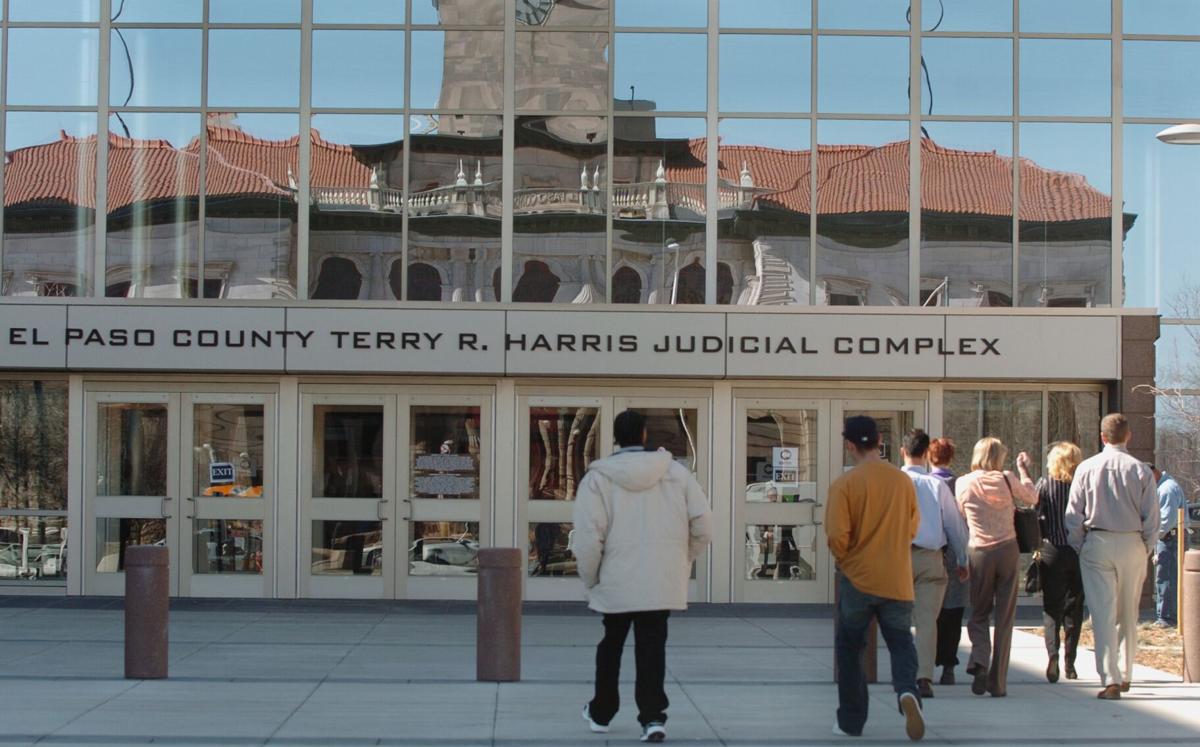
The entrance of the El Paso County Terry R. Harris Judicial Complex on Tejon Street in Colorado Springs.
The Gazette file

The Fourth Judicial District Attorney’s Office appealed directly to the Supreme Court, arguing Henson had not, in fact, established the relevance of the 10-year-old case.
“This reasoning contradicts the policies that a rape victim’s prior sexual conduct has no bearing on credibility, and that the purpose of a trial should not shift focus to the culpability of a victim,” wrote Deputy District Attorney Tanya A. Karimi.
The Supreme Court has ordered a response to the prosecution’s petition.
The case is People v. McFarland.
Effect of drug use on a newborn
Finally, the justices narrowly turned down a child neglect appeal out of Delta County. The child at the center of the case was born in September 2022 and tested positive for illicit substances at birth.
The county’s department of human services moved to declare the child dependent and neglected, a step that may lead to the termination of a parent’s legal relationship with their child. Based on evidence the department submitted, District Court Judge Steven L. Schultz found the child neglected because he was born affected by drug exposure and his “health or welfare is threatened” by the substance use.
In November, a three-judge panel for the Court of Appeals reversed that decision, determining it was not possible for Schultz to categorically find the child neglected without a hearing, as the evidence did not clearly establish a threat to the child’s health or welfare.
“What’s more, the undisputed facts show that the child was released from the NICU shortly after the Department filed the petition, and the Department did not allege any further complications from the child’s premature birth or his exposure to substances,” wrote Judge Neeti V. Pawar. “And although the Department presented evidence of parents’ past substance use, there was no evidence of substance use after the child was born.”
The county appealed to the Supreme Court. Chief Justice Brian D. Boatright and Justice Carlos A. Samour Jr. indicated they would have heard the case to answer whether the Court of Appeals correctly found “reasonable minds could differ” about any ongoing threat to the child’s health or welfare.
The case is People in the Interest of J.O.H.

Secret orders, requests for recusal bog down Colorado’s death penalty prosecution
Michael Karlik
michael.karlik@coloradopolitics.com
Updated 11 hours ago
Colorado’s only criminal case in which federal prosecutors are actively pursuing the death penalty has taken unusual turns in recent weeks, with defense attorneys continuing to challenge the judge’s ability to hear the case and the judge issuing orders not...

Routt County DA’s office faces multiple investigations after it drops high-profile rape case
Jenny Deam
jenny.deam@gazette.com
Updated 2 days ago
Routt County’s district attorney and deputy district attorney are now under increasing scrutiny on multiple fronts for their handling of the alleged drugging, rape and near-strangulation of a nationally ranked cross-country skier. The fallout from their decision not to prosecute...
Federal judge postpones CU regent’s request to lift censure restrictions
Michael Karlik
michael.karlik@coloradopolitics.com
Updated 3 days ago
A federal judge on Thursday canceled an upcoming hearing to decide whether to block the restrictions the University of Colorado’s governing body has placed on one of its members, indicating that he would instead pivot to the defendants’ motion to...
Appeals court reverses ‘particularly brutal’ sex assault convictions due to flawed warrant
Michael Karlik
michael.karlik@coloradopolitics.com
Updated 2 days ago
Colorado’s second-highest court reversed a Jefferson County defendant’s sexual assault and kidnapping convictions last month after concluding that police relied on an unconstitutionally broad search warrant to obtain evidence from the man’s cell phone. Jurors convicted Joseph Gabriel Van Eck...
Colorado Supreme Court intervenes in 3 ongoing cases
Michael Karlik
michael.karlik@coloradopolitics.com
Updated 4 days ago
The Colorado Supreme Court recently intervened in the prosecution of a juvenile defendant and will decide whether he is entitled to have prosecutors demonstrate probable cause at a hearing after a grand jury already determined probable cause existed. The justices...
Appeals court clarifies meaning of ‘at-risk’ victim based on breathing disability
Michael Karlik
michael.karlik@coloradopolitics.com
Updated 2 days ago
Colorado’s second-highest court clarified last month that victims qualify as “at risk” under state law if they required mechanical assistance to breathe on the date of the offense against them. El Paso County prosecutors charged Jon Claude Crow with third-degree...
Ex-attorney cannot remain anonymous while suing Colorado judicial branch, says 10th Circuit
Michael Karlik
michael.karlik@coloradopolitics.com
Updated 5 days ago
The Denver-based federal appeals court concluded last month that a former attorney cannot mask her identity while suing the Colorado Judicial Department for alleged improprieties in her disability and disbarment proceedings. “Jane Roe,” representing herself, sued the Judicial Department and...
Appeals court reverses convictions after judge blocked defendant’s character witnesses
Michael Karlik
michael.karlik@coloradopolitics.com
Updated 6 days ago
Colorado’s second-highest court reversed a defendant’s convictions for forgery and attempting to influence a public servant last month because a Boulder County judge improperly blocked him from calling witnesses who could testify about his truthfulness. A three-judge Court of Appeals...
Colorado Supreme Court accepts child neglect, unlawful search appeals
Michael Karlik
michael.karlik@coloradopolitics.com
Updated 5 days ago
The Colorado Supreme Court recently announced that it will decide whether a series of missteps led an El Paso County judge to improperly terminate a father’s parental rights, and whether a police officer defendant bears the burden of proving that...

Colorado Attorney General sues HUD over changes to homeless funding
Matt Kyle
matt.kyle@denvergazette.com
Updated 6 days ago
Colorado Attorney General Phil Weiser on Tuesday joined the attorneys general of several other states to sue the federal government over an attempt to cap funding for permanent housing projects. The change would result in tens of thousands of people...
PREV
PREVIOUS

Gunnison landlords escape contempt, but federal judge remains concerned about non-discrimination compliance
Although a trio of Gunnison landlords recently avoided being held in contempt of court, a judge has registered new concerns about their ongoing failure to comply with a non-discrimination agreement they entered into with the federal government. On Jan. 17, the U.S. Department of Housing and Urban Development asked for a status conference with David […]

Federal judge rules Circle K could fire 72-year-old store clerk who tried to stop robber
A federal judge ruled last month that Circle K lawfully fired a 72-year-old convenience store cashier after she attempted to stop a knife-wielding robber from stealing cigarettes. Mary Ann Moreno was a 16-year employee of the company and was behind the register at a Westminster Circle K store when a man holding two hunting knives […]