

Quantifying Colorado’s skyrocketing registered-voter rolls | CRONIN & LOEVY
Political scientists often use voter registration numbers rather than estimated population data to keep track of population growth.
The problem with population figures is they are only exact once every 10 years on the occasion of the decennial census. Voter registrations, however, are kept up to date. County clerks work hard to add new voters as they register to vote and to eliminate voters who have died or moved out of the state.
Also, Colorado has an “active voter” system that automatically removes from the voter rolls those voters who are not actively voting in current elections. You know the voters you are counting are real, because they are voting in ongoing state and local elections.
The Colorado Secretary of State publishes current voter registration in the state on the internet once a month. The data is always handy. We are using the voter registration data for April 1, 2010 and July 2, 2023.
Here’s the best reason to use voter registration data: it is part of the information population experts use to make their population estimates in the time between one census count and another.
Stay up to speed: Sign-up for daily opinion in your inbox Monday-Friday
From 2010 to 2023, a span of 13 years, the state of Colorado increased the total number of its registered voters from 2.4 million to 3.9 million, an increase of 1.5 million registered voters. That was a percentage gain of 60.4%.
Thus the state of Colorado has been growing its electorate and growing it fast.
Within the state, the county with the most registered voters in 2023 was El Paso County, home of Colorado Springs. El Paso County in July 2023 had 476,481 registered voters, up 202,777 voters from its total in 2010 of 273,704. That voter increase was the largest in the state. The percentage gain was 74.1%.
In terms of registered voters, El Paso County is the growth center of Colorado. It not only has more voters than any other county, but it is adding new voters faster than any other county. We predict it will continue to add new voters faster than the rest of the state’s counties.
For years, Denver had more registered voters than any other county, but it dropped behind El Paso County a decade-or-so ago. Denver currently is in second place with a total 441,992 registered voters, about 35,000 fewer than El Paso County. Denver increased its registered voters from 2010 to 2023 by 69.1%, 5% less than El Paso County’s percentage increase.
Denver’s problem is that it is closely surrounded by other cities and lacks open buildable land for adding more houses, more shopping centers and more voters. El Paso County, on the other hand, has a great deal of open land ready for development, particularly in the eastern portion of the county.
The third-largest electorate in Colorado is Jefferson County (Golden), a western suburb of Denver. In 2023 it had 426,098 registered voters and a relatively low 45% growth rate. The fourth largest is Arapahoe County, a southern suburb of Denver, with 414,244 voters and a 52.9% growth rate.
A number of counties have high growth percentages, higher than El Paso County or Denver, but their relatively small populations leave them behind in the total registered voter count.
Thus Weld County (Greeley), northeast of Denver, had a high growth rate from 2010 to 2023 of 95.6%, but ended up with only 216,276 voters, about half as many as El Paso County. Adams County (Brighton), a northern Denver suburb, grew by 83% but only had a total of 302,895 registered voters by July 2023.
We expect Weld and Adams Counties to continue to add voters rapidly, but we expect the rates of growth to go down as the two counties get larger. There is little chance either will come close to replacing El Paso County or Denver as the top counties for numbers of registered voters.
Denver shines when the Denver metropolitan area is compared to the Colorado Springs metropolitan area. Denver metro has almost 2.2 million of Colorado’s 3.9 million registered voters. That is 56.6% of all Colorado voters.
The Colorado Springs metropolitan area (El Paso plus Teller counties) has almost half-a-million (495,496) registered voters, about one-quarter the size of Denver metro. Colorado Springs metro is only 12.8% of the state’s total electorate.
When you add Denver metro’s 56.6% of all Colorado voters to Colorado Springs metro’s 12.8%, you get 69.4%. Denver metro and Colorado Springs metro contain almost 70% of the voters of Colorado.
We expect that Denver metro/Colorado Springs metro number to go up as much future growth of registered voters continues to occur in the Denver and Colorado Springs regions.
Recently four counties were added to the Denver metropolitan area. They are Park County (Fairplay), Clear Creek County (Georgetown), Gilpin County (Central City) and Elbert County (Elizabeth).
Two of those counties, Park County and Elbert County, are large geographically and will provide lots of acres for future housing and shopping center development in Denver metro. Elbert County, located just east of Douglas County, is already a fast-growing county with a growth percentage from 2010 to 2023 of 64.7%.
The Front Range is the thickly populated corridor that runs from Pueblo in the south through Colorado Springs and Denver to Fort Collins and Greeley in the north. It can also be referred to as the Interstate 25 Corridor.
It now contains 3.3 million of Colorado’s 3.9 million registered voters. It grew 63.2% in voter registrations from 2010 to 2023. It is 84.6% of the state’s registered voters.
For the foreseeable future, the Front Range of Colorado will continue to be the main growth and activity portion of the state.
Much is happening in the extensive part of Colorado not on the Front Range, with some of the counties showing respectable registered-voter growth rates.
Eagle County (Vail Resort) added registered voters from 2010 to 2023 at 54.1%. Pitkin County (Aspen ski resorts) registered new voters at 41.9% .
In southern Colorado, Alamosa County (Alamosa) was experiencing growth in registered voters at 57.9%.
But the growth in registered voters that was so strong in so many parts of Colorado from 2010 to 2023 did not extend to rural agricultural Colorado. Over the 13 years studied, Cheyenne and Kiowa counties on the eastern plains grew voters by only 4.4% and 9.4%.
The Colorado State Demographer’s office says economic problems created by the coronavirus epidemic in 2020 slowed down population growth in Colorado. Despite that, we expect the vibrant growth in registered voters that occurred from 2010 to 2023 to become normal again.
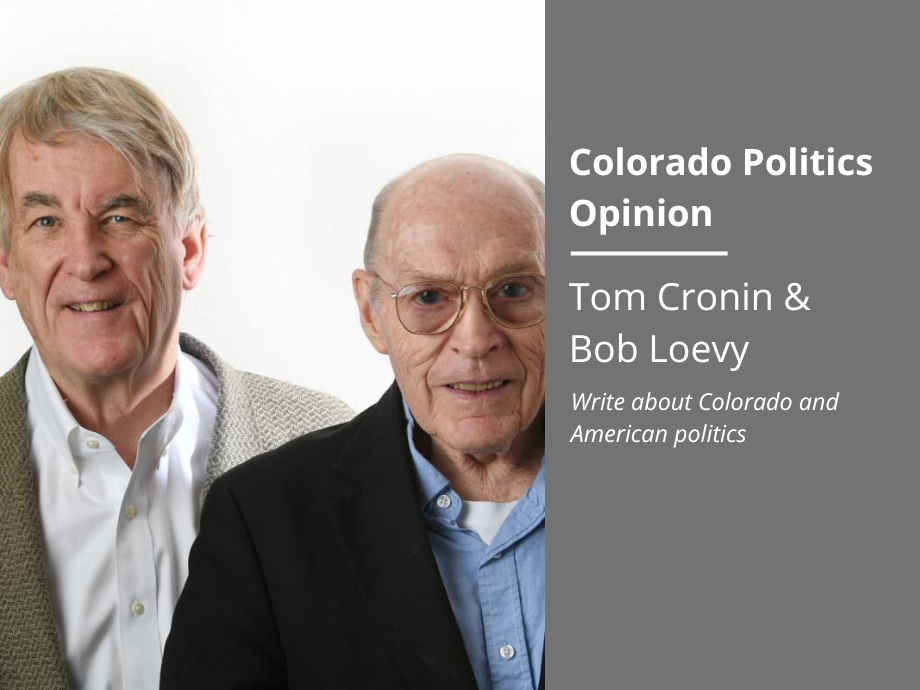
Tom Cronin and Bob Loevy write about Colorado and national politics.

Lori Gimelshteyn on 3 ballot measures to ‘let kids be kids’ | The OpEdge Podcast
Tony Olivero
tony.olivero@gazette.com
Updated 4 hours ago
Lori Gimelshteyn — board member of Protect Kids Colorado and executive director of the Colorado Parent Advocacy Network — joins The OpEdge to discuss three measures headed to Colorado voters this November. Gimelshteyn tells host and investigative columnist Jimmy Sengenberger...
A path toward justice and public safety | PODIUM
Anthony Hartsook
ahartsockop@gmail.com
Updated 18 hours ago
Strangulation can be one of the most dangerous forms of assault; despite the lack of visible ailments it is accompanied by. Though strangulation leaves no broken bones, bruises or visible wounds, it is one of the strongest predictors of future...

From moving people to managing them | GUEST COLUMN
Michael Hancock
michael-hancock@coloradopolitics.com
Updated 18 hours ago
Transportation policy used to have a fairly uncomplicated purpose: move people safely, efficiently and reliably. Build roads where people drive. Maintain bridges before they fail. Add capacity where growth overwhelms the system. Provide transit where it makes sense. Infrastructure was...
Trumpicans thumb their nose at the Constitution | Hal Bidlack
Hal Bidlack
hal-bidlack@coloradopolitics.com
Updated 2 days ago
As is all too often the case, there are again too many interesting things appearing in Colorado Politics for me to comment on all of them. So let me tell you what I won’t be talking about before I get...

CoComandering? | Miller Hudson
Miller Hudson
miller-hudson@coloradopolitics.com
Updated 3 days ago
At 8 a.m., Friday morning, Aug. 28, 70 or 80 mostly bleary-eyed visitors to the Transportation Technology Center outside Pueblo packed a conference room to attend the Front Range Passenger Rail District’s (FRPRD) Board meeting. With the exception of those...

Even Dem court couldn’t abide theft of GOP seats | Dick Wadhams
Dick Wadhams
dick-wadhams@coloradopolitics.com
Updated 3 days ago
Thanks to the Colorado Supreme Court, Colorado voters will be able to reaffirm their support for the Independent Congressional Redistricting Commission after the court struck down the Democratic scheme to steal three Republican congressional seats. Billionaire-funded national Democratic groups from...

Chaotic meeting began with attempt to squelch public comment | Rachel Gabel
Rachel Gabel
rachel-gabel@coloradopolitics.com
Updated 3 days ago
When Attorney General Phil Weiser takes the governor’s office in January, he must immediately address the chaos of the latest round of appointees to the Colorado Parks and Wildlife Commission to assure stakeholders he’s willing to put pressure on the...

Graduated income tax proposal is a flat tax in disguise | Jon Caldara
Jon Caldara
jon-caldara@coloradopolitics.com
Updated 6 days ago
“Youth is wasted on all the wrong people.” That’s one of my favorite lines from “It’s a Wonderful Life.” The older I get, the less it sounds like a joke. Every generation inherits victories it did not win. Young Americans...

AI optimism vs. anxiety — podcasters debate this every night | Tom Cronin
Tom Cronin
tom-cronin@coloradopolitics.com
Updated 4 days ago
President Donald Trump, CNBC’s “Mad Money” host Jim Cramer and entrepreneurial “accelerationists” celebrate the AI revolution and the infrastructure data-center build-out. Cramer recently gushed, “I like data centers so much that I wish I lived in one.” Trump criticized any community...

The dissonance of an American Jew thinking about Israel | SONDERMANN
Eric Sondermann
eric-sondermann@coloradopolitics.com
Updated 6 days ago
The Jewish High Holidays will soon be upon us. The third anniversary of Oct. 7 will then quickly follow. Three weeks later, Israeli voters will head to the polls to elect all 120 members of its parliament, the Knesset and...
PREV
PREVIOUS

It is wise to prioritize vocational trades | Colorado Springs Gazette
Today’s 20-somethings can be brilliant, quick and of value to society. Yet, ignorance abounds among the most educated generation in history. Examples include: Fake meat is health food; “their” is singular; Cinco de Mayo = Mexico’s Independence Day; The First Amendment forbids prayer in public schools; legal pot negates the black market; new housing developments […]

A tale of two homeless cities | CALDARA
091723-cp-web-oped-caldara-1 I’ve been searching for the right word to describe Mike Johnston’s very earnest approach to Denver’s homeless problem. The word I found is, “adorable.” Michael is one of the most likable affable, cuddly mayors Denver has ever had. He is the kid for whom you drive out of your way to buy a cup […]