

Audit finds ‘weak oversight’ of Denver’s college fund; millions of dollars unallocated

A Denver program that funds college scholarships for low-income students accumulated millions of dollars in revenue but only distributed less than half of those funds in the last five years, even as its administrative expense stood at nearly $2 million, a city audit said.
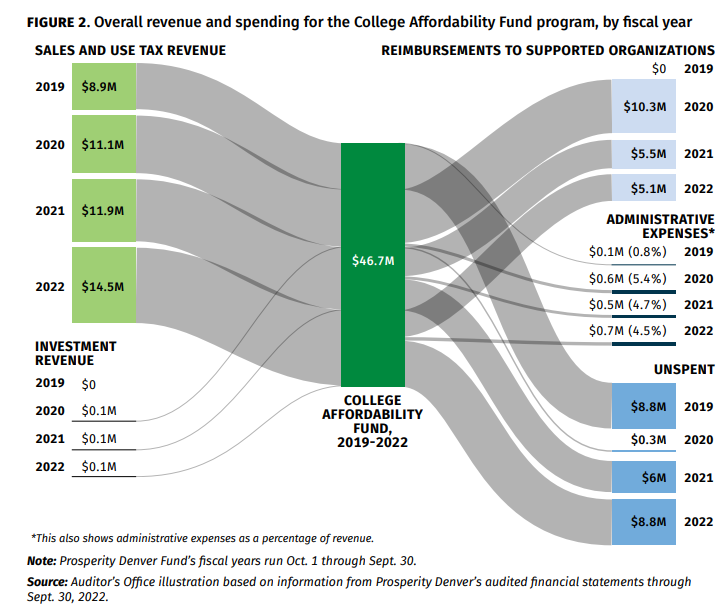
City auditors, who looked into the voter-approved college scholarship fund, found the program collected $46.4 million in revenue from a sales tax hike as of September 2022, but, of that amount, it paid out only about $20.9 million or 45% of the money.

In the meantime, the program has stockpiled nearly $30 million in cash.
Auditors said they found other problems, notably the lack of oversight by the city agency of the nonprofit that administers the fund.
Indeed, Denver’s government was unaware that Prosperity Denver Fund, the nonprofit that manages the program, does not adequately collect data to ensure the city gets reliable reports about where funds are going and that reimbursements are made only for eligible students, the auditors said.
In fact, the auditors added, Prosperity Denver Fund itself did not fully know of errors in some of its data.
“We found it has inadequate processes for managing data about the students being served. Therefore, it cannot ensure accurate and complete records for serving students – and it exposes itself to potential errors and fraud in distributing the city’s designated tax dollars,” the auditors said.
“Because of the weak system of oversight and the lack of controls, potential errors or fraud may not be prevented or may go undetected, and Prosperity Denver Fund may continue reimbursing ineligible students,” the auditors added.
Denver residents voted in 2018 to establish the college fund through a 0.08% increase in the sales and use tax. The money collected for the program has been growing since its first year, when $8.9 million came in. Last year, the program collected $14.5 million.
Under the model that voters approved, neither the city nor Prosperity Denver directly provides students with the scholarship to go to college. Instead, eligible students must first secure a scholarship from a nonprofit – called a “supported organization” – and the latter gets reimbursed by Prosperity Denver Fund.
On its website, Prosperity Denver Fund reported that 7,523 scholarships have been funded through the college fund, averaging $2,774 in reimbursement per scholarship.
In a news release, Denver Auditor Timothy O’Brien said what auditors uncovered is “yet another voter-approved tax that is bringing in significant revenue – but with little city supervision for how those dollars go out the door.”
Under the initiative, the responsibility to oversee the program and manage the contract with Prosperity Denver falls on the Denver’s Office of Children’s Affairs.
Here are the audit’s key findings:
? Prosperity Denver’s data containing reimbursements to organizations is “fragmented” and missing data in key fields, which means the city “cannot fully rely on Prosperity Denver’s reports.” The auditors said they learned no one is using data analytics to “look for potential errors or fraud.”
? Prosperity Denver did not assign “unique identifiers” to all students, so neither auditors nor the Office of Children’s Affairs “can be certain how many students Prosperity Denver truly serves.”
? Prosperity Denver reported “incomplete information” – such as information about gender, ethnicity, and race – about the number of students being served.
“Because of these data management issues, we cannot confirm whether the aid supported organizations received from the city was for only eligible students – in line with city ordinance and the will of the voters,” the auditors said. “The lack of oversight by the Office of Children’s Affairs and the insufficient data management by Prosperity Denver risk noncompliance with the city ordinance governing the College Affordability Fund program.”
The auditors added: “It also risks a lack of transparency and accountability with Denver voters who approved the designated tax revenue to be used for specific purposes – namely, to help households with lower incomes better afford the high cost of postsecondary education.”
Auditors said when they reviewed spreadsheets that contained reimbursement, they found duplications, as well as missing information in key fields. One spreadsheet that contained information to track communications between Prosperity Denver Fund and aid organizations had been “accidentally deleted,” they added.
Prosperity Denver later provided auditors an adjusted number of reimbursements – 7,523 reimbursements instead of 7,570. Auditors said that supports their claim that the nonprofit is “not sufficiently tracking and reporting on the overall number of students served.”
“Any requirements for eligibility should be properly checked and recorded,” O’Brien said. “The city council recently changed those requirements with the intent of getting more money out the door and into the hands of the families who need it. But that does not change the importance of proper documentation and data.”
The program has undergone a few changes since its inception, notably broadening eligibility, the goal of which is to reach more students.
In May, the council allowed students up to age 25 who have graduated from a Denver Public Schools high school or have lived in Denver six months before attending a postsecondary institution to be eligible for the scholarship.
In addition, eligibility now includes students ages 25 to 30.
Among other recommendations, the Denver Auditor’s Office said the Office of Children’s Affairs should ensure that Prosperity Denver Fund sufficiently oversees the process of verifying students’ eligibility to receive taxpayer dollars.
Also, Prosperity Denver Fund’s oversight process should be documented, and the Office of Children’s Affairs should enforce it. For example, auditors said reimbursement requests should undergo a secondary review by someone other than the individual who prepared it.
Neither the Office of Children’s Affairs nor the Prosperity Denver Fund could be immediately reached for comment.
Both entities, however, told auditors they are working on improvements to their systems.
Prosperity Denver Fund said it will hire a data and evaluation director, who will serve as the point person for developing and maintaining data management, and implementing the auditors’ recommendations. It is also developing a new database to streamline its data collection processes, the nonprofit group said.
The city agency, meanwhile, said it will hire an additional contract compliance coordinator this year. And, for its 2024 budget, the agency will request more staffing positions, including a special projects administrator dedicated to overseeing all programming funded by special revenue funds, including the college program.
“With added capacity, OCA will be in a much better position to provide the level of oversight recommended by this report,” the city said.


Healthcare Freefall: Finger‑pointing intensifies as Colorado’s healthcare system strains under rising costs, shrinking coverage
Thelma Grimes
thelma.grimes@coloradopolitics.com
Updated 1 hour ago
Editor’s Note: Colorado’s healthcare system is entering a period of accelerating instability — a “tsunami,” as multiple leaders describe it — driven by collapsing hospital finances, shrinking Medicaid reimbursements, disappearing services and a political fight over who is responsible for...
Colorado appeals judge’s delays in releasing opinions noted by performance commission
Michael Karlik
michael.karlik@coloradopolitics.com
Updated 4 hours ago
The citizen-led performance commission that provides guidance to voters about whether to retain members of Colorado’s second-highest court raised concerns by judges and attorneys that Judge Elizabeth L. Harris sometimes struggles with releasing opinions promptly. Harris, who joined the Court...

DPS board sends $44 million tax increase to Denver voters
Nico Brambila
nico.brambila@denvergazette.com
Updated 1 hour ago
The Denver Public Schools board on Thursday unanimously voted to place a mill levy override on the November ballot that — if approved by voters — would raise taxes by $43.9 million annually, largely to fund employee raises. The request...

Jeff Crank, Jessica Killin set to face off in 2 debates in Colorado’s 5th Congressional District
Ernest Luning
ernest.luning@coloradopolitics.com
Updated 2 minutes ago
Republican U.S. Rep. Jeff Crank and Jessica Killin, his Democratic challenger, have agreed to debate twice in the weeks leading up to the general election in Colorado’s 5th Congressional District, their campaigns have said. Crank is seeking a second term...

Colorado judge explores sanctions against DOJ, ICE for rearresting man 4 days after release on bond
Michael Karlik
michael.karlik@coloradopolitics.com
Updated 17 hours ago
A federal judge in Colorado is considering sanctions against the government after immigration agents rearrested a man four days after an immigration judge found him suitable for release on bond. On July 28, U.S. Magistrate Judge N. Reid Neureiter ordered...

White House deploys private companies to help crack down on cybersecurity breaches
David Zimmermann
david-zimmermann@coloradopolitics.com
Updated 23 hours ago
The White House intends to use private companies in the United States to help crack down on cybersecurity breaches perpetrated by transnational criminal organizations. President Donald Trump signed a memorandum on Wednesday, directing his administration to employ the private sector...

Voters prefer socialist over MAGA candidate in 2028 matchup: Poll
Mabinty Quarshie
mabinty-quarshie@coloradopolitics.com
Updated 21 hours ago
New polling released this week suggests that a socialist candidate would defeat a Make America Great Again candidate in a hypothetical 2028 presidential matchup, a move that implies the reach of progressive leftists isn’t abating despite recent setbacks in Wisconsin....

Fort Carson garrison commander says staff cuts created ‘uncertainty and fear’
Mary Shinn
mary-shinn@coloradopolitics.com
Updated 18 hours ago
The Fort Carson garrison commander departed Wednesday after what he described as a difficult 18 months for installation and garrison staff. “I know the last 18 months has been marked by profound uncertainty and fear, but you weathered the storm...

Divided disciplinary panel censures Montezuma County judge after agreement reached
Michael Karlik
michael.karlik@coloradopolitics.com
Updated 23 hours ago
A disciplinary panel formally imposed a public censure, suspension, and further training on Montezuma County Court Judge Ian J. MacLaren on Tuesday by a 2-1 vote. Under constitutional Amendment H, which voters adopted in November 2024, MacLaren was set to...

Aurora police officer resigns after taking narcotics found during traffic stop
Kyla Pearce
kyla.pearce@gazette.com
Updated 18 hours ago
An Aurora Police Department officer resigned after investigators found that he took narcotics that were collected as evidence during a traffic stop. Michael Gallagher violated several agency policies, including substance abuse, tampering with evidence and lying in a criminal investigation,...
PREV
PREVIOUS

Colorado Supreme Court develops chief justice 'onboarding' plan, an outlier among states
The Colorado Supreme Court has joined an apparent minority of its peers across the country in laying down a written transition plan for chief justices, who are executive leaders of the judicial branch in addition to their roles deciding cases. A “chief justice onboarding” document, drafted in 2022, outlines the duties of incoming Colorado chief […]

El Paso County Redistricting Commission finalizes new commission districts; not all pleased
In the culmination of a monthslong contention among competing racial, military and geographic communities of interest, the El Paso County Redistricting Commission has selected a final map outlining new commissioner districts. The redistricting commission, consisting of the five members of the El Paso County Board of Commissioners, said it selected the map from three finalists, […]