

Colorado Supreme Court to hear criminal appeals on racial bias, ‘Make My Day’ defense
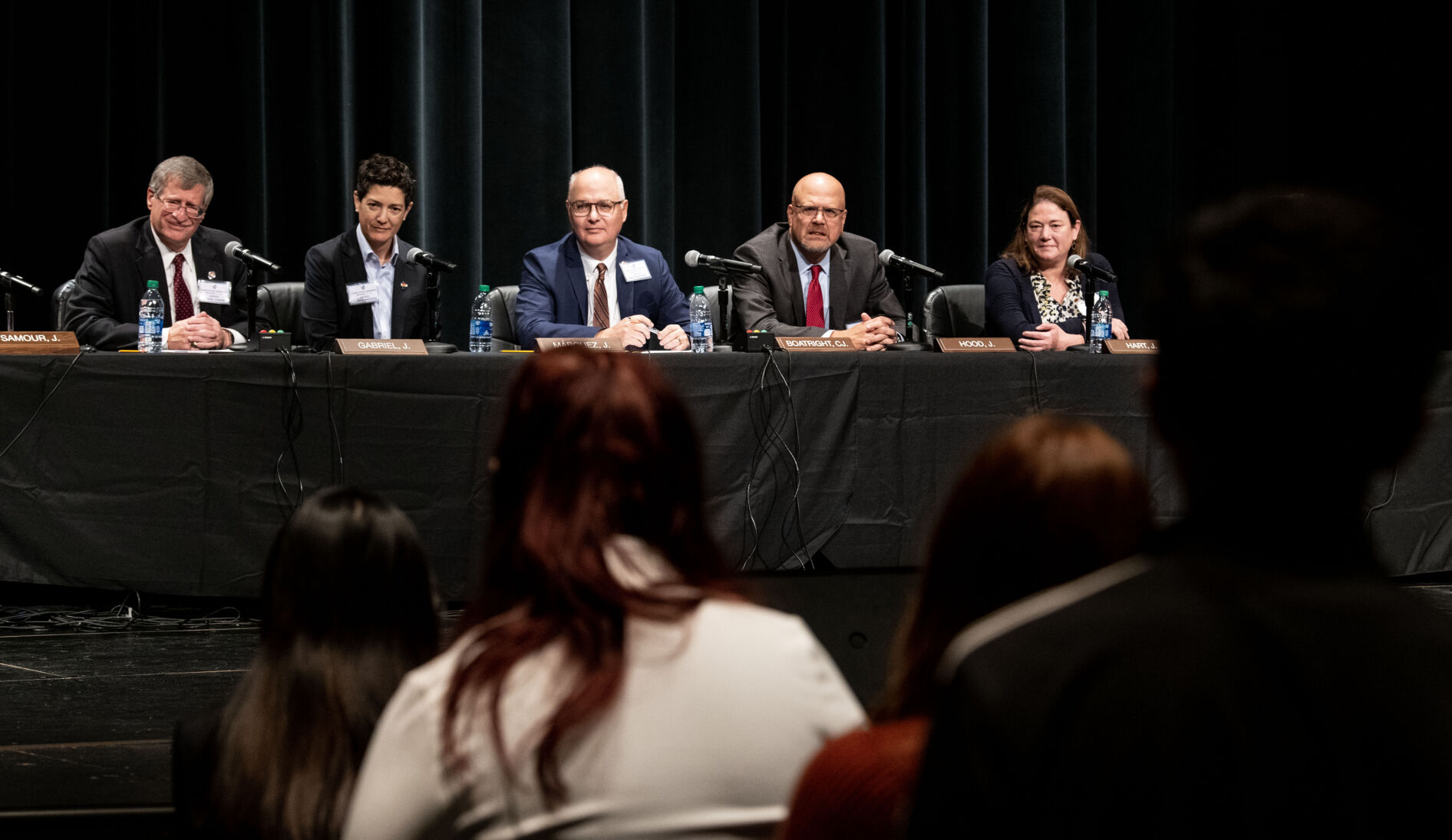
The Colorado Supreme Court announced earlier this month that it will review multiple criminal cases, with issues ranging from racial bias in jury selection and the meaning of a parent-child relationship to the law justifying deadly force against home intruders.
At least three of the court’s seven members must agree to hear a case on appeal.
The justices also resolved three appeals that came directly from the trial courts. One case was terminated as moot, another returned to the trial court with an admission that the judge committed an error, and the third case saw the Supreme Court let the trial judge’s ruling stand.
The ‘disinterested’ juror
For nearly 40 years, the U.S. Supreme Court has recognized intentional racial discrimination in jury selection is unconstitutional. If a defendant challenges a prosecutor’s decision to remove, or “strike,” a juror of color, the prosecutor must supply a “race neutral” reason for their decision.
At Phillip Romero’s criminal trial in Weld County, the prosecutor briefly spoke with one of the two Hispanic members of the jury pool. The prosecutor then moved to strike the juror. As a race neutral reason, the prosecutor said the man “appeared very disinterested” and had a “wandering mind.”
Neither the defense nor District Court Judge Shannon Lyons corroborated that account. In fact, Lyons said he “just didn’t see anything” to suggest the juror was disengaged. Nonetheless, Lyons allowed the prosecution to strike the juror.
A three-judge panel for the Court of Appeals ordered a new trial. Judge Neeti V. Pawar, writing for the majority, indicated the absence of any evidence supporting the prosecutor’s claim meant Lyons should not have credited the race neutral explanation.
Judge David J. Richman dissented, arguing the question was actually whether any evidence contradicted the prosecutor’s rationale. He added that nothing required the prosecutor to give the exact reason why the juror seemed disinterested.
The state Supreme Court accepted the government’s request to review the appeal.
The case is People v. Romero.
Make My Day
There was no dispute that Justin Brendan Martinez shot and killed his friend, Ismael Huerta, inside Martinez’s house. Martinez and another witness described the shooting as a freak accident, one in which Martinez shot at the floor but happened to fatally wound Huerta.
An Adams County jury acquitted Martinez of murder but convicted him for manslaughter. Unlike with the murder charge, the trial judge did not allow Martinez to assert affirmative defenses to manslaughter. Affirmative defenses, like self-defense, seek to justify or mitigate a person’s criminal conduct, and the prosecution must disprove at least one component of the affirmative defense to secure a conviction.
The Court of Appeals agreed Martinez could not assert an affirmative defense under Colorado’s “Make My Day” law, which empowers people to use deadly force inside a home against an intruder. Manslaughter involves acting recklessly, explained Judge Elizabeth L. Harris, meaning ignoring an unjustifiable risk.
“Under the force-against-intruders statute, any risk of harm to the intruder is, by definition, ‘justified,'” she wrote.
The Supreme Court will answer whether a person’s right to deadly force under the Make My Day law can excuse reckless behavior.
The case is Martinez v. People.

Parent-child relationship
After a jury convicted Abdullahi Salah of sexually assaulting a child, he received a sentence of sex offender probation. The terms required him not to be around children, except those who were his siblings or with whom he had a “parental role.”
Salah’s probation officer later moved to revoke his sentence after learning Salah was living with his sister and her infant child. An Adams County judge concluded there was “no evidence” Salah had a parent-like relationship with his nephew, and that Salah violated his probation.
“The probationer bears the burden of demonstrating the nature of his relationship with a family member who isn’t his child,” wrote Judge Jerry N. Jones in the Court of Appeals’ opinion agreeing with the trial judge. Salah “failed to demonstrate the nature of his relationship with his sister and nephew.”
Salah turned to the Supreme Court, blasting the Court of Appeals’ opinion as “poorly-reasoned” and with no guidance about what a parent-child relationship must look like to be protected.
The Supreme Court will analyze whether Salah’s constitutional right to familial association was violated.
The case is Salah v. People.
Postconviction relief
Following her conviction for kidnapping and robbery, Francine Erica Segura filed a petition with numerous claims that she received ineffective assistance from counsel. Then-Denver District Court Judge Kenneth M. Laff rejected most claims outright, but appointed a lawyer to represent Segura on one allegation that appeared to have merit. Laff subsequently denied postconviction relief following a hearing.
The Court of Appeals determined Laff did not follow the proper procedure. If a judge finds at least one plausible claim in a postconviction petition, they must forward the entire document to appointed counsel, not restrict representation to only the claim with merit.
The court’s decision in September was “not published,” meaning it was not intended to set a precedent. Since then, the Court of Appeals has issued a precedent-setting decision in another case, doubling down on the message that trial judges cannot dictate which claims a postconviction attorney may investigate.
The Supreme Court will decide whether the appeals court interpreted the rules correctly after all.
The case is People v. Segura.

Evidence of sexual history
Bryan Andrew Burkhalter stands accused of sexual assault through force in Boulder County. A forensic examination of the alleged victim, one day after she and Burkhalter had intercourse, revealed bruises and tears to her body and genitals.
Burkhalter sought to introduce evidence that the victim had sex with another man the day before her encounter with Burkhalter, raising the possibility that multiple acts of sexual intercourse actually caused the injuries. District Court Judge Nancy W. Salomone denied the request under Colorado’s “rape shield” law, which generally prohibits explorations of an alleged victim’s sexual history.
Burkhalter appealed to the Supreme Court, noting it recently issued two decisions clarifying that prosecutors may not present misleading narratives to jurors. One of the rulings involved another sex assault case from Boulder County in which a judge excluded evidence favorable to the defendant. The Supreme Court asked the prosecution to respond to Burkhalter.
The district attorney’s office countered that the issue was whether Burkhalter had the victim’s consent or not. It provided evidence of Burkhalter continuing to pressure the victim for sex after the alleged rape. She texted him, “when someone says no … you stop doing that.” In response, Burkhalter warned her, “Don’t you dare ghost me over butt stuff.”
The Supreme Court ultimately declined to get involved in Burkhalter’s trial.
The case is People v. Burkhalter.
Withdrawing a guilty plea
Last August, Richard Qu pleaded guilty to a misdemeanor domestic violence offense. He received a deferred judgment, meaning if he completed certain conditions, the case against him would be dismissed.
However, Qu later moved to withdraw his guilty plea, allegedly because he had not realized the consequences of a domestic violence offense for his divorce case and his ability to share custody of his daughter.
Arapahoe County Court Judge Kelly LaFave denied the request, noting the procedural rules required Qu to withdraw before she imposed the deferred judgment.
Qu appealed to the Supreme Court, which in turn directed the government to justify LaFave’s decision. Both the district attorney’s office and the Colorado Attorney General’s Office, which represented LaFave, acknowledged she made a mistake. Under the Supreme Court’s own precedent, Qu’s motion to withdraw his plea was valid.
The Supreme Court returned Qu’s case to the trial court for a hearing.
The case is People v. Qu.
Guilty plea means case is moot
Brian Donald Hollaway had been in custody since November 2020 for a pair of criminal cases in Jefferson County. In June, he asked the Supreme Court to intervene, citing a law that requires dismissal of criminal charges when a pretrial detainee has been confined for at least 50% of the maximum sentence they would have served had they been convicted of the most serious charge.
In Hollaway’s case, he argued he faced up to 18 months’ incarceration for his most serious charge. Given his time in custody, Hollaway had already passed the threshold to have the cases against him dismissed.
Six days after the Supreme Court ordered the government to respond to Hollaway’s petition, both the prosecution and defense agreed to withdraw the appeal. Hollaway had since pleaded guilty and resolved the charges against him, making the controversy moot.
The case is People v. Hollaway.



Parenting from prison: Inmates hope to be present in their children’s lives, while physically absent
Marianne Goodland
marianne.goodland@coloradopolitics.com
Updated 6 hours ago
The room was decorated with balloons, the tables sparking bright with colors as the smell of pizza and cake wafted through the air. As did music. This was, after all, a father-daughter dance. Except this was not a typical father-daughter...
Appeals court confirms Colorado judges can compel electronic records from out of state
Michael Karlik
michael.karlik@coloradopolitics.com
Updated 2 days ago
Colorado’s second-highest court clarified on Thursday that judges are empowered to compel out-of-state companies to produce electronic records under state law. El Paso County jurors convicted Mischa Jargowsky on three counts of money laundering and one violation of Colorado’s organized...

10th Circuit upholds finding of no racial discrimination against family at Denver Chili’s
Michael Karlik
michael.karlik@coloradopolitics.com
Updated 3 days ago
The Denver-based federal appeals court agreed on Wednesday that a Black plaintiff failed to show that a Chili’s manager’s request for her family to provide valid payment at the outset of their meal amounted to racial discrimination. Markesha Futrell-Smith filed...
Appeals court reinstates Mesa County defendant’s request for DNA testing under new Colorado law
Michael Karlik
michael.karlik@coloradopolitics.com
Updated 4 days ago
Colorado’s second-highest court revived a Mesa County defendant’s petition for DNA testing in his three-decade-old attempted murder case on Thursday, concluding that a trial judge wrongly interpreted a recent Colorado law in dismissing the request outright. Jurors convicted Billy Joe...
Appeals court reverses Denver juvenile’s conviction due to improper expert testimony
Michael Karlik
michael.karlik@coloradopolitics.com
Updated 2 days ago
Colorado’s second-highest court reversed a juvenile defendant’s conviction for unlawful sexual contact on Thursday after an expert witness’s testimony improperly suggested the child victim was telling the truth. The defendant, identified as S.H-S., was around 16 years old when he...

Judge orders home confinement for Barry Morphew
Dennis Huspeni
dennis.huspeni@gazette.com
Updated 4 days ago
An Alamosa County district judge has ordered home confinement for Barry Morphew, who is accused of murdering his wife. Barry Morphew, 59, faces a first-degree murder charge in the death of his wife, Suzanne Morphew, who disappeared Mother’s Day weekend...
Appeals court says jury does not need to view porn to determine if it’s ‘obscene’
Michael Karlik
michael.karlik@coloradopolitics.com
Updated 2 days ago
Colorado’s second-highest court ruled for the first time on Thursday that a jury does not always need to view pornographic material to determine if it meets the criteria for obscenity. Mesa County jurors found Shayla Ann Simpson guilty of child...
10th Circuit disagrees Sterling officer had no basis to arrest motorist who lacked insurance details
Michael Karlik
michael.karlik@coloradopolitics.com
Updated 5 days ago
The Denver-based federal appeals court disagreed on Tuesday with a trial judge’s decision to bar evidence from a pat-down search from being used against a defendant. Federal prosecutors obtained an indictment of Jorge Sigala-Baray for being a felon in possession of a...

Colorado Springs officers’ tasing, threats prompt federal judge to block use of suspect’s statements
Michael Karlik
michael.karlik@coloradopolitics.com
Updated 5 days ago
A federal judge blocked the government last month from using some of a defendant’s statements as evidence, reasoning that the defendant made them involuntarily as Colorado Springs officers tased him five times and one officer threatened to kill him. Officers...

Appeals court rejects CDOT employee’s discrimination, retaliation claims
Michael Karlik
michael.karlik@coloradopolitics.com
Updated 3 days ago
Colorado’s second-highest court agreed last week that a Colorado Department of Transportation employee had not shown that his employer discriminated and retaliated against him due to his religion and national origin. Ayman Salloum, who described himself as a 70-year-old Muslim...
PREV
PREVIOUS
Denver Gazette, 9News town hall tackles youth violence
The recent fusillade of violent crimes in Denver involving teenagers and children, both as perpetrators and victims, is raising alarms across the entire metro area. Are we in the throes of a new Summer of Violence? Kids in the crossfire Why have the violent deaths of 12- to 18-year-olds suddenly become “normalized”? Why has gunfire […]

22% of suicide hotline calls went unanswered in Colorado, report says
The Colorado suicide prevention lifeline received more than 11,200 calls – 22% of which went unanswered – between April and May of this year, according to a new report from a health policy research group. The 988 suicide and crisis lifeline went live in July of 2022, providing both phone and text support for individuals experiencing […]